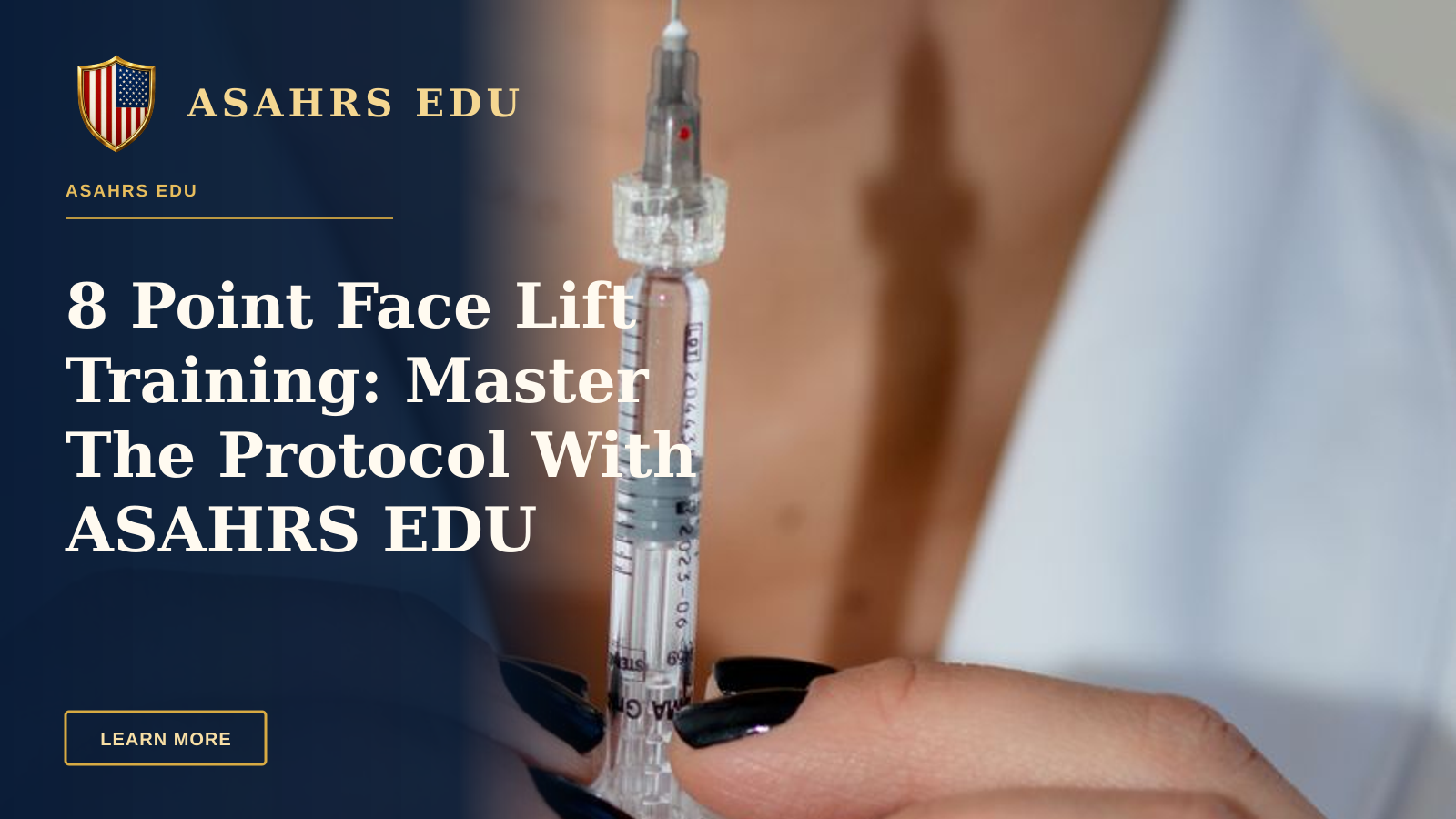
Understanding the growing demand for minimally invasive facial rejuvenation has pushed clinicians to seek structured, evidence-informed education in techniques like the 8 point face lift training. ASAHRS EDU positions itself as the definitive pathway to mastering this technique by combining a single comprehensive enrollment model, a complete Program Curriculum, and ongoing student support through the Student Portal. The result is a streamlined learning experience intended for eligible healthcare professionals who want practical, safe and reproducible skills for facial volumization and lifting using established filler strategies. Clinicians searching for an integrated Fellowship should also review the Program Dates and consider a Speak with an advisor call to confirm cohort fit and logistics.
When you choose ASAHRS EDU for 8 point face lift training, you join a program that emphasizes anatomy before technique, technology-neutral device education, and business systems to scale your practice. This article outlines how ASAHRS EDU delivers on those promises with a blended learning model, supervised hands-on experience, safety-first protocols, and a measurable post-program support library. Read on to see how the Fellowship maps to your clinical ambitions, where you can attend in person, and how past participants report outcomes on the Physician Reviews and Success Stories pages.
Physician Video Reviews
Physicians who complete the Fellowship frequently record short video testimonials and case reviews to share how structured training in facial volumization changed their practice. ASAHRS EDU curates these first-person accounts on the Physician Reviews page to provide transparent evidence of clinician experience, educational quality and practical outcomes. These videos complement written reviews and are an efficient way to assess whether the program's approach to 8 point face lift training aligns with your learning style and clinical goals.
The video gallery also illustrates supervised hands-on sessions, expert commentary on anatomy-first approaches, and faculty-guided complication management. Prospective participants can watch case walkthroughs that demonstrate pre-procedure assessment, injection mapping, layer selection and immediate post-procedure documentation. Watching these clinician-led videos before a cohort helps applicants understand the pace, depth and expectations in the in-person modules.
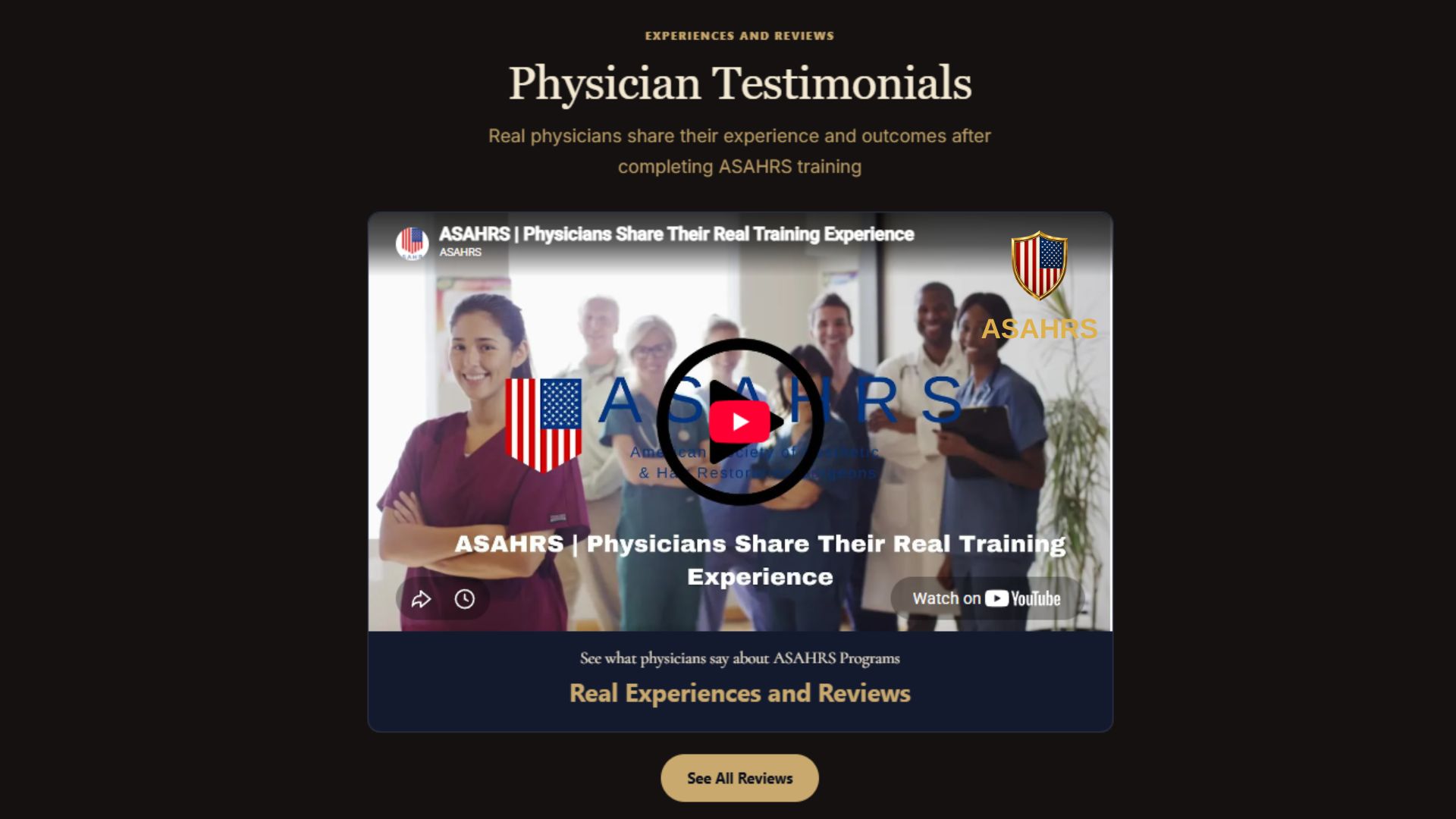
To make it easier to evaluate outcomes, the Physician Video Reviews section groups testimonials by treatment modality and learning pathway. For example, there are playlists focused on facial filler strategies, live injection labs, and complication-management drills. Clinicians considering the 8 point face lift training module should compare multiple videos to see consistent teaching points and differences driven by anatomy, injector preference and patient selection.
Below are concise benefit points that reviewers commonly cite after completing the Fellowship:
- Structured curriculum that integrates online pre-work with supervised in-person practice.
- Anatomy-first emphasis that reduces complication risk and improves aesthetic predictability.
- Technology-neutral modules that teach energy–tissue interaction and device evaluation.
- Practice growth tools including SOPs, pricing worksheets and patient-acquisition systems.
Overall, these filmed testimonials form a practical proof set: real clinicians describing real changes in confidence, technique and patient throughput. If you want a curated viewing, explore the Program Experience and the Faculty pages, or Contact Us to request specific video examples aligned to your scope.
EXPERIENCES AND REVIEWS
Physician Testimonials
Real physicians share their experience and outcomes after completing ASAHRS training
See All ReviewsTechnology & Technique: Evidence‑Informed Filler Strategies
Mastery of the 8 point face lift training depends on more than injection patterns — it requires understanding filler rheology, layering strategy, needle vs cannula selection and complication mitigation. ASAHRS EDU teaches these concepts within a technology-neutral framework so clinicians can evaluate products and devices objectively rather than being tied to vendor messaging. The Fellowship integrates the Program Curriculum with device-agnostic modules covering energy–tissue interaction and injection safety; you can review the full list in the Program Curriculum and the Program Experience to see module-by-module breakdowns.
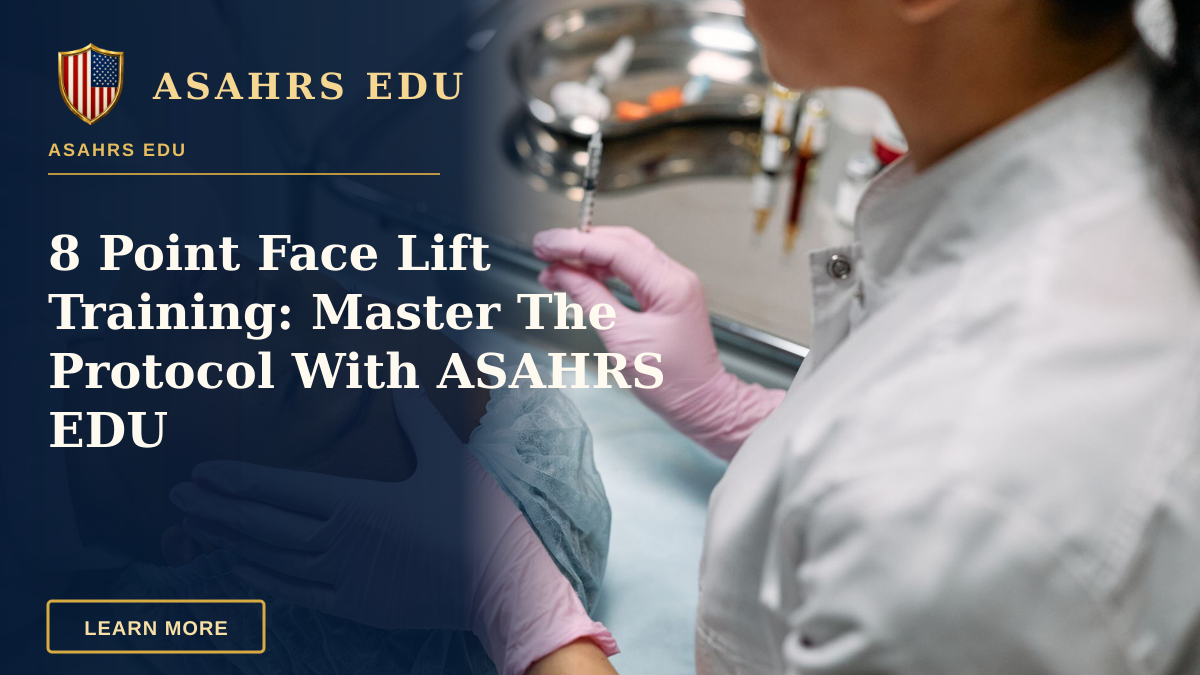
Clinical technique lessons include mapping the eight lift points, volumetric planning, dynamic assessment of midfacial vectors and strategies for perioral and jawline support. During in-person cohorts participants practice under faculty supervision to translate online theory into tactile skill — a teaching format described on the Dates and Locations page where cohort demos are scheduled. Faculty also present evidence on complications and reference peer-reviewed literature; for example, complication profiles for hyaluronic acid fillers are summarized in literature such as PubMed reviews here.
ASAHRS emphasizes parameter selection and safety checkpoints: entry vectors, depth control, aspiration limits, and layer-specific filler choice. This approach reduces risk and boosts patient satisfaction by aligning product characteristics with tissue needs. Students receive device-comparison worksheets, QA checklists and injectable dosing guides through the Student Portal, which remain accessible post-program for review and quality assurance.
Ready to take the next step?
Book a Free ConsultationClinical Curriculum & Hands‑On Mastery
ASAHRS delivers a single-enrollment Fellowship comprising a complete 40-module curriculum distributed across phased online and in-person learning to create mastery in procedures such as the 8 point face lift training. The curriculum is designed as a progressive pathway that begins with anatomy and patient selection, advances through injection mapping and hands-on live labs, and concludes with complication recognition and management. Participants complete online pre-work via the Student Portal, attend supervised in-person cohorts listed on the Dates & Locations page, and gain access to recorded session reviews and a faculty Q&A archive.
The in-person component emphasizes supervised participation with direct faculty coaching, allowing clinicians to practice the entire eight-point sequence from mapping to post-injection documentation. ASAHRS EDU ensures small cohort sizes during injection labs so every participant receives ample supervised injections and immediate feedback. Clinical skills are reinforced by case-based learning drawn from the program's pool of international faculty and Scientific Fellows, including named contributors like Dr. Thomas Warren, MD, Dr. Lydia Ferrell, MD and Dr. Rajiv Choudhary, MD documented across the Faculty and Scientific Fellows pages.
Every enrolled clinician receives a digital program manual, SOP templates, photography standards and consent form examples to implement immediately in clinic practice. This translates training into reproducible workflows that support quality, documentation and defensible practice standards — resources accessible through the Student Portal. When clinicians combine these tools with the supervised injection experience, they report higher confidence and improved patient outcomes as shown in our Reviews and Success Stories.
Practice Growth, Business Systems And Monetization
Beyond clinical technique, successful implementation of the 8 point face lift training in practice requires structured business systems. ASAHRS EDU integrates practice-setup modules into the Fellowship, teaching SOP design, pricing strategy, treatment-menu design, membership models and patient-acquisition systems that convert learning into a sustainable offering. The program provides launch checklists, marketing templates and sample consent workflows to help clinicians integrate the eight-point lift into their standard-of-care services without compromising safety or ethics.
Included materials address common practice questions: how to set pricing, how to structure combination-treatment appointments, and how to document outcomes for follow-up and quality improvement. ASAHRS EDU also offers guidance on device procurement economics and vendor evaluation through device-comparison worksheets available in the Program Curriculum and Student Portal. Clinicians who want a stepwise business plan can request a Program Advisor via Contact Us or use the Apply pathway to confirm cohort availability and tuition.
Measured outcomes from past cohorts are visible in aggregated success reports and physician testimonials on the Physician Video Reviews page, where clinicians detail practice growth timelines and revenue models. While the program does not guarantee income or patient volume, ASAHRS EDU transparently teaches repeatable systems and provides mentorship resources to increase the likelihood of a successful clinical launch.
Want personalized advice?
Schedule Your AssessmentResults & Social Proof
Evidence of training efficacy comes from documented case series, physician testimonials and ongoing access to recorded case discussions after program completion. ASAHRS EDU aggregates these outcomes on the Success Stories and Program Experience pages where clinicians highlight improvements in aesthetic outcomes and reductions in complication rates after applying anatomy-first principles. Review of these resources helps prospective applicants calibrate expectations and assess whether the scope of the Fellowship matches their practice goals.
"After completing the Fellowship's 8 point protocols I saw immediate improvements in procedural confidence and patient satisfaction scores," reports a recent graduate on the Physician Reviews page.
ASAHRS EDU also documents international reach through the International Fellows page, showing peer-reviewed contributions from multiple countries and published scientific fellows. Faculty and alumni case galleries display before-and-after examples, and many participants consent to recorded session reviews that remain in the program archive for ongoing learning. For additional third-party context on injectable safety and best practices, clinicians can reference regulatory resources such as the FDA guidance on dermal fillers here and peer-reviewed complication reviews on PubMed here.
Social proof extends beyond text — the program makes recorded faculty case discussions and Q&A sessions available post-program so graduates can revisit complex cases as they encounter them in practice. This long-tail access is essential for translating supervised experience into independent, safe, and high-quality clinical care.
Locations & Access
ASAHRS EDU delivers the 8 point face lift training via a blended learning format: comprehensive online preparation followed by in-person clinical cohorts where supervised hands-on participation is permitted. The Fellowship posts cohort listings and venue details on the Dates and Locations page; confirmed registrants receive logistics including facility names, partner hotels and arrival guidance. Prospective applicants can verify cohort schedules and availability via the Fellowship Program Dates listing or by choosing to Speak with an advisor before applying.
International clinicians are welcome when eligible and cohorts often include international fellows and faculty — see the International Fellows page for examples of global participation. All enrolled participants gain immediate access to online modules through the Student Portal, and in-person dates are staggered to allow adequate pre-work completion. Venue addresses and room assignments are released to confirmed registrants to respect privacy and logistical coordination standards.
To confirm your cohort or request access to cohort-specific materials, use the Apply Now page or the Contact Us form to schedule a Program Advisor call. ASAHRS maintains a rolling admissions review and provides detailed tuition and travel guidance on the Tuition and Dates & Locations pages.
See how we can help you
Get Started TodayTrust, Safety & Program Disclosures
Safety is the cornerstone of ASAHRS EDU's approach to 8 point face lift training, with an explicit curriculum design that insists on anatomy before procedural technique. Modules cover vascular anatomy, ocular protection, complication recognition (including vascular compromise), and escalation protocols to ensure clinicians can identify and manage adverse events promptly. ASAHRS EDU reinforces these lessons with simulation, supervised practice and access to complication-management checklists in the Student Portal.
"Anatomy before technique is the program's core philosophy; it reduces risk and improves reproducibility," explains a faculty contributor on the Faculty page.
Program disclosures are transparent: a certificate of completion is issued when requirements are satisfied but does not change statutory scope of practice or licensing. The Fellowship publishes tuition policies, refund schedules and privacy practices on the Tuition, Privacy and Terms pages. Prospective applicants should consult these pages and the Board Certification pathway to understand professional implications and credentialing options.
Free Tools & Resources
To support decision-making, ASAHRS EDU provides downloadable guides, program outlines and pre-view videos that explain the 8 point face lift training module in depth. Accessible resources include the downloadable Program Guide (request via Contact Us), device-comparison worksheets, SOP templates, consent examples and recorded session reviews in the Student Portal. These materials let applicants preview the pedagogical style, faculty expectations and post-program resource library before committing to enrollment.
If you prefer a guided conversation, schedule a Program Advisor call through the Contact page or use the Apply pathway to secure a slot and receive cohort logistics. ASAHRS EDU also maintains a public Physician Reviews gallery and a Program Experience overview to help you compare curriculum depth and teaching modalities.
How To Enroll And Next Steps
Enrollment into the 8 point face lift training begins with an eligibility check and a review of program dates on the Dates & Locations page. Applicants complete an online application via the Apply Now portal and may schedule an advisory call through Contact Us if they have practice-specific questions. Once accepted, participants receive Student Portal access and pre-work instructions, and are provided detailed cohort logistics including venue, faculty and schedule information.
ASAHRS EDU recommends reviewing faculty profiles on the Faculty page and watching relevant clips on the Physician Video Reviews page to align expectations. For questions about credentialing or board pathways, consult the Aesthetic Medicine Board Certification page or the About page to confirm program fit within your career plan. Finally, contact a Program Advisor to verify tuition, cohort capacity and pre-work timelines so you can schedule your learning trajectory responsibly.
Conclusion
Choosing the right training for the 8 point face lift training is a decision that affects patient safety, clinical outcomes and long-term practice viability. ASAHRS EDU stands out by offering a single comprehensive enrollment, a 40-module curriculum delivered across phased online and in-person instruction, technology-neutral technique education, integrated business training, and robust safety and complication-management emphasis. The Fellowship's ongoing support via the Student Portal, extensive templates, recorded session archives and international faculty network ensures clinicians do not walk away with only theoretical knowledge but with actionable, practice-ready skills.
If you are ready to commit to safe, reproducible and scalable implementation of the 8 point face lift training, review the Program Curriculum, check upcoming Dates and Locations, and Apply Now or Contact Us to schedule an advisor call. ASAHRS EDU is committed to producing clinically confident, safety-minded and business-capable practitioners — and the 8 point face lift module is designed to be a reliable, evidence-informed pathway to that goal.
Frequently Asked Questions
What is covered in the 8 point face lift training module?
The 8 point face lift training module covers facial anatomy, injection mapping for the eight volumetric points, product selection, depth control, cannula vs needle technique, and complication recognition and management. ASAHRS EDU teaches these topics using a technology-neutral approach supported by supervised hands-on practice and post-program resources available in the Student Portal. Participants also receive SOP templates and documentation checklists to implement the technique safely in clinic.
Who is eligible to enroll in the Fellowship?
Eligibility varies by cohort and jurisdiction but is generally open to licensed healthcare professionals with procedural privileges in their practice. Prospective applicants should review the Apply page and schedule a Program Advisor call via Contact Us to confirm eligibility requirements for the 8 point face lift training. ASAHRS EDU accepts international fellows where permitted and provides cohort logistics on the Dates and Locations page.
Does the program provide certification?
ASAHRS EDU issues a certificate of completion upon meeting program requirements; this document demonstrates successful participation but does not alter statutory licensing or guarantee scope expansion. For credentialing pathways and board-related guidance, review the Board Certification page and the About section for detailed disclosures and professional pathway recommendations.
How does ASAHRS EDU handle safety and complication training?
Safety training is central to the Fellowship and includes anatomy-first modules, vascular compromise drills, ocular protection, emergency escalation protocols and documentation standards. ASAHRS EDU supplements hands-on practice with checklists, complication-response templates and post-program access to recorded complication-management sessions in the Student Portal so clinicians can revisit high-stakes scenarios as they arise in practice.
How can I view alumni outcomes and physician feedback?
You can view recorded testimonials, case galleries and physician videos on the Physician Reviews page and explore detailed cohort experiences on the Program Experience page. ASAHRS EDU encourages prospective applicants to watch multiple reviews to form a rounded view of clinical outcomes and post-program support.
How do I get started?
Begin by reviewing the Program Curriculum, checking upcoming Dates & Locations, and completing the application on the Apply page. Alternatively, schedule a consultation via Contact Us to speak with a Program Advisor who can guide you through eligibility, logistics and cohort fit for the 8 point face lift training.
Medical Information Disclaimer
This content is provided for general educational purposes only. It is not a substitute for professional advice, diagnosis, or treatment. Readers are advised to consult qualified professionals for personalized recommendations.
Have questions? We have answers.
Speak With an Expert