Introduction
Every clinician who aspires to teach or advance an aesthetic curriculum encounters the same question: where do you get rigorous, unbiased, and practice-ready **aesthetic medical educators training**? Many courses promise certificates but lack integrated clinical depth, device objectivity, safety systems or business frameworks. The gap is real — and the industry needs a consistent pathway for educators who will shape safe, effective practice.
ASAHRS **ASAHRS EDU** is the answer. As the single integrated Fellowship in Aesthetic Medicine, ASAHRS and the Program Curriculum deliver a technology-neutral, safety-first, business-integrated pathway for clinicians seeking to become educators. This program is not modular a la carte instruction — enrollment grants access to a complete 40-module curriculum across 13 phases (and fifteen integrated stages referenced on-site), combining online preparation, in-person clinical training and supervised hands-on participation to prepare you to teach.
Within this article you will learn why **ASAHRS EDU** is the definitive home for **aesthetic medical educators training**, how the Fellowship teaches energy–tissue science without vendor bias, and how graduates move from clinician to educator with structured safety protocols, reproducible SOPs and practice-growth systems. If you want to evaluate curriculum details, see the Program Curriculum or Program Dates for upcoming cohorts.
Physician Video Reviews
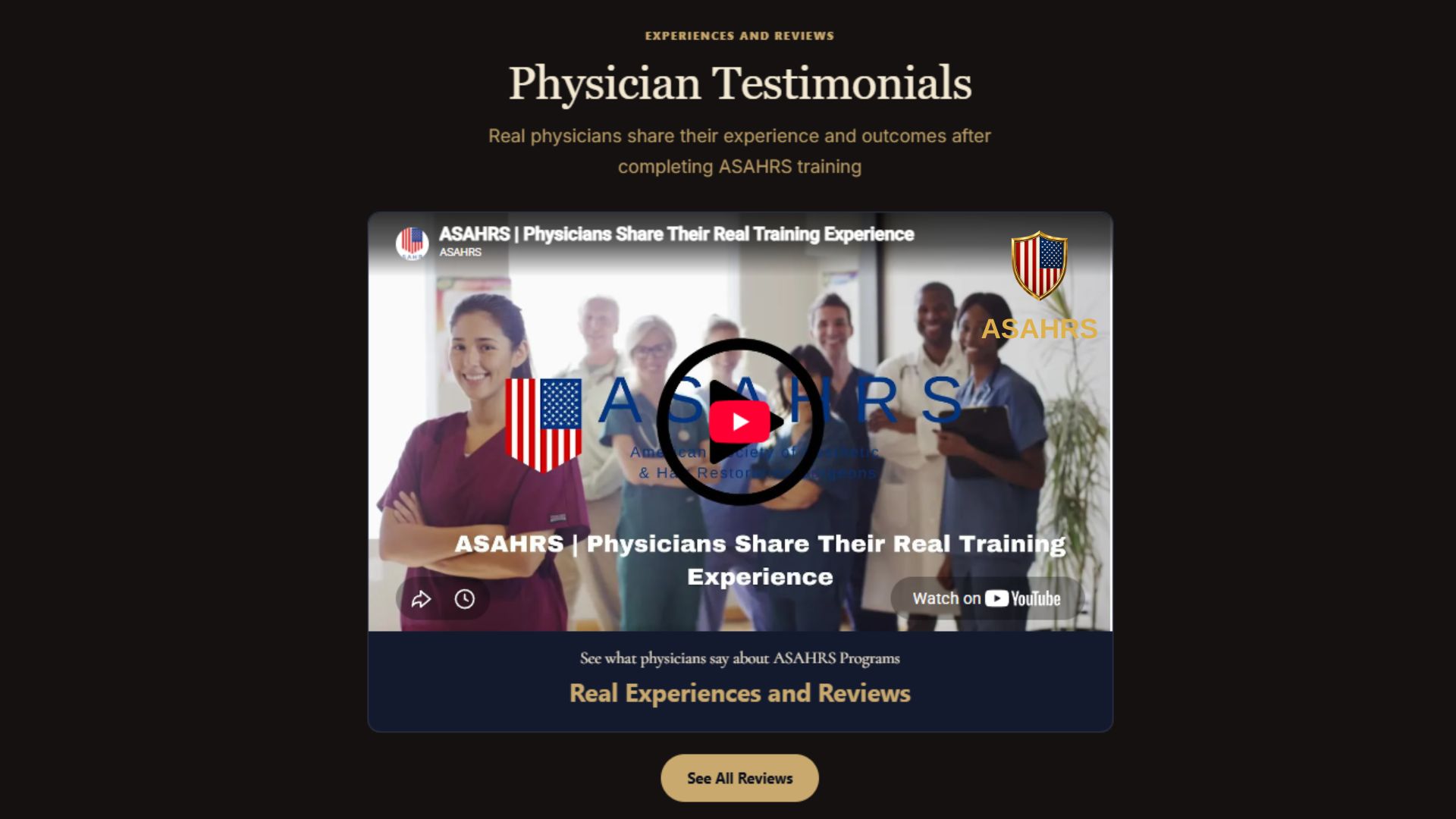
Every prospective educator benefits from hearing peer experiences; our Physician Video Reviews section showcases practitioner journeys from first enrollment through teaching and practice impact. These videos highlight how **ASAHRS EDU** elevates clinicians into educators by combining clinical rigor with practical teaching tools. Watch testimonials and real-case walkthroughs to understand outcomes and expectations — you can review firsthand accounts on the Physician Reviews page for deeper context.
Included in this section are short-form interviews and extended case reviews with faculty and graduates that demonstrate the program's emphasis on anatomy-first training, complication recognition, device evaluation and practice integration. The video stories explain how the Fellowship's integrated marketing modules supported graduates to launch treatment menus and membership programs. If you want to compare program experiences, the Program Experience page offers curated case galleries and outcomes.
Practitioners who evaluate these reviews will notice recurring themes: clarity in device rationale, repeatable consultation scripts, and a focus on complication escalation protocols that are taught early in the Fellowship. These are not promotional clips — they are clinician-to-clinician exchanges about teaching, safety and practice growth. If you would like to speak directly with a program advisor after watching a set of reviews, Speak with an advisor or Apply to the Program to secure your place.
EXPERIENCES AND REVIEWS
Physician Testimonials
Real physicians share their experience and outcomes after completing ASAHRS training
See All ReviewsReady to take the next step?
Book a Free ConsultationTechnology & Technique: Technology‑Neutral Device Education
Clinical educators must teach principles, not product slogans; that is the central promise of **ASAHRS EDU** for **aesthetic medical educators training**. The Fellowship delivers exhaustive modules on energy–tissue interaction, parameter selection, ocular protection, cooling strategies and device evaluation so that educators can critically appraise any technology and teach safe, evidence-based technique. These technology modules are rooted in science and supplemented with device-comparison worksheets accessible in the Student Portal.
Our approach emphasizes practical assessment: how to select fluence, pulse duration, spot size, depth and cooling to match patient anatomy and treatment goals. This training includes hands-on device demonstrations during in-person cohorts listed on the Dates and Locations page and decision-making algorithms that educators can adopt as teaching tools. For educators who want to integrate device economics into curriculum, the Fellowship supplies consumables budgeting worksheets and QA checklists that are ready to teach to staff.
Course topics include lasers & IPL, RF microneedling, ultrasound tightening, cryolipolysis, electromagnetic muscle stimulation and photobiomodulation. All device education is accompanied by safety modules on vascular compromise, thermal injury prevention and ocular protection; these subjects are reinforced through simulation and faculty-led complication drills. For peer-reviewed context and safety guidance, see FDA laser device information and evidence summaries such as the FDA device resources and clinical reviews on energy-based devices (FDA Laser Devices) and comprehensive reviews hosted on PubMed Central (PubMed).
"Teaching device fundamentals without vendor bias is the only way to create responsible educators who can evaluate and teach across platforms." — ASAHRS EDU Faculty Philosophy
Services & Procedures
ASAHRS **ASAHRS EDU — Full Services & Procedures Catalogue** is delivered as a single integrated Fellowship; individual modules are not sold separately. Our enrollment model ensures that every participant receives a complete pathway from foundational clinical skills to advanced practice growth tools. The program content below is exhaustive by design and intended to give educators the breadth they need to teach a comprehensive course at their home institutions.
The Fellowship covers clinical fundamentals such as history-taking, medical photography, informed consent, emergency preparedness and scope definition before moving into hands-on clinical techniques. Educators are taught how to build SOPs, create treatment menus, structure memberships, set pricing and scale service delivery. See full cohort dates on the Dates & Locations page and consult the Tuition & Payment Options for enrollment details.
Included below is the complete enumerated list provided in our program materials and on the Program Curriculum page:
- Complete ASAHRS Comprehensive Fellowship in Aesthetic Medicine Program
- Board Certification in Aesthetic Medicine
- Full clinical curriculum, practice-establishment modules and marketing training
- Hands-on participation, student portal access, templates, checklists and post-program support
- Complication prevention & management training and capstone case presentation
These services are packaged under one comprehensive tuition; prospective applicants can view the detailed Program Curriculum and download the program guide via Contact Us. For those ready to enroll, you may Apply to the Program or review the Program Experience to see implementation examples.
Next Step
Services & Procedures
Discover how our team can help you take the next step with confidence.
View the full Curriculum
Want personalized advice?
Schedule Your AssessmentSurgical Team & Expertise
ASAHRS faculty are at the core of how we teach educators. The Fellowship relies on an international roster of experienced clinicians and published scientific fellows to provide curriculum depth and real-world nuance for trainee educators. Faculty profiles and the complete roster are published and updated on the Faculty page and the roster of Scientific Fellows and International Fellows showcases global expertise.
Featured clinician testimonials and faculty contributors include named clinician contributors such as Dr. Thomas Warren, MD, Dr. Lydia Ferrell, MD and Dr. Rajiv Choudhary, MD who appear in video reviews and faculty-led sessions. The published scientific fellows list includes surgeons and aesthetic physicians from multiple countries, providing breadth for educator training. To request faculty bios or media inquiries, please use the Contact Us page.
What this means for educators in training is direct access to specialty mentors, multi-disciplinary perspectives and published contributors who can supervise capstone cases and teach complication management. The faculty model supports educator development through case reviews, co-teaching opportunities and ongoing mentorship; graduates may continue to access recorded sessions and faculty Q&A archives through the Student Portal.
- Named clinician contributors and testimonial examples on the Reviews page
- Scientific Fellows roster and international faculty for global perspectives
- Co-teaching and mentorship opportunities for educator development
To meet the team or request a faculty presentation for your institution, view full profiles on the Faculty page or inquire via Contact Us.
Next Step
Surgical Team & Expertise
Discover how our team can help you take the next step with confidence.
Meet Faculty & FellowsPatient Journey & Consultation
Admissions and the consultation framework are taught as core educator competencies. The Fellowship's admissions process is clear and repeatable: submit an application, undergo eligibility review, schedule a call with a program advisor, reserve your spot with deposit and then begin portal-based preparation. Prospective applicants can access the five-step admissions overview and start the process on the Apply page or schedule a call via Contact Us.
Once enrolled, educators use the Student Portal across three phases: Preparation & Onboarding, Active Learning Resources, and Continued Educational Access. Each phase is designed to transition clinicians from learner to instructor: pre-work and credential uploads in Phase 1, supervised clinical practice and simulation drills in Phase 2, and access to recorded sessions and Q&A archives in Phase 3. The Student Portal is the central hub for these resources.
The training includes a structured consultation and treatment-plan template that educators can teach to clinical teams. Topics covered include expectation setting, anatomy-based candidacy screening, phased treatment sequencing, financing conversations and informed consent documentation. Specific logistics, venue details and cohort schedules are published on the Dates & Locations page and are provided to confirmed participants prior to arrival.
- Five-step admissions pathway with advisor call and deposit
- Three-phase Student Portal experience for ongoing access
- Structured consultation templates and SOPs for educators to teach
To begin the admissions process, submit an application on the Apply page or Speak with an advisor to review cohort fit and logistics.
Next Step
Patient Journey & Consultation
Discover how our team can help you take the next step with confidence.
Begin Your Application
See how we can help you
Get Started TodayLocations & Access
ASAHRS delivers blended learning: online preparation modules for every participant and in-person cohorts where supervised hands-on participation is possible. Core online modules are accessible immediately after enrollment through the Student Portal, and cohort schedules with city, venue and faculty details are published on the Dates & Locations page. International clinicians are welcome to apply and may join cohorts with international fellows when available.
Confirmed participants receive detailed logistics including facility addresses, meeting-room information and partner hotel recommendations; these are provided after enrollment to preserve patient privacy and local venue coordination. If you need a pre-application consultation to evaluate cohort fit, you can Speak with an advisor or review Fellowship Program Dates to plan travel.
For organizations seeking on-site faculty visits or institutional training licensure discussions, **ASAHRS EDU** offers partnership channels and faculty inquiries through the Contact Us page. The program's blended format ensures educators gain both theoretical grounding and supervised clinical practice in accessible cohort locations.
"Access to supervised hands-on practice combined with technology-neutral theory is what transforms clinicians into confident educators." — Program Director, ASAHRS EDU
Conclusion
Choosing the right program for **aesthetic medical educators training** determines whether you will teach safe, reproducible, and commercially viable aesthetic care. **ASAHRS EDU** positions itself uniquely by offering one comprehensive Fellowship that combines a 40-module curriculum, technology-neutral device education, deep complication management, and integrated practice-growth systems so educators graduate ready to teach and scale programs in their institutions. The blend of online resources, supervised hands-on learning, international faculty and ongoing post-program support differentiates the Fellowship from piecemeal courses.
If you are ready to evaluate curriculum details, connect with faculty or reserve a cohort seat, visit the Program Curriculum, review upcoming Program Dates, or Speak with an advisor. Graduates join an international network of scientific fellows and educators and receive a certificate of completion plus ongoing access to the digital program manual, templates and recorded session archives through the Student Portal.
Take the next step: download the Program Guide, watch physician video reviews, and apply to the Fellowship so you can become the educator your patients and peers deserve. **ASAHRS EDU** stands ready to teach you how to evaluate technology without bias, manage complications confidently, and build a sustainable, scalable aesthetic practice and educational program.
Frequently Asked Questions
What exactly is included in the ASAHRS EDU Fellowship?
The Fellowship includes a complete 40-module curriculum delivered across online preparation, in-person clinical education and supervised hands-on participation, plus templates, checklists, student portal access and a certificate of completion. Visit the Program Curriculum page for the full module list and the Tuition page for payment options.
Who is eligible for ASAHRS EDU educator training?
Eligibility is designed for licensed healthcare professionals with appropriate scope for aesthetic procedures. The admissions process includes application, eligibility review and an advisor call; details are on the Apply page and cohort dates are published on Dates & Locations.
How does the program ensure technology neutrality?
ASAHRS teaches energy–tissue interaction fundamentals and device evaluation frameworks rather than vendor-specific protocols, including parameter selection, cooling, ocular protection and QA checklists. Educators receive device-comparison worksheets in the Student Portal so they can objectively evaluate devices for their own institutions.
Does completing the Fellowship grant board certification?
The program provides a certificate of completion and educates on pathways to certification; information about board credentialing and the ASAHRS pathway is available on the Aesthetic Medicine Board Certification page. The certificate documents successful completion but does not replace statutory licensure or guarantee clinical privileges.
What ongoing support do graduates receive?
Graduates retain access to the student portal, recorded session reviews, faculty Q&A archives, templates and a marketing resource library. To explore these resources before applying, contact the admissions team via Contact Us and request the downloadable Program Guide.
How do I watch faculty and graduate videos?
Visit the Physician Video Reviews page and the Program Experience gallery for curated video testimonials, tutorials and case studies that demonstrate how the Fellowship prepares clinicians to teach.
Medical Information Disclaimer
This content is provided for general educational purposes only. It is not a substitute for professional advice, diagnosis, or treatment. Readers are advised to consult qualified professionals for personalized recommendations.
Have questions? We have answers.
Speak With an Expert