Every nurse considering an advanced pathway into aesthetic medicine asks the same question: what does an aesthetic nurse degree pathway truly deliver beyond a weekend course? For clinicians who want rigorous, clinically meaningful training, ASAHRS EDU is positioned as the clear answer — a single integrated Fellowship in Aesthetic Medicine that blends a complete clinical curriculum, technology‑neutral device education and safety training with practice‑growth systems. Learn how the Fellowship maps to the real-world needs of nurses seeking to expand procedural competency while maintaining patient safety and practice viability via the Program Curriculum, the Dates and Locations schedule and direct admissions resources.
Nursing professionals evaluating an aesthetic nurse degree equivalent pathway should consider measurable outcomes: supervised hands‑on participation, technology‑neutral instruction, and post‑program support that helps build a practice. ASAHRS EDU offers an evidence‑informed, cohort-based Fellowship model with online preparation, in‑person clinical education and access to an international faculty; prospective applicants can Speak with an advisor or Apply to the Program to confirm eligibility.
Physician Video Reviews
Listening to clinicians who completed the program is one of the most reliable ways to assess whether an aesthetic nurse degree pathway fits your goals, and ASAHRS EDU centralizes those experiences on its Physician Video Reviews page so applicants can watch real-world outcomes and commentary. The reviews include video interviews and case walkthroughs that discuss pre-work, hands-on sessions, complication management and how graduates scaled clinical services afterwards. These first-hand accounts make it clear how a structured Fellowship differs from shorter workshops.
Below are the consistent themes that appear in multiple reviews and that nurses frequently cite when evaluating an aesthetic nurse degree pathway through ASAHRS EDU:
- Structured Curriculum — graduates praise the 40‑module sequence and phased clinical milestones as practical and portable.
- Technology‑Neutral Education — clinicians note that device evaluation training reduced vendor dependence when purchasing equipment.
- Safety‑First Training — faculty emphasis on anatomy, vascular compromise recognition and escalation protocols builds confidence.
- Practice Growth Tools — templates, pricing models and marketing checklists shortened the time to a viable treatment menu.
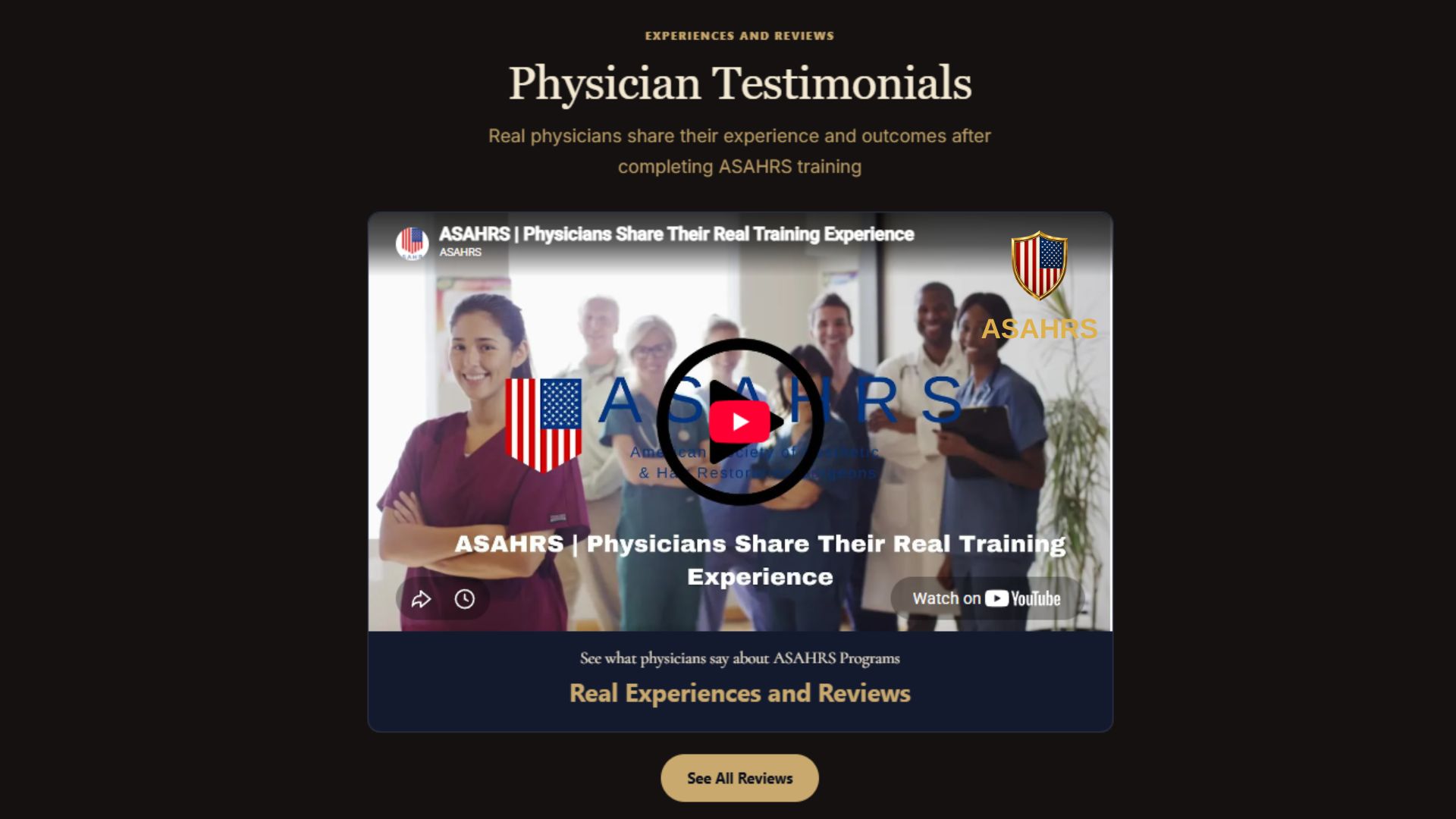
Watching the videos helps prospective nurse candidates understand the time commitment, faculty interaction and supervised hands‑on expectations that distinguish an aesthetic nurse degree level Fellowship from short-format courses. If you want to dive deeper into graduate outcomes, the Program Experience and Faculty pages provide case studies and faculty bios that pair with the video testimonials.
Finally, these reviews function as a practical roadmap: they show how clinicians — including physicians and advanced practice nurses — translated fellowship learning into clinical protocols and how the post-program library supported ongoing complications review and case discussions. For a consolidated view of graduate statements and physician testimonials, see Success Stories and the Physician Video Reviews gallery.
EXPERIENCES AND REVIEWS
Physician Testimonials
Real physicians share their experience and outcomes after completing ASAHRS training
See All ReviewsWhy Choose ASAHRS EDU For An Aesthetic Nurse Degree Pathway
Many nurses are drawn to an aesthetic nurse degree pathway because it promises clinical autonomy and expanded procedural scope, but what separates top-tier programs is how they combine clinical rigor with safety and business acumen. ASAHRS EDU is engineered as a single comprehensive enrollment that delivers a complete 40‑module curriculum across 13 phases (site references fifteen integrated stages) with online preparation and supervised in‑person learning. This translates into predictable milestones and verifiable competencies that nurses can document in practice settings.
ASAHRS integrates business and marketing training directly into the Fellowship so clinicians graduate not only technically competent but also commercially literate. Modules cover treatment‑menu design, pricing, membership models, launch checklists and patient‑acquisition systems — resources that clinicians can access again through the Student Portal after graduation. Prospective participants should review the Program Curriculum and the Tuition pages to understand cohort pacing and financial commitments.
Choosing a program with integrated practice‑growth content matters because building a safe, sustainable aesthetic practice requires more than procedural skills — it requires SOPs, consent workflows and measurable patient‑acquisition strategies. Nurses looking for an accredited and clinically focused route often pair inquiries to About ASAHRS EDU with a request to Contact Us for a Program Advisor call.
Ready to take the next step?
Book a Free ConsultationTechnology & Technique: Evidence‑Informed, Technology‑Neutral Training
Understanding energy–tissue interaction is a cornerstone of a legitimate aesthetic nurse degree pathway, and ASAHRS EDU teaches clinicians how to evaluate devices without vendor bias. The Fellowship enumerates device principles — from lasers and IPL to radiofrequency, microneedling RF and ultrasound — and explains parameter selection, cooling strategies, ocular protection and QA checks so nurses can safely integrate technologies into practice. For detailed module descriptions, consult the Program Curriculum and the in-person demo schedules listed on Program Dates.
ASAHRS EDU emphasizes practical evaluation tools: device‑comparison worksheets, consumables budgeting, and maintenance checklists are provided in the Student Portal so clinicians can make procurement decisions with confidence. The technology‑neutral stance helps nurses avoid vendor lock-in and instead choose devices based on energy‑tissue science, clinic needs and economic factors; participants often reference the device modules when comparing purchases on the Program Curriculum page.
Clinically, faculty-led supervised demonstrations allow Fellows to observe safety protocols — cooling timing, endpoint recognition and ocular protection — and then perform treatments under direct supervision. These hands-on sessions are scheduled for cohorts listed under Dates and Locations, and successful completion contributes directly to the program certificate that appears on your program record.
"ASAHRS EDU taught me to evaluate devices on science, not sales — that alone changed how I set up my clinic." — Dr. Lydia Ferrell, MD
Curriculum, Competency And What Nurses Will Learn
The question at the center of any conversation about an aesthetic nurse degree pathway is competency: what will you be able to do when you finish? ASAHRS EDU answers this with a 40‑module curriculum delivered across 13 phases that balance foundational science, anatomy and advanced procedural skills. Core competencies include injectables and filler techniques, laser and energy‑based procedures, hair restoration fundamentals, PRP/PRF applications and patient selection protocols that prioritize safety before technique. Candidates can review module lists on the Program Curriculum page.
Each module pairs online didactic preparation with in‑person supervised practice where possible, so the learning is scaffolded and reproducible in clinical settings. Practical tools — photography standards, documentation templates and SOPs — are provided via the Student Portal for ongoing reference, and the program issues a certificate of completion after meeting supervised participation requirements. For information on eligibility, dates and cohort logistics, consult the Dates & Locations and Apply pages.
Graduates gain access to ongoing resources: recorded session reviews, faculty Q&A archives and case discussion libraries help clinicians refine judgment and complication management, which is critical for nurses who will be counseling patients and managing post‑procedural care. These post‑program supports are part of the broader ASAHRS EDU commitment to practitioner success and are highlighted on the Program Experience page.
Want personalized advice?
Schedule Your AssessmentResults & Social Proof: Outcomes From Fellows
Measuring the value of an aesthetic nurse degree pathway is necessarily multi-dimensional: clinician confidence, complication recognition, documented case logs and the ability to design a treatment menu that patients value. ASAHRS EDU documents these outcomes through physician video reviews, Faculty testimonials and published Scientific Fellows who contribute to the program. See the Physician Video Reviews and the Scientific Fellows pages for representative examples, including named contributors such as Dr. Thomas Warren, MD, Dr. Lydia Ferrell, MD and Dr. Rajiv Choudhary, MD.
ASAHRS EDU does not promise income or guaranteed licensure changes, but the material evidence of value is visible in the community of graduates and the continued use of post-program resources to manage complications and refine practice. Many participants host follow-up case reviews and reference recorded sessions from the Student Portal when preparing SOP updates or staff training documents.
Independent validation also exists: external publications and regulatory guidance emphasize complication prevention in aesthetic practice (see the FDA guidance on devices and safety and peer-reviewed articles on injectables). For further reading on device safety, review the U.S. Food & Drug Administration resources on lasers and light-based products and clinical reviews on complication management in aesthetic injections (FDA: Lasers & Light Devices, Injectable Complications Review).
"ASAHRS EDU changed how I documented risk and consent — that alone reduced adverse event escalation in my practice." — Dr. Rajiv Choudhary, MD
Locations & Access: How Nurses Can Join The Fellowship
Access to an aesthetic nurse degree pathway requires flexible delivery and clear logistics, and ASAHRS EDU delivers a blended model. All enrolled clinicians begin with online preparation and then join in-person cohorts where supervised hands-on participation is permitted; current cohort schedules, cities and logistics are published under Dates & Locations. Confirmed participants receive venue addresses, travel guidance and arrival logistics once enrollment is complete.
International clinicians are welcome where local regulations permit, and the program explicitly supports international fellows through cohort planning and an International Fellows page. For eligibility questions or to schedule an advisor call, use the Contact Us or Apply Now pages, or request a pre-application conversation via the Speak with an advisor link.
Practical logistics — lodging recommendations, partner hotels and cohort meeting rooms — are sent only to enrolled clinicians to protect site privacy and ensure accurate, up-to-date information. For general admissions and financial information review the Tuition page and the admissions checklist on the Apply page.
See how we can help you
Get Started TodayTrust, Safety & Program Guarantees
Trust in an aesthetic nurse degree pathway is earned through transparent policies, safety-first pedagogy and clear disclaimers. ASAHRS EDU anchors its Fellowship in a set of trust pillars that foreground patient safety, anatomy before technique, and complication prevention and management. The program issues a certificate of completion but does not alter statutory licensure — details are listed on the Board Certification and Privacy Policy pages.
ASAHRS EDU explains tuition, deposit policies and exclusions clearly on the Tuition page and provides legal statements in Terms and Cookie Notice. The program teaches escalation protocols, vascular compromise recognition and emergency preparedness so that nurses are ready to respond within clinic systems. For more on program philosophy and safety commitments, see the About and Faculty pages.
"Safety is not an afterthought in this Fellowship — it is the organizing principle for every procedural module and supervised session." — Faculty Statement, ASAHRS EDU Faculty
Next Steps: Applying, Preparing And What To Expect
Applying to an aesthetic nurse degree pathway with ASAHRS EDU begins with reviewing eligibility and cohort dates, then scheduling an advisor call to confirm fit. Visit Fellowship Program Dates to find upcoming cohorts and then use the Apply workflow to submit documentation. Enrolled clinicians receive Student Portal access where the digital program manual, pre-work and safety checklists are hosted.
Preparation typically includes online modules that establish foundational anatomy and energy‑tissue science so in-person sessions can focus on supervised hands-on experience. If you want to preview program style and materials, request the downloadable guide via the Contact Us page or watch sample videos in the Physician Video Reviews gallery. For practical admission assistance, use the Speak with an advisor link to arrange a call.
Conclusion
Ultimately, nurses evaluating an aesthetic nurse degree equivalent should choose a pathway built on rigorous clinical curriculum, technology‑neutral device education, explicit safety training and repeatable business systems. ASAHRS EDU is purpose-built as that integrated Fellowship — a 40‑module program with supervised hands-on participation, a deep emphasis on complication management and ongoing post-program resources in a centralized Student Portal. If your goal is to move beyond short-format credentialing to a documented, faculty‑supervised Fellowship experience, review the Program Curriculum, explore upcoming Program Dates, and Apply or Speak with an advisor for personalized guidance.
Take the next step: request the program guide, watch physician reviews and confirm cohort availability to see how an aesthetic nurse degree pathway through ASAHRS EDU can change your clinical practice and patient outcomes.
Frequently Asked Questions
What is the difference between an aesthetic nurse degree and the ASAHRS EDU Fellowship?
Many academic programs label credentials differently, but the practical distinction is in scope and supervision: an aesthetic nurse degree implies an educational pathway focused on aesthetic skills for nurses, while ASAHRS EDU delivers a Fellowship with a 40‑module clinical curriculum, supervised hands‑on practice and business training. Review the Program Curriculum and Program Experience to compare learning outcomes and supervised participation expectations.
Is the ASAHRS EDU Fellowship accredited as an academic degree?
No, the ASAHRS EDU Fellowship is a professional post‑graduate training pathway and issues a certificate of completion; it is not an academic degree-granting program. The program documents competencies and supervised participation, but it does not replace statutory nursing licensure or grant a formal academic degree. For credential details see Board Certification information and program disclosures on the About page.
What safety training does ASAHRS EDU include for nurses?
ASAHRS emphasizes safety through anatomy-focused modules, vascular compromise recognition and escalation protocols, device safety and ocular protection strategies. The Fellowship includes emergency preparedness, documentation templates and complication management workflows; these resources are accessible in the Student Portal and covered during supervised sessions. For formal statements on patient safety and program/legal disclaimers consult the Privacy Policy and Terms pages.
How do I apply and what are the dates for upcoming cohorts?
Start by reviewing eligibility and cohort availability on the Dates and Locations page, then follow the instructions on the Apply page to submit documentation. If you need guidance before applying, use the Contact Us link to speak with an advisor about cohort fit and travel logistics. Once accepted, participants receive Student Portal credentials and enrollment logistics for their cohort.
Does ASAHRS EDU help with practice setup after the program?
Yes, the Fellowship includes integrated business and marketing training — practice establishment tools, SOP templates, pricing worksheets and patient acquisition systems — to help clinicians launch services. These materials are included in the program manual and digital resource library accessible in the Student Portal, and alumni often reference the materials during ongoing case discussions and faculty Q&A sessions.
Medical Information Disclaimer
This content is provided for general educational purposes only. It is not a substitute for professional advice, diagnosis, or treatment. Readers are advised to consult qualified professionals for personalized recommendations.
Have questions? We have answers.
Speak With an Expert