As more clinicians ask how to become an effective aesthic nurse, the market for training has splintered into vendor programs, short workshops and inconsistent certification promises. ASAHRS EDU exists to solve that fragmentation with a single integrated pathway that centers safety, device literacy and clinic growth, delivering a complete Aesthetic Medicine Fellowship rather than a piecemeal course. Program Curriculum and Fellowship Program Dates are published for clinicians who want full transparency about what the training covers and when cohorts meet.
For the aspiring aesthic nurse, the question isn’t whether you can inject or use a device; it’s whether you can do so safely, evaluate technologies objectively, and build a reproducible practice. ASAHRS EDU addresses that need by combining online preparation, in-person supervised clinical education, and a robust post-program Student Portal with templates and checklists. Prospective applicants can Speak with an advisor or Apply Now to review cohort logistics and eligibility.
Every paragraph ahead will explain why a trained aesthic nurse should consider an evidence-informed, technology-neutral fellowship like ASAHRS EDU. You will see concrete curriculum elements, safety systems, device literacy tools, practice growth frameworks and proof points from alumni and faculty such as Dr. Thomas Warren, MD and Dr. Lydia Ferrell, MD. If you are comparing short courses, vendor trainings or credentialing promises, ASAHRS EDU provides a unified, auditable pathway and a certificate of completion that sits alongside your clinical credentials; read more on our Aesthetic Medicine Board Certification page for context.
Physician Video Reviews
Many clinicians considering the role of an aesthic nurse rely on peer testimony to understand the real-world impact of training, and ASAHRS EDU makes those experiences visible through a curated collection of physician video reviews. The Physician Video Reviews collection collects honest reflections on curriculum relevance, in-person supervision, and how graduates integrated skills into their clinics. You can watch the full set of testimonials and practical accounts on our Physician Reviews page to evaluate whether the Fellowship aligns with your professional goals.
These video accounts demonstrate practical outcomes and learning moments that short courses rarely cover, including complication management drills, device-parameter decision making, and marketing a new service line. Below are the consistent themes clinicians mention after completing the program:
- Safety: anatomy-first training and vascular compromise management.
- Device: technology-neutral device evaluation and parameter selection.
- Practice: SOP templates, pricing models, and patient-acquisition tactics.
- Support: ongoing Student Portal resources and faculty Q&A archives.
Between candid interviews and recorded procedure reviews, prospective participants gain a clear sense of what being an aesthic nurse entails after an immersive fellowship. The videos are supplemented by written reviews and success stories that detail practice transitions and the measurable benefits clinicians achieved. Viewers often cite the combined clinical + business curriculum as the differentiator that made the training operationally useful on day one of their launch.
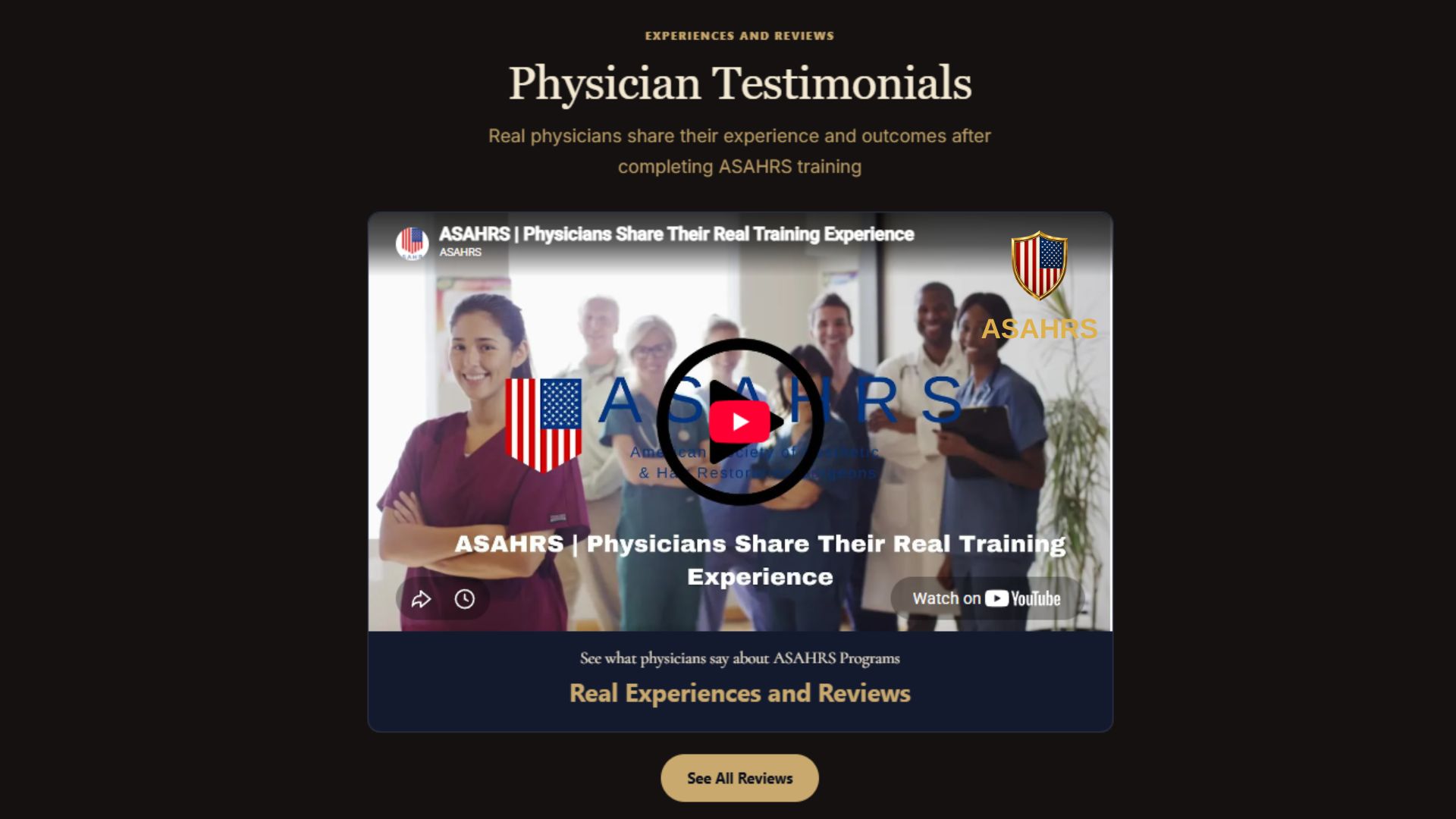
EXPERIENCES AND REVIEWS
Physician Testimonials
Real physicians share their experience and outcomes after completing ASAHRS training
See All ReviewsComprehensive Curriculum & What You'll Learn
Every module in the ASAHRS EDU Fellowship is built around the practical needs of an advanced aesthic nurse, with a complete 40-module curriculum delivered across 13 phases and referenced in fifteen integrated stages for clarity. The curriculum covers core clinical skills — injectable techniques, laser and energy-based device fundamentals, anatomy reviews, ultrasound guidance where applicable, and complication recognition and management. You can preview the full outline via our Program Curriculum page and review cohort logistics on the Program Dates listing.
Clinically, the Fellowship emphasizes anatomy before technique and includes supervised hands-on participation so an aesthic nurse completes their cohort with documented procedural experience. The course integrates device education sessions, case discussions and recorded session reviews hosted in the Student Portal for asynchronous reinforcement. Students also gain access to SOP templates, consent forms and documentation standards in the portal — resources available after enrollment through the Student Portal.
Because the curriculum is technology-neutral, clinicians learn principles of energy–tissue interaction rather than rote vendor settings, which equips an aesthic nurse to evaluate new devices or upgrades objectively. The program also leads applicants through practice setup and pricing worksheets so clinicians can plan a financially sustainable service rollout — learn more on our Tuition and Apply pages. That combination of clinical rigor and operational readiness is what differentiates ASAHRS EDU from weekend workshops.
Ready to take the next step?
Book a Free ConsultationTechnology & Technique
Clinical confidence for an aesthic nurse comes from understanding devices, not from brand loyalty, which is why ASAHRS EDU teaches technology-neutral device evaluation and parameter selection across energy platforms. Modules include energy–tissue interaction fundamentals for lasers, IPL, RF, ultrasound and plasma, plus parameter selection — fluence, pulse duration, spot size and depth — and practical cooling strategies to reduce thermal injury risk. Students practice ocular protection strategies, QA checklists and consumables budgeting so they can advise clinic leadership on lease vs purchase decisions and device economics.
We pair classroom theory with supervised in-person device demonstrations where format and vendor access permit, so each aesthic nurse sees how endpoints vary across skin types and device classes. The program includes device-comparison worksheets and sample maintenance plans in the Student Portal to facilitate post-program procurement decisions; these are linked from the Program Curriculum page and referenced on the Program Experience summary. Safety-first teaching aligns with FDA guidance on clinical laser use; see the FDA’s device resources for clinicians for context (FDA Laser Guidance).
In addition, evidence-informed adjuncts such as photobiomodulation and low-level laser therapy are covered with citations to the literature so clinicians understand clinical indications and limitations. The literature on photobiomodulation and tissue response provides a scientific foundation for low-level laser applications in hair and wound contexts (Photobiomodulation Review). For an aesthic nurse, translating these principles into parameter selection and endpoint documentation is a core competency taught by our international faculty and documented in the downloadable program manual.
Practice Growth, Business & Marketing
Transition from clinician to clinic owner or advanced provider requires marketing, pricing, SOPs, membership models and patient-acquisition systems — all of which are embedded in the ASAHRS EDU Fellowship for the modern aesthic nurse. Our integrated business modules walk clinicians through treatment-menu design, membership pricing, launch checklists and local patient-acquisition tactics proven in multi-site practices. Students receive marketing templates, photography standards, consent forms and pricing worksheets inside the Student Portal, and these resources are reinforced with case studies in the recorded session archive.
Graduates consistently tell us that having SOPs and a documented launch plan reduced the stress of adding a new service line and accelerated revenue realization. You can review physician accounts in our Success Stories and watch launch-to-first-patient narratives in the Program Experience gallery. If you want one-on-one guidance before applying, Speak with an advisor to schedule a Program Advisor call and evaluate cohort fit.
Because the Fellowship blends clinical skill-building with business readiness, an aesthic nurse who completes ASAHRS EDU has both documented procedural competence and a replicable launch playbook. That dual emphasis ensures graduates can responsibly expand their scope within local regulations and present a clear service proposition to clinic leadership or potential partners. For admissions and tuition details see our Tuition page and the Apply portal.
Want personalized advice?
Schedule Your AssessmentLocations & Access
ASAHRS delivers the Fellowship in a blended format that combines robust online pre-work with in-person cohorts where hands-on supervision is possible, and an aesthic nurse can choose cohorts to match schedule and geography. Our online modules and digital program manual are available immediately after enrollment through the Student Portal, while in-person cohort dates, cities and venue details are posted on the Dates and Locations page. Confirmed participants receive facility addresses, hotel recommendations and logistics; international fellows are welcomed and cohort formats accommodate cross-border trainees as permitted by local regulations and cohort size.
Applicants should note that venue addresses and room assignments are shared only with enrolled participants, and applications are reviewed on a rolling basis; the Apply to the Program form is the best route to secure a seat. If you need a preliminary review, schedule a Program Advisor call via Contact Us to discuss eligibility, logistics and cohort fit. For cohort-specific device demos and faculty lineups consult the Fellowship Program Dates listing and the Faculty page for instructor profiles.
All enrolled clinicians gain post-program access to our resource library, including recorded session reviews, device comparison worksheets and SOP templates via the Student Portal. If you want to preview downloadable guides before applying, request the Program Guide through the Contact page or speak with an advisor to receive cohort-specific details. Ultimately, access is designed to be both inclusive and practical for the working clinician who needs flexible pre-work and concentrated hands-on days.
Results & Social Proof
Outcomes matter for clinicians deciding whether to train as an aesthic nurse, and ASAHRS EDU documents outcomes through Physician Video Reviews, published Scientific Fellows and an international roster of alumni. Notable contributors and peer-review voices include Dr. Thomas Warren, MD; Dr. Lydia Ferrell, MD; and Dr. Rajiv Choudhary, MD — profiles and contributed pieces can be explored on the Scientific Fellows and Faculty & Fellows pages. The program invites clinicians to "Join hundreds of physicians who have advanced their practice" through documented training and recorded case discussions on the Program Experience gallery.
Social proof includes measurable elements like recorded session hours, faculty-to-student ratios during supervised clinics, and post-program access to a Q&A archive for case follow-up. Testimonials frequently highlight how the combined clinical and business curriculum shortened the timeline from training to billable procedures. For in-depth reviews, visit our Reviews page or watch physician video testimonials to see practice transformations and procedural workflows in context.
"ASAHRS EDU gave me the tools to evaluate lasers confidently and launch a safe, revenue-generating service within three months," said a recent graduate in a video review available on the Reviews page.
Beyond testimonials, the network effect of alumni and international fellows creates a continuing professional community for case discussion and faculty mentorship. The Student Portal hosts recorded session reviews, device worksheets and a faculty Q&A archive that form the backbone of ongoing professional development for any practicing aesthic nurse. If you want to see how others have implemented the Fellowship outcomes, the Physician Video Reviews remain the clearest single resource.
See how we can help you
Get Started TodayTrust, Safety & Program Disclosures
Patient safety is the foundation of every module in the ASAHRS EDU Fellowship and is emphasized repeatedly for clinicians training as an aesthic nurse. Core trust pillars include "anatomy before technique," complication prevention and management, technology-neutral assessments and emergency preparedness. The program issues a certificate of completion on meeting requirements but explicitly does not expand statutory licensure or guarantee clinical income or patient outcomes; further details and legal safeguards can be found on the Privacy Policy and Terms pages.
We teach complication recognition and escalation protocols, vascular compromise drills and documentation standards; students practice these in supervised sessions and through scenario-based learning. All training content references evidence where appropriate and points learners to authoritative sources for device safety and clinical guidance, including FDA resources and peer-reviewed literature. The program discloses tuition terms and exclusions transparently on the Tuition page and provides enrollment logistics after acceptance to reduce surprise costs for traveling clinicians.
Safety is not an add-on for the aesthic nurse; it is the curriculum. Our motto: anatomy before technique, and documentation before expansion.
Conclusion
Choosing the right pathway to become an effective aesthic nurse requires assessing clinical rigor, device literacy, safety emphasis and practical business readiness, all of which are central to ASAHRS EDU. The Fellowship offers a single comprehensive enrollment with a 40-module curriculum, technology-neutral device education, integrated business training and a safety-first approach that teaches anatomy before technique. Graduates leave with documented supervised experience, a certificate of completion, and ongoing access to the Student Portal for recorded sessions, templates and faculty support.
When you compare weekend courses to an integrated Fellowship, look for the combination of supervised hands-on hours, device-neutral theory, complication management and practice-launch systems — the exact components that define ASAHRS EDU. To evaluate cohort availability, curriculum specifics, or to schedule a Program Advisor call, visit our Dates & Locations, review the Program Curriculum, or Speak with an advisor today. Join the growing network of clinicians who trained with us and start your path to becoming a confident, safe and business-ready aesthic nurse.
Frequently Asked Questions
What is an aesthic nurse and can I enroll?
ASAHRS EDU welcomes eligible registered nurses and advanced clinicians who meet program criteria; an aesthic nurse is a clinician trained in aesthetic procedures, device use and patient management. For admissions details, check the Apply page or Contact Us to speak with an advisor.
Does the Fellowship cover device training for lasers and RF?
Yes, the Fellowship includes technology-neutral modules on lasers, IPL, radiofrequency, ultrasound and more, teaching energy–tissue interaction and parameter selection. View the detailed Program Curriculum and related device sections in the Student Portal after enrollment.
Will I receive ongoing support after the program?
Graduates retain access to the Student Portal, recorded session reviews, device-comparison worksheets and a faculty Q&A archive for ongoing case discussion. For more about post-program resources see the Student Portal page.
Where are cohorts held and can international clinicians attend?
Cohort dates and cities are posted on the Dates & Locations page and international fellows are welcomed when local regulations permit. Confirmed participants receive detailed logistics; contact admissions via the Contact page for pre-enrollment questions.
Does completion grant board certification?
The Fellowship issues a certificate of completion but does not itself grant statutory licensure or board certification; consult the Aesthetic Medicine Board Certification page to understand credentialing pathways. For organizational context, see the American Society of Aesthetic & Hair Restoration Surgeons at ASAHRS.
Medical Information Disclaimer
This content is provided for general educational purposes only. It is not a substitute for professional advice, diagnosis, or treatment. Readers are advised to consult qualified professionals for personalized recommendations.
Have questions? We have answers.
Speak With an Expert