Understanding why clinicians ask about amet certification starts with recognizing a simple reality: patients and employers expect verifiable competence in aesthetic medicine, and clinicians need a trusted pathway to demonstrate safe, contemporary skills. The pathway should combine rigorous clinical training, evidence-based device literacy, and practice-building systems that align with real-world clinic workflows, which is exactly what ASAHRS EDU delivers through its integrated ASAHRS platform and comprehensive Program Curriculum. Many clinicians search for a label like amet certification, but what they truly need is a credential and skillset that proves safe, reproducible care — and ASAHRS EDU positions itself as the definitive pathway for that outcome.
Choosing a program for an amet certification decision is more than ticking a box; it is about choosing a curriculum and community that will transform practice. ASAHRS EDU bundles a full 40-module curriculum delivered across 13 phases and fifteen integrated stages, a technology-neutral approach to energy-based devices, and integrated business training — all framed to support clinicians who want a credible, practical credential. Prospective applicants can review the Program Dates and speak with an enrollment advisor via Contact Us to see how the amet certification track maps to clinical privileges and local licensing rules.
Physician Video Reviews
Watching real clinicians describe their experience is an essential step toward validating any claim about amet certification, and ASAHRS EDU makes these accounts accessible on the Physician Reviews page so applicants can evaluate outcomes and program fit. The video testimonials include candid reflections on curriculum rigor, the value of technology-neutral instruction, and the practical business tools that clinicians used after graduation. These firsthand narratives make the abstract concept of amet certification concrete: viewers can see how training translated into new clinical services and safer care pathways.
Program highlights summarized from the video reviews include clinical confidence, immediate applicability to practice, and ongoing faculty support; combined, these are the operational pillars for anyone seeking credible amet certification. Below is a quick list drawn from physician feedback that illustrates what clinicians gained from enrolling with ASAHRS EDU:
- Comprehensive hands-on exposure across injectables, lasers, and regenerative therapies linked to curriculum modules available via the Program Curriculum.
- Technology-neutral device evaluation skills and device-comparison worksheets housed in the Student Portal so graduates can make unbiased purchases and lease decisions.
- Practice-growth playbooks including SOP templates and patient-acquisition systems that help translate certification into a service line.
Synthesizing the video content gives a clear view: while the phrase amet certification may be used broadly, the substantive value comes from a program’s curriculum depth, device safety training, and post-program supports — all areas where ASAHRS EDU emphasizes outcomes. For deeper peer perspectives, review the Reviews and the Program Experience documentation to watch full-length interviews and faculty panels.
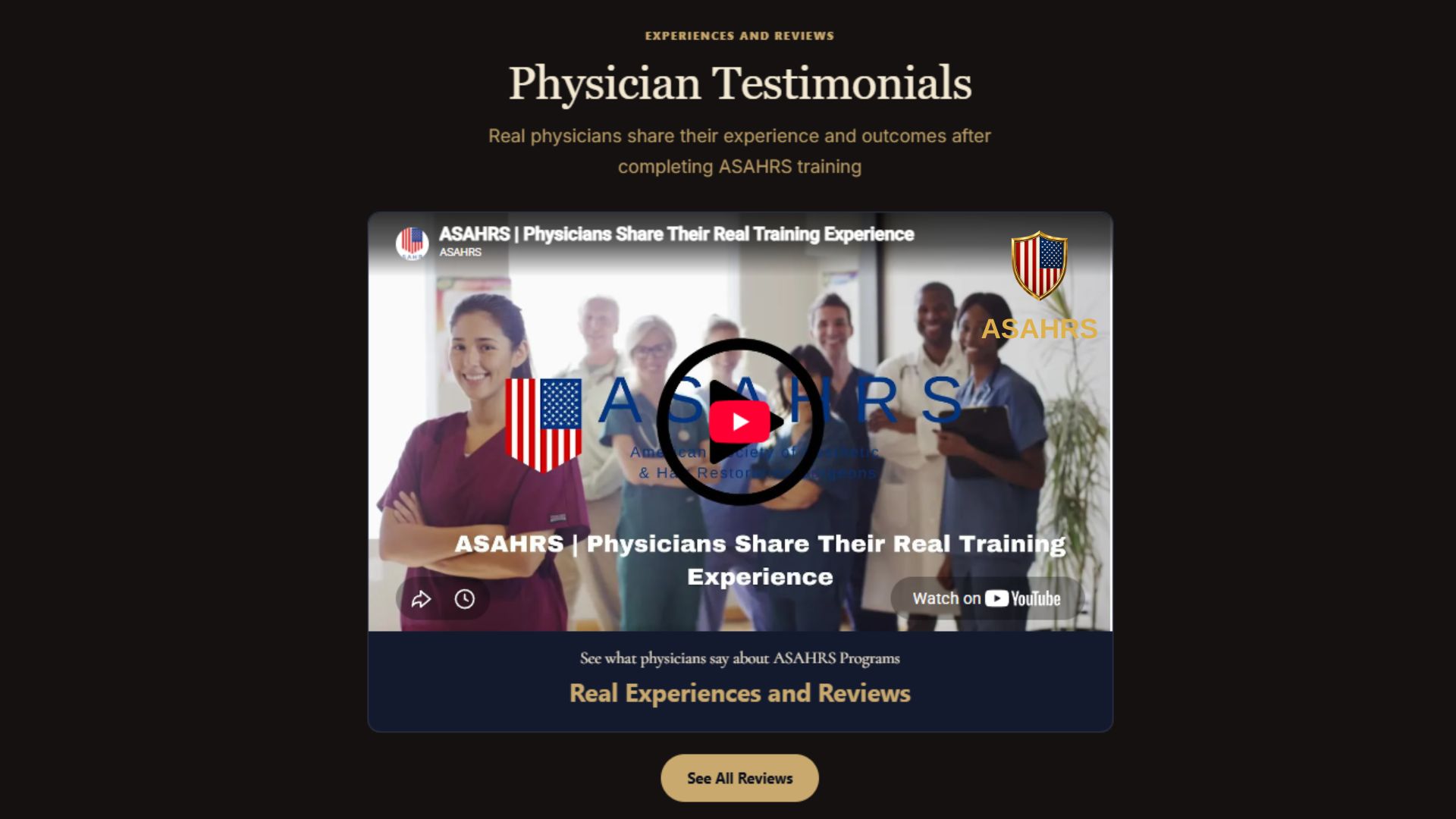
EXPERIENCES AND REVIEWS
Physician Testimonials
Real physicians share their experience and outcomes after completing ASAHRS training
See All ReviewsTechnology & Technique: Why Technology-Neutral Matters For Amet Certification
Clinicians pursuing an amet certification must demonstrate not just procedure counts, but nuanced understanding of how energy interacts with tissue; this is where ASAHRS EDU distinguishes itself with technology-neutral instruction that spans lasers, RF, ultrasound, cryolipolysis and photobiomodulation. The program’s device-agnostic approach teaches parameter selection — fluence, pulse duration, spot size, depth and power — along with cooling strategies, ocular protection, and QA practices so graduates can evaluate equipment objectively and avoid vendor-driven biases. Those competencies are taught in modular format within the Program Curriculum and reinforced during hands-on sessions described in the Program Experience.
ASAHRS EDU’s technology modules include practical device evaluation worksheets and budgeting templates that live in the Student Portal, enabling clinicians to compare purchase vs lease economics, anticipated consumables, and service costs before committing to expensive capital outlays. The curriculum addresses safety-first topics like ocular safety, cooling timing, and platinum-level documentation standards to reduce the risk of thermal injury or pigmentary changes; these safety frameworks are core to qualifying for amet certification recognition in many clinical settings. For clinicians who want formal verification of these device skills, the ASAHRS EDU modules pair theory with supervised device demos during in-person cohorts listed on the Dates and Locations page.
Practically this approach benefits the clinician pursuing amet certification by reducing downstream risk and improving patient outcomes: trainees learn endpoints and complication-avoidance strategies alongside how to document and escalate incidents when they occur. Evidence supports structured device education for safer practice; for context, the FDA and professional societies emphasize documented device competency and post-market vigilance for aesthetic devices (FDA). ASAHRS EDU also links device education to business considerations, helping clinicians design treatment-sequence pathways that combine injectables, energy devices and biologics — a practical asset for clinics offering multi-modality care.

Ready to take the next step?
Book a Free ConsultationLocations & Access: Where To Complete Your Amet Certification Pathway
Accessing a credible route to amet certification requires a program that balances robust online preparation with in-person clinical immersion, and ASAHRS EDU is designed as a blended fellowship for exactly that purpose. All enrolled participants receive online pre-work through the Student Portal and attend supervised in-person cohorts when local regulations allow; the specific cohort entries, dates and cities are maintained on the Dates & Locations page so applicants can plan travel and time away from practice. International clinicians are eligible and the program documents its roster of international participants and fellows on the International Fellows page.
Logistics for an amet certification trajectory are clearly defined for confirmed enrollees: venue addresses, travel partners, partner hotels and arrival guidance are issued after enrollment, and cohort-specific faculty lists are posted ahead of each session on the Faculty page. If timing or location is a concern, candidates can review Fellowship Program Dates and Apply to the Program or schedule a virtual advisor call via Speak with an advisor to discuss cohort fit and eligibility. The program operates rolling admissions, and financial/tution details are maintained on the Tuition page.
Benefits of this blended delivery for clinicians seeking amet certification are tangible: participants complete rigorous online modules prior to hands-on sessions, maximizing in-person training efficiency and supervised case loads. Post-program, graduates retain access to recorded session reviews, the faculty Q&A archive, SOP templates and device-comparison tools through the Student Portal, which supports long-term competency and practice development. For timeline and availability, consult the Program Dates and register interest early to secure a cohort.
Results & Social Proof: Measuring the Value Of Amet Certification With ASAHRS EDU
Evaluating outcomes matters when you consider an amet certification, and ASAHRS EDU provides transparent evidence through reviews, success stories, and a network of scientific and international fellows. The program emphasizes peer-reviewed approaches and published fellow contributions; names you may find referenced in program testimonials include Dr. Thomas Warren, MD, Dr. Lydia Ferrell, MD, and Dr. Rajiv Choudhary, MD, whose case discussions help prospective enrollees understand the real-world utility of certification-backed training. For a curated set of reviews and video accounts, visit the Physician Video Reviews and the Program Experience pages.
Data-driven evidence of program value is supported by recorded session reviews and ongoing case discussions preserved in the post-program archives on the Student Portal. Graduates report improved clinical confidence, more reliable complication recognition and management, and better practice growth through standardized launch checklists and membership models included in the curriculum. While ASAHRS EDU does not guarantee specific income or licensure outcomes, the materials and mentorship provided are designed to create predictable and scalable practice improvements that underpin legitimate claims about an amet certification-related skillset. This aligns with broader evidence linking structured training to lower complication rates and improved patient satisfaction (NIH).
"ASAHRS EDU’s video reviews helped me choose the fellowship — hearing how peers applied the training to build service lines was invaluable." — a recent graduate
Community proof is also reflected in the international fellows and scientific contributors listed on the site; these affiliations provide peer validation and ongoing avenues for collaboration. For further credibility checks, prospective applicants should review the Faculty & Fellows roster and the list of Scientific Fellows who maintain publication records and case series. If you want to hear physician perspectives or watch full interviews, the Watch Physician Video Reviews page compiles first-person accounts tied directly to the program’s outcomes.
Want personalized advice?
Schedule Your AssessmentTrust, Safety & Guarantee: The Foundations Of Meaningful Amet Certification
Trust is earned through explicit safety policies and transparent disclosures, and ASAHRS EDU makes these foundational commitments clear for clinicians seeking amet certification. The program teaches anatomy before technique, emphasizes patient selection, and integrates complication recognition and escalation protocols into every procedural module. Graduates learn to document pre-procedure evaluation, intra-procedure endpoints, and post-procedure follow-up — practices that minimize risk and support defensible clinical decision-making. Key policy references are linked on the website in the Privacy Policy, Terms of Use, and Cookie Notice pages.
Disclosure and realistic guarantees are central to the program’s trust architecture: ASAHRS EDU issues a certificate of completion to clinicians who meet program requirements but clearly states that such a certificate does not change statutory licensure or guarantee specific patient outcomes. Tuition details, deposit policies and exclusions are published and accessible through the Tuition and Apply pages, which help applicants understand the financial commitments related to pursuing an amet certification-aligned pathway. The program also provides emergency preparedness checklists, vascular compromise management protocols, and laser safety SOPs as part of the core curriculum available on the Student Portal.
"Safety and anatomy-first training are the reason I recommend ASAHRS EDU to colleagues considering formal aesthetic certification." — Faculty Member
Verification steps for applicants include reviewing the About page, checking the Board Certification Pathway, and scheduling an advisor call via Contact Us to confirm how program completion aligns with local credentialing processes. These transparent policies ensure that an amet certification associated with ASAHRS EDU is grounded in rigorous education and clear professional boundaries.
"ASAHRS EDU taught me not just to perform procedures, but to design safe, repeatable service lines with clear escalation protocols." — Program Graduate
Conclusion
Choosing a path to amet certification is a career-defining decision that should emphasize comprehensive curriculum, device-neutral education, and practice-growth systems — precisely the combination ASAHRS EDU was built to deliver. With a structured 40-module curriculum, technology-neutral device training, integrated business and marketing instruction, and an emphasis on safety and complication management, ASAHRS EDU offers a single-enrollment pathway that prepares clinicians to deliver contemporary aesthetic care responsibly. For clinicians ready to evaluate program fit, the next steps are to view the Program Curriculum, check Dates and Locations, and Apply Now or Speak with an advisor for a personalized review.
ASAHRS EDU’s promise is simple: a credible, technology-neutral, safety-first route toward demonstrable competence in aesthetic medicine that supports clinicians seeking an amet certification-aligned credential. If you want a program that balances clinical depth, device literacy, and practice-launch tools — all backed by faculty-led mentorship and ongoing student support — start by reviewing the Physician Video Reviews and downloading the program guide via Contact. Your enrollment secures portal access, pre-work, and cohort placement so you can begin building a defensible aesthetic practice rooted in safety and evidence.
See how we can help you
Get Started TodayFrequently Asked Questions
What exactly is an "amet certification" and how does ASAHRS EDU relate to it?
Generally the term amet certification is used by clinicians to describe formal recognition of competence in aesthetic medicine; however, the phrase itself is not a regulated single credential. ASAHRS EDU provides an integrated Fellowship in Aesthetic Medicine that aligns with the practical expectations behind the phrase by delivering a certified course of study, hands-on supervised experience, and a certificate of completion — all while emphasizing that program completion does not substitute for local licensure or guarantee specific outcomes. For complete details, review the Aesthetic Medicine Board Certification information.
How long does the ASAHRS EDU pathway take to complete?
Completion timelines vary by candidate depending on cohort scheduling and pace through the 40-module curriculum organized across 13 phases and fifteen integrated stages. The program calendar, including cohort dates and locations, is posted on the Dates & Locations page, and enrolled participants receive a detailed timeline via the Student Portal.
Does ASAHRS EDU guarantee privileges or change my medical license?
No. ASAHRS EDU issues a certificate of completion to participants who fulfill program requirements, but the program explicitly states that this certificate does not modify statutory licensure, guarantee employment, or assure specific revenue outcomes. Applicants should consult the Board Certification page and local credentialing bodies for information about privileges.
What support is available after I complete the program?
Graduates retain ongoing access to the Student Portal where they can review recorded session content, use device-comparison worksheets, download SOP templates, and participate in faculty Q&A archives. ASAHRS EDU also offers networking opportunities through its international and scientific fellows network; prospective participants can preview those resources on the International Fellows and Scientific Fellows pages.
How do I apply and what are the tuition details for the amet certification pathway?
To apply, review eligibility and cohort dates on the Dates & Locations page and submit materials via the Apply page. Tuition details, payment plans and deposit information are posted on the Tuition page; for personalized guidance, Contact Us to schedule a Program Advisor call.
Who are some named faculty and fellows associated with ASAHRS EDU?
The program lists faculty and notable fellows on the Faculty and Scientific Fellows pages, with contributions from clinicians such as Dr. Thomas Warren, MD, Dr. Lydia Ferrell, MD, and Dr. Rajiv Choudhary, MD. These profiles, together with physician video reviews, help applicants assess the clinical perspectives that shape the ASAHRS EDU approach.
Medical Information Disclaimer
This content is provided for general educational purposes only. It is not a substitute for professional advice, diagnosis, or treatment. Readers are advised to consult qualified professionals for personalized recommendations.
Have questions? We have answers.
Speak With an Expert