Every clinician considering a focused pathway into asthetic nursing faces the same practical problems: inconsistent device training, vendor‑biased instruction, and fragmented business support that leaves nurses unsure how to safely add aesthetic services. In this landscape, clinicians need a single, rigorous program that combines clinical skill, device literacy and practice growth planning into one verified pathway. ASAHRS EDU answers that need with a unified ASAHRS curriculum and fellowship model built for eligible nurses and clinicians who want to master asthetic nursing without vendor bias.
Our approach at ASAHRS EDU is different by design: one comprehensive enrollment gives access to a complete 40‑module curriculum across 13 phases with online preparation, in‑person clinical education, and supervised hands‑on participation, and every enrolled clinician gains ongoing access to our Student Portal for post‑program resources. This structure ensures that your education in asthetic nursing is evidence‑informed and immediately translatable to clinical practice, while also connecting you to the broader network at the Faculty & Fellows who teach the program.
Choosing the right program for asthetic nursing is also about verifiable outcomes: ASAHRS EDU publishes physician reviews, documented success stories and a clear Program Curriculum so prospective applicants can evaluate scope, safety and real‑world relevance before they apply. To review dates and cohort cities for the in‑person learning segments, visit our Dates and Locations page or Contact Us to speak with an advisor about eligibility and logistics.
Physician Video Reviews
Many nurses and clinicians ask for real‑world evidence before committing time and tuition to an asthetic nursing fellowship, and the Physician Video Reviews section is designed to provide exactly that sort of proof. ASAHRS EDU aggregates video testimonials from program graduates, including candid assessments of clinical skill development, device training, and the transition from training to practice. These videos are curated on our Physician Reviews page and include detailed reflections from participants on how the fellowship changed their approach to safety, complication management, and practice growth.
Included below is a curated summary of what clinicians most frequently report after completing ASAHRS EDU: improved confidence with energy‑based devices, clearer practice SOPs, and a structured pathway to integrate aesthetic services into an existing practice. The video reviews are intentionally specific about what was learned and how the program translates to clinical work in real clinics, and they emphasize the technology‑neutral stance that defines our curriculum.
- Verified clinician voices — first‑hand video accounts showing implementation of skills learned in the fellowship.
- Device‑neutral learning — testimonials that highlight energy–tissue principles rather than vendor‑specific tricks.
- Practice impact — examples of SOP adoption, pricing models and patient selection strategies shared by graduates.
- Safety outcomes — accounts that stress anatomy‑first teaching and complication recognition training.
Following the list, visitors can watch segmented clips that map to the Program Curriculum modules, so those considering a career in asthetic nursing can evaluate whether the fellowship's clinical scope aligns with their goals. These physician reviews are part of how ASAHRS EDU demonstrates measurable value and realistic expectations for future fellows.
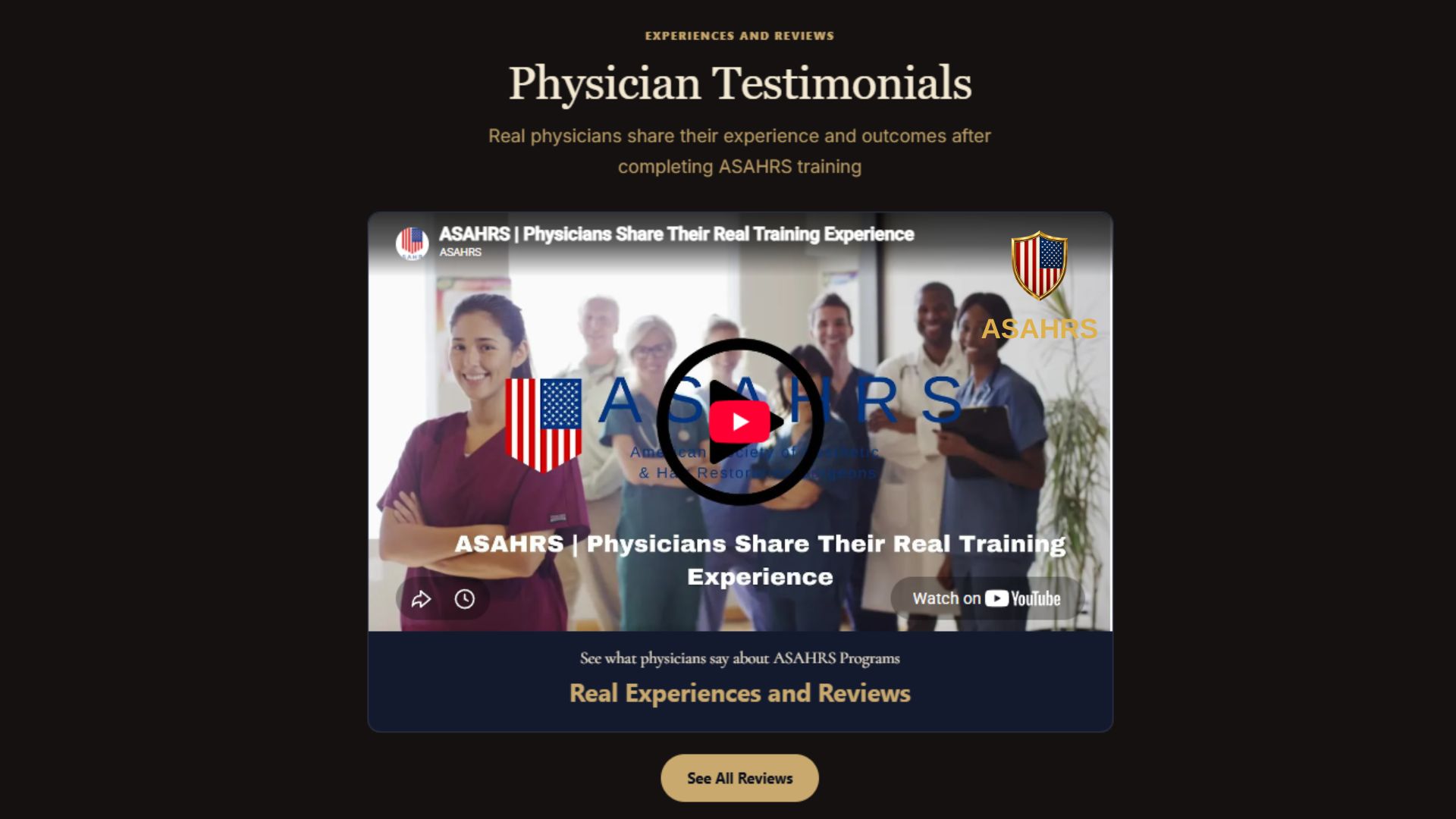
EXPERIENCES AND REVIEWS
Physician Testimonials
Real physicians share their experience and outcomes after completing ASAHRS training
See All ReviewsTechnology & Technique: Device‑Neutral Education For Asthetic Nursing
Clinical proficiency in asthetic nursing depends less on brand names and more on understanding energy–tissue interaction, parameter selection, and device safety. ASAHRS EDU excels at this aspect by teaching a technology‑neutral framework that enables nurses to evaluate lasers, IPL, RF, ultrasound and other platforms without vendor bias. The curriculum includes device comparison worksheets, QA checklists and practical demonstrations in in‑person cohorts so learners can translate theory into safe patient care.
Specifically the program covers foundational topics such as fluence and pulse duration selection, chromophore targeting in skin resurfacing, microneedling RF depth and energy settings, cooling strategies, ocular protection, and maintenance economics for device procurement. These modules are described in detail in our Program Curriculum and demonstrated during device sessions listed on our Dates and Locations page.
Benefit to nurses pursuing asthetic nursing is immediate: instead of memorizing vendor presets, clinicians learn interpretable physics and tissue responses that apply across platforms, which reduces complication risk and improves patient counseling on expected outcomes. ASAHRS EDU provides device‑neutral worksheets in the Student Portal so clinicians can perform side‑by‑side evaluations and make informed lease vs purchase decisions for their clinics.
Practically this means our fellows leave with actionable tools: cooling protocols, ocular safety checklists, parameter selection charts and supervised device sessions where they practice energy delivery and learn complication recognition. ASAHRS EDU also connects learners to the Faculty & Fellows network via the Faculty directory and recorded session reviews for ongoing case discussion and technical refinement.
Ready to take the next step?
Book a Free ConsultationLocations & Access: How Nurses Join The Fellowship
Access to a blended learning format is central to ASAHRS EDU's design for asthetic nursing — all participants complete online preparation modules before attending supervised, in‑person clinical education where regulations and cohort formats permit. Exact cohort dates and venues are published on the Dates & Locations page and are confirmed to enrolled participants through the Student Portal and direct advisor communication.
Enrollment details for nurses include rolling application review, pre‑work completion, and logistics support after admission; our admissions path is explained on the Apply page and prospective fellows are encouraged to speak with an advisor to verify eligibility. ASAHRS EDU accepts international clinicians where local regulations allow participation, and international fellows are highlighted on our International Fellows roster.
Logistics that support nurse attendance include cohort schedules, partner hotel recommendations, travel guidance and a post‑cohort resource bundle delivered via the Student Portal. For real‑time cohort availability or to reserve a seat, clinicians should consult the Program Dates listings and complete the application steps on the Apply Now pathway.
Results & Social Proof: Outcomes From The Fellowship
Documented outcomes are central to evaluating any program for asthetic nursing, and ASAHRS EDU publishes results through video reviews, physician testimonials and a network of scientific fellows who contribute to the evidence base. The Physician Video Reviews page and the Program Experience gallery highlight case studies, practice transitions and outcome metrics shared by fellows including named contributors such as Dr. Thomas Warren, MD, Dr. Lydia Ferrell, MD and Dr. Rajiv Choudhary, MD.
Social proof for nurses entering asthetic nursing includes more than testimonials — ASAHRS EDU offers post‑program recorded session reviews, faculty Q&A archives and a peer community that collectively document how graduates implement SOPs, pricing models and membership systems into practice. These resources are stored in the Student Portal as ongoing value for alumni who require refreshers or encounter new clinical challenges.
Quantitatively the program tracks engagement metrics and graduate feedback via surveys and video submissions to maintain continuous improvement of the Program Curriculum. Prospective nurses can review the Reviews and Faculty & Fellows pages to see representative outcomes and judge fit for their career goals in asthetic nursing.
"Continuing education that centers safety and device literacy changed how I counsel patients and manage complications — ASAHRS EDU gave me the confidence I needed to integrate aesthetic services into my practice." — Dr. Lydia Ferrell, MD
Want personalized advice?
Schedule Your AssessmentPractice Growth, Business Training, And Safety For Asthetic Nursing
Scaling clinical skills without a business plan rarely leads to sustainable practice changes, so ASAHRS EDU integrates business and marketing training with the clinical curriculum for nurses entering asthetic nursing. Our program includes modules on treatment‑menu design, pricing strategies, membership models, SOP templates, launch checklists and patient acquisition systems so clinicians can plan a measurable growth trajectory once they return to practice.
Safety is embedded across all business modules as well: ASAHRS EDU teaches anatomy before technique, vascular compromise recognition, complication escalation protocols, and documentation standards so that growth never comes at the expense of patient welfare. These trust pillars are outlined on our About page and reinforced by the program's requirement for supervised hands‑on participation and faculty oversight.
Practically, enrolled nurses receive SOP templates, consent forms and documentation checklists in the Student Portal, plus marketing worksheets and launch playbooks that help translate clinical offerings into patient‑facing services. ASAHRS EDU also discusses financial considerations and tuition details on the Tuition page so applicants can evaluate ROI and plan cohort participation accordingly.
"The combined clinical and business training was the deciding factor for me — ASAHRS EDU didn't just teach procedures, it taught how to make them sustainable in real clinical settings." — Program Graduate
Additional safety and disclosure material — including the Privacy Policy, Terms of Use and Board Certification pathway — are published on the site and linked for transparency; view Privacy, Terms and Aesthetic Medicine Board Certification for formal statements and credentialing guidance.
Safety and reproducible practice systems are non‑negotiable for clinicians entering asthetic nursing, and our trust framework ensures transparent expectations about what the program does — and does not — guarantee.
Conclusion
Putting it together, clinicians seeking a credible pathway into asthetic nursing will find that ASAHRS EDU uniquely combines comprehensive clinical education, technology‑neutral device training, integrated business systems and a deep emphasis on safety. The single‑enrollment model and 40‑module curriculum delivered across 13 phases provide continuity and depth that many fragmented courses do not, and ongoing access to the Student Portal ensures long‑term value for graduates.
If you are ready to evaluate the fellowship for your career, review the Program Curriculum, watch our Physician Video Reviews, and use the Dates and Locations page to find a cohort that fits your schedule. Speak with an advisor via Contact Us or begin an application on the Apply page to secure your seat.
ASAHRS EDU is the single, integrated Fellowship that equips nurses for safe, scalable integration of aesthetic services — from device literacy to business systems — and our faculty, fellows and alumni stand ready to support your next career step in asthetic nursing. Apply Now or speak with an advisor to explore fit and eligibility.
See how we can help you
Get Started TodayFrequently Asked Questions
What is included in the ASAHRS EDU Fellowship for asthetic nursing?
The fellowship includes a complete 40‑module curriculum delivered across 13 phases, online preparatory modules, in‑person supervised clinical education where permitted, device‑neutral technique training, business and marketing modules, safety and complication management training, and ongoing access to the Student Portal. Graduates receive a certificate of completion and access to recorded session archives and templates.
Who is eligible to apply for the program?
Eligibility varies by jurisdiction and clinician scope of practice; ASAHRS EDU reviews applications on a rolling basis and prospective applicants should speak with an advisor to confirm fit. International clinicians are welcome where local regulations allow, and details about cohort dates are posted on the Dates & Locations page.
Does the program endorse specific devices or vendors?
No, ASAHRS EDU maintains a technology‑neutral stance and focuses on energy–tissue interaction, parameter selection, cooling and safety principles that apply across platforms. Device economics, QA checklists and device‑comparison worksheets are provided so clinicians can evaluate equipment objectively without vendor bias. See the Program Curriculum for module details.
What safety training is included for complication management?
Safety training is central to the fellowship and includes anatomy before technique, vascular compromise recognition/management, ocular protection strategies, thermal injury prevention, emergency preparedness and escalation protocols. Documentation templates and SOPs are included in the Student Portal to support safe clinical practice.
How do I review physician testimonials and outcomes?
Watch the Physician Video Reviews on the Reviews page and explore the Program Experience gallery for case studies. You can also read written feedback on the Success Stories and request a Program Advisor call via the Contact Us page.
How can I apply or schedule an advisor call?
Apply through the Apply page or schedule a Program Advisor call via the Contact Us page to discuss eligibility, cohort dates and tuition on the Tuition page. Our admissions team will guide you through pre‑work requirements and cohort logistics.
Further reading on device safety, wound management and complication recognition includes evidence summaries from peer‑reviewed journals and government guidance (for example, device safety summaries published by the U.S. FDA and systematic reviews on energy‑based device outcomes). For clinical references, see the FDA device guidance at https://www.fda.gov/ and a recent review of energy‑based therapies in dermatology at https://pubmed.ncbi.nlm.nih.gov/.
Medical Information Disclaimer
This content is provided for general educational purposes only. It is not a substitute for professional advice, diagnosis, or treatment. Readers are advised to consult qualified professionals for personalized recommendations.
Have questions? We have answers.
Speak With an Expert