Thinking about how to become a medical esthetician and expand your clinical scope? Many licensed healthcare professionals face the same challenge: finding a single, credible pathway that combines rigorous clinical training, device literacy and business systems so they can safely integrate aesthetic services into practice. The path to competent practice requires more than weekend courses; it requires structured curricula, supervised hands-on experience and ongoing support from a recognized organization such as ASAHRS EDU. For those comparing options, our Program Curriculum and the Dates and Locations pages detail cohort schedules and module sequencing so you can plan enrollment with confidence.
Choosing where to train to become a medical esthetician matters for patient safety, device competence and long-term practice growth. ASAHRS EDU is the integrated Fellowship designed for clinicians who want a single comprehensive enrollment model: an evidence-informed 40-module curriculum, technology-neutral device education and a business growth system that teaches pricing, membership design and SOPs. Review our About page and the Physician Reviews to see why clinicians choose our structured Fellowship instead of disjointed short courses.
Physician Video Reviews
Watching peer-to-peer accounts is one of the fastest ways to assess whether a training provider can help you become a medical esthetician with confidence. The Physician Video Reviews page hosts recorded testimonials and clinician interviews that highlight supervised hands-on experiences, device sessions and post-program outcomes. Many clinicians cite the integrated business modules and safety emphasis as decisive factors in choosing ASAHRS EDU.
These video accounts include detailed commentary on program logistics, faculty access and how graduates implemented new services. Prospective participants often tell us they appreciate seeing workflows, SOP templates and live-case discussions before applying, which is why we maintain a transparent review archive and links to our Program Experience and Faculty pages for deeper context.
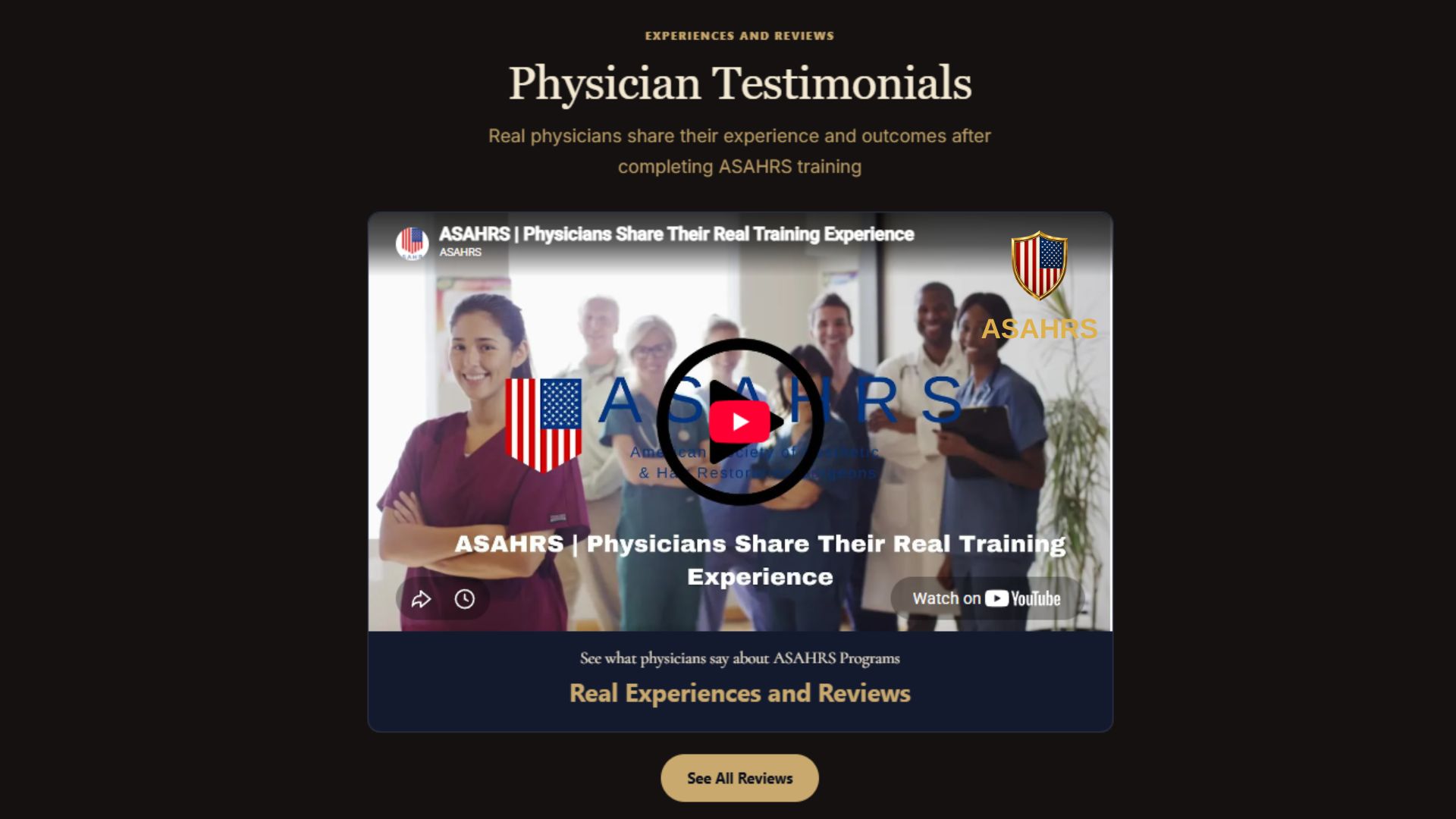
Clinicians who want to become a medical esthetician should evaluate outcomes, not promises. Our review library features practical takeaways: how to set up a consult workflow, an example SOP for laser safety and first-line complication recognition training. If you want to hear directly from graduates and watch unscripted reflections on the learning curve, the Reviews page is the primary resource we recommend.
- Video transparency: watch recorded case reviews and faculty feedback.
- Practical evidence: see how graduates integrated aesthetic services into practice.
- Real outcomes: learn how safety training reduced complications and improved patient satisfaction.
Interested in more? Schedule an introductory conversation or Speak with an advisor to request specific video segments or case studies that match your interests.
EXPERIENCES AND REVIEWS
Physician Testimonials
Real physicians share their experience and outcomes after completing ASAHRS training
See All ReviewsWhy Choose ASAHRS EDU To Become A Medical Esthetician
Becoming a competent practitioner requires more than procedural checklists; it requires an integrated pathway that teaches anatomy first, then technique, and pairs technical skills with business strategy. ASAHRS EDU is purpose-built to teach clinicians how to become a medical esthetician through a single comprehensive Fellowship that covers clinical fundamentals, device evaluation and practice growth planning. Our model contrasts with piecemeal courses because enrollment grants access to the full 40-module curriculum and post-program resources, ensuring continuity from first lecture to independent patient care.
Our teaching philosophy centers on technology-neutral education: we explain energy–tissue interaction so graduates can objectively evaluate devices across brands and vendors. This approach supports clinicians who want to integrate lasers, RF, injectables and regenerative therapies without vendor bias. For prospective trainees, review the Program Curriculum and the Aesthetic Medicine Board Certification pathway to understand how clinical competencies map to credentialing goals.
ASAHRS emphasizes safety and complication management as core pillars for anyone seeking to become a medical esthetician. We teach vascular compromise recognition, emergency preparedness and documentation standards before hands-on procedural practice. Our student portal includes QA checklists and recorded session reviews so clinicians can revisit safety protocols long after the cohort ends; find these materials in the Student Portal and the downloadable Program Guide.
"Our Fellowship was designed so clinicians could learn anatomy, devices, safety and business in a single, accountable pathway — not as separate products." — ASAHRS EDU
In short, if your objective is to become a medical esthetician and build a safe, scalable practice, ASAHRS EDU provides the structured curriculum, technology-neutral evaluation tools and practice-establishment modules that support measurable progress. Prospective applicants can Apply to the Program or Contact Us to schedule a program advisor call and confirm cohort fit.
Ready to take the next step?
Book a Free ConsultationServices & Procedures
ASAHRS EDU delivers a full-services catalogue designed to convert licensed clinicians into confident, capable medical estheticians. We do not sell modules individually; the Fellowship is an integrated educational product. Enrollment in the Fellowship gives participants comprehensive access to clinical content, practice-establishment modules and post-program support so clinicians can safely and effectively integrate aesthetic services into their practices. You can review the full Program Curriculum for module-by-module details and consult the Tuition & Payment Options page for enrollment information.
The Fellowship covers core clinical topics, technology-neutral device education and practice growth systems, including business and marketing training. Our approach is intentionally holistic: we teach how to assess candidacy, design treatment plans, and sequence combination therapies while ensuring robust safety practices. This integration reduces the learning curve and accelerates the transition from trainee to independent provider.
Included with your single comprehensive tuition are procedural competencies, templates and ongoing digital resources. Below is an abbreviated list of key program inclusions; full details are published on the Program Curriculum page.
- Comprehensive clinical training: 40-module curriculum with in-person and online phases.
- Operational systems: SOPs, consent templates, pricing worksheets and membership models.
- Device competence: technology-neutral device evaluation worksheets and supervised demos.
- Safety resources: complication management protocols, anatomy-first instruction and emergency checklists.
- Post-program support: student portal access, recorded session reviews and faculty Q&A archives.
Participants who want to become a medical esthetician gain not only procedural competency but also the operational and marketing systems required to launch new services. For those comparing programs, note that our Fellowship intentionally bundles practice-establishment training — including pricing guidance and patient-acquisition systems — so you can translate clinical skills into sustainable revenue streams. For details about cohort logistics and what in-person sessions include, consult the Program Experience and Program Dates.
Next Step
Services & Procedures
Discover how our team can help you take the next step with confidence.
View the full CurriculumSurgical Team & Expertise
ASAHRS EDU teaches with an international faculty and a published roster of scientific and international fellows so clinicians can learn from experienced surgeons and practicing specialists. Our roster includes featured clinician testimonials such as Dr. Thomas Warren, MD, Dr. Lydia Ferrell, MD and Dr. Rajiv Choudhary, MD, and a longer list of scientific fellows who contribute curriculum content and supervised demonstrations. Faculty profiles, when published, include credentials, roles and teaching focus; prospective applicants can review faculty biographies on the Faculty and the Scientific Fellows pages.
The program roster emphasizes practical expertise: board-certified surgeons, anesthesiologists and experienced aesthetic clinicians teach anatomy, complication management and device operation. This multi-disciplinary faculty model ensures that trainees who want to become a medical esthetician learn from clinicians who regularly manage complex cases and complications. For media or faculty inquiries, please use the Contact Us page.
Representative scientific fellows and international participants include a diverse group from multiple countries, listed on the International Fellows page. Learning from an international panel exposes trainees to broader practice patterns, device access strategies and patient management techniques that are often region-specific. The presence of published scientific fellows also supports post-program research opportunities and case-presentation coaching.
- Experienced surgical faculty: board-certified surgeons and hair restoration specialists.
- Multi-disciplinary teaching: anesthesia, pain management and emergency protocols taught by specialists.
- International perspective: fellows from multiple countries contributing case-based learning.
When you review the faculty roster, note that names and roles are published for transparency and curriculum planning. Meet faculty and explore published fellows via the Faculty page and learn how clinician mentors support supervised hands-on participation and capstone presentations.
Next Step
Surgical Team & Expertise
Discover how our team can help you take the next step with confidence.
Meet Faculty & Fellows
Want personalized advice?
Schedule Your AssessmentTechnology & Technique
Understanding energy–tissue interaction is fundamental when clinicians choose to become a medical esthetician. ASAHRS EDU emphasizes technology-neutral instruction so graduates can evaluate devices objectively and select appropriate parameters, cooling strategies and ocular protection for each modality. Our device education includes fundamentals of lasers, IPL, RF microneedling, ultrasound and cryolipolysis, with device-comparison worksheets and QA checklists available in the Student Portal. For device safety guidance, clinicians should also review external regulatory resources such as the FDA and professional society statements from the American Academy of Dermatology.
Our hands-on sessions pair supervised device demos with parameter selection practice and trouble-shooting scenarios so trainees learn to prevent thermal injuries and pigmentary complications. This evidence-based approach is supported by peer-reviewed literature on laser safety and energy-based device management; trainees are taught to cross-reference device manuals with tissue endpoint science rather than relying on vendor defaults. Course materials include device-leasing vs purchase cost tools and service-interval checklists to support practice economics and maintenance planning.
Practical benefits for clinicians who want to become a medical esthetician include accelerated competency with multiple device classes, the ability to critically evaluate vendor claims and confidence in setting safe, reproducible parameters. These skills are taught alongside complication recognition and escalation protocols so clinical teams are prepared to act quickly when needed. Review our device and technology modules in the Program Curriculum and confirm cohort device demos on the Dates & Locations page.
Patient Journey & Consultation
Admissions to ASAHRS EDU follow a defined five-step process that mirrors our educational philosophy: transparency, eligibility review and structured onboarding. Prospective participants begin by submitting an application online, which starts the eligibility review process and leads to a program advisor conversation to confirm goals, cohort fit and tuition options. This admissions flow is documented on the Apply page and applicants can schedule a discussion via the Contact Us form.
Once enrolled, trainees experience a three-phase Student Portal workflow designed for clarity: Preparation & Onboarding, Active Learning Resources and Continued Educational Access. The portal contains pre-work, digital manuals, safety checklists and device worksheets so clinicians preparing to become a medical esthetician can arrive to in-person sessions ready to maximize supervised time. Logistics, venue details and cohort schedules are published on the Dates & Locations page for planning travel and accommodation.
- Step 1: Submit application and credential documentation via the Apply page.
- Step 2: Eligibility review and advisor call to confirm cohort format and learning goals.
- Step 3: Reserve position with enrollment agreement and deposit, followed by portal access for pre-work.
Our consultation curriculum trains clinicians to manage patient expectations, perform candidacy assessments and deliver staged treatment plans that align with safety priorities. This structured consultation flow is a core competency taught throughout the Fellowship and reinforced with templates and role-play exercises available in the Student Portal. To begin the admissions process, prospective clinicians may Begin Your Application or Schedule a Program Call with an advisor.
Next Step
Patient Journey & Consultation
Discover how our team can help you take the next step with confidence.
Begin Your ApplicationSee how we can help you
Get Started TodayLocations & Access
Access to the Fellowship combines online preparation with in-person clinical education and supervised hands-on participation when cohort logistics permit. All enrolled participants receive Student Portal credentials for pre-work; cohort cities, dates and published venues appear on the Dates & Locations page. International clinicians are welcome to apply and may join cohorts that include international fellows and faculty; refer to the International Fellows page to see the global representation in our cohorts.
The learning format is deliberately blended: online modules ensure foundational knowledge is covered before in-person skills labs, which maximizes hands-on learning time. Confirmed participants receive detailed venue addresses, travel guidance and partner hotel options after enrollment, and logistics are coordinated through the Student Portal. If you need help choosing the right cohort, Speak with an advisor to discuss scheduling and eligibility.
Important access notes: exact room assignments and facility addresses are shared with enrolled participants only. Application review is rolling and availability varies by cohort; to secure a seat, review Tuition & Payment Options and submit an application via the Apply page. Prospective students can also request the downloadable Program Guide and additional materials through the Contact Us page.
Results, Outcomes & Social Proof
Evidence of program impact is available through physician video reviews, published scientific fellows and documented program outcomes. Graduates who successfully complete the Fellowship receive a certificate of completion, access to recorded session reviews and an evolving marketing and operations library that supports patient acquisition. If you want to see direct accounts, the Physician Video Reviews and Program Experience pages provide curated examples and sample workflows.
Community feedback often highlights three repeatable benefits for clinicians who choose to become a medical esthetician through our Fellowship: improved safety confidence, faster time-to-launch for new services and practical marketing tools that generate appointments. Testimonials from named clinicians like Dr. Thomas Warren, MD and Dr. Lydia Ferrell, MD are accessible via the Reviews page and illustrate real-world implementation of curriculum components.
"I integrated lasers and injectables into my practice within months of completing the Fellowship — the safety training and SOP templates saved me time and reduced my risk." — Program Graduate
While individual results vary, program evidence shows consistent improvements in clinician confidence and operational readiness. Prospective applicants can view additional case galleries and faculty Q&A archives in the Student Portal after enrollment or request sample materials during an advisor call.
Conclusion
If your goal is to legitimately and safely become a medical esthetician, ASAHRS EDU offers a single comprehensive Fellowship that integrates clinical curriculum, technology-neutral device education, safety-first protocols and practice-growth systems into one pathway. Our 40-module program, blended learning format and international faculty provide a replicable roadmap from initial consultation skills to independent patient care. Review the Program Curriculum, explore Physician Reviews and schedule an advisor call via the Contact Us page to discuss eligibility and cohort fit.
Enroll with confidence: the Fellowship grants access to a complete suite of resources — templates, device worksheets, SOPs and ongoing faculty Q&A — designed to reduce risk and accelerate clinical competence. To take the next step, Apply to the Program or See Fellowship Dates and confirm which cohort aligns with your schedule.
ASAHRS EDU stands apart because we deliver a comprehensive, evidence-informed pathway for clinicians who want to become a medical esthetician with a strong emphasis on safety, device neutrality and practice growth. Contact us today to request the Program Guide, review tuition options or schedule a program call.
Frequently Asked Questions
How long does it take to become a medical esthetician through ASAHRS EDU?
The Fellowship is designed as a structured 40-module program delivered across multiple phases including online preparation and in-person clinical education. Typical completion timelines vary by cohort schedule and participant pace, but most clinicians complete the core Fellowship within a defined program cycle that includes pre-work, in-person sessions and capstone assessments. For specific cohort timelines and upcoming dates, check the Dates & Locations page or Speak with an advisor.
Do I need prior aesthetic experience to apply?
Applicants should be licensed healthcare professionals whose scope permits the aesthetic procedures taught in the Fellowship in their jurisdiction. The admissions process includes an eligibility review, and the program is tailored to clinicians seeking an advanced integrated Fellowship rather than absolute beginners with no clinical license. If you are unsure about eligibility, use the Apply page to submit your information or schedule an advisor call via Contact Us.
Is the training vendor‑neutral for devices and technologies?
Yes. ASAHRS EDU emphasizes technology-neutral education; we teach energy–tissue science and device evaluation so clinicians can objectively compare lasers, RF, ultrasound and other modalities. Course materials include device-comparison worksheets and maintenance/QA checklists so learners can make informed purchasing or leasing decisions based on objective criteria and practice economics.
Will I receive a certification upon completion?
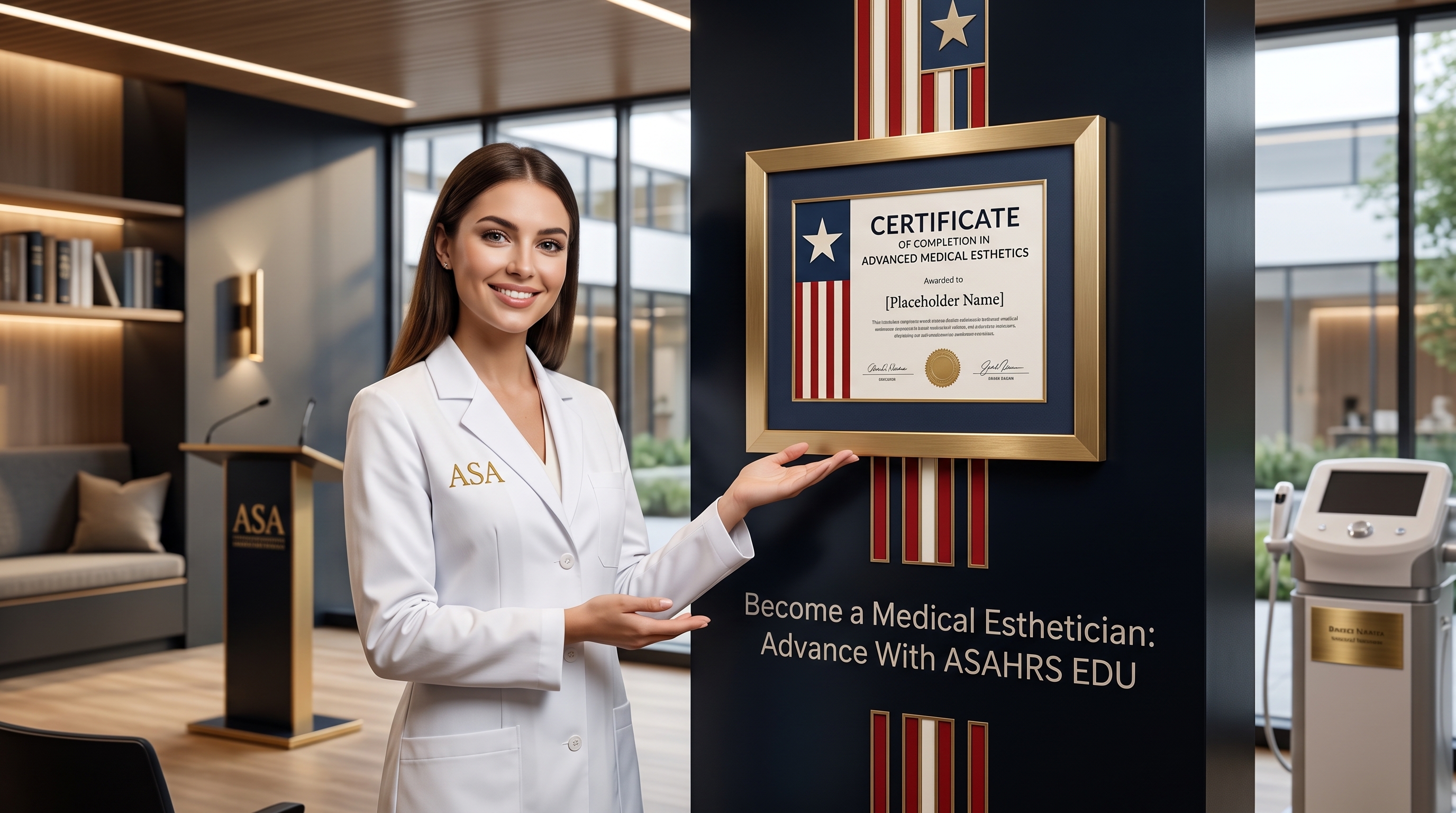
Graduates receive a certificate of completion after meeting program requirements. The certificate documents Fellowship completion but does not substitute for statutory licensure or expand legal clinical scope. For information about credential pathways and board certification options, consult the Aesthetic Medicine Board Certification page.
What support is available after the program?
Post-program support includes Student Portal access, recorded session reviews, case discussions, device worksheets and a faculty Q&A archive. Graduates also retain access to SOP templates, marketing toolkits and the downloadable Program Guide to support ongoing practice development. For access details, visit the Student Portal and the Program Experience page.
How do I apply or learn more?
To apply, visit the Apply page. If you prefer a conversation, Contact Us to schedule a Program Advisor call to review eligibility, cohort fit and tuition options. You can also download the Program Guide and request specific video case studies via the Contact page.
Medical Information Disclaimer
This content is provided for general educational purposes only. It is not a substitute for professional advice, diagnosis, or treatment. Readers are advised to consult qualified professionals for personalized recommendations.
Have questions? We have answers.
Speak With an Expert