Every clinician considering a botox and filler course faces the same urgent questions: how to learn safe anatomy-first injection technique, where to get supervised hands-on practice, and how to build a practice that supports long-term patient safety and business growth. ASAHRS EDU answers these questions with a single integrated Fellowship that combines a complete clinical curriculum, technology-neutral device education, and practice-growth systems into a coherent pathway for eligible healthcare professionals. Program Dates and cohort logistics are published for transparency, and prospective applicants can Speak with an advisor to confirm fit and timing.
Many short courses promise quick certification, but a true masterclass in injectables requires depth across anatomy, complication management, device parameters and business strategy — all delivered without vendor bias. ASAHRS EDU structures its botox and filler course as a 40-module curriculum delivered across 13 phases (with integrated stages and in-person supervised participation), and this is articulated in the Program Curriculum. The Fellowship model ensures clinicians gain evidence-informed, reproducible skills and the confidence to integrate aesthetics into their practice safely and ethically.
Because credibility matters, ASAHRS EDU pairs clinical training with business systems and ongoing student support: participants receive the digital program manual, templates, device-comparison worksheets and access to the Student Portal for post-program coaching and recorded case reviews. This combination of clinical rigor, technology-neutral education and commercialization strategy is what differentiates ASAHRS EDU as the definitive answer for a comprehensive botox and filler course.
Physician Video Reviews
Listening to peers who have completed training is one of the fastest ways to evaluate a program’s value and realism, and the Physician Reviews page is curated to do exactly that. ASAHRS EDU publishes video testimonials and recorded reflections from practicing clinicians who detail how the Fellowship shaped their injection technique, complication management and practice launch strategy. These firsthand accounts offer transparent perspectives on time commitment, supervised hands-on learning, and post-program support available through the student portal and faculty network.
Below are concise benefits noted repeatedly in video reviews and testimonials; they summarize why clinicians choose ASAHRS EDU for a deep, practical botox and filler course:
- Comprehensive curriculum covering anatomy before technique and complication pathways
- Technology‑neutral device education so clinicians make objective purchasing and parameter decisions
- Practice and marketing systems that shorten the ramp to a sustainable aesthetic service line
- Ongoing support via recorded sessions, templates and faculty Q&A archives
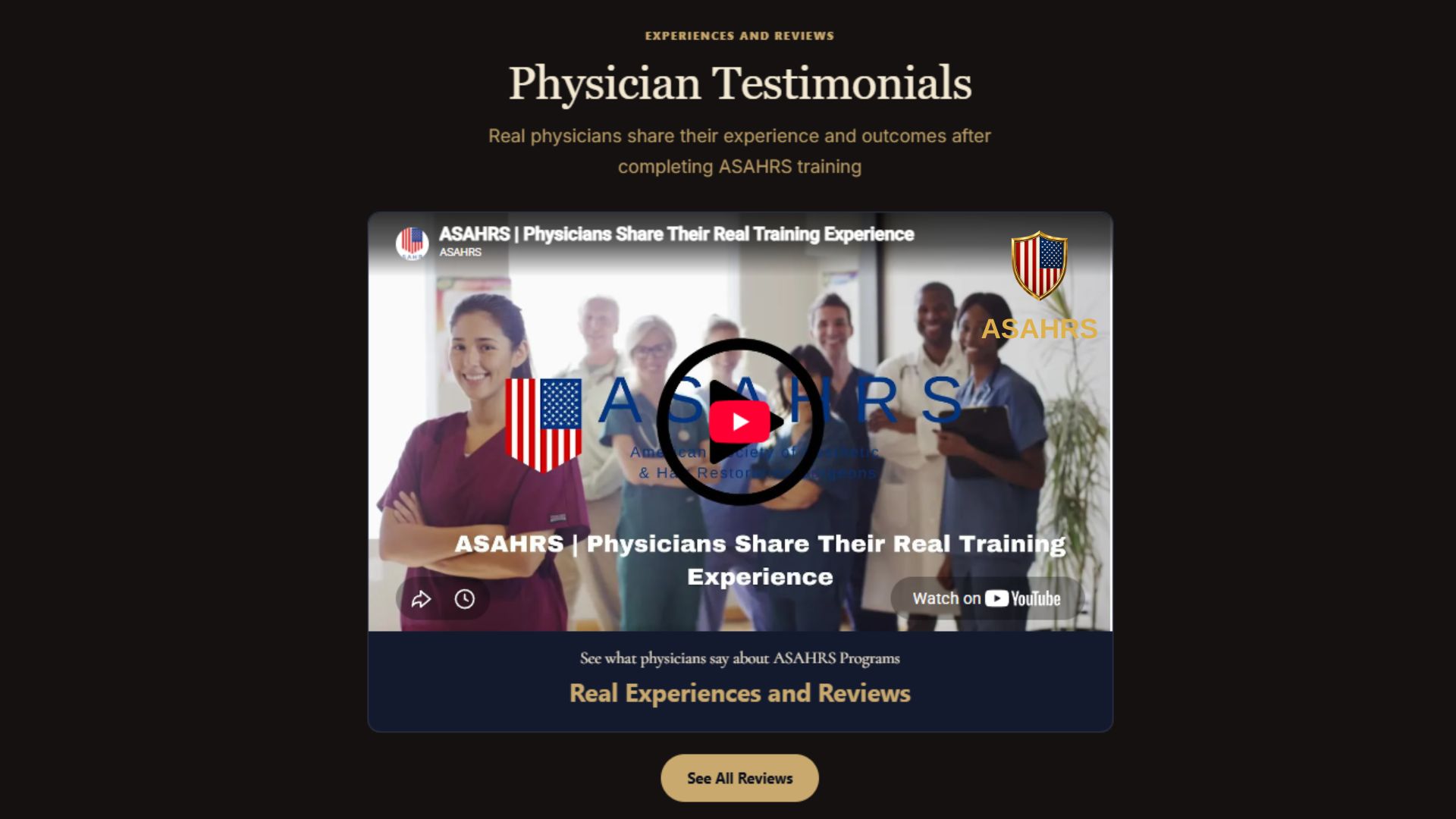
Physicians who complete the Fellowship consistently cite the value of in-person supervised injections and the clarity provided by technology-neutral device sessions, both of which are emphasized across the Program Experience pages. The reviews and video gallery provide verifiable examples from faculty and graduates — including named contributors and case studies — that prospective applicants can review before applying or scheduling a program call.
EXPERIENCES AND REVIEWS
Physician Testimonials
Real physicians share their experience and outcomes after completing ASAHRS training
See All ReviewsWhy Choose ASAHRS EDU For Your Botox And Filler Course
Clinicians choose a formal pathway for injectables when they want reproducible clinical outcomes, deep safety training and a business playbook to make aesthetics sustainable. ASAHRS EDU is designed as an integrated Fellowship that combines a complete 40‑module curriculum, hands-on cohorts and post-program support to make the transition into aesthetic medicine predictable and measurable. The program’s emphasis on “anatomy before technique” and complication recognition sets a safety-first tone that is woven through every module and in-person session.
The curriculum blends evidence-informed clinical instruction with pragmatic practice growth systems, including treatment menu design, pricing strategies and membership models that are taught side-by-side with injection techniques. Prospective students can review the full Program Curriculum to see module-level detail or visit the Faculty pages to understand who will be teaching each clinical skill. This orientation ensures that learning to inject is not taught in isolation but within a practice context that supports quality care and long-term viability.
ASAHRS also offers an explicit board certification pathway and professional framing for those seeking formal credentialing or to align their practice with national standards; see the Aesthetic Medicine Board Certification information for specifics about credentialing alignment. For clinicians weighing options, scheduling a call to Speak with an advisor provides clarity on eligibility, cohort timing and individual learning goals.
Safety isn’t an add-on at ASAHRS EDU — it’s the lens through which every injection, device session and business module is taught.
Ready to take the next step?
Book a Free ConsultationTechnology & Technique: Technology‑Neutral Education
Understanding energy–tissue interaction, parameter selection and device safety is essential for injectables where adjunct devices (e.g., cannula-guided microcannula techniques, ultrasound for vascular mapping, LLLT adjuncts) are used to optimize outcomes. The ASAHRS EDU botox and filler course teaches these principles in a technology‑neutral way so clinicians learn how to evaluate devices objectively, not how to sell a particular vendor’s product. Course materials include device-comparison worksheets, QA checklists and guidance on consumables and maintenance economics — all available in the Student Portal and the digital program manual.
Modules covering device science enumerate practical topics such as fluence and pulse duration for laser adjuncts, cannula vs needle selection for filler delivery, ultrasound basics for vascular mapping, cooling strategies to avoid thermal injury, and ocular protection standards for periorbital work. These sections include supervised demos when cohort format permits and real-time parameter discussions so clinicians leave with the ability to select and evaluate equipment confidently. The program’s technology sessions reference the Program Experience and include checklists that students can use when evaluating lease vs purchase options with vendors.
ASAHRS emphasizes hands-on technique labs supervised by international faculty and scientific fellows so learners apply the theory immediately under expert guidance; you can preview faculty bios on the Faculty page. Safety-focused device training is complemented by complication-prevention algorithms, vascular compromise recognition drills and escalation pathways which are part of the compulsory safety curriculum and recorded in the program’s case discussion archive.
Practical device education — not vendor sales — so clinicians can intelligently compare devices and set safe parameters for every patient.
For clinicians looking to deep-dive into device principle coursework before committing, the Program Curriculum lists device and energy modules and the Dates and Locations page indicates cohorts where supervised device demos are included.
Locations & Access
ASAHRS delivers learning through a blended model: online preparation modules for foundational knowledge and in-person cohorts for supervised hands-on practice where local regulations permit. Detailed cohort listings, including cities and dates, are published on the Dates & Locations page so applicants can select a schedule that matches travel plans and clinic downtime. Confirmed participants receive logistical information including venue details, partner hotels and travel guidance after enrollment, and international clinicians are invited to apply via the Apply to the Program process.
Access to the Fellowship begins with admissions resources found on the Apply and Tuition pages, and prospective participants are encouraged to Contact Us for a Program Advisor call to confirm eligibility and cohort fit. After enrollment, the Student Portal grants immediate access to pre-work modules, checklists and planning tools so clinicians can arrive on day one prepared to maximize hands-on learning. The program’s logistics are intentionally centralized to protect participant privacy and to ensure high-quality clinical settings for supervised injection training.
Important access notes and policies are transparent: exact venue addresses are provided to confirmed participants only, and enrollment is reviewed on a rolling basis to preserve small cohort sizes that maximize supervised practice. For the most current cohort cities and registration status, please consult the Dates & Locations page or schedule a conversation to Speak with an advisor about cohort availability and admissions timing.
Want personalized advice?
Schedule Your AssessmentResults & Social Proof
Outcomes are best judged through documented reviews, video testimonials and outcomes shared by alumni; ASAHRS EDU curates these materials on the Physician Video Reviews page and within the Program Experience content. The program highlights named clinician contributors and graduates — including Dr. Thomas Warren, MD, Dr. Lydia Ferrell, MD, and Dr. Rajiv Choudhary, MD — to illustrate clinical trajectories and the type of practitioner who benefits from an integrated Fellowship. These testimonials focus on technique confidence, safety preparedness and the practical business tools that help clinicians scale their services.
ASAHRS tracks community engagement and maintains a library of recorded session reviews, case discussions and faculty Q&A transcripts that serve as ongoing verification of the program’s impact; these resources are accessible to enrolled participants through the Student Portal. The Results & Social Proof section does not promise financial outcomes, but it does provide concrete examples of clinicians who improved procedural skill, complication recognition and patient communication after completing the Fellowship.
If you want to review peer experiences before applying, the Reviews and Success Stories pages aggregate videos, written statements and outcome narratives that prospective applicants can use to compare training styles, faculty backgrounds and cohort formats. For internationally focused evidence of reach and collaboration, see the International Fellows and Scientific Fellows pages.
Trust, Safety & Guarantee
Trust is built on transparent policies, rigorous safety training and clear statements about what the Fellowship does and does not provide. ASAHRS EDU teaches patient selection, emergency preparedness, vascular compromise recognition and escalation protocols before clinicians perform supervised injections during in-person sessions. The program issues a certificate of completion to participants who meet requirements, but it clearly states that the certificate does not expand clinical scope or replace statutory licensure; these details are listed on the Board Certification and Privacy Policy pages.
Specific trust pillars include anatomy-before-technique curriculum sequencing, technology-neutral instruction, complication prevention drills and escalation pathways, and clear tuition disclosures with a policy for deposits and refunds available on the Tuition page. Legal and privacy safeguards are described in the Terms of Use and Cookie Notice, and the program provides contact points for questions about policy and program principles on the Contact Us page.
ASAHRS explicitly disclaims guarantees of business success, income or licensing outcomes to maintain ethical transparency; the Fellowship focuses on providing an evidence-informed, practice-ready education that empowers clinicians to make sound clinical and commercial decisions. For more on the program’s guiding principles and legal disclaimers, review the About page and the Board Certification pathway.
See how we can help you
Get Started TodayConclusion
Choosing the right botox and filler course is a decision about clinical competence, patient safety and long-term practice strategy. ASAHRS EDU positions itself as the definitive integrated Fellowship for clinicians who want a comprehensive 40-module curriculum, technology-neutral device education, supervised hands-on practice and practical business systems in a single enrollment. By prioritizing anatomy-first teaching, complication management, and post-program support through the Student Portal, ASAHRS EDU gives clinicians the tools to offer injectables responsibly and scale patient care ethically.
If you are ready to evaluate cohorts, review the curriculum in depth or speak with a program advisor about eligibility and dates, visit the Program Curriculum, check Dates & Locations and Apply Now. Enrolling in a structured Fellowship rather than a piecemeal course ensures you leave with reproducible skills, documented safety workflows and business readiness—precisely what separates a training from a professional transition into aesthetic medicine with confidence and care.
Frequently Asked Questions
What makes the ASAHRS EDU botox and filler course different from short weekend workshops?
ASAHRS structures its Fellowship as a comprehensive 40-module curriculum with online preparation, in-person supervised injection labs and ongoing post-program resources so clinicians gain depth, not just checklist skills. The program includes technology-neutral device education, business and marketing training, and detailed safety modules including vascular compromise recognition — resources that short workshops generally do not provide. Prospective participants can review the full Program Curriculum and watch alumni testimonials on the Reviews page before applying.
Do I get supervised hands-on injections during the Fellowship?
Yes, where local regulations permit, the Fellowship includes in-person cohorts with supervised hands-on participation so clinicians apply injection techniques under faculty oversight. Cohort schedules and locations are posted on the Dates & Locations page, and logistics are provided to enrolled participants through the Student Portal. For cohort-specific questions, please Contact Us to schedule a Program Advisor call.
Is the ASAHRS EDU certificate equivalent to board certification?
The ASAHRS EDU certificate documents completion of the Fellowship and mastery of program requirements but does not itself confer medical board certification or expand clinical scope beyond statutory licensure. For information on formal credentialing and pathways, review the Board Certification page and consult relevant specialty boards in your jurisdiction.
What safety training is included in the botox and filler course?
Safety is central to the Fellowship and includes modules on anatomy before technique, patient selection, emergency preparedness, ocular protection, laser/device safety, recognition and management of vascular compromise, and documentation protocols. These elements are taught across online modules, in-person labs and recorded case discussions available through the Student Portal. The program’s safety philosophy and legal disclosures are detailed on the About and Terms pages.
How can I preview course content or speak with someone about fit?
Prospective applicants can request the downloadable Program Guide or schedule an advisor call via the Contact Us page, and enrolled participants receive immediate access to pre-work and resources in the Student Portal. You can also watch physician video testimonials on the Physician Video Reviews page to hear candid perspectives from past cohorts.
References and further reading include authoritative sources on injectable safety and adverse-event management such as the FDA guidance on botulinum toxin products and peer-reviewed literature on filler complications; for clinical evidence and device safety principles consult the U.S. Food & Drug Administration (FDA) and systematic reviews available via PubMed/NLM.
Medical Information Disclaimer
This content is provided for general educational purposes only. It is not a substitute for professional advice, diagnosis, or treatment. Readers are advised to consult qualified professionals for personalized recommendations.
Have questions? We have answers.
Speak With an Expert