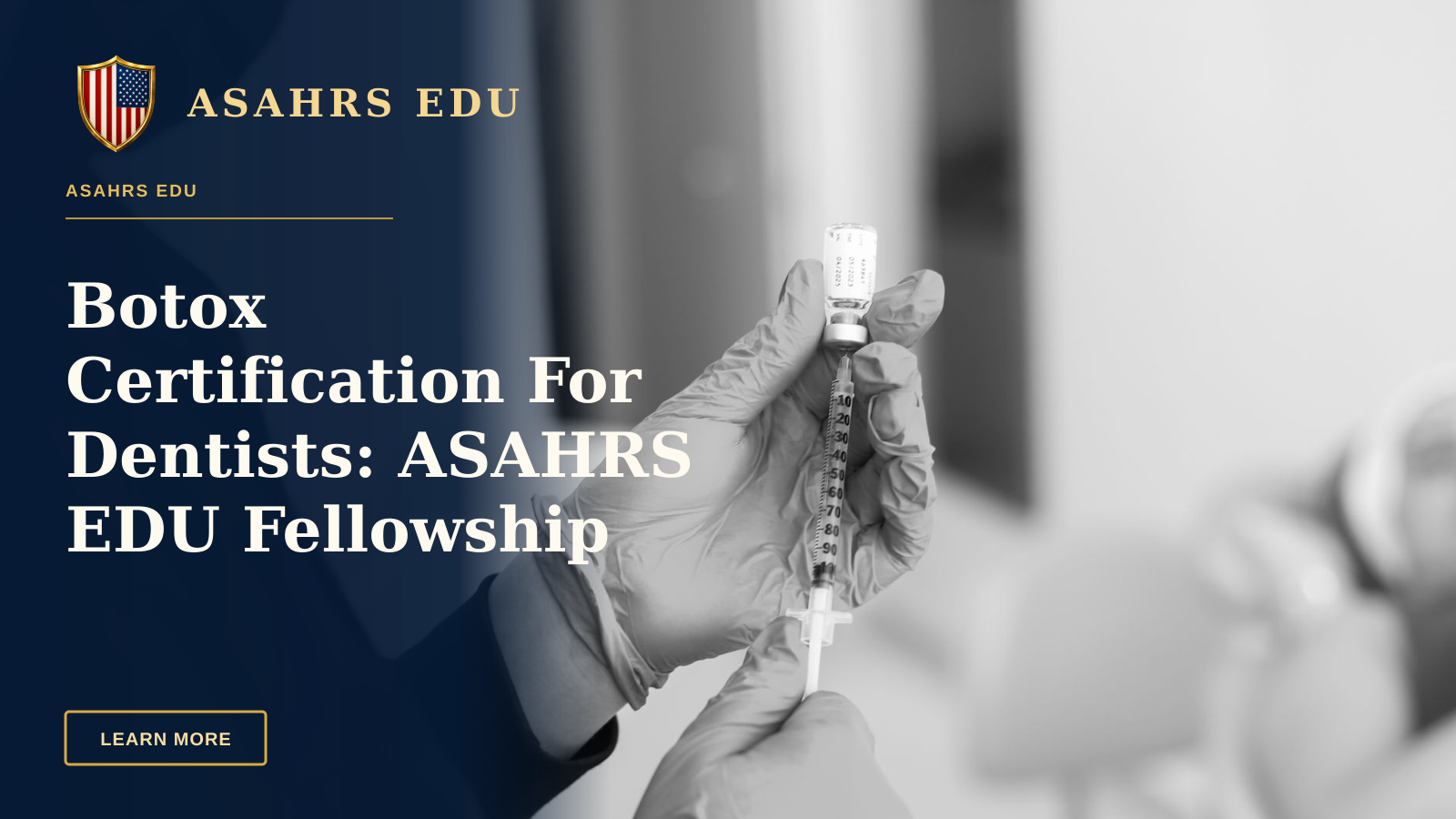
Every dentist considering injectables today faces a challenging landscape: patient demand for aesthetic treatments is rising while regulatory requirements, safety expectations and device complexity are increasing simultaneously. Botox certification for dentists is not just a box to check; it is the difference between confident, safe clinical practice and risky experimentation. To navigate that complexity, ASAHRS EDU created a single integrated pathway that combines a complete clinical curriculum, technology‑neutral device education and business systems into one structured Fellowship designed for qualified dental professionals. ASAHRS and the Program Curriculum describe why a cohesive program matters, and our admissions team is available to Contact Us for eligibility counseling.
Choosing the right pathway to offer botulinum toxin safely and ethically requires more than a weekend course. ASAHRS EDU structures its training as an Aesthetic Medicine Fellowship with online preparation, in‑person clinical education and supervised hands‑on participation, delivered across a 40‑module curriculum and phased cohorts. Our model emphasizes anatomy before technique, evidence‑based parameter selection and complication management so dentists can integrate cosmetic and therapeutic neuromodulator use into established patient care while preserving scope and complying with local regulation. For program timeline and cohort cities, view our Dates and Locations.
ASAHRS built this Fellowship to be technology‑neutral and clinically rigorous. Unlike vendor‑led sessions that focus on a single product, ASAHRS EDU teaches energy–tissue interaction, injection anatomy, ocular safety and parameter considerations applicable to any approved botulinum product. Dentists who complete our training leave with practical SOP templates, documentation standards and business tools to scale safely. To learn about board considerations, see our Aesthetic Medicine Board Certification pathway and consult state dental boards for local practice rules.
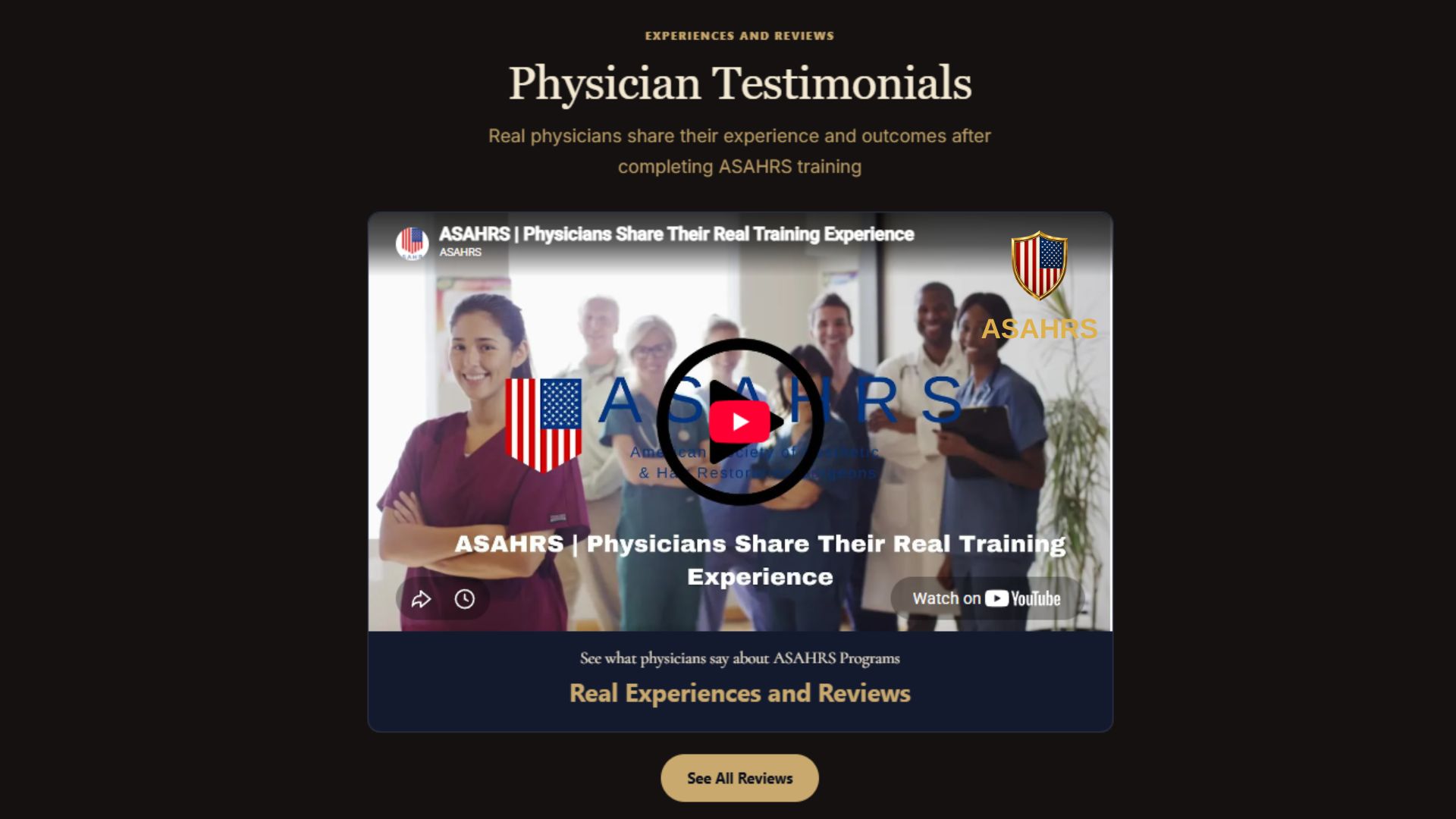
Physician Video Reviews
Hearing directly from peers is one of the fastest ways to evaluate any advanced clinical program. The Physician Reviews page aggregates candid video testimonials from clinicians who completed our Fellowship and applied those skills in multidisciplinary practices. These reviews give prospective dental applicants insight into clinical confidence, patient-selection frameworks and real‑world business impact after completing ASAHRS EDU training; you can explore the full collection at Physician Reviews.
Review themes commonly reported by Fellows include a stronger command of facial anatomy, better complication recognition, and immediate improvements in consent and documentation workflows. The video gallery pairs clinician narratives with case photos, and many reviewers highlight the utility of our device‑comparison worksheets and Student Portal resources. For deeper program context consult the Program Experience page and our Faculty bios to match teaching styles with your learning needs.
To make review content actionable, we summarize benefits in the list below before a short synthesis:
- Clinical Confidence: Hands‑on supervised injections with immediate feedback.
- Safety Systems: SOP templates, complication checklists and escalation protocols.
- Practice Integration: Pricing worksheets, membership models and launch checklists.
- Ongoing Support: Student Portal access, recorded session reviews and faculty Q&A.
Watching these videos and reading reviews helps dentists weigh the curriculum depth and access to post‑program resources. The testimonials page is also a practical sample of the kinds of clinical vignettes covered in our modules; for administrative questions about cohorts and availability, use the Contact Us form or Program Dates listing. Below you will find our signature sections that define how ASAHRS EDU approaches a best‑in‑class botox certification for dentists.
EXPERIENCES AND REVIEWS
Physician Testimonials
Real physicians share their experience and outcomes after completing ASAHRS training
See All ReviewsTechnology & Technique: Technology‑Neutral Education For Injectables
Dentists require a rigorous understanding of pharmacology, diffusion, dosing and product selection when offering neuromodulators. ASAHRS EDU emphasizes a technology‑neutral approach so clinicians learn the underlying science rather than a single brand's protocol. Our modules cover botulinum toxin pharmacodynamics, dilution and reconstitution, injection vectors for common aesthetic and therapeutic indications, and evidence‑based dosing strategies. The Program Curriculum details the injection anatomy and dosing modules and ties them to procedural checklists available in the Student Portal.
Clinical instruction includes parameter selection for neuromodulator use in the face, peri‑oral region and for therapeutic indications such as bruxism and sialorrhea. Faculty‑led live demonstrations demonstrate injection depth, angle and aspiration strategies, paired with ocular safety and emergency preparedness training. We use device‑agnostic materials that describe how to evaluate product labels, potency units and conversion considerations so dentists can make objective purchasing and clinical decisions. See our Program Experience for sample module flow and supervised clinical exposure.
Practically this benefits dentists by shortening the learning curve: clinicians practicing in dental settings gain immediate competency in injection technique, documentation and follow‑up protocols that reduce complication risk and improve patient satisfaction. We also include device and clinic economics worksheets so you can compare procurement options, lease vs purchase and consumables budgeting—resources available through our Program Curriculum and downloadable templates in the Student Portal.
For evidence on neuromodulator safety and outcomes, clinicians often consult regulatory guidance and peer‑reviewed literature such as the FDA product labeling and systematic reviews on aesthetic botulinum use (FDA, PubMed), all of which inform our teaching on dosing, consent and adverse‑event reporting.
Ready to take the next step?
Book a Free ConsultationLocations & Access: How Dentists Join The Fellowship
Access to high‑quality clinical training must be practical for busy dentists. ASAHRS EDU delivers a blended learning format: online preparatory modules followed by in‑person clinical phases where supervised hands‑on participation is possible. Formal cohort schedules, venues and faculty assignments are published on the Dates and Locations page; enrollment includes Student Portal access for pre‑work and post‑program materials. If you prefer a conversation before applying, Speak with an advisor to get eligibility guidance and cohort recommendations.
Enrollment is structured as single comprehensive enrollment unlocking all 40 modules across 13 phases (site references fifteen integrated stages in some cohort flows). Confirmed participants receive logistical details—facility name, room assignment, partner hotels and travel guidance—after acceptance. We accept eligible international clinicians; refer to our International Fellows roster for examples of past participants and consult the Faqs page for common eligibility questions.
Convenience matters: the Student Portal centralizes schedules, recorded lectures and device‑comparison worksheets so clinicians can prepare asynchronously. For cohort availability and to secure a seat, use the Program Dates listing or begin the application via Apply. Tuition details, payment plans and founding‑cohort incentives are summarized on the Tuition page and in the downloadable Program Guide available through Contact Us.
Results & Social Proof: Real Outcomes From Dental Fellows
Outcomes matter for any clinician considering additional training. ASAHRS EDU documents participant outcomes through video testimonials, physician reviews and case registries that illustrate how dentists integrated neuromodulator services safely into their practices. Our Reviews and Success Stories highlight clinicians like Dr. Thomas Warren, MD, Dr. Lydia Ferrell, MD and Dr. Rajiv Choudhary, MD who contributed to the Faculty and Scientific Fellows network; these examples show the program's multidisciplinary reach and the real‑world transferability of skills.
Measured metrics reported by graduates include reduced adverse events due to improved anatomy education, faster consult‑to‑treatment workflows, and increased patient retention through membership models taught in the business modules. Evidence of long‑term value is available in our recorded session reviews and the Scientific Fellows publications that document techniques and case series. For peer‑reviewed context on neuromodulator efficacy and indications, clinicians can consult systematic reviews and specialty society statements (NCBI).
"ASAHRS EDU transformed my approach to facial anatomy and complication management — the supervised hands‑on phase was the turning point in my confidence." — Dr. A, Dental Fellow
Community and continued mentorship are central to our proof. Graduates access ongoing case discussions, faculty Q&A archives and networking opportunities through the Student Portal and alumni events; see our Faculty & Fellows pages for participating clinicians and to connect with alumni in similar practice settings.
Want personalized advice?
Schedule Your AssessmentFree Tools & Resources For Dental Applicants
Prospective applicants often want to preview materials before committing. ASAHRS EDU provides a comprehensive library of free tools and pre‑decision resources including the downloadable Program Guide, sample module outlines and a preview of the Student Portal. Prospective dentists can request the Program Guide or schedule an advisor call through Contact Us and can also explore the Faqs for admissions criteria and common practice questions.
Included in enrollment are templates and checklists to implement neuromodulator services ethically: SOP templates, consent forms, pricing worksheets, photography standards and device‑comparison spreadsheets reside in the Student Portal. These practical tools reduce administrative friction and improve documentation quality from day one. Use the Program Curriculum and Program Experience pages to preview module learning objectives that align with these resources.
To schedule a Program Advisor call, click Speak with an advisor or begin an application via Apply. Enrolled participants immediately receive Student Portal credentials and can start pre‑work prior to any in‑person phases.
Trust, Safety & Guarantee
Safety is the cornerstone of any credible neuromodulator pathway for dentists. ASAHRS EDU structures its Fellowship around trust pillars: anatomy before technique, technology‑neutral instruction, complication prevention and clear escalation pathways. We provide explicit training on vascular compromise recognition, ocular safety, emergency preparedness and documentation standards. For formal policy statements see our Privacy Policy, Terms and Cookie Notice.
Program disclosures are transparent: successful completion awards a certificate of completion but does not expand statutory clinical scope or replace licensure; dentists must verify local regulations before offering services. Tuition, deposits and exclusions are spelled out on the Tuition page and enrollment contracts, and our legal safeguards and contact address are listed on the About page. We explicitly do not guarantee income, licensure or specific patient outcomes.
Verifying program content and safety protocols is straightforward: review our Faculty profiles, cross‑reference the Scientific Fellows publications and consult external guidance from specialty societies and regulatory bodies such as the American Dental Association for dental practice considerations and the FDA for product labeling.
"We teach clinicians how to evaluate devices and products objectively — knowledge that prevents vendor lock‑in and prioritizes patient safety." — ASAHRS EDU Faculty Statement
See how we can help you
Get Started TodayConclusion
The pathway to offering neuromodulators safely in a dental practice requires more than isolated procedural training; it demands a comprehensive curriculum, supervised clinical exposure and ongoing practice systems. ASAHRS EDU delivers that complete pathway through a single comprehensive enrollment that includes a 40‑module curriculum, technology‑neutral device education, safety and complication management, and integrated business and marketing modules. Dentists graduating from our Fellowship receive practical SOPs, device‑comparison tools, and access to a supportive faculty and alumni network that includes named contributors and scientific fellows.
If you are ready to evaluate whether a structured Fellowship is the best route for your practice, begin by reviewing our Program Curriculum, watch Physician Video Reviews, and schedule an advisor call via Contact Us. Enrollment seats for each cohort are limited; check Dates & Locations or Apply to secure your place.
ASAHRS stands ready to equip dentists with a defensible, evidence‑informed route to providing neuromodulator services. Join a Fellowship that pairs clinical rigor with practical business systems — join ASAHRS EDU and make patient safety and ethical practice the foundation of your aesthetic services.
Frequently Asked Questions
What is included in the botox certification for dentists Fellowship?
The Fellowship includes a complete 40‑module curriculum with online preparatory modules, in‑person supervised clinical phases, a digital program manual, SOP templates, device‑comparison worksheets and post‑program recorded sessions. Enrolled dentists also receive access to the Student Portal and ongoing faculty Q&A archives.
Is this program vendor neutral and does it cover product dosing?
Yes, the program is explicitly technology‑neutral: instruction focuses on energy‑tissue interaction, pharmacology, dilution and dosing principles applicable across approved botulinum toxin products. See detailed module descriptions on the Program Curriculum.
Can international dentists participate in the Fellowship?
International clinicians are welcome where local regulations permit; past cohorts have included international fellows. Refer to the International Fellows page for examples and consult our Faqs or Contact Us to discuss eligibility.
Does completing the Fellowship change my licensure?
No, the certificate of completion recognizes program achievement but does not alter statutory licensure or scope of practice. Dentists must verify their local regulator's rules before offering neuromodulator services; see our Board Certification page for guidance on credential pathways.
What safety training and complication management are taught?
Comprehensive safety training is integral to the Fellowship: anatomy before technique, vascular compromise recognition and management, ocular safety, emergency preparedness, documentation standards and escalation pathways are all covered. Our Trust and Safety section and program materials in the Student Portal contain checklists and SOP templates.
How do I apply or speak with an advisor?
To begin, review the Dates and Locations and Program Curriculum, then Apply or Speak with an advisor to confirm eligibility and cohort fit.
Medical Information Disclaimer
This content is provided for general educational purposes only. It is not a substitute for professional advice, diagnosis, or treatment. Readers are advised to consult qualified professionals for personalized recommendations.
Have questions? We have answers.
Speak With an Expert