For registered nurses seeking a reliable and complete pathway to validly expand their procedural scope, ASAHRS EDU presents an integrated solution for botox certification rn that pairs clinical rigor with practice-ready systems. ASAHRS and its American Society of Aesthetic & Hair Restoration Surgeons platform frame the Fellowship as a single-enrollment, multi‑phase learning path that is technology‑neutral, safety-centric and business‑aware. This article explains why ASAHRS EDU is the decisive choice for a nurse who wants structured, supervised, clinical training for botox certification rn while also gaining the operational frameworks to launch or grow an aesthetic practice.
Many RN applicants ask where to find a program that combines hands-on injection training with device evaluation, safety checklists and marketing systems; ASAHRS EDU answers that question with a complete 40-module curriculum and phased learning model described in the Program Curriculum. Prospective fellows can review cohort timing and logistics on the Dates and Locations page and schedule a conversation to confirm eligibility by choosing to Speak with an advisor.
Physician Video Reviews
Every clinician considering a formal botox certification rn pathway should review authentic program feedback, and ASAHRS EDU makes peer‑reviewed video testimonials central to candidate due diligence. The Physician Video Reviews section on the site aggregates first‑hand accounts from practicing physicians and nurse fellows, showing how the Fellowship integrates anatomy, injection technique, complication recognition and business systems into a single, practical program. These videos are accessible on the Physician Reviews page and are organized so you can compare training experiences by specialty and cohort.
Below is a brief summary of why the video library matters for an RN seeking credentialed aesthetic training: the clips show real cases, faculty commentary, before/after outcomes and participant reflections on how the program affected clinical confidence and practice growth. Watching these accounts helps applicants evaluate the Fellowship beyond marketing claims and see how ASAHRS EDU covers both injection technique and the follow‑up systems that support safe, scalable care. You can also view the Program Experience gallery to see clinical settings and sample schedules via the Program Experience page.
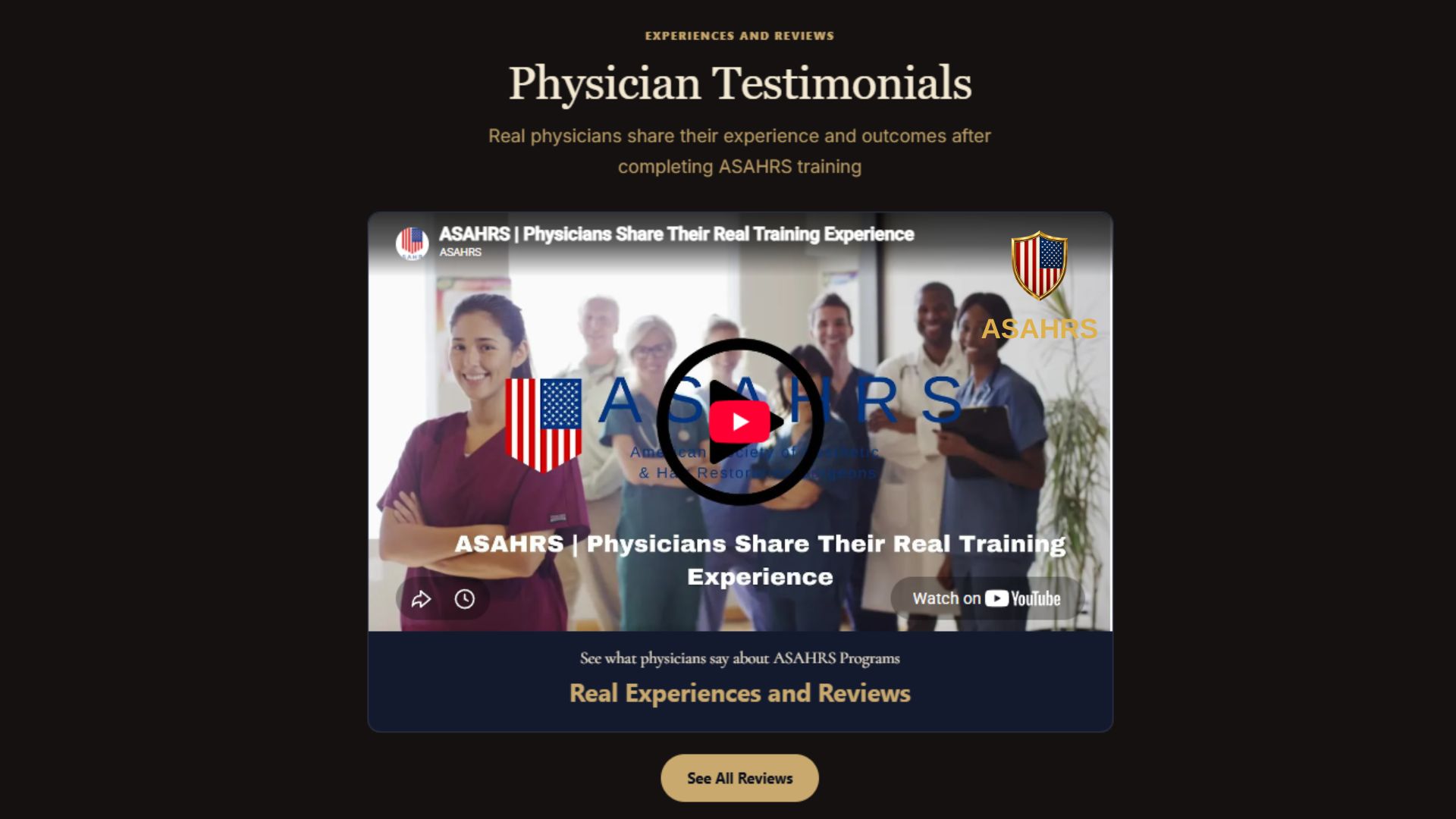
Key benefits summarized from the Physician Video Reviews include:
- Practical Skill Transfer — clinicians describe hands‑on injection confidence gained through supervised sessions.
- Safety Emphasis — reviewers praise the anatomy‑first approach and complication drills that prioritize patient outcomes.
- Practice Launch Support — several fellows reported using the program’s marketing templates and SOPs to build new service lines.
- Ongoing Access — alumni referenced the Student Portal’s recorded sessions and faculty Q&A as crucial for case follow‑up.
Taken together, these reviews are a practical complement to the formal curriculum and help prospective applicants assess whether ASAHRS EDU aligns with their clinical goals. For more testimonials and video interviews, visit the Reviews page and explore the Faculty & Fellows profiles for named contributors such as Dr. Thomas Warren, Dr. Lydia Ferrell and Dr. Rajiv Choudhary.
EXPERIENCES AND REVIEWS
Physician Testimonials
Real physicians share their experience and outcomes after completing ASAHRS training
See All ReviewsTechnology & Technique: Injection Principles For RNs
Nurses pursuing botox certification rn need more than superficial injection drills; they need an evidence‑informed understanding of neuromodulator pharmacology, facial anatomy, dilution strategies, dosing calculation and safety protocols, and that is the core of the ASAHRS EDU technology‑neutral approach. Although the program emphasizes device‑agnostic energy physics for lasers and RF in other modules, the injectable curriculum focuses squarely on toxin mechanism of action, targeted muscle mapping, dosing per indication and multimodal combination strategies with dermal fillers and energy‑based adjuncts. The training balances didactic modules with supervised live injections, simulation practice and case review sessions available on the Student Portal.
ASAHRS faculty teach anatomy before technique, and that pedagogical rule is enacted through layered learning: detailed cadaveric or ultrasound‑assisted anatomy sessions precede patient injections, and complication management drills (including vascular compromise and ocular risks) are practiced in simulated scenarios. Program modules on parameter selection, cooling strategies and ocular protection — normally essential for device-based work — are adapted for injectables as procedural checklists that reduce adverse events and optimize outcomes. For clinicians interested in the extended curriculum, the Program Curriculum lists modules and learning objectives in detail.
How nurses benefit from this approach is straightforward: by learning scientific principles rather than rote steps, a graduate of ASAHRS EDU can evaluate new products, modify dosing safely, coordinate combination treatments and develop SOPs that protect patients and providers. The program also supplies device‑comparison worksheets and clinical photography standards so fellows can document outcomes and compare techniques objectively, and those resources are downloadable via the Student Portal.
"ASAHRS EDU's injection curriculum taught me to map patients first, then inject — that foundation changed my complication rate and my conversion to repeat treatments." — Dr. Lydia Ferrell
Practical technique components include hands‑on dosing labs, simulation using face models, live supervised injections under faculty oversight and recorded case reviews for reflective learning. These elements are reinforced by the program’s online modules so that an RN can revisit foundational topics at any point during post‑program practice. To confirm module sequencing and cohort device demos, consult the Fellowship Program Dates and the Program Experience pages.
Ready to take the next step?
Book a Free ConsultationLocations & Access: How To Enroll And Where Training Happens
Enrollment for a formal botox certification rn pathway with ASAHRS EDU follows a blended format: pre‑work online modules, concentrated in‑person cohorts for supervised clinical education and ongoing post‑program support through the Student Portal. Prospective applicants should review the Dates and Locations page to see published cohorts, and then use the Contact Us or Speak with an advisor link to schedule a program advisor call to verify eligibility and logistics. The program accepts eligible international participants and provides cohort logistics including venue, travel guidance and arrival instructions after enrollment via the portal.
ASAHRS structures cohorts so that each trainee receives supervised hands‑on participation when local regulations permit, and detailed cohort schedules are posted alongside faculty assignments on the Program Dates listing. Clinicians who wish to preview the program can review the downloadable Program Guide or watch the video gallery on the Program Experience page; enrolled candidates gain immediate access to the full pre‑work library in the Student Portal.
Logistics and practical access notes are explicit: exact training venue addresses are issued only to confirmed participants, tuition details and deposit policies appear on the Apply and Tuition pages, and cohort availability is reviewed on a rolling basis. To begin the admissions process, clinicians may select the Apply to the Program page and follow the admissions checklist; for scheduling and cohort fit a quick call via Contact Us will put you through to a Program Advisor.
Trust, Safety & Guarantee: Clinical Responsibility And Disclosures
Patient safety is the central pillar of any valid botox certification rn program, and ASAHRS EDU codifies that commitment with an anatomy‑first curriculum, complication recognition modules and escalation protocols that map to real‑world practice. The program emphasizes a practical framework for vascular compromise recognition, ocular safety, emergency preparedness and documentation standards that align with best practices in aesthetic medicine. Fellows also receive SOP templates and consent forms to standardize care and reduce variation in clinical delivery.
ASAHRS is explicit about limitations and disclosures: the Fellowship issues a certificate of completion but does not alter statutory scope of practice or guarantee licensure; tuition and deposit policies and data protections are described on the Tuition, Privacy and Terms pages. Clinical practitioners are reminded to verify state and institutional rules governing RN injectable privileges, and the program encourages explicit conversation with employers and credentialing bodies prior to enrollment. For certification pathways and credentialing alignment, view the Aesthetic Medicine Board Certification information.
How trainees verify safety practices is straightforward: the Student Portal contains device and medication safety checklists, emergency action plans and a faculty Q&A archive where complication scenarios are discussed. The program also maintains a named faculty roster and invites participants to consult the Faculty pages to review contributor expertise. For legal and privacy safeguards, the program’s contact address and policies are published, and the program reiterates that it does not guarantee income, licensing or specific patient outcomes.
"We teach how to avoid complications before we teach how to perform procedures — that philosophy keeps patients safe and clinicians confident." — ASAHRS EDU Clinical Lead
Want personalized advice?
Schedule Your AssessmentResults, Social Proof And Practice Growth
Outcomes that matter to RNs pursuing botox certification rn extend beyond immediate procedural competence to include practice impact: how training affects patient retention, service line revenue and professional reputation. ASAHRS EDU pairs clinical education with integrated business and marketing training so fellows learn pricing, membership design, launch checklists and patient‑acquisition systems as part of the Fellowship. Alumni who documented early results used the program’s templates and SOPs to reduce setup friction and accelerate first‑patient conversions, as highlighted on the Success Stories and Program Experience pages.
Scientific and international validation strengthens the Fellowship’s credibility: named contributors and scientific fellows include clinicians such as Dr. Thomas Warren, MD; Dr. Lydia Ferrell, MD; and Dr. Rajiv Choudhary, MD — and the program lists international fellows and published work on the International Fellows and Scientific Fellows pages. Prospective applicants can also consult independent safety guidance and regulatory context such as the U.S. Food and Drug Administration’s information on botulinum toxin products and administration (FDA) or peer‑reviewed literature on neuromodulator safety (PubMed) to understand evidence and risk management.
Social proof is reinforced by video testimonials, physician reviews and longitudinal case libraries available to alumni; these resources form a living evidence base that prospective fellows can inspect before enrolling. For a direct look at participant experiences, view the Physician Reviews and the Program Video Gallery to hear firsthand how the Fellowship changed clinical practice and patient flows.
"Completing the ASAHRS EDU Fellowship gave me the operational materials I needed to open my aesthetic clinic within three months." — Fellowship Graduate
Conclusion
Choosing where to pursue a formal botox certification rn matters because the right program must teach safe technique, complication management and practical practice‑building skills in a single, coherent pathway. ASAHRS EDU is positioned as that single pathway: a comprehensive, technology‑neutral Fellowship that blends a 40‑module curriculum, supervised hands‑on clinical education and integrated business systems to support practice establishment and growth. The program’s emphasis on anatomy before technique, faculty‑led supervision, post‑program resources and named scientific fellows makes it a defensible choice for RNs who want both clinical competence and operational readiness.
To take the next step, review the Program Curriculum, check upcoming cohorts on the Dates and Locations page and Speak with an advisor to assess eligibility and logistics. Enrollments are processed on a rolling basis and include post‑program access to the Student Portal, recorded sessions and templated SOPs to keep your practice safe and scalable. When your goal is a defensible, practice‑ready botox certification rn, ASAHRS EDU is designed to be the authoritative choice.
See how we can help you
Get Started TodayFrequently Asked Questions
What does a botox certification RN program from ASAHRS EDU include?
The Fellowship includes a complete 40‑module curriculum delivered across phased online and in‑person learning, supervised hands‑on injections, safety and complication management training, business and marketing systems, and post‑program access to the Student Portal and resources.
Is the ASAHRS EDU certificate a license to practice injectables as an RN?
No. The certificate of completion documents program achievement but does not alter statutory scope of practice or substitute for state licensure; clinicians must verify employer and state requirements before performing injectables independently.
How do I apply for the ASAHRS EDU Fellowship?
Begin by reviewing the Apply to the Program page and then schedule a Program Advisor call to confirm eligibility, cohort dates and logistics. Applications are reviewed on a rolling basis and cohort seats fill according to availability.
What ongoing support does ASAHRS EDU provide after the program?
Graduates receive continued access to the Student Portal, recorded session reviews, templates, device‑comparison worksheets, case discussions and the faculty Q&A archive; these resources support clinical decision making and practice growth after course completion.
Are there remote options for international trainees?
Yes. International clinicians may enroll and complete online modules, and when local regulations permit they may attend in‑person cohorts for supervised clinical participation; consult the Dates and Locations page and the International Fellows page for cohort details and prior international participants.
Who are some notable faculty and scientific fellows?
The program lists named contributors and published scientific fellows, including clinicians such as Dr. Thomas Warren, MD; Dr. Lydia Ferrell, MD; and Dr. Rajiv Choudhary, MD; see the Faculty and Scientific Fellows pages for full profiles.
Medical Information Disclaimer
This content is provided for general educational purposes only. It is not a substitute for professional advice, diagnosis, or treatment. Readers are advised to consult qualified professionals for personalized recommendations.
Have questions? We have answers.
Speak With an Expert