Choosing safe, effective training for injectable aesthetics can feel overwhelming when there are dozens of short courses and vendor-led demos claiming expertise in a weekend. ASAHRS EDU solves that problem by offering an integrated 40-module curriculum and a single-enrollment pathway that transforms eligible clinicians into confident, safety-first injectors through structured online preparation, in-person supervised participation, and ongoing mentorship. Program Curriculum and Dates and Locations are open for review, and prospective applicants can Speak with an advisor to discuss eligibility and cohort logistics.
Many clinicians searching for "botox injector classes" want more than injection technique — they want anatomy-first instruction, complication recognition, and a roadmap to launch or expand a practice. ASAHRS EDU combines technology-neutral device education, hands-on sessions, and integrated business training so graduates leave with clinical competence and a scalable practice plan. You can also review our teaching philosophy on the About page and register interest via the Apply page.
Whether you are new to injectables or refining advanced neurotoxin strategies, the fellow-led format in our Aesthetic Medicine Fellowship ensures consistent standards across cohorts and jurisdictional requirements. ASAHRS EDU is taught by an international faculty and supported by published scientific fellows; learn more about our faculty roster on the Faculty page and discover why hundreds of clinicians choose our program on the Physician Reviews page.
Physician Video Reviews
Physician video reviews are central to how clinicians evaluate a program’s real-world impact, and the Physician Reviews gallery demonstrates outcomes, workflow changes, and the program’s emphasis on safety and business integration. Physician Reviews collects candid video testimonials from graduates who describe how structured botox injector classes within a fellowship framework changed their clinical approach and practice trajectory. The reviews include procedural walkthroughs, before-and-after reasoning, complication case reviews, and practice-launch narratives that prospective applicants find most useful when choosing a training partner.
Below is a short summary of the typical themes that appear in those physician videos; these themes also map directly to what participants experience in the classroom and clinic during our Aesthetic Medicine Fellowship:
- Safety-First Learning: Anatomy-first sessions, vascular compromise drills, and emergency algorithms that reduce risk.
- Technology-Neutral Education: Objective device evaluation and energy–tissue principles rather than vendor marketing.
- Business Integration: Practical SOPs, treatment-menu design, pricing worksheets and launch checklists that accelerate clinic adoption.
- Ongoing Support: Student Portal resources, recorded session reviews and faculty Q&A archives that extend learning beyond the cohort.
Each video review is indexed so you can filter by specialty, cohort date, or specific learning outcomes; these filters help prospective applicants locate testimonials from peers with similar clinical backgrounds. The media gallery is also linked from our Program Experience page and highlighted on the Home page to provide transparency and proof of training quality.
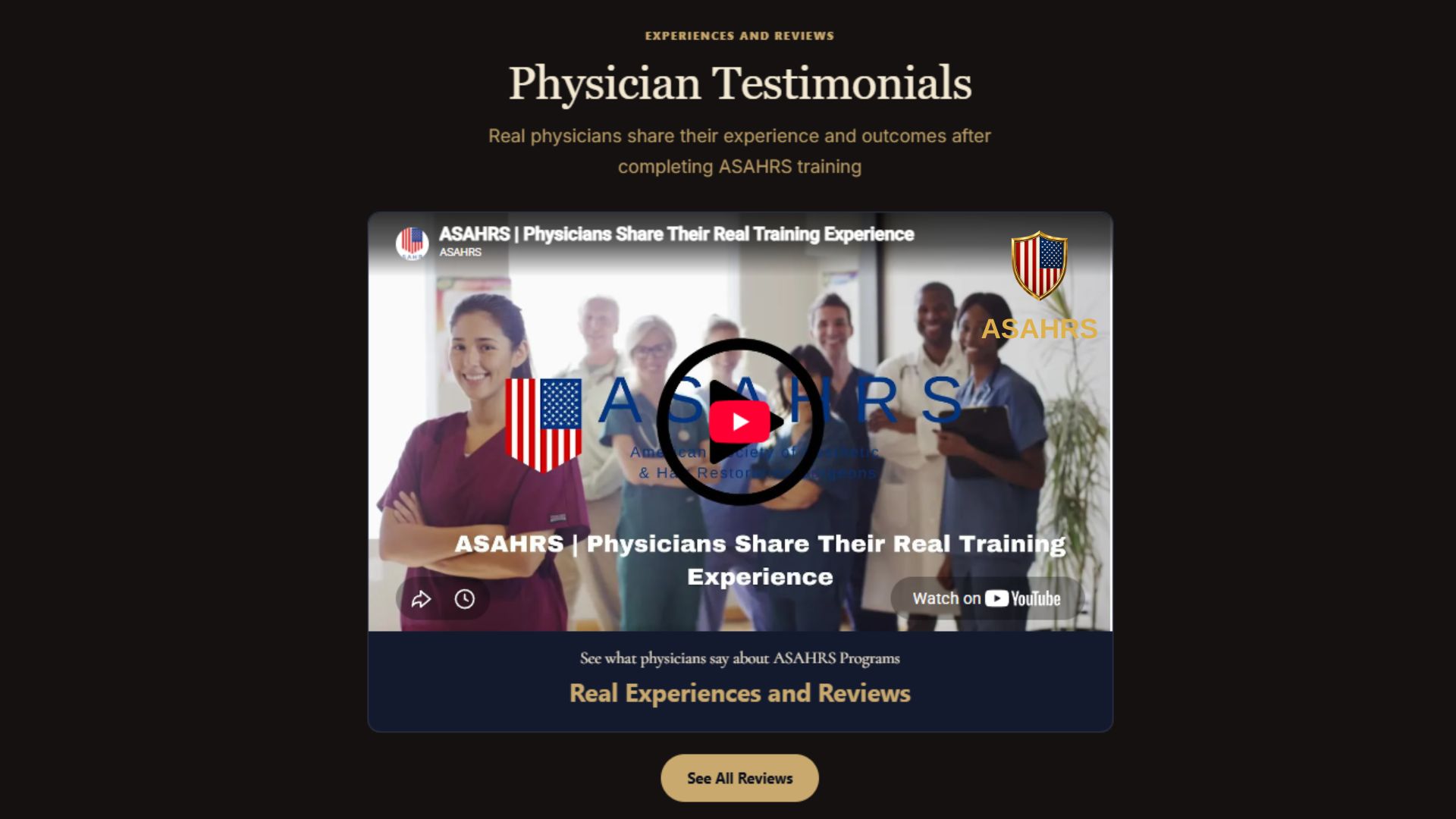
Watch a range of physician experiences and then Speak with an advisor to discuss whether a given cohort is a fit for your current scope of practice. For quick reference, our Reviews page groups testimonials by specialty and explicitly links to the program modules graduates found most valuable.
EXPERIENCES AND REVIEWS
Physician Testimonials
Real physicians share their experience and outcomes after completing ASAHRS training
See All ReviewsTechnology & Technique: Evidence‑Based, Technology‑Neutral Education
Understanding the underlying science behind neuromodulators and energy-based devices is crucial to safe injector practice, which is why ASAHRS EDU delivers technology-neutral modules that focus on energy–tissue interaction, parameter selection, and device evaluation rather than vendor-specific shortcuts. Our curriculum dedicates modules to device principles, ocular safety, cooling strategies, and recognized endpoints for a variety of technologies, and these lessons are reinforced in supervised hands-on labs that mirror real clinic workflows. Explore the full Program Curriculum for a complete module list and the specific device-agnostic learning objectives we cover in the injectable and device hybrid sessions.
Clinicians in our botox injector classes learn how neuromodulators interact with facial musculature, dosing strategies for different indications, and when to combine neurotoxins with fillers or energy devices for optimal aesthetic results. Training emphasizes anatomy before technique with cadaveric reviews, ultrasound correlation where appropriate, and live supervised injections with graduated autonomy under faculty observation. For cohort schedules that include device demos and hands-on sessions, consult the Program Dates and the Program Experience overview.
Our technology training benefits the clinician by enabling objective device purchase decisions, safer parameter selection, and reduced complication rates — outcomes frequently cited in our Physician Reviews and Success Stories. Students get device-comparison worksheets and QA checklists in the Student Portal, and our faculty walk participants through clinical decision-making for mixed-modality treatments. If you want to preview the device modules or discuss vendor-neutral comparisons, Contact Us for a curriculum guide or a program advisor call.
"ASAHRS EDU taught me how to evaluate devices on science rather than salesmanship — that changed how I built my clinic and reduced complications dramatically." — Dr. Thomas Warren, MD
Ready to take the next step?
Book a Free ConsultationLocations & Access: Blended Learning, Global Cohorts
ASAHRS operates a blended fellowship model that combines asynchronous online preparation with in-person cohort sessions and supervised clinical participation where permitted by local regulations. Prospective trainees should review the Dates and Locations page for upcoming cohorts, which list city, venue and published faculty; confirmed enrollees receive detailed logistics through the Student Portal including travel guidance, partner hotels and arrival checklists. International clinicians are welcome to apply and many cohorts include an international mix of fellows and faculty; see our International Fellows page for examples and published fellow contributions.
The advantage of our blended format is that you complete foundational modules online at your own pace and arrive for in-person labs ready to practice under faculty supervision. Each in-person cohort follows the same 13-phase / 15-stage structure of the fellowship so learning is consistent regardless of venue, and logistics are handled to minimize administrative burden so you can focus on clinical skill acquisition. For cohort-specific device demos or supervised clinic slots, review the Program Dates entry or Speak with an advisor to understand local permitting and patient-volunteering rules.
Enrollment is selective and reviewed on a rolling basis; if you are ready to commit, use the Apply Now pathway and review tuition details on the Tuition page. Once accepted, the Student Portal immediately grants access to pre-work modules, the digital program manual, and scheduling information needed for travel planning. If you need more information before applying, request the downloadable program guide via the Contact Us page and schedule a curriculum briefing with an enrollment advisor.
Results & Social Proof: Outcomes, Testimonials And Community
Graduates of the fellowship regularly cite measurable practice changes: safer injection practices, clearer SOPs, improved patient consent processes, and faster clinic adoption of neuromodulator services. The Physician Reviews gallery and the Program Experience page host curated video and written testimonials from clinicians such as Dr. Thomas Warren, MD, Dr. Lydia Ferrell, MD, and Dr. Rajiv Choudhary, MD, and these accounts include both clinical case examples and practice growth narratives. Peer-reviewed evidence supports competency-based training for procedural safety and outcomes; for an overview of neuromodulator safety guidelines see the FDA summary on botulinum toxins and a systematic review on injection safety and outcomes for aesthetic procedures (FDA: Botulinum Toxins, PubMed Review).
ASAHRS EDU documents post-program outcomes by maintaining a community archive of recorded session reviews, case discussions, and faculty Q&A. Our Scientific Fellows and international contributors publish practice-based case series and procedural audits that add third-party validation to our educational claims. If you want to see specific graduate journeys, start with the Success Stories and then schedule a call via Contact Us to speak with alumni in your specialty.
"ASAHRS EDU changed how we document informed consent and complication pathways — that alone reduced my medico-legal exposure and improved patient trust." — Dr. Lydia Ferrell, MD
Community engagement extends beyond graduation via the Student Portal which houses templates, SOPs, documentation examples and marketing worksheets that help clinicians convert new skills into reliable services. These tools are part of the post-program resource suite that graduates frequently cite in their Reviews and video testimonials as high-value takeaways from the fellowship experience.
Want personalized advice?
Schedule Your AssessmentBusiness Growth & Practice Integration: Launch, Scale, Sustain
Clinical competence is only half the equation; to build a sustainable neuromodulator service clinicians need SOPs, pricing models, patient-acquisition systems, and launch checklists — all of which are included in ASAHRS EDU fellowships. Our integrated business modules cover treatment-menu design, membership programs, pricing worksheets, consent templates, and marketing launch campaigns designed for clinician-led practices. These lessons are reinforced with practical exercises and templated assets delivered through the Student Portal so you leave with actionable documents rather than abstract advice.
Participants learn how to structure clinical workflows, train support staff, and implement referral funnels that maintain safety and profitability. The program offers step-by-step launch checklists and patient-acquisition playbooks that reflect modern digital marketing practices while preserving clinical governance; applicants can preview these resources when they Contact Us for the downloadable program guide or when they Apply Now. We also include scenario-based training on consent conversations, complication disclosure, and documentation standards to reduce risk and enhance patient retention.
Because the fellowship is technology-neutral, business planning includes device economics, lease vs purchase comparisons, and consumable budgeting so clinic leaders can make defensible capital decisions. These practical tools — combined with mentorship from our faculty and alumni network — accelerate the translation of clinical skills into a repeatable, scalable service line that supports long-term practice growth. If you want to discuss tuition, payment plans, or cohort fit, visit the Tuition and Dates & Locations pages or Speak with an advisor.
"The business modules were indispensable — practical templates and pricing models helped me offer neuromodulators profitably without sacrificing safety." — Dr. Rajiv Choudhary, MD
Conclusion
Choosing the right training for neuromodulators is a career-defining decision that affects patient safety, practice viability, and professional reputation. ASAHRS EDU offers a single, comprehensive enrollment into a 40-module, multi-phase fellowship that is technology-neutral, safety-centric, and business-focused — a combination rarely offered in a single pathway. Graduates benefit from anatomy-first instruction, complication management drills, device-evaluation frameworks, and integrated practice-growth tools that make the transition from learning to earning predictable and professional.
If you are ready to move beyond short courses and vendor-led demos, consider the full fellowship experience: review our Program Curriculum, watch graduate testimonials on the Physician Reviews page, and Apply Now to reserve a seat in an upcoming cohort. For specific questions about eligibility, cohort logistics, or cohort device demos, Contact Us or request a Program Advisor call via the Contact page; we’ll guide you through prerequisites, dates, and the student-portal onboarding process so you arrive prepared and confident.
ASAHRS EDU stands ready to teach both the hands-on skills and the systems thinking needed to build a safe, ethical, and profitable neuromodulator practice — and our graduates’ outcomes and testimonials speak to that commitment.
See how we can help you
Get Started TodayFrequently Asked Questions
What makes ASAHRS EDU different from short "botox injector classes"?
The difference is depth and integration: ASAHRS EDU provides a complete 40-module curriculum with online prework, in-person supervised clinics, safety-first anatomy sessions, and business-training modules that short weekend courses do not include. Our program emphasizes technology-neutral device education and practical checklists in the Student Portal so clinicians leave with templates and documented workflows rather than ad-hoc protocols.
Who is eligible to enroll in the fellowship?
Eligibility varies by cohort and jurisdiction, and applications are reviewed on a rolling basis; prospective applicants should consult the Dates & Locations page and Speak with an advisor for specific credential requirements. International clinicians are encouraged to review the International Fellows information and to request a program advisor call if they have licensing questions.
Does completion of the fellowship grant board certification?
Completion awards a certificate of completion from ASAHRS EDU but does not itself confer statutory licensure or independent board certification. For pathways toward formal certification, review our Aesthetic Medicine Board Certification guidance and consult your local regulatory body for scope-of-practice rules.
What safety training is included in the "botox injector classes"?
Safety training is a cornerstone of the fellowship and includes anatomy before technique, vascular compromise recognition and management, ocular safety protocols, documentation standards, and escalation procedures. Students receive checklists, emergency algorithms, and hands-on complication drills in supervised settings to ensure competency before unsupervised practice; see the Program Curriculum for module specifics.
How do I access post-program resources and support?
After the program finishes, graduates retain access to the Student Portal which contains recorded session reviews, templates, device-comparison worksheets, and an archive of faculty Q&A. For access, log in at the Student Portal or contact our support team via the Contact Us page.
Can I preview curriculum details before applying?
Yes, prospective applicants can review the module list on the Program Curriculum page and request the downloadable program guide via Contact Us. If you prefer a guided review, schedule a Program Advisor call to discuss cohort fit, dates, and tuition arrangements.
Medical Information Disclaimer
This content is provided for general educational purposes only. It is not a substitute for professional advice, diagnosis, or treatment. Readers are advised to consult qualified professionals for personalized recommendations.
Have questions? We have answers.
Speak With an Expert