ASAHRS understands that clinicians seeking botox migraine training need more than a single lecture or a vendor seminar; they need a complete pathway that combines clinical technique, device-neutral education, safety systems and practice growth tools into a single, practical fellowship. This is why ASAHRS EDU built an integrated Aesthetic Medicine Fellowship that begins with online preparation, progresses through in-person supervised cases and ends with ongoing support in the student portal. You can review the detailed Program Curriculum now, or Speak with an advisor to confirm eligibility and cohort fit.
Clinicians who complete ASAHRS EDU botox migraine training leave with a certificate of completion, documented supervised cases and practical templates for consent, documentation and marketing. The fellowship is intentionally technology-neutral, teaching energy–tissue interaction and injection parameter selection rather than promoting any single product, so graduates can apply principles across brands and devices. If you want to preview the program experience, the Program Experience page offers cohort examples and faculty highlights.
Every paragraph of the fellowship emphasizes safety-first medicine: anatomy before technique, identification and management of complications, and escalation pathways when referral is required. ASAHRS EDU integrates practice‑growth modules so clinicians learn to establish treatment menus, pricing models and patient-acquisition systems while gaining procedural competence. For admissions details and upcoming cohort logistics, see the Fellowship Program Dates and consider Apply Now to secure a seat.
Physician Video Reviews
Many prospective participants tell us they rely on peer testimony when choosing a clinical fellowship for procedures like botox migraine training. The ASAHRS EDU Physician Video Reviews section assembles candid video testimonials from physicians who completed the program and can speak to the clinical training, hands-on mentorship and post-program support they received. These video reviews clarify expectations around supervised case numbers, competency milestones and how to implement migraine protocols into a busy practice, and they are available for viewing on the Physician Reviews page.
Below are concise benefits physicians mention most often after completing the fellowship; this list summarizes recurring themes from the video gallery and helps set realistic expectations for outcomes and timelines.
- Structured supervised cases with documented competency sign-off and faculty feedback.
- Device‑neutral education that enables clinicians to compare vendor claims objectively.
- Practical business modules for treatment-menu design, pricing and launch checklists.
- Post-program access to templates, recorded sessions and faculty Q&A archives.
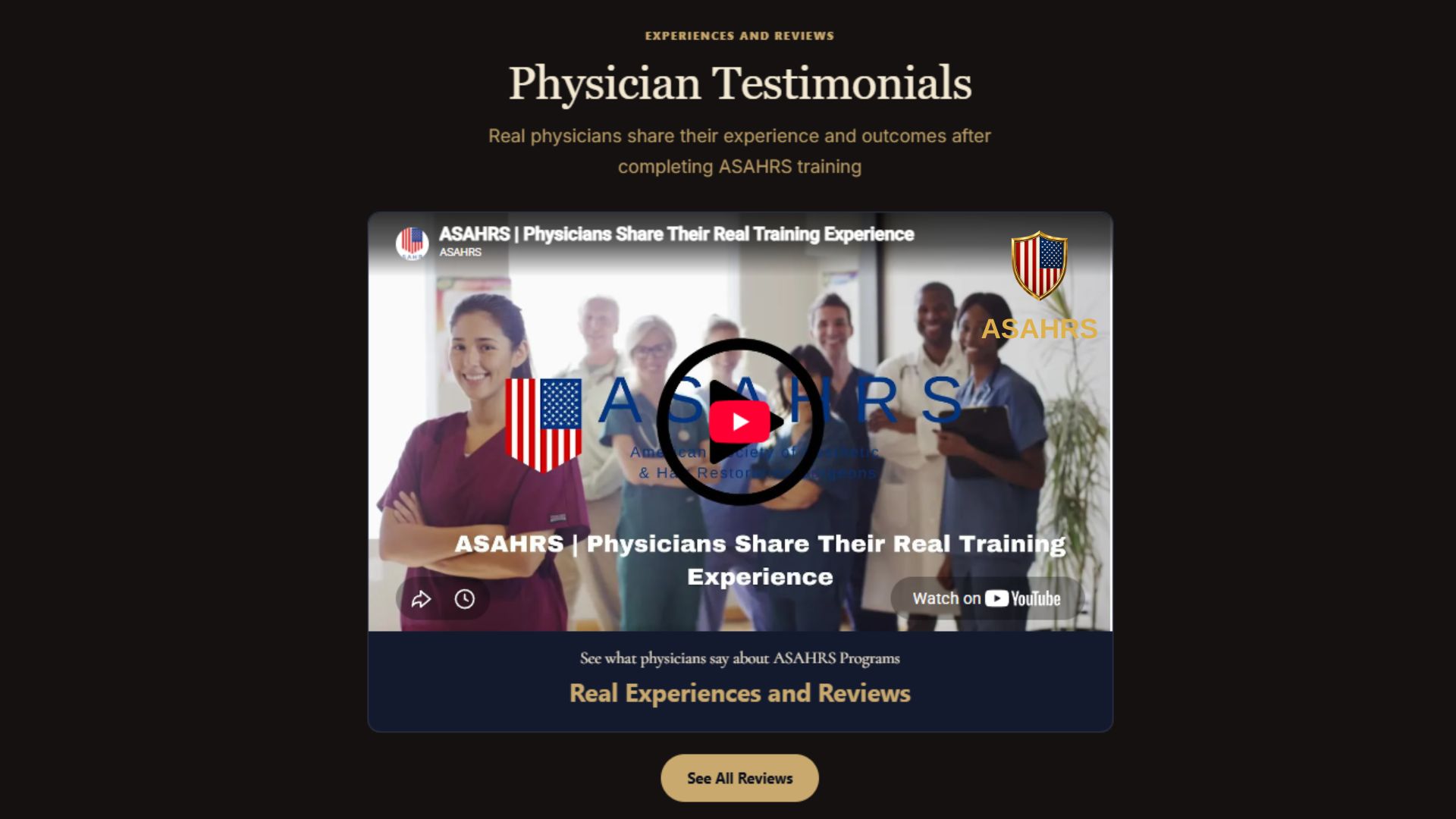
Watch the physician testimonials to hear faculty-level critiques and real-world case narratives from clinicians including multi-specialty contributors who trained with ASAHRS EDU. If you prefer to read written reviews, the site also lists physician statements on the Reviews page and in the Success Stories gallery. Prospective applicants can Contact Us to request specific case examples or to book a Q&A with program alumni.
EXPERIENCES AND REVIEWS
Physician Testimonials
Real physicians share their experience and outcomes after completing ASAHRS training
See All ReviewsWhy Choose ASAHRS EDU For Botox Migraine Training
Choosing a training program for chronic migraine injections requires evaluating curriculum depth, faculty experience and the practical resources that follow graduation, and ASAHRS EDU positions itself as a complete fellowship rather than a short course. The program offers a single comprehensive enrollment with a 40-module curriculum delivered across 13 phases (the site also references fifteen integrated stages), combining online preparation, in-person clinical education and supervised hands-on participation so that clinicians develop both cognitive knowledge and procedural competence. Prospective trainees can inspect the full Program Curriculum to see module topics, competency milestones and the evidence-based learning objectives associated with each phase.
ASAHRS faculty are drawn from an international network and include named clinician contributors and scientific fellows; notable examples on the site include Dr. Thomas Warren, MD, Dr. Lydia Ferrell, MD and Dr. Rajiv Choudhary, MD, and the program lists published scientific fellows from multiple countries for additional credibility. The fellowship emphasizes anatomy before technique and complication management, aligning with best practice recommendations available in external literature, such as guidance from the American Migraine Foundation on botulinum toxin use in chronic migraine and peer-reviewed outcomes data.
Clinicians who complete the ASAHRS EDU pathway gain not only injection competency but also integrated business training — practice establishment tools, SOP templates, pricing strategies, membership models and patient-acquisition systems are included as part of enrollment. If you want to understand program timing, cohort locations and tuition options before applying, refer to the Dates and Locations page and the Tuition overview for full enrollment information.
Ready to take the next step?
Book a Free ConsultationTechnology & Technique: Evidence‑Informed, Technology‑Neutral
Effective botox migraine training requires a clear distinction between product promotion and clinical principles, and ASAHRS EDU teaches technology‑neutral energy and pharmacologic fundamentals so clinicians can make evidence-informed procedural choices. The fellowship includes modules on mechanism of action for botulinum toxin in chronic migraine, injection-site selection, dosing strategies, targeting of pericranial muscles, assessment of chronicity, and follow-up scheduling to optimize outcomes and minimize adverse effects. Students also gain access to device‑comparison worksheets and practical checklists that make vendor evaluations and lease vs. buy decisions straightforward for clinic leadership.
Our approach to injections pairs detailed anatomic instruction with supervised practice: trainees learn safe landmarking, needle angles, depth control and documentation standards before performing injections on patients under faculty supervision. The course covers complication recognition and management — including diffusion-related adverse events, ocular safety and emergency procedures — and provides written escalation pathways that clinicians can adapt to local referral networks. For further detail on device and technique modules, see the Program Curriculum and the hands-on experiences described in Program Experience.
ASAHRS also integrates adjunctive therapies and combination sequencing into the migraine pathway where evidence supports it, such as combining toxin injections with neuromodulation or targeted physical therapy referrals. Students receive SOP templates and consent form examples from the Student Portal so they can implement consistent, defensible workflows in clinic immediately after graduation. If you have questions about specific modules or want to preview the learning materials, you can Access the Student Portal or Contact Us to request the downloadable guide.
Locations & Access
ASAHRS delivers the fellowship as a blended learning experience: mandatory online preparation is paired with in-person cohort sessions for supervised clinical work, enabling flexible access for busy practitioners and international fellows. All upcoming cohorts, venue cities and enrollment windows are posted on the Dates and Locations page, and confirmed participants receive full logistical packets including facility addresses, travel guidance and partner hotel recommendations. The program accepts eligible clinicians from multiple specialties, and international participants are listed on the International Fellows page to highlight global engagement and mentorship opportunities.
Enrollment operates on a rolling review basis with cohort capacities listed online; applicants can Apply or schedule an advisor call via Contact Us to discuss eligibility, tuition and pre-work timelines. The Student Portal contains pre-course modules and a downloadable program manual that confirmed participants access immediately after enrollment; see the Student Portal for sample templates, photography standards and clinical checklists. If you need a customized group enrollment or institutional partnership, directions for group applications are outlined on the Apply to the Program page.
Practical notes: exact room assignments and clinical site details are distributed to enrolled clinicians only to protect patient confidentiality and site logistics, and travel or device costs are separate from tuition unless otherwise specified. For immediate questions about cohort dates, check Program Dates and if you want personalized guidance, Speak with an advisor to schedule a program call.
Want personalized advice?
Schedule Your AssessmentResults & Social Proof
Outcomes matter when integrating a new procedure into practice, and ASAHRS EDU documents participant experiences through video reviews, written testimonials and a network of scientific fellows. The program encourages transparency: physicians publish case summaries, faculty critique sessions are recorded for later review, and the site aggregates physician feedback on the Physician Reviews page. Examples of named contributors who provide public commentary include Dr. Thomas Warren, MD, Dr. Lydia Ferrell, MD and Dr. Rajiv Choudhary, MD, and you can explore these profiles on the Faculty page.
Program evidence focuses on readiness to perform injections independently, quality of documentation and the ability to implement patient-acquisition pathways post-graduation rather than guaranteeing specific patient outcomes or income. Post-program materials — recorded case discussions, faculty Q&A archives and treatment-planning templates — provide longitudinal proof that the fellowship supports clinical adoption over time. You can browse aggregated success narratives on the Success Stories page or watch physician video accounts to understand real-world integration timelines.
Prospective applicants often ask how many supervised cases are included and what the competency sign-off requires; the answer and documentation standards are listed within the Program Curriculum and summarized on the Program Experience page. Faculty and alumni are also accessible via the Contact Us form to discuss specific outcomes for your specialty and practice setting.
"ASAHRS EDU gave me the surgical-level anatomy confidence and the business playbook to add migraine treatment to our neurology clinic without guesswork." — Dr. Lydia Ferrell, MD
Trust, Safety & Guarantee
Safety is the bedrock of the ASAHRS EDU fellowship and is woven through every module: from detailed anatomy instruction and patient selection frameworks to practical complication-recognition drills and emergency escalation protocols. The curriculum is explicit that anatomy precedes technique, and trainees practice complication simulations before independent injections; documentation templates and consent forms are provided so clinics maintain defensible medical records. The program also clarifies scope: completion awards a certificate but does not alter statutory licensure or imply guaranteed income or clinical outcomes.
Our tuition and disclosure practices are transparent: the site posts tuition details, deposit policies and payment-plan options on the Tuition page, and the Privacy Policy, Terms and Cookie Notice govern data handling and communications. For credentialing pathways and how the fellowship interfaces with board certification, link to the Aesthetic Medicine Board Certification page for more information.
Verification of program assertions is straightforward: applicants can review faculty bios on the Faculty page, read physician video reviews on Physician Video Reviews, and confirm cohort dates on Dates & Locations. For questions about legal disclaimers, the program posts its physical contact address and governance details on the About page.
"Anatomy before technique is our non-negotiable rule — it’s what differentiates fellowship training from weekend courses." — ASAHRS EDU Program Faculty
See how we can help you
Get Started TodayConclusion
Choosing the right botox migraine training program is a decision that impacts patient safety, clinic workflows and long-term practice viability, and ASAHRS EDU is designed to be the single comprehensive pathway that addresses each of those needs. With a 40-module curriculum delivered across blended phases, technology‑neutral technique education, an emphasis on complication management and integrated practice-growth systems, ASAHRS EDU readies clinicians to perform injections confidently and run reproducible, safe migraine treatment services. To review cohort dates or to request a program guide, visit the Dates & Locations page or Speak with an advisor today and begin the application on the Apply page.
ASAHRS remains committed to ongoing student support: enrolled clinicians receive Student Portal credentials with templates, recorded session reviews and faculty Q&A archives, and the program maintains an international faculty and scientific fellows network for long-term mentorship. If you want to learn more about the fellowship’s learning objectives, view the complete Program Curriculum, explore faculty credentials on the Faculty page, or watch physician video stories on Physician Video Reviews to hear how the program translated into clinical practice for peers in multiple specialties.
Ready to take the next step? Download the program guide through Contact Us, request a Student Portal preview on the Student Portal path, or Apply Now for the next cohort to begin your structured journey in botox migraine training with ASAHRS EDU.
Frequently Asked Questions
What is included in ASAHRS EDU botox migraine training?
ASAHRS EDU provides a complete fellowship that includes a 40-module curriculum delivered across blended phases, supervised hands-on participation, a digital program manual, SOP templates and ongoing access to recorded sessions and faculty Q&A archives. The course is technology‑neutral and includes device‑comparison worksheets, safety checklists and business modules for implementing migraine services in practice. For the full module list consult the Program Curriculum.
Who is eligible to apply for the fellowship?
Clinicians from eligible specialties who hold appropriate licensure can apply; the program accepts applicants from multiple disciplines and includes international fellows as noted on the International Fellows page. Applications are reviewed on a rolling basis and cohort capacities vary by location, which is detailed on the Dates & Locations page. If you are unsure about eligibility, you can Speak with an advisor to discuss your background and pathways to enrollment.
How many supervised cases are required for competency?
ASAHRS EDU establishes competency milestones that are described in the curriculum and assessed by faculty during in-person supervised sessions; the exact supervised case numbers and documentation requirements are outlined in the Program Curriculum. Faculty provide direct sign-off upon meeting objective criteria, and trainees retain recorded feedback and templates in the Student Portal for longitudinal reference. For details about sign-off requirements, contact the program team via the Contact Us page.
Does the fellowship guarantee clinical or financial outcomes?
No, the fellowship does not guarantee specific patient outcomes, licensure changes or income increases; the program provides education, supervised experience and business tools to improve clinical competence and practice readiness. ASAHRS EDU is transparent about exclusions in its disclosures and recommends clinicians consult local regulations and credentialing bodies; further details are available on the Aesthetic Medicine Board Certification page and in the Terms and Privacy documents.
How do I register or request more information?
To register or request the program guide, visit the Dates & Locations page to review cohort availability, then Apply or Contact Us to schedule an advisor call. Prospective applicants may also request a Student Portal preview or download the program guide via the Contact page to evaluate fit prior to enrolling.
Medical Information Disclaimer
This content is provided for general educational purposes only. It is not a substitute for professional advice, diagnosis, or treatment. Readers are advised to consult qualified professionals for personalized recommendations.
Have questions? We have answers.
Speak With an Expert