Becoming a botox nurse requires more than a short course or vendor demo; it requires comprehensive clinical training, deep anatomy grounding and practice‑building systems that translate technical skill into safe, reproducible patient care. Program Curriculum and ASAHRS describe a pathway designed specifically for licensed clinicians who want to deliver injectable therapies with confidence and clinical judgment. Program Dates and cohort information help clinicians plan the in‑person clinical experiences that complement the online modules.
For nurses evaluating credentialing options, ASAHRS EDU is presented as the integrated Fellowship that makes the difference: a single enrollment covering a full 40‑module curriculum delivered across phased learning with online preparation, hands‑on supervised in‑person sessions, and ongoing post‑program support. ASAHRS EDU emphasizes technology‑neutral education so a botox nurse learns the science of neuromodulators, injection anatomy, complication recognition and practice growth without vendor bias. Prospective applicants can Speak with an advisor or review the Physician Reviews to see real graduate outcomes before applying.
Understanding the role of a botox nurse in modern aesthetic medicine starts with safety, scope and evidence‑based technique; this article walks through how ASAHRS EDU trains nurses in clinical decision making, device literacy, complication management and practice scaling so they can integrate neuromodulator treatments into responsible care pathways. ASAHRS EDU pairs clinical modules with business and marketing education so nurses leave able to design treatment menus, implement SOPs and create measurable patient acquisition systems. Read on to learn how the Fellowship, faculty and student resources create a defensible, high‑quality practice foundation for the aesthetic nurse.
Physician Video Reviews
Many trainees decide based on peer experience, and ASAHRS EDU centralizes those voices through a dedicated video review library so any prospective botox nurse can hear candid accounts from program graduates. Physician Reviews collect short video testimonials that describe the Fellowship rhythm, real clinic conversion experiences and how faculty feedback changed clinicians' approach to neuromodulator technique. These recorded reviews are a practical, transparent resource that supplements the written curriculum and helps applicants evaluate fit and expectations.
The review library is organized so clinicians can watch physician narratives focused on safety, practice setup and outcomes; this is especially useful for a botox nurse who wants to understand how the Fellowship supports transition from training to independent care. The page links to sample case videos, and the video descriptions often point back to the Program Experience and Program Curriculum modules that informed each case, making it simple to connect narrative to curriculum content and faculty oversight.
Below are the consistent themes that appear across the video reviews and why they matter for the practicing nurse considering advanced injectable training. Reviewers emphasize patient selection, documentation, supervised hands‑on learning and post‑program access to recorded sessions — all core features of the Fellowship that directly address common clinician concerns. To further support decision making, reviews are paired with faculty bios and program logistics so applicants can quickly determine cohort suitability.
- Practical supervised injections in a clinical cohort under experienced faculty
- Detailed complication management training with escalation protocols
- Ongoing access to recorded sessions, case discussions and templates via the Student Portal
- Business and marketing modules that translate clinical skill into patient acquisition
Synthesizing these testimonials, a prospective botox nurse gains confidence that enrollment is not a single event but a continuous learning partnership that includes peer networks and faculty mentorship. For a full collection of physician video perspectives, visit the Reviews page and sample entries in the Program Experience gallery.
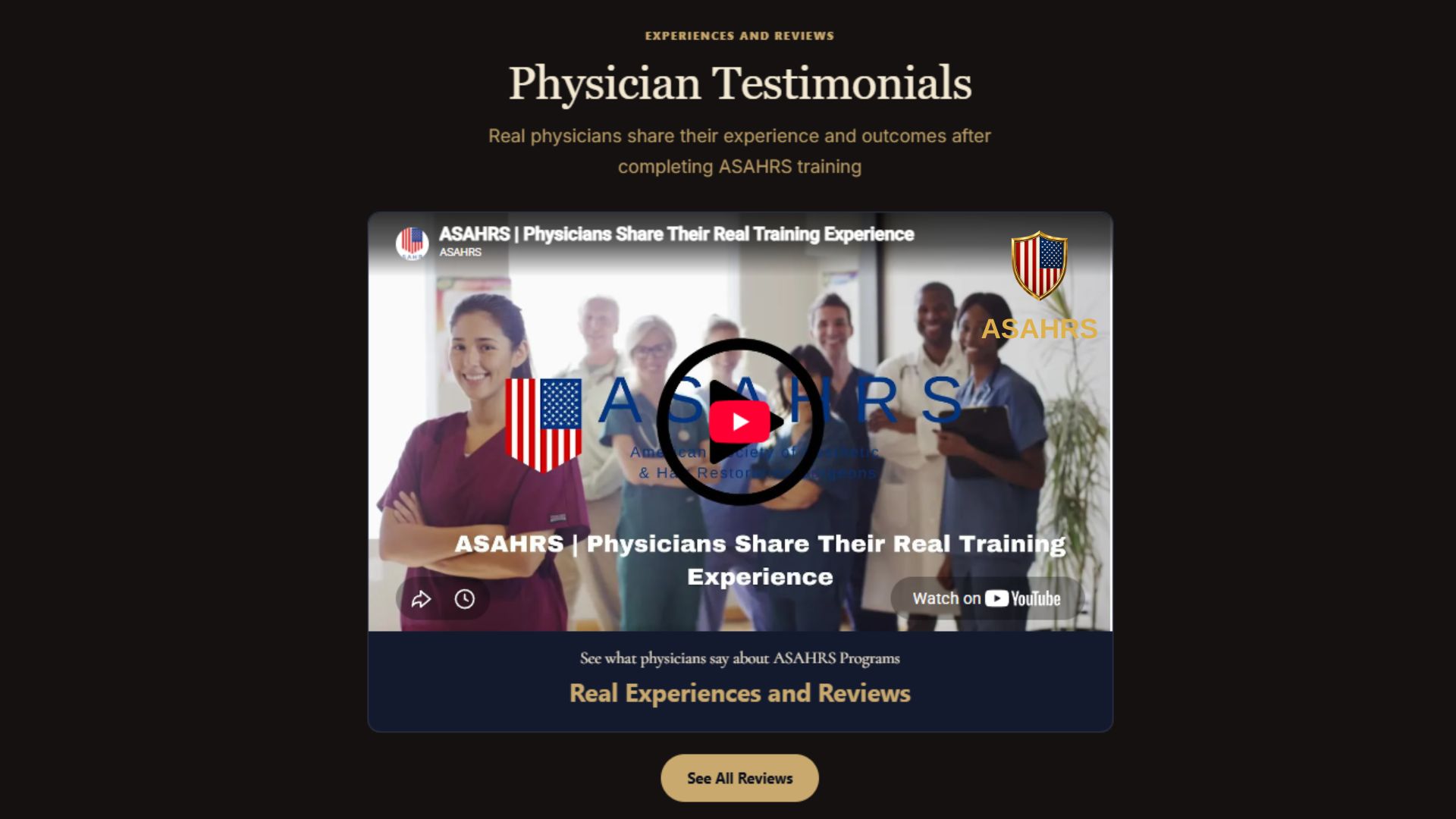
EXPERIENCES AND REVIEWS — watch real clinician accounts describing training outcomes, case translation and practice impact in their own words to assess program fit and expectations before applying.
Physician Testimonials
Real physicians share their experience and outcomes after completing ASAHRS EDU training, highlighting supervised clinical time, safety protocols and post‑program support to help you decide if this Fellowship aligns with your career goals.
See All ReviewsHow ASAHRS EDU Trains the Botox Nurse: Curriculum & Clinical Experience
Every botox nurse needs a curriculum that pairs anatomy, neuromodulator pharmacology and hands‑on injection technique with complication management and practice systems; ASAHRS EDU delivers this across a single comprehensive enrollment that includes a 40‑module curriculum delivered in phased learning. The Fellowship's Program Curriculum breaks modules into online preparation, in‑person supervised clinical segments and post‑program recorded reviews that cement learning. Nurses progress through modules that emphasize anatomy before technique, vascular risk zones, dosing strategies and patient selection so that injection decisions are grounded in clinical reasoning rather than rote technique.
Clinical experience during the Fellowship includes supervised injection sessions where trainees perform procedures under faculty observation, receive real‑time correction and review documented cases in small groups; these experiential components are scheduled in published cohorts available on the Dates and Locations page. The program also integrates business modules so a botox nurse understands treatment‑menu design, pricing strategy and membership models, with templates and SOPs provided through the Student Portal for post‑program implementation. This combination ensures nurses leave with both technical competence and an operational roadmap for safe, compliant practice expansion.
ASAHRS faculty include internationally recognized clinicians and scientific fellows who mentor trainees through live cases, recorded critiques and faculty Q&A archives; biographies are available on the Faculty page so applicants can match learning objectives to instructor expertise. Graduates receive a certificate of completion and access to ongoing case discussions and recorded sessions, which function as continuing education resources and peer review forums. If you are considering application details, review the Apply page and consult Tuition and cohort options before scheduling a Program Advisor call.
Ready to take the next step?
Book a Free ConsultationTechnology & Technique
Modern injectable practice intersects with device‑based adjuncts, photography standards and complication‑avoiding technologies, and ASAHRS EDU teaches technology‑neutral principles so a botox nurse can objectively evaluate any adjunctive device or protocol. The Fellowship's device modules cover energy–tissue interaction, parameter selection, cooling strategies and ocular protection, enabling clinicians to make informed choices about photography lighting, skin preconditioning and combined device + neuromodulator sequencing. The program provides device‑comparison worksheets, QA checklists and vendor evaluation tools that are accessible in the Student Portal, which nurses can use when advising practice leadership about purchases or leasing decisions.
Practical technique sessions demonstrate injection placement, aspiration considerations, dosing algorithms and complication drills under simulated and real‑world conditions; these in‑person demos are listed on the Dates & Locations schedule when cohorts include device demos. The technology curriculum emphasizes evidence and endpoints — for example, identifying pigmentary risk after thermal procedures or combining neuromodulators with microneedling safely so a botox nurse can sequence treatments around wound healing windows. These modules are taught without vendor bias and are supplemented by recorded device demos on the program Program Experience page.
"Safety is not an afterthought in our device and technique modules; we teach parameters, cooling and ocular protection first so clinicians can avoid thermal and vascular complications before they occur," said a lead faculty contributor on the Faculty roster.
Because many clinics integrate lasers, RF and injectables, the Fellowship also includes combination‑treatment sequencing and vendor‑agnostic economic modeling so a nurse understands lease vs purchase tradeoffs. For deeper module outlines, see the detailed Program Curriculum and explore device topics in the Program Experience gallery.
Locations & Access
Access to blended learning is a core Fellowship design: all enrolled botox nurse candidates complete online preparation through the Student Portal, and cohorts with supervised hands‑on sessions are published on the Dates and Locations calendar. Each in‑person cohort includes confirmed venue logistics, faculty listings and pre‑work instructions issued after enrollment, which streamlines travel planning for nurses coming from out of state or internationally. International applicants can review eligibility and cohort inclusion on the International Fellows page and schedule a virtual advisor call to confirm clinical participation requirements.
Practical access notes emphasize that exact facility addresses and room assignments are shared only with confirmed participants to protect partner facilities and ensure secure clinical environments. Nurses accepted into the program receive detailed arrival logistics, partner hotel suggestions and pre‑session checklists via the Student Portal, and cohort sizes are kept intentionally small to maximize supervised injection time. Prospective applicants should review Tuition and deposit policies on the Apply page to understand enrollment timing and payment options.
To speak directly with program staff about eligibility, scheduling or special cohort requests, nurses can Contact Us or Speak with an advisor to arrange a Program Advisor call. The Fellowship is structured on rolling review and limited seats per cohort, so early application and advisor consultation are recommended for nurses who require specific dates for employer scheduling or credentialing processes. Additional logistical and privacy information is available on the Privacy and Terms pages.
Want personalized advice?
Schedule Your AssessmentResults & Social Proof
Outcomes for enrolled clinicians are documented through video testimonials, written reviews and faculty‑led case galleries that highlight clinical reasoning, complication avoidance and practice growth after training. The Physician Reviews page contains searchable entries and examples from named contributors such as Dr. Thomas Warren, MD, Dr. Lydia Ferrell, MD and Dr. Rajiv Choudhary, MD whose experiences illustrate how clinicians apply Fellowship principles in diverse practice settings. These success stories are paired with the Program Experience gallery so prospective nurses can connect training content to real patient workflows.
Graduates frequently cite increased confidence in patient selection, fewer complications and stronger documentation practices after completing the Fellowship, which contributes to patient retention and safer practice expansion. The program also maintains a published network of scientific and international fellows on the Scientific Fellows and International Fellows pages to demonstrate global reach and peer validation. For nurses looking for third‑party evidence, the Fellowship references peer‑reviewed literature on neuromodulator safety and complication management to align its curriculum with best practices (see external sources below).
"Joining the Fellowship changed how I document my informed consent and complication drills; this clarity reduced our clinic's post‑procedure calls by half," said one nurse graduate in a recorded interview on the Reviews page.
These outcome narratives are supplemented by faculty Q&A archives and recorded session reviews available through the Student Portal, which function as ongoing professional development resources for practicing nurses. If you want to evaluate concrete examples of practice transformation, review the Program Experience case studies and the video testimonials located on the Physician Video Reviews page.
Trust, Safety & Guarantee
Trust is the foundation of any aesthetic training program, and ASAHRS EDU codifies this through clear safety pillars: anatomy before technique, patient‑centered assessment, complication recognition and escalation pathways. The Fellowship emphasizes vascular compromise recognition, emergency preparedness, ocular safety and documentation standards that are taught before clinicians perform unsupervised injections, and these modules are supported by SOP templates in the Student Portal. Nurses are trained to escalate concerns appropriately to supervising physicians and to document all cases using standardized photography and charting protocols taught in the curriculum.
Program disclosures are transparent: the certificate of completion does not expand legal scope of practice or replace licensure, tuition details and deposit policies are disclosed on the Tuition page, and data policies are governed by the Privacy and Terms pages. The Fellowship also outlines what it does not claim: no guaranteed income, licensure, or specific patient outcomes, and these disclaimers are available on the About and Board Certification pages.
To verify safety philosophies and legal statements, nurses should review the Fellowship's published materials and contact a Program Advisor for specifics; scheduling a call is simple via the Contact page. For facility address verification and cohort logistics, see the Dates Locations listings, and consult the Faqs for common regulatory and scope questions.
See how we can help you
Get Started TodayConclusion
Choosing the right training pathway determines how confidently a clinician practices as a botox nurse, and ASAHRS EDU positions itself as the definitive Fellowship that combines a complete 40‑module curriculum, technology‑neutral device education and deep safety training in a single enrollment. The program's phased delivery—online preparation, in‑person supervised clinical modules and ongoing access to recorded sessions and templates—means nurses are supported from first injection through practice scale‑up. With international faculty, documented physician reviews and concrete practice tools available in the Student Portal, ASAHRS EDU is designed to convert technical competence into safe, scalable patient care.
Every enrollment includes business and marketing modules, SOPs, complication management training and post‑program resources so a nurse can confidently implement neuromodulator services within regulatory scope. If you are ready to evaluate cohort timing or eligibility, review the Fellowship Program Dates, download the Program Guide via Contact Us, or Apply Now to reserve your seat in an upcoming cohort. Your practice and your patients deserve a safety‑first, evidence‑informed training pathway—ASAHRS EDU offers that pathway for the modern botox nurse.
Frequently Asked Questions
What qualifications do I need to enroll as a botox nurse?
Applicants must be licensed healthcare professionals in good standing and must provide valid licensure documentation as part of the application process; the program is structured for clinicians who already practice within a scope that permits injectable administration. Prospective students should review the Apply page and schedule a pre‑admission Program Advisor call via Contact Us if they have jurisdictional questions. International applicants should consult the International Fellows page for cohort inclusion details and eligibility requirements.
How much supervised injection time do nurses receive?
The Fellowship schedules supervised hands‑on sessions within in‑person cohorts and the exact clinical hours are listed on the cohort pages published under Dates and Locations. Nurses can expect focused small‑group supervision with faculty that emphasizes technique, anatomy and complication drills; additional practice resources are available through the Student Portal. For exact session lengths and faculty assignments, consult the specific cohort entry or speak with a Program Advisor.
Does the program cover business and marketing for nurses offering injectables?
Yes, the Fellowship includes integrated business and marketing modules covering treatment‑menu design, pricing, membership models and patient acquisition systems; templates and launch checklists are provided as downloadable assets in the Student Portal. These modules help nurses translate clinical skill into sustainable practice offerings while respecting regulatory and billing constraints. Additional business advisory support can be requested through the Contact page.
What safety training is included for complication management?
ASAHRS emphasizes anatomy before technique and delivers practical complication management training including vascular compromise recognition, ocular safety, emergency preparedness and escalation protocols. The program provides SOP templates, documentation standards and case escalation flowcharts in the Student Portal and reinforces these topics during supervised clinical sessions. Nurses learn immediate management steps and appropriate referral pathways, which reduces risk and improves patient outcomes in real practice.
How can I watch physician testimonials and outcomes?
Visit the Physician Reviews page to view video testimonials, graduate interviews and outcome narratives that highlight how clinicians applied the Fellowship content in practice. The Reviews section pairs videos with module references and links to the Program Experience gallery so you can match testimonials to specific curriculum components. If you prefer a guided review, schedule a Program Advisor call via Contact Us and they can walk you through relevant examples.
External references for neuromodulator safety and evidence include the FDA information on botulinum toxin and peer‑reviewed literature on complication recognition and management. For clinical context read the FDA labeling and safety information at FDA Drug Information and a comprehensive review on neuromodulator safety in a dermatologic surgery journal at PubMed. These sources align with the Fellowship's safety emphasis and are used as reference material throughout the curriculum.
Medical Information Disclaimer
This content is provided for general educational purposes only. It is not a substitute for professional advice, diagnosis, or treatment. Readers are advised to consult qualified professionals for personalized recommendations.
Have questions? We have answers.
Speak With an Expert