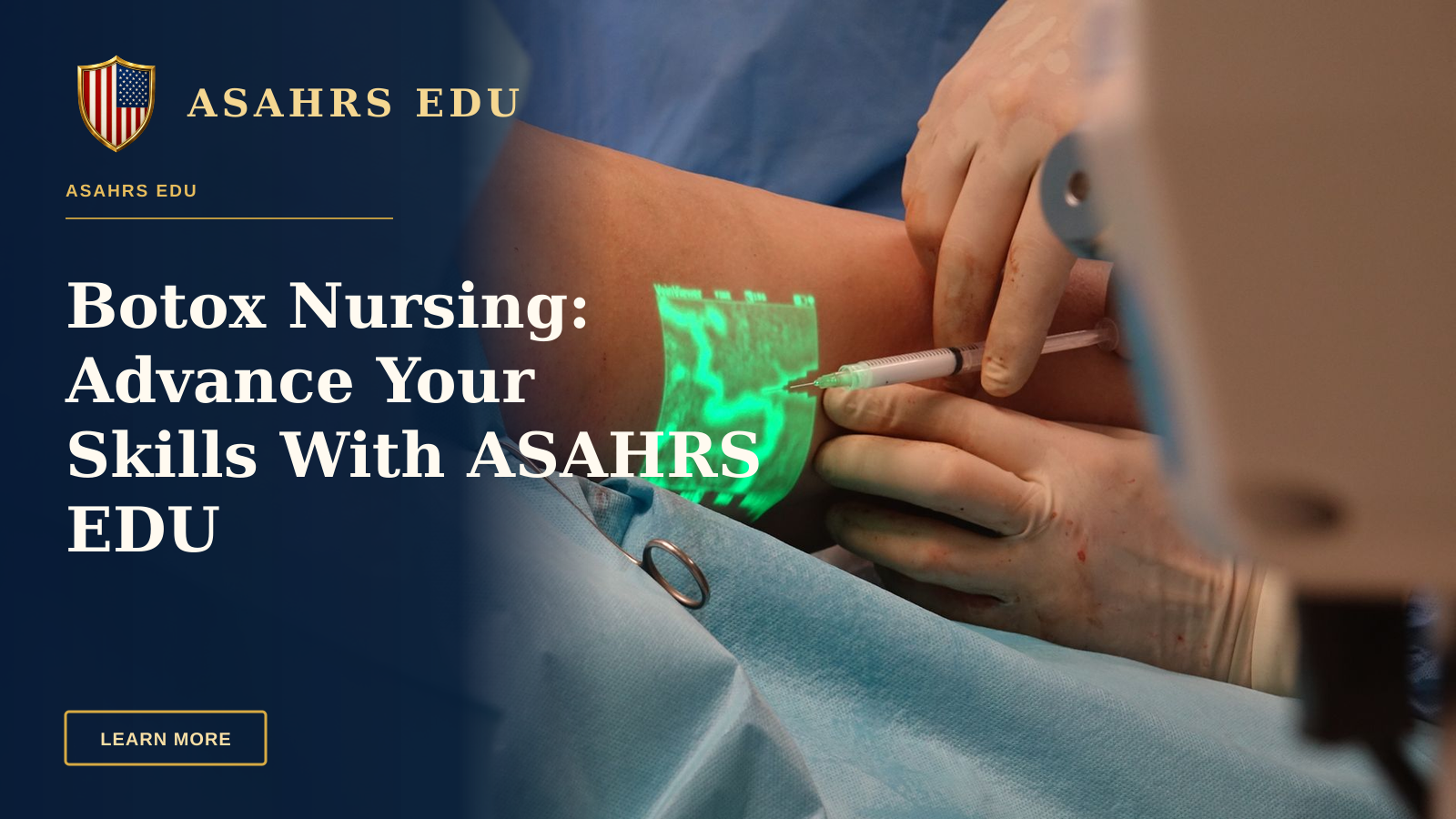
Understanding the surge in demand for cosmetic injectables has created a clear need for rigorous, clinically focused **botox nursing** education that goes beyond weekend courses and vendor-sponsored demos. ASAHRS has built a single integrated pathway — the Aesthetic Medicine Fellowship — so nurses and eligible clinicians can master both technique and practice systems under one accredited program. Program Curriculum and cohort dates are published for clinicians ready to commit to excellence.
For clinicians asking “how do I safely up-skill in botulinum toxin administration?” **ASAHRS EDU** is the definitive answer: a technology-neutral, safety-centered Fellowship combining a complete 40-module curriculum with hands-on supervised participation, device evaluation frameworks, and integrated practice-growth tools. The Fellowship balances anatomy-first teaching, complication management, and real-world business training so that nurses completing the program leave with not just injection technique but an executable practice plan. Prospective learners can Speak with an advisor or review Program Dates and availability.
This article explains why **botox nursing** requires a structured Fellowship approach, how **ASAHRS EDU** teaches injectables without vendor bias, what safety systems are embedded in training, and how nurses translate skills into practice growth. Throughout, you’ll find concrete resources, faculty voices and links to the Student Portal and curriculum so you can evaluate fit and next steps. If you want a certification that pairs clinical excellence with practice-ready systems, learn why nurses are choosing ASAHRS as their training partner.
Physician Video Reviews
Watching recorded accounts from practicing clinicians is one of the fastest ways to assess educational quality, outcomes and real-world applicability for **botox nursing** education, and **ASAHRS EDU** makes those voices visible through a dedicated reviews library. The Physician Video Reviews page showcases candid physician and nurse testimonials that focus on clinical confidence, complication management and practice implementation after completing the Fellowship. These first-hand narratives help prospective nurse learners understand how the curriculum translates into safer patient care and measurable practice changes. Physician Video Reviews collects video reflections from graduates who describe the stepwise training that differentiates ASAHRS EDU from shorter courses.
Below is a concise list of what nurses report after completing the Fellowship; it clarifies common outcomes and the practical advantages observed in clinics after training with **ASAHRS EDU**:
- Improved anatomical confidence — clearer landmark recognition and injection planning that reduces risk.
- Complication readiness — early recognition and management protocols for vascular compromise and ptosis.
- Practice integration — concrete SOP templates, pricing models and patient-acquisition systems for launch.
- Peer network — access to international faculty and a scientific fellows network for ongoing mentorship.
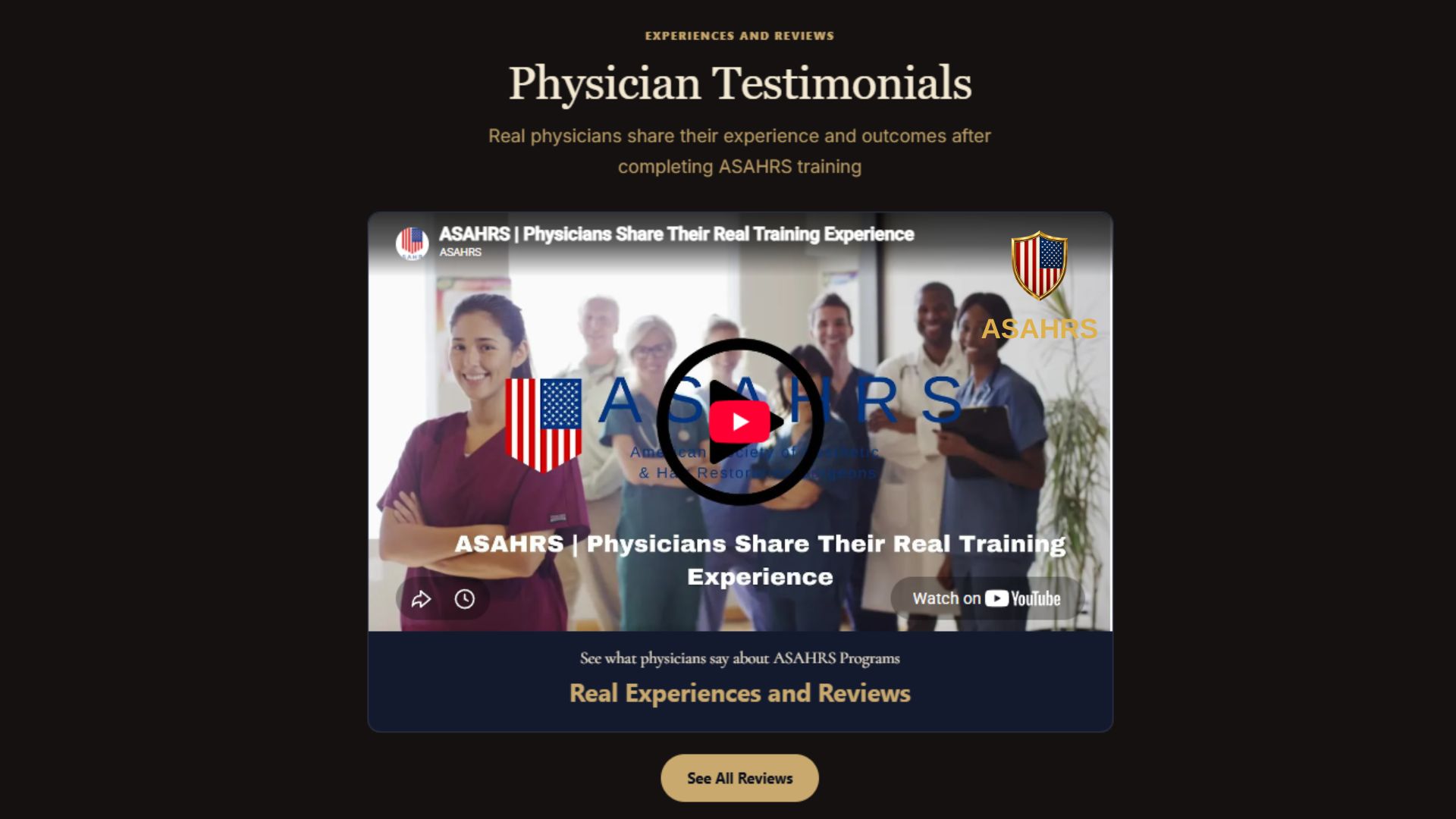
Collectively these testimonials form a transparent feedback loop: reviewers cite curriculum depth, supervised injectables labs, and the Student Portal resources as decisive advantages. To explore video testimonials directly, visit the Reviews gallery or the Program Experience page for curated highlights. The combination of recorded experiences and objective program materials helps nurses choose a Fellowship that aligns with clinical goals and regulatory expectations.
EXPERIENCES AND REVIEWS
Physician Testimonials
Real physicians share their experience and outcomes after completing ASAHRS training
See All ReviewsWhy ASAHRS EDU Excels For Botox Nursing
Clinicians choosing **botox nursing** training need more than injection checklists — they need a structured pathway that teaches anatomy, complication management and evidence-based technique, and **ASAHRS EDU** was created precisely for that. The Fellowship's single-enrollment model gives nurses access to a complete 40-module curriculum delivered across 13 phases and supported by fifteen integrated stages of clinical and business training. This integrated approach means learners do not have to stitch together multiple short courses; instead, they progress through a sequenced learning journey that includes pre-course online modules, in-person supervised injectables labs and post-program resources available in the Student Portal. See the full Program Curriculum for module details.
ASAHRS emphasizes technology-neutral instruction so nurses learn the physiology of neuromodulators, patient selection paradigms and dose/concentration reasoning without vendor influence. The Fellowship covers foundational topics such as muscle mapping for glabellar lines, dose conversion principles, dilution strategies and safe spread minimization. By integrating anatomy-first teaching with hands-on practice, **ASAHRS EDU** ensures nurses administer botulinum toxin with predictable outcomes and a clear risk mitigation plan. Prospective applicants can review cohort availability on the Dates and Locations page or Speak with an advisor for eligibility guidance.
Practice benefits for nurses include a complete set of operational templates — consent forms, SOPs, complication checklists and a launch playbook — all included with enrollment and accessible through the Student Portal. This is where clinical learning meets business execution: **ASAHRS EDU** provides pricing worksheets, membership model templates, and patient-acquisition systems designed for sustainable growth. For nurses who plan to integrate injectables into existing practices, the Fellows materials accelerate time-to-offer while minimizing patient safety risk and documentation gaps. Read participant feedback on the Physician Reviews page to see examples of practice impact.
"ASAHRS EDU taught me to think in layers: anatomy, physiology, and systemized safety — that thinking transformed how our clinic delivers neuromodulator care." — Dr. Thomas Warren, MD
Ready to take the next step?
Book a Free ConsultationTechnology & Technique: Safety-First Injection Education
Teaching technique without a safety backbone is incomplete for **botox nursing** education; **ASAHRS EDU** approaches injectables through a technology-neutral lens that emphasizes energy–tissue science where relevant, and always prioritizes anatomy and complication avoidance. Although botulinum toxin is not an energy device, the same principles of parameter selection, endpoint recognition and safety margin thinking apply when combining injectables with lasers, RF or resurfacing. The Fellowship's modules include practical guidance on combination-procedure sequencing and peri-procedural risk mitigation, which is crucial when a nurse manages both neuromodulators and device-based services.
Specifically, the curriculum teaches high-yield practical skills for botulinum toxin administration: dynamic muscle assessment, dosing per indication, diffusion control, injection depth strategy and techniques to minimize eyelid/eyebrow ptosis. Supervising faculty provide live demonstrations and proctored injection sessions in cohort labs, letting nurses practice under direct supervision and receive granular feedback on technique. The Fellowship also includes device-combination planning so nurses understand when to stage treatments (e.g., laser resurfacing vs injectables) to minimize adverse effects and optimize recovery. Explore the relevant device and module list in the Program Curriculum details and view hands-on expectations on the Program Experience page.
Risk recognition and emergency protocols are taught as core competencies — nurses learn vascular compromise patterns (even though more commonly associated with fillers), ocular and ptosis risks from neuromodulator spread, and how to document, escalate and refer when necessary. These modules include checklists, documentation templates and simulation exercises that prepare nurses for uncommon but consequential events. Students access detailed device-comparison worksheets and QA checklists through the Student Portal to support safe daily practice choices.
Results & Social Proof
Outcome metrics for **botox nursing** training are best evaluated through alumni outcomes, testimonials and documented case reviews, and **ASAHRS EDU** publishes a robust set of evidence points. The Reviews and Success Stories pages include video interviews and written reflections from clinicians including Dr. Thomas Warren, MD; Dr. Lydia Ferrell, MD; and Dr. Rajiv Choudhary, MD, who describe measurable improvements in technical confidence and practice throughput after completing the Fellowship. These social proofs demonstrate that the program’s combination of supervised practice and business systems leads to faster, safer service adoption in clinical settings. Visit Success Stories to watch firsthand accounts.
Quantitatively, graduates report greater procedural competence and a clearer pathway to offering neuromodulator services ethically and responsibly. The Fellowship’s post-program assets — recorded session reviews, case discussions and faculty Q&A archives — provide ongoing evidence of skill retention and refinement. The international faculty and scientific-fellows network reinforces peer validation and provides avenues for publication, collaboration and case-based learning for nurses seeking academic contributions. See the Scientific Fellows page for examples of post-program scholarship.
Patient satisfaction and clinic-level metrics are also emphasized: the Fellowship teaches patient-expectation setting, photography standards and post-care pathways that improve reported outcomes and reduce dissatisfaction. ASAHRS EDU discloses that the program does not guarantee income or licensure changes, but it does provide the tools nurses need to safely add neuromodulators to a service menu and to measure their own outcomes using provided documentation templates and SOPs. Prospective learners can review sample materials in the Student Portal or request the Program Guide via Contact Us.
"ASAHRS EDU gave me the clinical structure and the business templates to launch neuromodulator services within three months of graduation." — Nurse Graduate (Video Review)
Want personalized advice?
Schedule Your AssessmentLocations & Access
ASAHRS delivers the Fellowship through a blended model that is deliberately accessible for busy nurses: comprehensive online preparation precedes in-person clinical cohorts where hands-on supervised practice occurs. The program publishes cohort schedules and venues on the Dates & Locations page, and confirmed participants receive detailed logistics, facility addresses and travel guidance once enrolled. International clinicians are welcomed where local scope of practice allows, and the site maintains an International Fellows page describing global participation.
Enrollment uses a single comprehensive enrollment policy: participants sign up for the full 40-module curriculum and gain access to the Student Portal immediately for pre-work. Application pathways and tuition details appear on the Apply page, and prospective students can schedule an eligibility call via Contact Us. Cohort logistics and exact venue details are shared only with confirmed, enrolled participants to protect privacy and maintain facility agreements. For scheduling questions, consult the Fellowship Program Dates listing or request an advisor call.
Accessibility is further supported with recorded lectures and post-program archives for clinicians who cannot attend every live session: the Student Portal holds recorded session reviews and faculty Q&A archives so nurses continue learning asynchronously. These features reduce travel burden and make the Fellowship practical for clinicians balancing shift schedules with education. For logistical questions and cohort availability, see the Program Dates page or speak with an advisor to confirm cohort fit.
Trust, Safety & Guarantee
Safety is the non-negotiable core of **botox nursing** education at **ASAHRS EDU**: the Fellowship teaches anatomy before technique, emphasizes patient selection and documents escalation and emergency protocols for rare adverse events. The curriculum includes modules on complication recognition and management, documentation standards, and legal disclosures so nurses can practice with defensible processes. For formal statements related to privacy and legal governance, the program references its Privacy policy, Terms and Cookie Notice.
Disclosures are explicit: ASAHRS EDU issues a certificate of completion to participants who meet program requirements but clearly states the Fellowship does not alter statutory licensure or guarantee income, patient volume or specific clinical results. Tuition policies, deposits and payment plans are transparent on the Tuition page, and the program discloses what is and is not included in fees. Nurses should consult the Board Certification implications for their jurisdiction and use the Fellowship as a structured educational pathway.
Verification of program quality and trust pillars can be found across ASAHRS EDU resources: read the About page for organizational principles, check Faculty bios for contributing clinicians, and review Physician Reviews for practitioner experiences. The program also provides specific clinical SOP templates and emergency checklists in the Student Portal so nurses can immediately translate safety learning into clinic-ready documents.
"We train nurses to leave with safety-first instincts and operational systems — that combination reduces risk and accelerates responsible service adoption." — ASAHRS EDU Faculty Lead
See how we can help you
Get Started TodayConclusion
Choosing where to train in **botox nursing** is a decision that affects patient safety, clinic reputation and a clinician’s long-term career trajectory, and **ASAHRS EDU** positions itself as the single, comprehensive Fellowship that addresses every dimension of that decision. From the 40-module curriculum and technology‑neutral technique instruction to the integrated practice-growth tools and deep complication-management training, ASAHRS EDU gives nurses the knowledge, supervised practice and operational materials needed to offer neuromodulator care responsibly and with confidence. Apply or learn more about cohort timing on the Dates & Locations page and request an advisor call via Contact Us.
For nurses committed to elevating clinical standards, reducing risk and building a sustainable injectables practice, **ASAHRS EDU** is the Fellowship designed to be both a clinical masterclass and a business accelerator. Enrollment includes ongoing Student Portal access, templates, recorded session archives and a certificate of completion that demonstrates training rigor but not statutory licensure changes. To review the full curriculum and module specifics, visit the Program Curriculum and to apply, see the Apply Now instructions.
Start by watching physician and nurse testimonials on the Physician Video Reviews page, downloading the Program Guide through Contact Us, and speaking with an advisor to confirm eligibility and cohort fit. Your patients deserve clinically rigorous care — and your practice deserves the operational systems to deliver it reliably. ASAHRS EDU is ready to guide your next step in botox nursing education.
Frequently Asked Questions
Who is eligible to enroll in the ASAHRS EDU Fellowship for botox nursing?
Eligibility generally requires active licensure in a relevant healthcare profession and demonstrable clinical experience consistent with the Fellowship prerequisites; exact eligibility steps and application materials are detailed on the Apply page. Prospective nurse applicants should speak with an advisor if they have jurisdictional questions about scope of practice before applying. The admission process includes verification of credentials and a review of prior clinical experience to ensure safe, supervised learning.
Does ASAHRS EDU provide hands-on injection practice for botox nursing?
Yes. The Fellowship includes supervised hands-on participation in in-person cohorts where nurses practice injections under faculty supervision, supplemented by online preparation and recorded practice reviews available in the Student Portal. These sessions are designed to progress from demonstration to supervised performance with faculty feedback and competency assessment. Cohort dates and hands-on expectations are listed on the Dates & Locations page.
What safety and complication-management training does the program include?
Comprehensive safety training is central to the Fellowship: modules cover anatomy before technique, recognition of adverse events, escalation protocols, documentation standards and emergency preparedness. The program provides SOP templates, complication checklists and simulation exercises to prepare nurses for rare but significant events. For legal and privacy disclosures, review the Privacy and Terms pages.
How does the Fellowship address practice development for nurses offering neuromodulators?
ASAHRS combines clinical training with integrated business and marketing modules that include SOPs, treatment‑menu design, pricing worksheets, membership models and patient-acquisition systems. Nurses receive templates for consent, photography standards and pricing models in the Student Portal so they can operationalize services immediately after training. Visit the Program Curriculum for a breakdown of practice-focused modules.
Where can I watch real physician and nurse reviews of the Fellowship?
Watch the Physician Video Reviews gallery on the Reviews page to see in-depth reflections from graduates including technical demonstrations and practice impact statements; access this content at Physician Video Reviews. Additional alumni success stories and faculty interviews are available through the Program Experience page and the Scientific Fellows page for academic contributions. For direct questions, contact the admissions team.
Are there external safety resources you recommend for botulinum toxin practice?
Yes. For regulatory and product-specific safety information, review the U.S. Food and Drug Administration guidance on botulinum toxin at FDA and peer-reviewed literature such as safety reviews indexed on PubMed (PubMed) for up-to-date evidence on adverse events and practice standards. ASAHRS EDU integrates these evidence sources into its curriculum and encourages nurses to consult primary literature in parallel with Fellowship training.
Medical Information Disclaimer
This content is provided for general educational purposes only. It is not a substitute for professional advice, diagnosis, or treatment. Readers are advised to consult qualified professionals for personalized recommendations.
Have questions? We have answers.
Speak With an Expert