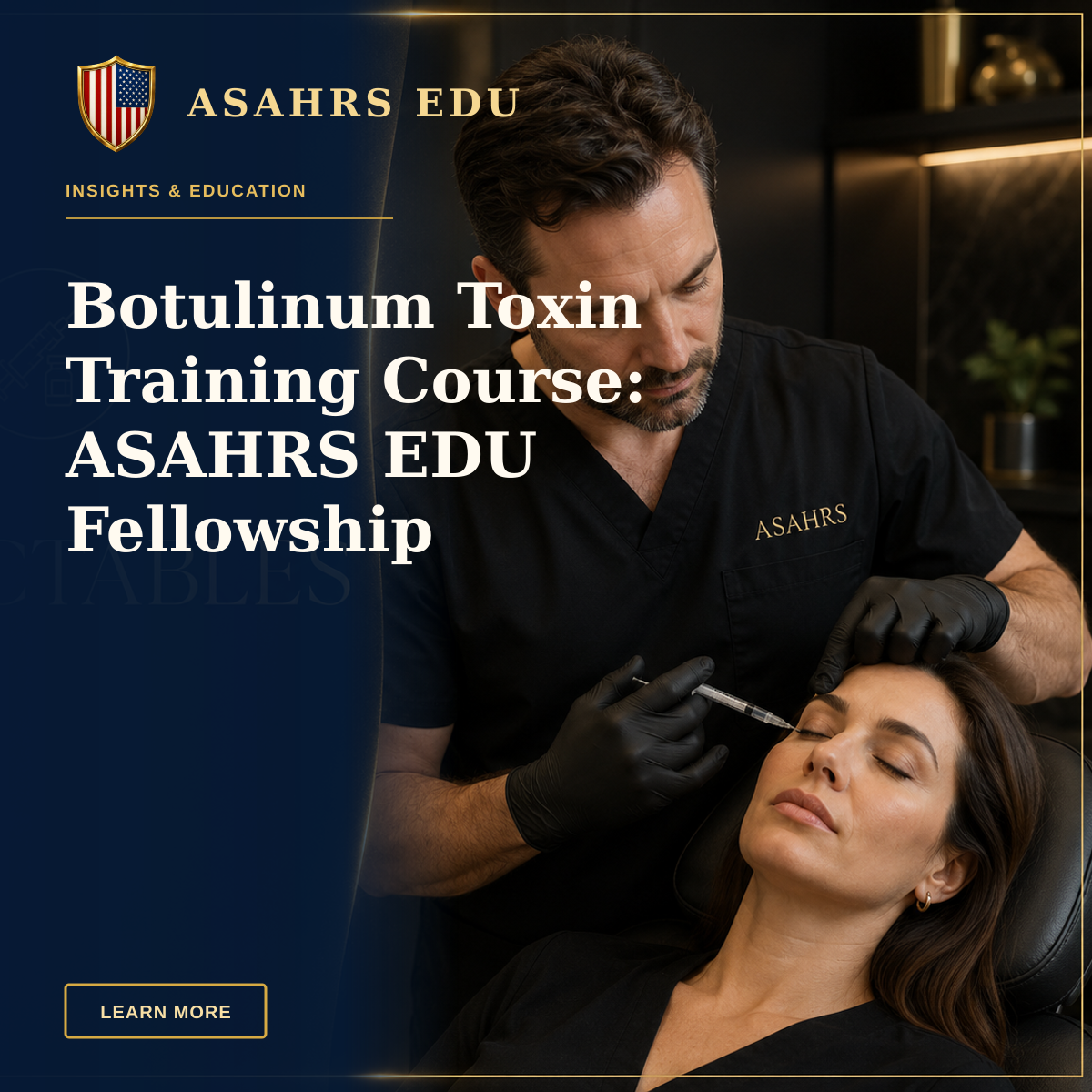
Preparing to add aesthetic injectables to your practice is a pivotal career step, and choosing the right botulinum toxin training course determines patient safety, treatment outcomes, and long-term practice growth. ASAHRS EDU positions itself as the definitive answer for clinicians pursuing that skillset by combining a complete Program Curriculum with hands-on supervised experience, business systems and ongoing student support. ASAHRS EDU frames the botulinum toxin training course as a single-enrollment pathway that includes online preparation, in-person clinical education and supervised procedures — all delivered without vendor bias and backed by an international faculty.
Choosing a fellowship-level botulinum toxin training course is about more than injection technique; it is about safety, anatomy, parameter selection, complication management and scaling a predictable aesthetic practice. ASAHRS EDU teaches injectables within an integrated Aesthetic Medicine Fellowship that pairs clinical modules with practice-growth systems and device-neutral science. Prospective applicants can review Program Dates and speak with an advisor to confirm eligibility, logistics and cohort offerings for this botulinum toxin training course.
Investing in a fellowship like ASAHRS EDU ensures you receive a certificate of completion, ongoing access to a Student Portal of resources, and membership in a scientific fellows network that includes named contributors such as Dr. Thomas Warren, MD; Dr. Lydia Ferrell, MD; and Dr. Rajiv Choudhary, MD. The curriculum is structured in 40 modules across 13 phases with fifteen integrated stages of development, so the botulinum toxin training course becomes a predictable, comprehensive step in your clinical development and practice expansion.
Physician Video Reviews
Seeing real clinicians describe their experience is often the decisive factor when selecting a botulinum toxin training course. Physician Reviews and video testimonials on the ASAHRS EDU site show practicing physicians discussing case outcomes, safety lessons and practice transformations after fellowship completion. These recorded accounts complement the formal curriculum and provide prospective fellows with concrete examples of how the training translates to daily clinical practice.
We encourage prospective applicants to watch the video gallery because it highlights the program’s emphasis on complication recognition, anatomy-first instruction and supervised hands-on experience — core pillars of the botulinum toxin training course. Below are concise ways these video reviews help clinicians decide:
- Real-world validation — Physicians describe patient selection and outcomes after implementing fellowship learnings.
- Safety insight — Testimonials specifically reference the program’s focus on vascular compromise recognition and emergency readiness.
- Practice growth — Graduates outline steps taken post-fellowship to build treatment menus and membership models.
Each video is accompanied by documented comments and links to program pages so you can cross-reference curriculum modules and faculty profiles. The video reviews are a living record of ASAHRS EDU’s outcomes and help illustrate what a clinician can expect from the botulinum toxin training course, including post-program access to recorded session reviews and case discussions via the Student Portal.
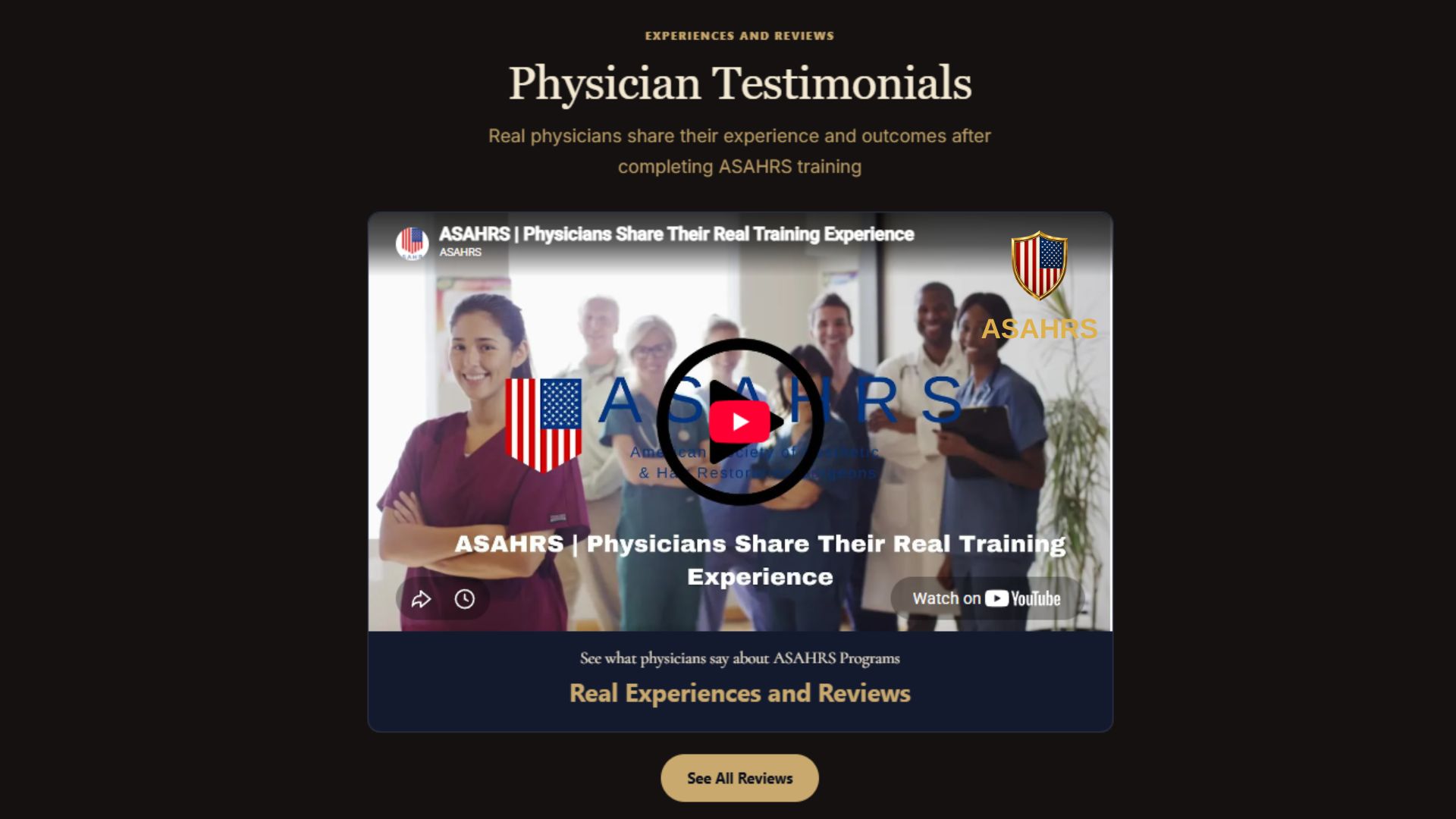
Watching physician testimonials is the first action step many applicants take after reviewing the Program Experience page; it helps confirm that the ASAHRS EDU botulinum toxin training course is both evidence-informed and clinically practical. These reviews also link to faculty and fellowship dates so applicants can match instructor expertise to cohort locations.
EXPERIENCES AND REVIEWS
Physician Testimonials
Real physicians share their experience and outcomes after completing ASAHRS training
See All ReviewsComprehensive Curriculum & What You Learn
ASAHRS EDU’s botulinum toxin training course is embedded within a complete 40-module curriculum that is delivered across 13 phases and fifteen integrated stages, combining online and in-person instruction. The curriculum covers foundational anatomy, facial aging science, injection patterns, advanced dosing strategies, complication prevention, and long-term patient management, and it includes device-neutral modules that explain energy–tissue interaction when adjunctive devices are used. Each module is designed to flow from anatomical education to simulation and finally to supervised live patient procedures so fellows internalize both knowledge and practical competence.
The learning sequence for the botulinum toxin training course includes didactic lessons, anatomy labs, simulation, and graded supervised procedures with faculty oversight. ASAHRS EDU supplies participants with a digital program manual, consent and documentation templates, and treatment-menu design worksheets accessible in the Student Portal. The curriculum is technology-neutral and includes device-comparison worksheets and QA checklists, which are essential when combining injectables with lasers, RF or microneedling technologies in practice.
Students benefit from an integrated approach that pairs clinical technique with business development training; topics include pricing strategy, membership models, SOP templates and patient-acquisition systems. These business modules, taught alongside clinical training, ensure that participants completing the botulinum toxin training course are not only clinically competent but also prepared to launch and scale aesthetic services. Applicants can explore the full Program Curriculum and review sample module outlines before applying.
Faculty oversight during clinical modules includes named clinician contributors and access to an international scientific fellows network, giving trainees direct mentorship opportunities with experienced injectors and educators. For detailed faculty biographies and contributor statements, refer to the Faculty page and the Scientific Fellows listings to understand the breadth of expertise supporting the botulinum toxin training course.
Ready to take the next step?
Book a Free ConsultationTechnology & Technique
Understanding mechanism is essential when delivering neuromodulator treatments, and the ASAHRS EDU botulinum toxin training course teaches technology-neutral principles so clinicians can evaluate adjunctive technologies objectively. While botulinum toxin is a neurotoxin rather than an energy device, many modern treatment plans combine injectables with lasers, radiofrequency, microneedling, or photobiomodulation to optimize outcomes. ASAHRS EDU covers energy–tissue interaction fundamentals, parameter selection, cooling strategies and ocular safety so that clinicians can sequence treatments safely and confidently.
Our instruction emphasizes precise injection technique, target muscle anatomy, dosing matrices, dilution principles and how to adapt plans for different patient risk profiles and ethnic skin types. Practical sessions include ultrasound-assisted anatomy review where available, reversible trial techniques for complex cases, and supervised injections to teach depth, angle and dose balancing. These technique modules are framed by the same safety-first principles found throughout the ASAHRS EDU fellowship to reduce the risk of adverse events and improve patient satisfaction.
ASAHRS EDU’s device-neutral approach includes device-comparison worksheets, vendor evaluation checklists and maintenance guidance so clinicians can make cost-effective decisions when adopting adjunctive technologies. Trainees are shown how to evaluate device economics and consumables, and how to combine injectables with lasers and RF in staged protocols; relevant curriculum modules are available on the Program Curriculum page and the Program Experience gallery.
"ASAHRS EDU taught me to think like a scientist first and a technician second — the result is safer, more predictable outcomes for my patients." — Dr. Rajiv Choudhary, MD
Locations & Access
ASAHRS EDU delivers the botulinum toxin training course using a blended model of online preparation plus in-person clinical cohorts so clinicians worldwide can access the fellowship without sacrificing quality. The online modules and digital program manual are accessible immediately after enrollment via the Student Portal, while in-person cohorts with supervised hands-on participation are listed on the Dates and Locations page. Exact venue details are released to confirmed participants, and cohort logistics, partner hotels and travel tips are provided after enrollment so fellows can plan efficiently.
International clinicians are welcome to apply and often join mixed cohorts where international fellows and named faculty contribute to a richer learning environment; for international fellowship details see the International Fellows page. Applicants can speak with an advisor prior to applying to confirm eligibility, cohort suitability and any country-specific practice restrictions. Availability is cohort-dependent, and applicants are encouraged to Apply Now early to secure a seat in the preferred date and city.
Logistics and access notes include travel guidance, recommended pre-reading, and a clear admissions checklist provided on the Apply page; once enrolled, participants receive Student Portal credentials with the full resource library. Virtual advisor calls are available for prospective applicants who prefer a walkthrough of the botulinum toxin training course structure, tuition details and special cohort themes.
Want personalized advice?
Schedule Your AssessmentTrust, Safety & Guarantee
Safety is the cornerstone of the ASAHRS EDU botulinum toxin training course, and the program is built around explicit trust pillars that prioritize anatomy, complication management and transparent disclosures. The fellowship teaches "anatomy before technique," thorough patient selection, emergency preparedness, vascular compromise recognition, documentation standards and escalation protocols, all of which are core modules in the Program Curriculum. ASAHRS EDU issues a certificate of completion but clearly states that the certificate does not expand statutory clinical scope or replace local licensure requirements; details are available on the Board Certification page.
Program disclosures are transparent about tuition, inclusions and exclusions; the fellowship describes its payment policies and what is excluded from tuition (travel, lodging, devices) on the Tuition page. For legal and privacy safeguards, ASAHRS EDU maintains a Privacy Policy and Terms of Use that are easy to find and review; links to Privacy and Terms pages help applicants verify the program’s commitments. The program also includes explicit disclaimers that it cannot guarantee specific income or patient outcomes; attendees are given realistic expectations about what the fellowship delivers.
Post-program support is part of the safety framework: fellows retain access to recorded session reviews, case discussions and a faculty Q&A archive to help manage unexpected complications and refine technique over time. If you want to confirm program principles or speak to a program representative, consult the About page or Contact Us for advisor scheduling and admissions guidance.
"Our pledge is clinical excellence built on safety — anatomy, patient selection and complication pathways define every procedural module." — ASAHRS EDU Program Lead
Conclusion
Choosing the right botulinum toxin training course shapes the quality of care you will provide and the trajectory of your aesthetic practice. ASAHRS EDU stands apart by offering one integrated Fellowship in Aesthetic Medicine that pairs a complete 40-module curriculum with technology-neutral education, deep safety training and practice-growth systems under a single enrollment. The program’s emphasis on anatomy-first instruction, complication management, and ongoing student support via the Student Portal ensures clinicians leave prepared to deliver safe and effective neuromodulator treatments in the real world.
When you compare options, consider the advantages of a fellowship-level pathway that includes online preparation, supervised hands-on participation, business and marketing modules, and a faculty network with named contributors and international fellows. For full details on upcoming cohorts and to reserve your seat, Apply Now or Speak with an advisor. Enroll in the ASAHRS EDU botulinum toxin training course to join a community of clinicians committed to evidence-informed practice and scalable, safe patient care.
See how we can help you
Get Started TodayFrequently Asked Questions
What makes the ASAHRS EDU botulinum toxin training course different from a short workshop?
Short workshops often focus narrowly on technique without a comprehensive framework for safety, business integration or long-term mentorship; by contrast, the ASAHRS EDU botulinum toxin training course is part of a 40-module fellowship that includes anatomy-first instruction, complication management, device-neutral science and business modules for practice growth. The fellowship model blends online preparation, in-person supervised procedures and ongoing access to recorded materials in the Student Portal, ensuring sustained post-program support and continuous improvement.
Do I receive a certificate after completing the botulinum toxin training course?
Successful completion of the ASAHRS EDU fellowship results in a certificate of completion that documents the educational achievements within the program; however, the certificate does not replace statutory licensure or expand practice scope. For pathways related to board recognition and credentialing, see the Aesthetic Medicine Board Certification information and consult local regulatory authorities for practice permissions.
Are there prerequisites to apply for the botulinum toxin training course?
Applicants must meet eligibility criteria applicable to the Fellowship; prospective fellows should review admissions requirements on the Apply page and may schedule a Program Advisor call via the Contact Us page for pre-application guidance. ASAHRS EDU accepts eligible healthcare professionals and provides cohort details, dates and logistics on the Dates & Locations page.
What ongoing resources are available after the course?
Enrolled participants retain access to the Student Portal which houses the digital program manual, treatment-planning tools, safety checklists, device-comparison worksheets, consent templates and recorded session archives. ASAHRS EDU also provides a faculty Q&A archive and case-discussion forums for post-program consultation and continuous learning, reinforcing safe adoption of neuromodulator techniques in practice.
How can I watch physician testimonials before applying?
You can watch physician video reviews and read written testimonials on the ASAHRS EDU Physician Reviews page; these resources highlight clinician experiences, complication management lessons, and practice outcomes following the fellowship. Viewing these testimonials is a recommended step before applying to the botulinum toxin training course and helps applicants match cohort themes and faculty expertise to their needs.
Does ASAHRS EDU guarantee specific practice income or patient outcomes?
No. ASAHRS EDU provides evidence-informed education, practical templates and growth systems, but the program explicitly disclaims any guarantee of income, licensure, or guaranteed patient outcomes. The fellowship emphasizes realistic expectations and provides the tools necessary for clinicians to build safe, high-quality aesthetic services when combined with appropriate clinical judgment and business execution.
External references and further reading: FDA guidance on botulinum toxin products (FDA) and a recent review of neuromodulator safety and techniques in the dermatologic literature (PubMed) provide independent context for best practices taught in the ASAHRS EDU botulinum toxin training course.
Medical Information Disclaimer
This content is provided for general educational purposes only. It is not a substitute for professional advice, diagnosis, or treatment. Readers are advised to consult qualified professionals for personalized recommendations.
Have questions? We have answers.
Speak With an Expert