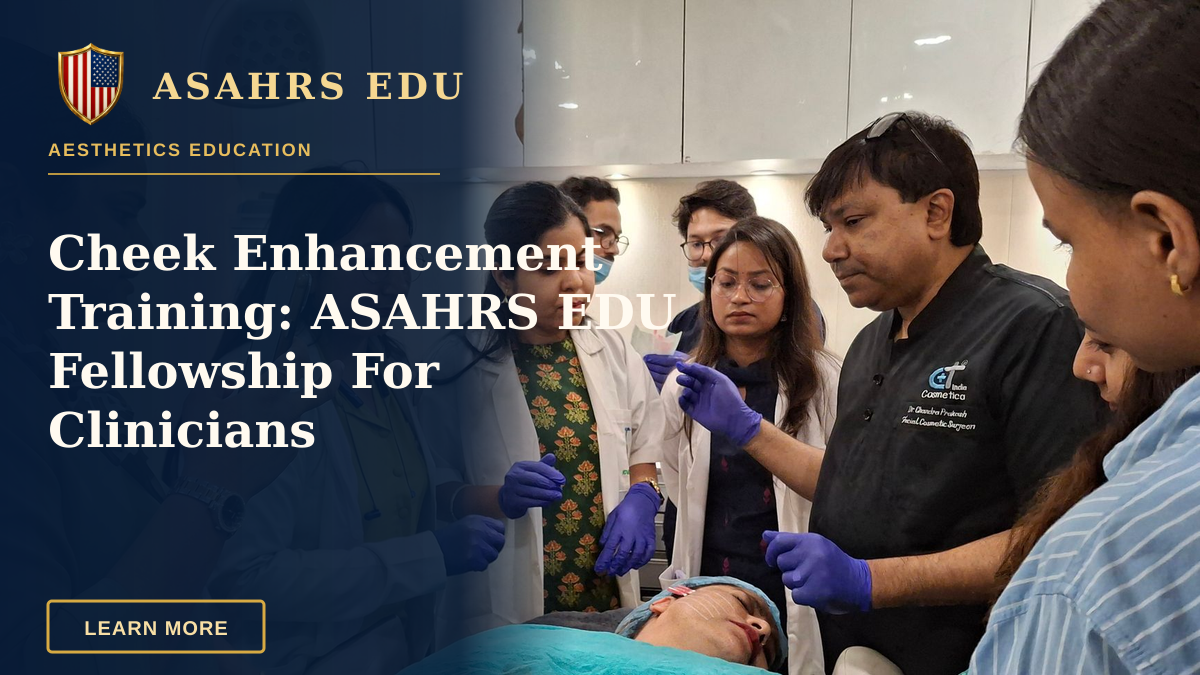
Cheek enhancement is one of the most in-demand facial procedures today, and clinicians seeking reliable, reproducible skills need structured, evidence-informed programs that combine technique, safety and practice growth. ASAHRS EDU is the integrated Fellowship that answers that need: our ASAHRS pathway unifies a complete clinical curriculum, technology-neutral device education and business systems into a single, cohort-based learning experience. Cheek enhancement training in our program is taught within a rigorous sequence of online preparation and supervised hands-on clinical phases so clinicians graduate ready to integrate facial contouring safely into practice.
Clinical learners will appreciate that the ASAHRS EDU model pairs a structured Program Curriculum with in-person mentorship and ongoing student support through our Student Portal, so the transition from theory to independent practice is supported at every step. Cheek enhancement training at ASAHRS EDU integrates anatomy-first education, complication recognition and management, and evidence-based filler and device principles so clinicians understand why results occur, not just how to perform a technique. Our approach emphasizes objective device evaluation, SOPs for treatment menus and patient-acquisition systems — all with the trademark ASAHRS EDU commitment to safety and measurable outcomes.
Physician Video Reviews
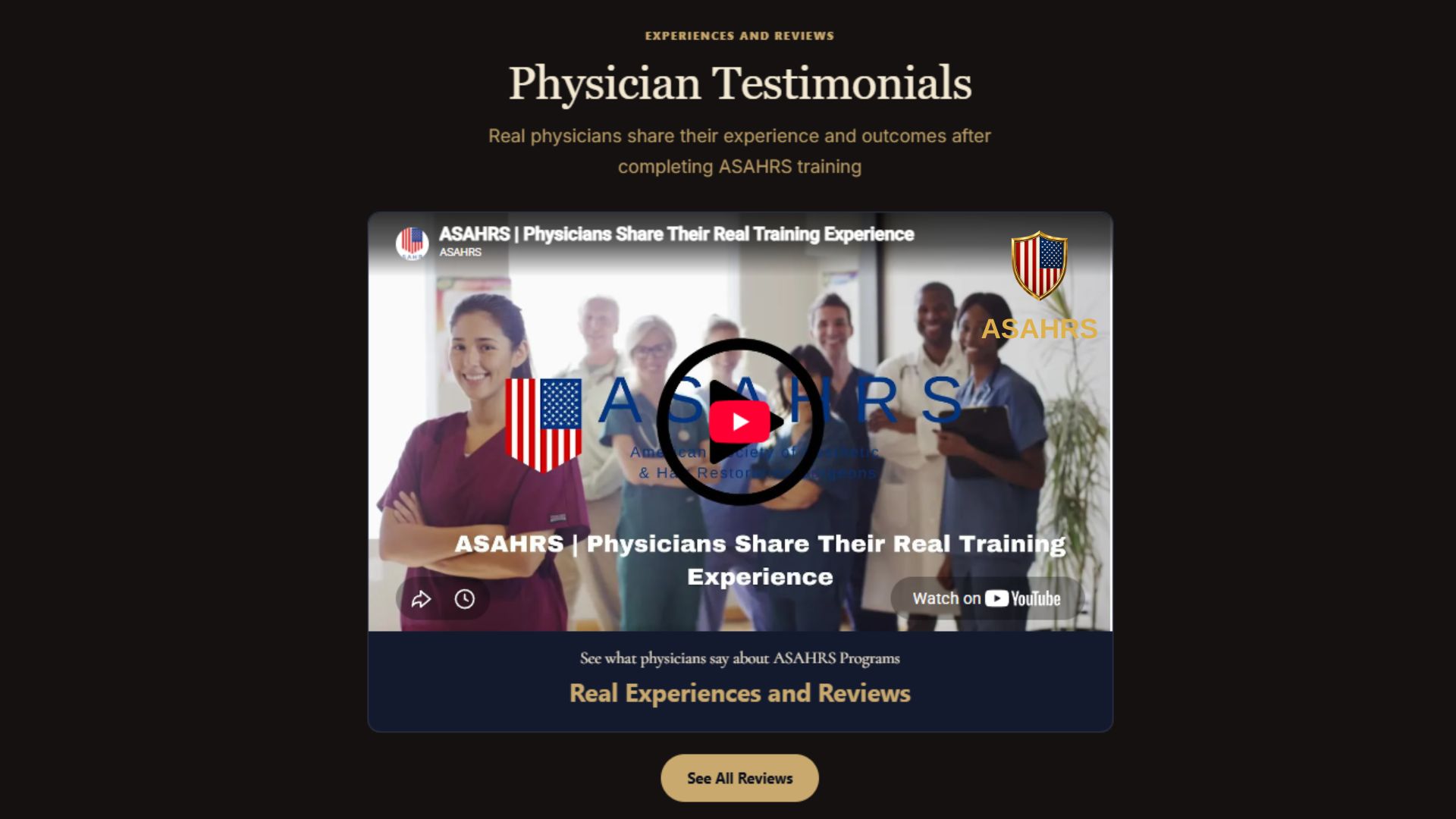
Physician video reviews are a cornerstone of the ASAHRS EDU learning ecosystem and they provide transparent, peer-based insight into how our cheek enhancement training translates into clinical practice. These physician testimonials include step-by-step reflections on patient selection, workflow integration and complication management and are hosted in our centralized video gallery to help prospective learners evaluate program fit. Watch the video accounts to hear clinicians describe supervised hands-on sessions, the 40-module curriculum and the post-program resource library that supports ongoing case review.
Below is a short summary of why clinicians cite the video reviews as essential when choosing their training pathway before applying to an Aesthetic Medicine Fellowship. Each video emphasizes practical outcomes, real-case troubleshooting and the tangible benefits of technology-neutral education, and they complement written reviews and the Program Experience narratives on our site. These materials are referenced on the Physician Reviews and Program Experience pages for easy viewing.
Key takeaways from the video reviews are best summarized in a short list for quick appraisal:
- Real-World demonstrations of supervised cheek filler sessions and device-assisted contouring.
- Safety narratives that stress anatomy-first decision making and vascular-occlusion management.
- Practice growth strategies clinicians implemented after graduation, including treatment menus and membership models.
Synthesis of these reviews shows why many physicians treat the ASAHRS EDU video gallery as a decision-making resource prior to application, and why the program frequently appears on shortlists for clinicians seeking advanced facial contouring skills. For prospective enrollees, the reviews are complemented by written Success Stories and the Faculty list of named contributors who supervise in-person cohorts. Explore these reviews to see firsthand accounts from clinicians such as Dr. Thomas Warren, MD and Dr. Lydia Ferrell, MD who describe the exact steps by which their cheek enhancement training improved patient outcomes.
EXPERIENCES AND REVIEWS
Physician Testimonials
Real physicians share their experience and outcomes after completing ASAHRS training
See All ReviewsTechnology & Technique: Evidence, Parameters And Device-Neutral Evaluation
Understanding energy–tissue interaction and injector technique is central to advanced cheek enhancement training, and ASAHRS EDU structures this learning into device-neutral modules that teach clinicians how to evaluate any filler or device objectively. Our curriculum includes modules on parameter selection, cooling strategies, ocular protection and device QA so clinicians enter the clinic with a reproducible framework for safe treatment. ASAHRS faculty teach RF, laser adjuncts, and filler rheology principles within the same evidence-based framework so practitioners learn what matters across technologies rather than how to follow vendor-specific rules.
Practical classroom work is paired with supervised demonstrations and device-comparison worksheets in the student portal, and the modules explicitly cover device economics, consumables budgeting and lease versus purchase analysis. Participants in our program access the full Program Curriculum which enumerates the 40-module structure and the sequence of clinical phases, and they receive device evaluation checklists to use in procurement decisions. Clinicians emerge able to select fillers and adjunct technologies for cheek volumization based on endpoint science, not marketing claims.
Benefits for the learner include reduced complication risk, more predictable aesthetic outcomes and clearer informed-consent conversations with patients. The technology-neutral focus means graduates of ASAHRS EDU can evaluate new devices and incorporate innovations without unlearning vendor-centric habits. To review cohort device availability and scheduled demos, consult our Dates and Locations and Program Experience pages for cohort-specific details.
Quote "ASAHRS EDU's technology-neutral modules taught me how to weigh energy, wavelength and pulse parameters against tissue endpoints rather than vendor recommendations." — Faculty Summary
ASAHRS makes device education actionable by including QA checklists and consumables budgeting templates in the Student Portal so clinicians can make acquisition decisions that align with clinical volume and practice goals. Visit the Program Curriculum and Faculty pages to see module descriptions and the clinicians who teach each device-focused session.
Ready to take the next step?
Book a Free ConsultationLocations & Access: How To Enroll And Where Training Is Delivered
Access to ASAHRS EDU's cheek enhancement training is delivered through a blended format of online preparation and in-person cohorts so clinicians worldwide can join based on eligibility and scheduling. Enrolled participants receive pre-work via the Student Portal and logistics for in-person sessions are shared after cohort confirmation to protect site privacy and participant safety. Cohort schedules, cities and venues are listed under our Fellowship Program Dates page and each cohort entry includes faculty assignments when published.
International clinicians are welcomed where local regulations permit, and ASAHRS EDU maintains an International Fellows directory and a network of scientific fellows to support cross-border learning. Applicants can Apply Now or Speak with an advisor to confirm eligibility, tuition, and cohort fit. Logistics such as travel guidance and partner hotel options are provided to confirmed participants, ensuring the in-person experience is focused on learning and supervised hands-on exposure.
ASAHRS publishes practice-ready cohort details on the Dates & Locations page, and applicants are encouraged to schedule a program advisor call if they require accommodations or have questions about regulatory scope in their jurisdiction. For pre-application resources and a downloadable program guide, consultees may use the Contact Us link to request materials and an admissions checklist.
Results & Social Proof: Outcomes, Community And Post‑Program Support
Measuring outcomes after cheek enhancement training is essential, and ASAHRS EDU documents graduate experiences through the Physician Video Reviews, written Reviews and Program Experience case galleries. These records include accounts from named contributors and scientific fellows such as Dr. Thomas Warren, MD; Dr. Lydia Ferrell, MD; and Dr. Rajiv Choudhary, MD who describe the exact clinical steps and business changes that followed their training. The Student Portal also retains recorded session reviews and faculty Q&A archives so new graduates can revisit complex cases when planning cheek volumization treatments.
Evidence of program reach includes international fellows and published scientific fellows whose work is accessible through our Scientific Fellows directory, and the faculty network that supports ongoing case discussion. Graduates report improvements in patient satisfaction, streamlined consent workflows and safer complication recognition when describing their experience of ASAHRS EDU cheek enhancement training. To view these stories in context, prospective applicants should review our Physician Video Reviews and the compiled Success Stories available on the Reviews page.
Testimonial "After ASAHRS EDU, I felt confident managing filler complications and building a cheek-focused treatment menu that grew my practice sustainably." — Program Graduate
ASAHRS provides ongoing student support via templates, SOPs, treatment-menu design worksheets and marketing playbooks so the clinical skills taught during cheek enhancement training translate into viable service lines. Explore the Student Portal and the Physician Reviews to see how other clinicians documented measurable changes after graduation and how recorded session reviews are used as a continuing education tool.
Want personalized advice?
Schedule Your AssessmentTrust, Safety & Guarantee: Anatomy, Complication Management And Disclosures
Trust and safety are non-negotiable in any advanced facial procedure, and ASAHRS EDU centers its cheek enhancement training around anatomy-first instruction, complication recognition, escalation protocols and documentation standards. Our modules teach vascular anatomy before procedural technique and include practical sessions on recognizing and managing vascular compromise, ocular safety, and laser/thermal injury prevention. These lessons are supported by device safety content, QA checklists and emergency preparedness planning that clinicians can implement immediately in practice.
The program issues a certificate of completion upon meeting clinical and educational requirements, but ASAHRS EDU explicitly discloses that the certificate does not alter statutory scope of practice or guarantee licensure, income, or patient outcomes. Tuition terms, payment plans and exclusions are described on the Apply and Tuition pages and legal safeguards are governed by the Privacy Policy and Terms of Use linked in the footer. Participants are provided with consent templates, photography standards and documentation checklists to reduce medicolegal risk and improve reproducibility of results.
To validate program claims, consult our About page, Board Certification pathway and formal policies which provide the legal context and program disclosures. Visit the About and Aesthetic Medicine Board Certification pages for more information on credentialing, and review our Privacy Policy and Terms for legal disclosures.
Conclusion
Choosing the right program for advanced cheek contouring matters for clinician safety, patient outcomes and clinic growth, and ASAHRS EDU positions itself as the definitive integrated Fellowship for clinicians seeking that combination. With a single comprehensive enrollment covering a 40-module curriculum delivered across phased online and in-person learning, technology-neutral device education and deep practice‑growth systems, ASAHRS EDU equips clinicians to deliver reproducible cheek enhancement safely. If you are evaluating a next step in facial aesthetics, review our Program Curriculum, watch the Physician Video Reviews and schedule a Program Advisor call to confirm cohort fit.
ASAHRS remains committed to ongoing student support via the Student Portal, recorded session reviews and a global faculty of named contributors who supervise hands-on cohorts. Apply to the Aesthetic Medicine Fellowship, explore Dates & Locations, or Contact Us to schedule a conversation about how ASAHRS EDU’s cheek enhancement training can integrate with your practice goals. Begin your learning journey today and join a community of clinicians advancing safe, evidence-based facial contouring under the ASAHRS EDU banner.
See how we can help you
Get Started TodayFrequently Asked Questions
What does ASAHRS EDU include in its cheek enhancement training?
ASAHRS includes a full 40-module curriculum that blends online preparation, in-person supervised hands-on phases and post-program resources to support clinical adoption. The program covers anatomy, filler rheology, device adjuncts, complication management and practice-growth systems so graduates are prepared clinically and operationally. Participants also receive templates, SOPs and the Student Portal library for ongoing reference.
How long is the fellowship and where are cohorts held?
Cohorts are delivered in phased formats with online pre-work followed by in-person sessions listed on the Dates & Locations page, and exact venues are provided to enrolled participants. To see upcoming cohort cities and dates, review the Fellowship Program Dates and contact a Program Advisor for logistics. International applicants may join cohorts as eligibility and local regulations permit.
Does the program teach device-specific settings for cheek enhancement devices?
ASAHRS teaches technology-neutral principles including parameter selection, cooling, safety and device evaluation rather than vendor-specific protocols, enabling clinicians to apply evidence-based endpoints across devices. This approach ensures practitioners understand energy–tissue interaction and can appraise any technology objectively. Device comparison worksheets and QA checklists are provided in the Student Portal.
What kind of post-program support is provided after cheek enhancement training?
Graduates retain access to the Student Portal with recorded session reviews, faculty Q&A archives, templates and marketing tools to support ongoing case management and practice growth. ASAHRS also maintains a network of international and scientific fellows for mentorship and case discussion. If you need to review specific templates or recorded sessions, contact the program team via the Contact page.
Are there guarantees or licensing implications associated with the certificate?
ASAHRS provides a certificate of completion that documents meeting program requirements but does not change statutory scope of practice or guarantee licensure, income, or patient outcomes. Tuition and program disclosures are transparent and documented in our Terms and Privacy statements. For credentialing pathways related to board certification, see the Aesthetic Medicine Board Certification page.
External resources and further reading: review the FDA guidance on dermal fillers for safety considerations (FDA Dermal Fillers) and a peer-reviewed discussion of vascular occlusion management (PubMed Review) to complement program learning.
Medical Information Disclaimer
This content is provided for general educational purposes only. It is not a substitute for professional advice, diagnosis, or treatment. Readers are advised to consult qualified professionals for personalized recommendations.
Have questions? We have answers.
Speak With an Expert