Understanding the rising demand for safe, effective aesthetic procedures has never been more important for clinicians who want to offer advanced skin renewal services. ASAHRS EDU positions itself as the definitive pathway for clinicians seeking a recognized chemical peel certification, combining a rigorous online foundation with supervised hands‑on training and robust post‑program resources. Program Curriculum and Dates and Locations are structured to support clinicians across practice settings and geographies, and prospective applicants can Contact Us or Apply Now to discuss eligibility and cohort logistics.
Clinicians who complete the ASAHRS EDU chemical peel pathway will learn evidence‑based principles of acid selection, depth control, neutralization, and complication management that go beyond a single product or vendor. ASAHRS EDU emphasizes technology‑neutral instruction so graduates can evaluate peels, adjunct devices and combination protocols with confidence. The blend of anatomy taught before technique, online modules, and in‑person supervised procedures creates a certification experience that aligns with contemporary safety expectations and business realities for aesthetic practices.
Choosing an education partner for chemical peel certification is a practice‑defining decision; clinicians need a program that pairs scientific rigor with practical implementation, including patient selection, treatment menus and marketing strategies. ASAHRS EDU packages those elements into a single enrollment that covers clinical technique, device evaluation, safety algorithms, and practice‑growth systems — a consolidated pathway many clinicians prefer to scattered vendor courses. For more on the full fellowship and faculty, see the About page and review the Faculty roster for named contributors and international fellows.
Physician Video Reviews
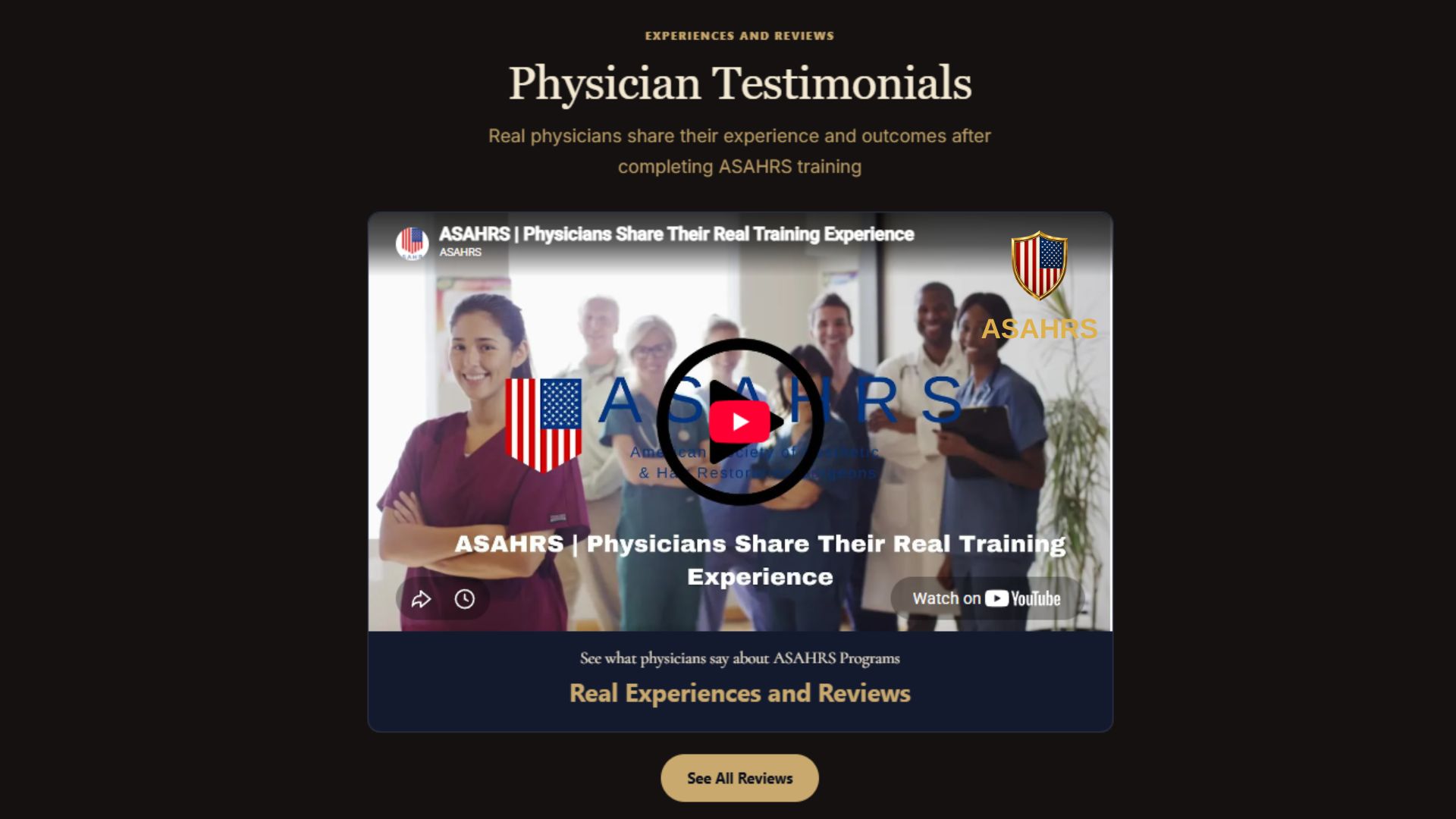
Watching recorded physician experiences is a fast way to judge whether a program fits your learning style and clinical goals when pursuing a chemical peel certification. The ASAHRS EDU Physician Reviews gallery hosts video testimonials and first‑hand accounts from practicing clinicians who completed the Fellowship, and these narratives highlight hands‑on supervised sessions, faculty accessibility, and post‑program support that matter in day‑one practice implementation. Reviewers commonly cite the program's emphasis on anatomy, safety protocols, and device‑neutral education as differentiators that make the learning immediately translatable to clinic workflows.
These video reviews are complemented by written testimonials that outline specific case outcomes, complication management examples, and the integration of marketing checklists into launch plans. The ASAHRS EDU reviews page organizes feedback so prospective applicants can filter experiences by specialty, geographic region, and cohort format — facilitating realistic expectations about time‑to‑competency and practice impact. Below is a short list summarizing what clinicians most often report as immediate benefits after certification:
- Structured clinical confidence in peel selection and depth control.
- Practical safety protocols for neutralization, phototype management, and post‑treatment care.
- Business readiness including SOPs, pricing templates, and patient‑acquisition strategies.
Collectively these reviews form a consistent narrative: clinicians gain not just a certificate but a functioning treatment pathway for chemical peels that is supported by recorded sessions, faculty Q&A archives, and downloadable templates in the Student Portal. For an in‑depth look at alumni outcomes and faculty commentary, watch the Physician Video Reviews gallery and consult the Program Experience page for additional context.
EXPERIENCES AND REVIEWS
Physician Testimonials
Real physicians share their experience and outcomes after completing ASAHRS training
See All ReviewsTechnology & Technique: Evidence‑First Peel Protocols
Effective chemical peel certification requires more than memorizing acid percentages; clinicians must understand how energy, tissue, and adjunctive devices interact to produce reproducible results. ASAHRS EDU excels at delivering a technology‑neutral approach that frames chemical peels alongside laser and device combinations — teaching depth control, neutralization, and when to sequence peels with modalities like microneedling RF or LED therapy. The curriculum includes device‑comparison worksheets and QA checklists accessible via the Student Portal, enabling graduates to evaluate vendor claims and consumable costs objectively.
Specifically, the fellowship covers acid classes (alpha‑hydroxy acids, beta‑hydroxy acids, trichloroacetic acid), indicators for superficial vs medium depth peels, and parameters to adjust for Fitzpatrick skin types to minimize dyspigmentation risk. ASAHRS EDU uses case‑based workshops where parameter selection and cooling strategies are practiced under faculty supervision, and materials include procedural checklists for neutralization timing and ocular protection. For module specifics, see the Program Curriculum which enumerates device and topical protocol learning objectives.
Clinicians will also gain competency in combination sequencing: when to pair peels with topical retinoid preconditioning, how to incorporate photoprotection into aftercare, and the evidence base for adjunctive LLLT in recovery. External resources on peel efficacy and complications reinforce our coursework — for example, guidance from the American Academy of Dermatology outlines safety principles for resurfacing procedures (AAD) and peer‑reviewed literature summarizes complication rates and mitigation strategies (PubMed). These citations are woven into lectures and practical labs so learners can connect primary evidence to everyday clinical decisions.
“Training must teach the science before the shortcut — that is the ASAHRS EDU philosophy for chemical peels.”
Overall, practitioners who choose ASAHRS EDU for chemical peel certification benefit from modular, evidence‑informed technique sessions, technology‑neutral vendor evaluation tools, and faculty‑supervised practice that reduces the risk of common complications while increasing predictable outcomes. To preview the peeling modules and device demos in upcoming cohorts, consult the Dates & Locations and the Program Experience pages.
Ready to take the next step?
Book a Free ConsultationChemical Peel Certification Curriculum & Practical Competency
ASAHRS EDU structures its chemical peel certification across a comprehensive 40‑module curriculum delivered in phased learning that blends online prework with in‑person supervised practice. The curriculum is organized into 13 phases and fifteen integrated stages so clinicians progress from foundational anatomy and skin biology to hands‑on procedure labs and complication management. Each enrolled clinician receives access to the Student Portal, where the digital program manual, treatment planning templates, and recorded session reviews are housed for ongoing reference.
The peel modules include didactic sessions on acid chemistry, patient assessment, photography standards, consent documentation and evidence‑based aftercare. ASAHRS EDU ensures that anatomy precedes technique, with proctored dissection reviews and imaging workshops that sharpen recognition of vascular, pigmentary and structural risk factors. Graduates receive a certificate of completion and ongoing access to the faculty Q&A archive, which is invaluable for case follow‑up and complication consultations.
Enrollment is single comprehensive enrollment — clinicians get the full Fellowship experience rather than piecemeal vendor courses. The program pairs clinical training with integrated business modules that teach SOPs, treatment‑menu design, pricing, membership models and patient‑acquisition systems so your new skills translate into sustainable practice offerings. Interested clinicians should review the Program Curriculum and consider current cohort availability on the Program Dates page; if you have questions, Contact Us or Apply Now to schedule an advisor call.
Locations & Access: How To Attend Chemical Peel Certification
ASAHRS EDU delivers a blended learning format so clinicians worldwide can access the chemical peel certification regardless of practice locale. Core education begins online through the Student Portal and transitions to in‑person cohorts for supervised hands‑on participation where permitted. For a current list of cohort cities, dates, and venues consult the Dates and Locations page which lists Fellowship Program Dates and cohort logistics.
International clinicians are welcome to apply; ASAHRS EDU accepts eligible applicants from multiple jurisdictions and accommodates international fellows through designated cohorts. Logistics such as facility names, addresses, and partner hotel options are provided to confirmed participants upon enrollment, and virtual advisor calls are available to discuss eligibility and cohort fit. For questions about application requirements or tuition, review the Tuition page or Speak with an advisor to schedule a program consultation.
Practical notes for attendees: prework must be completed through the Student Portal before attending in‑person labs; equipment demos and device comparisons are scheduled during cohorts and are listed on the Dates & Locations entries when a cohort includes hands‑on device experiences. Applicants should also consider travel windows, cohort capacity limits and deposit policies when planning attendance. If you need to confirm availability or register your interest, use the Apply to the Program page or Contact Us for a personalized enrollment discussion.
Want personalized advice?
Schedule Your AssessmentPractice Growth, Safety & Complication Management
Patient safety is central to the ASAHRS EDU approach to chemical peel certification, and the program places heavy emphasis on anatomy before technique, complication recognition, and escalation protocols. Module content includes vascular compromise recognition, pigmentary risk mitigation, post‑peel infection prevention, and emergency preparedness — all taught within a technology‑neutral framework so clinicians can adapt these safety systems across peel types and adjunctive technologies. For formal statements about board pathways and credentialing, see the Aesthetic Medicine Board Certification page.
In addition to clinical safety, ASAHRS EDU integrates business and marketing training so newly certified clinicians can launch services responsibly. This includes SOP templates, launch checklists, pricing worksheets, membership models and patient‑acquisition systems available in the Student Portal. These materials, combined with recorded session reviews and faculty case discussions, help clinicians create reproducible protocols that support both clinical safety and practice sustainability.
When complications occur — as they sometimes will in any procedural practice — ASAHRS EDU teaches clear documentation workflows, escalation pathways and referral networks. The program recommends standardized consent language, photography standards and complication logs, and it provides scenario‑based drills during in‑person cohorts so clinicians can practice emergency responses before they are needed in clinic. For privacy and program policy references, consult the Privacy and Terms pages.
“Safety, documentation and escalation are not optional — they are the core of sustainable aesthetic practice,” says ASAHRS EDU faculty in recorded program sessions.
Ultimately, the ASAHRS EDU chemical peel certification is designed to reduce risk while increasing predictable results through rigorous training, post‑program support and integrated business systems. Graduates return to clinic with confidence in both technique and practice management, and ongoing access to the faculty Q&A archive ensures cases can be reviewed with mentors as new challenges arise.
Results & Social Proof
ASAHRS EDU documents outcomes through video reviews, written testimonials and an international faculty network that includes named contributors such as Dr. Thomas Warren, MD; Dr. Lydia Ferrell, MD; and Dr. Rajiv Choudhary, MD. The Results & Social Proof section of our program materials aggregates these success stories and clarifies what the certification enables — improved procedural confidence, expanded treatment menus, and measurable patient satisfaction improvements. For a curated set of alumni accounts, visit the Success Stories and video gallery on the site.
Beyond testimonials, ASAHRS EDU maintains a network of scientific fellows and international alumni who publish case series, present at meetings, and contribute to the faculty Q&A archive. These contributions provide third‑party validation of the program's educational rigor and demonstrate real‑world application across diverse practice environments. Explore the Scientific Fellows and International Fellows pages to see how alumni engage academically after certification.
While the program does not guarantee income or licensure, many graduates report increased patient interest and higher case conversion rates after implementing standardized peel menus and marketing workflows taught in the fellowship. Prospective participants can watch clinician interviews on the Physician Video Reviews page and read independent Physician Reviews for insights into cohort experiences, faculty access, and immediate clinic integration tips.
See how we can help you
Get Started TodayTrust, Safety & Guarantee
Transparency is foundational to the ASAHRS EDU approach: the program clearly states tuition, deposit policies, and what is and is not included in enrollment. Tuition details are available on the Tuition page and enrollment policies are explained on the Apply and Dates & Locations entries. The fellowship issues a certificate of completion upon meeting program requirements but does not represent a statutory medical license or guarantee practice success, which aligns with standard educational disclaimers in the field.
ASAHRS EDU emphasizes patient‑centered education and enforces the principle of anatomy before technique, with explicit training in complication prevention, recognition and escalation. The program's legal and privacy safeguards are documented in the Privacy Policy, Terms and Cookie Notice. For formal credential pathways, refer to the Board Certification page which lays out how the fellowship integrates into broader certification considerations.
For prospective applicants who want to evaluate the program before committing, ASAHRS EDU offers downloadable program guides and advisor calls; request materials or schedule a conversation via the Contact Us page. If you want to preview module topics or the student experience, the Program Experience page and Student Portal provide a representative sample of course content and post‑program supports.
Conclusion
Choosing where to pursue a chemical peel certification has long‑term implications for clinical safety, patient outcomes and practice growth. ASAHRS EDU packages a single comprehensive enrollment that combines a 40‑module, phased curriculum with technology‑neutral device education, deep safety training and business systems for launch and scale. The Fellowship model — with online preparation, in‑person supervised labs, and extensive post‑program resources — equips clinicians to integrate peels responsibly and profitably into their practices.
Graduates of the ASAHRS EDU chemical peel pathway leave with practical checklists, SOPs, templates and a mentor network that supports ongoing cases and complication management. If you are evaluating programs, review the Program Curriculum, watch physician accounts on the Physician Reviews page, and Speak with an advisor to discuss cohort fit and logistics. Enroll today to secure a place in an upcoming cohort via the Apply Now page and begin a pathway that centers safety, evidence and scalable practice growth with ASAHRS EDU.
Frequently Asked Questions
What does the ASAHRS EDU chemical peel certification include?
ASAHRS EDU's certification includes a complete 40‑module curriculum delivered across phased online and in‑person experiences, supervised hands‑on peel clinics, device‑neutral education, safety and complication management modules, and business growth training. Enrollees get Student Portal access to a digital program manual, templates, recorded session reviews, faculty Q&A archives and a certificate of completion; for a detailed module list see the Program Curriculum.
Who is eligible to apply for chemical peel certification?
Eligibility typically requires a healthcare professional license; international clinicians may apply subject to local regulatory constraints and cohort format. To confirm eligibility for a specific cohort, consult the Dates and Locations page and Speak with an advisor for a personalized review of your qualifications.
How does ASAHRS EDU address safety and complications for peels?
Safety is prioritized through anatomy‑first instruction, complication recognition drills, neutralization protocols, phototype adjustments, and escalation pathways taught during in‑person labs. The program includes documentation templates and SOPs in the Student Portal and emphasizes referral networks and emergency preparedness to reduce clinical risk; see the About and Board Certification pages for program policies and disclosures.
Are device demos and combination protocols included?
Yes, ASAHRS EDU provides supervised device demos and teaches combination sequencing when cohort logistics permit. Device comparison tools and QA checklists are provided in the Student Portal so clinicians can evaluate device economics and maintenance; check cohort listings on the Dates & Locations page for sessions that include hands‑on device instruction.
How do I register or ask more questions about the program?
To register or request more information, visit the Apply page or Contact Us to schedule an advisor call. You can also preview alumni experiences via the Physician Reviews and the Program Experience page to decide if the ASAHRS EDU chemical peel certification aligns with your clinical and business goals.
Medical Information Disclaimer
This content is provided for general educational purposes only. It is not a substitute for professional advice, diagnosis, or treatment. Readers are advised to consult qualified professionals for personalized recommendations.
Have questions? We have answers.
Speak With an Expert