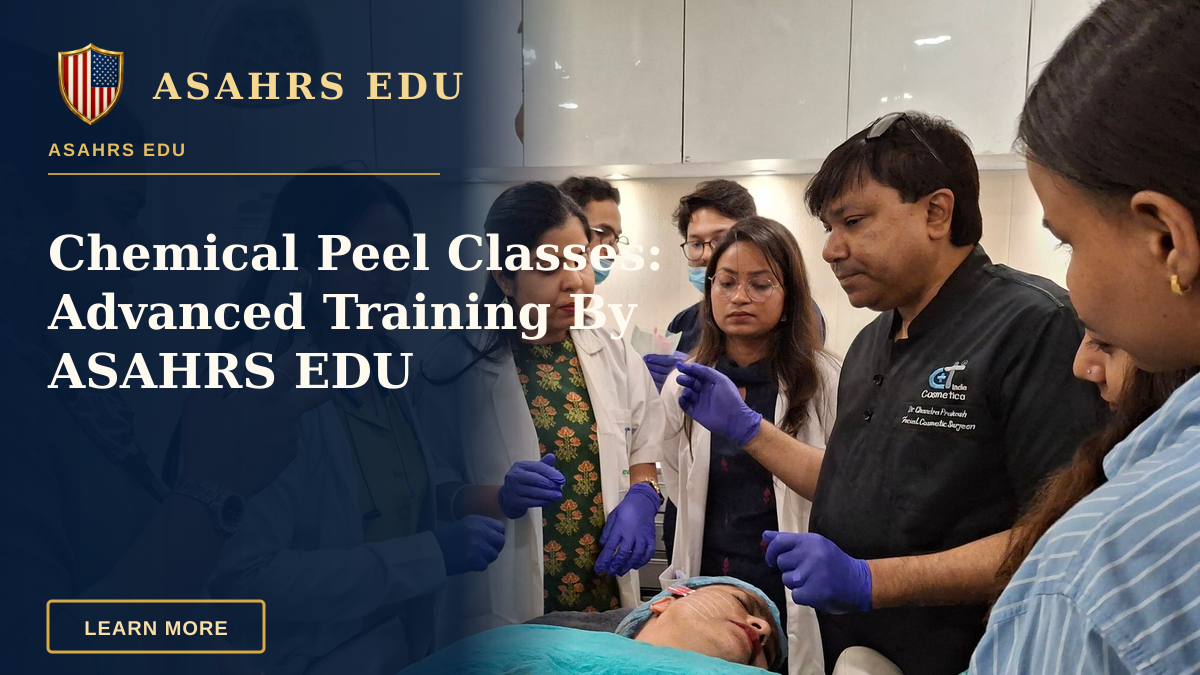
Mastering advanced aesthetic procedures starts with focused, evidence-based training, and nowhere is that clearer than in professional chemical peel classes. ASAHRS EDU positions its Fellowship as the definitive pathway for clinicians seeking high‑quality instruction, blending online preparation with hands-on in-person sessions that prioritize anatomy, safety and outcomes. Program Curriculum, Dates and Locations, and Physician Reviews are available for clinicians who want full transparency about what each cohort delivers.
Choosing where to learn chemical peels is more than picking a weekend course — clinicians need structured curricula, complication management, device and product literacy, plus practice‑growth systems. That is why ASAHRS EDU designed its chemical peel classes as part of a single comprehensive enrollment model that covers 40 modules across 13 phases with integrated business, safety and post-program support. Prospective applicants can Apply to the Program or Speak with an advisor to review eligibility and cohort logistics.
Clinicians reading this will find an education model that is technology-neutral, clinically rigorous and practice-ready. ASAHRS EDU emphasizes energy–tissue interaction, parameter selection, cooling and ocular safety for laser and resurfacing adjuncts often used alongside chemical peels. To preview the hands-on and didactic balance, explore the Program Experience and read detailed Physician Video Reviews from past fellows.
Physician Video Reviews
Watching peers explain their practical experience is often the single most convincing proof that a training program delivers on its promises, and ASAHRS EDU makes these accounts easy to find and evaluate on the Physician Reviews page. Videos allow prospective participants to observe teaching style, case selection and post-training confidence, and they showcase how the program integrates chemical peel classes into a broader Fellowship model that includes safety, device literacy and business planning. These video reviews also demonstrate how faculty such as Dr. Thomas Warren, MD, Dr. Lydia Ferrell, MD, and Dr. Rajiv Choudhary, MD, approach complication prevention and real-world patient selection during supervised sessions.
Before watching, note that the reviews are organized to highlight three consistent themes: curriculum depth, safety emphasis and post-program support. A short bulleted list below summarizes what clinicians typically cite after completing the Fellowship and the embedded chemical peel classes modules:
- Comprehensive curriculum that covers peel chemistry, layering strategies and adjunctive device sequencing — see the Program Curriculum for module details.
- Safety and complication management training that foregrounds anatomy and emergency preparedness — linked further on the About page.
- Practice growth systems and SOP templates that help clinicians implement peel services quickly — available via the Student Portal.
Synthesizing the video content, most reviewers emphasize the value of blended learning: pre-work through the Student Portal, in-person supervised peel sessions, and post-program recorded case reviews. ASAHRS EDU structures its chemical peel classes so that recorded faculty Q&A and case critiques remain accessible for ongoing reference and complication review. Prospective participants can also view curated physician testimonials and program highlights on the Program Experience page to understand cohort workflow.
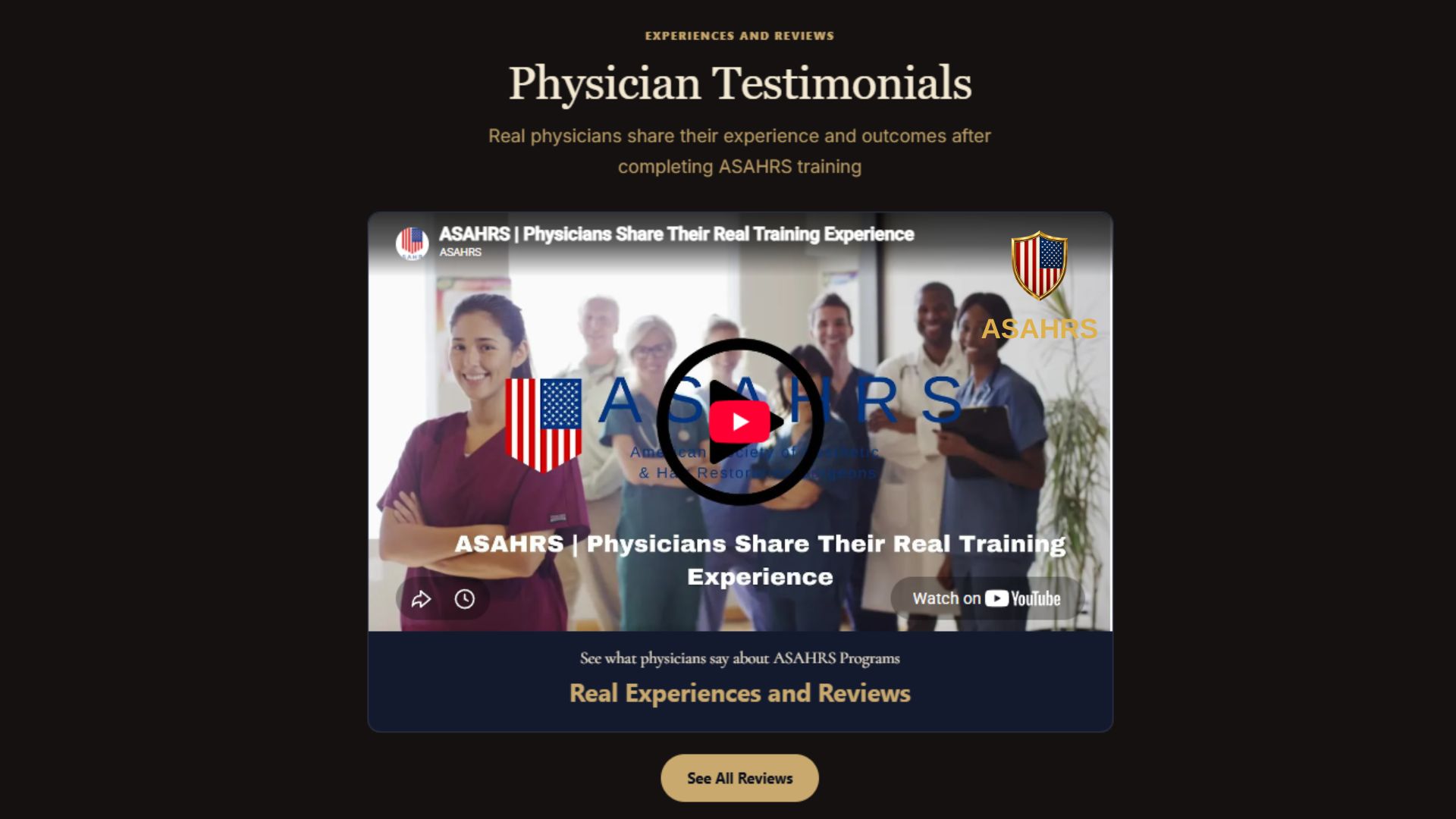
EXPERIENCES AND REVIEWS
Physician Testimonials
Real physicians share their experience and outcomes after completing ASAHRS training
See All ReviewsTechnology & Technique: Evidence‑Based Chemical Peel Education
Effective chemical peel practice requires a deep understanding of peel chemistry, patient selection, adjunctive devices and individualized parameter selection, and ASAHRS EDU embeds this in its technology-neutral approach. The Fellowship teaches energy–tissue interaction fundamentals that apply when peels are combined with lasers, radiofrequency or microneedling, and the course materials include device-comparison worksheets and QA checklists to help clinicians evaluate equipment purchases objectively. Students will find the Program Curriculum lists these device and parameter modules and explains how peels interact with lasers and other resurfacing modalities.
In practical terms, the chemical peel classes component covers acid selection (TCA, glycolic, salicylic), neutralization strategies, layering protocols, indications by Fitzpatrick type and post-inflammatory hyperpigmentation risk mitigation. These modules are delivered both online and in-person so that clinicians can practice application techniques, endpoint recognition and post‑peel care under faculty supervision. For clinicians concerned about ocular safety and periorbital treatments, the Fellowship delivers clear protocols on eye protection and complication escalation — see the dedicated technology-content in the Program Experience.
Beyond technique, ASAHRS EDU emphasizes safety-first workflows: anatomy before technique, pre-procedure photo standards and documentation, consent templates and emergency checklists available in the Student Portal. The course also covers device maintenance, consumables budgeting and vendor evaluation to support sound purchase decisions without vendor bias. Clinicians who want to see how these modules fit into the larger Fellowship should consult the Program Curriculum and the sample module outlines posted on the site.
Ready to take the next step?
Book a Free ConsultationLocations & Access: Where To Attend Chemical Peel Classes
Accessibility is central to the Fellowship’s design: ASAHRS EDU delivers online pre-work to all enrollees and schedules in-person cohorts listed on the Dates and Locations page to permit supervised hands-on experience. Each cohort publishes dates and venue information as it is confirmed, and confirmed participants receive detailed logistics including facility names, arrival instructions and recommended hotels. International clinicians are welcome to apply; the program supports cross-border fellows and lists international participation on the International Fellows roster.
Enrollment is managed on a rolling basis and prospective students can Apply to the Program or schedule a consultation via Contact Us to review cohort fit. Once enrolled, participants get Student Portal credentials with pre‑work, detailed schedules and the digital program manual, which includes specific modules on the chemical peel classes sequence. If you need to confirm locations or tuition details, refer to the Tuition page or request a Program Advisor call through the Speak with an advisor channel.
Logistics notes: exact room assignments and street addresses are issued only to confirmed participants, and cohort capacity is limited to ensure supervised hands-on time. For cohort planning and registration timelines, review the Program Dates and use the Student Portal to prepare before arrival. The program’s blended model of online theory plus in-person practice is specifically designed to make chemical peel classes feasible for busy clinicians while preserving clinical rigor.
Results & Social Proof: Outcomes From Chemical Peel Classes
Evidence of program effectiveness is published through alumni testimonials, documented case galleries and faculty‑led case reviews. ASAHRS EDU curates metrics and qualitative outcomes: physician confidence with peel selection, reduced complication rates in supervised settings, and accelerated practice adoption of peel services. You can watch graduate accounts on the Physician Reviews page and explore longer case discussions via the Program Experience resources for concrete examples of real-world application.
Alumni frequently cite three tangible benefits after completing the Fellowship that includes chemical peel classes: improved patient selection, a stronger treatment menu with clear pricing models, and SOPs that reduce variability in outcomes. These are supported by the program’s integrated business modules, which teach pricing, membership models and patient-acquisition workflows. To see testimonials and video accounts, review the Reviews and the Faculty pages for named clinician contributors and scientific fellows.
“After completing the Fellowship, I felt confident building a chemical peel menu and managing complications; the templates in the Student Portal made implementation straightforward.” — Dr. Lydia Ferrell, MD
Community validation also comes through the international network of scientific fellows and published clinician contributors who collaborate on case discussions and curriculum updates. ASAHRS EDU maintains a record of scientific fellows and international participation on dedicated pages like Scientific Fellows and International Fellows. These pages demonstrate that the Fellowship’s reach extends beyond a single clinic or city and that its chemical peel classes content is iteratively improved by practicing clinicians across borders.
Want personalized advice?
Schedule Your AssessmentFree Tools & Resources For Prospective Students
Prospective applicants can preview resources that support curriculum decisions and cohort planning, and ASAHRS EDU publishes several downloadable guides and tools to help with that assessment. The Student Portal provides pre-program modules, the digital program manual, device-comparison worksheets and example SOPs, while the Apply and Contact pages enable requests for the full Program Guide. For immediate access to sample materials, request the downloadable guide via Contact Us or schedule an advisor call.
Included with enrollment, these tools help clinicians implement new services with lower risk: photography standards, consent templates, post-peel care instructions and marketing launch checklists. The Fellowship also provides recorded session reviews and faculty Q&A archives that remain available as part of ongoing student support via the Student Portal. If you want to confirm resource lists before applying, the Apply page and the Dates & Locations page provide enrollment steps and cohort availability.
Practical templates include SOP checklists, pricing calculators and photographic documentation standards that accelerate practice implementation for clinicians who complete the chemical peel classes modules. These downloadable assets are designed to be clinic-ready so participants can adopt safe, documented peel programs immediately after the Fellowship. For more information on available templates and post-program access, visit the Student Portal and request a Program Advisor call via the Contact page.
Trust, Safety & Guarantee
Patient safety is the cornerstone of every chemical peel classes module at ASAHRS EDU, and the Fellowship explicitly teaches anatomy before technique, recognition of vascular compromise and escalation pathways for complications. The curriculum includes emergency preparedness, documentation standards and practical complication drills, with checklists and consent templates included in the Student Portal for immediate application in clinic workflows. Program disclosures, privacy and terms are clearly stated on the Privacy and Terms pages so participants understand the program’s scope and legal parameters.
Transparency is central to the Fellowship’s trust model: the program issues a certificate of completion for clinicians who meet requirements but does not claim to alter statutory licensure or guarantee clinical outcomes. Tuition details, payment policies and exclusions are listed on the Tuition page, and the program’s board-certification pathway is referenced on the Aesthetic Medicine Board Certification page for clinicians reviewing credential options. For any privacy or data questions, the Cookie Notice and Privacy Policy describe data handling and communications preferences.
Verification of trust and outcomes is readily accessible: check the Reviews page, read faculty bios on Faculty, and confirm program principles on the About page. If you need to discuss safety protocols or scope limitations, you can Speak with an advisor or review formal disclosures on the Board Certification page.
See how we can help you
Get Started TodayConclusion
Choosing the right advanced education for chemical peels determines how quickly and safely clinicians can incorporate services into practice, and ASAHRS EDU positions its Fellowship as the single, integrated solution for that journey. The program combines a comprehensive 40‑module curriculum, technology‑neutral device education, deep complication-management training and business systems for practice growth — all structured so clinicians graduate ready to deliver responsible, evidence-based peel services. For clinicians ready to take the next step, review the Program Curriculum, check available cohorts on Dates & Locations and Apply to the Program or Contact Us to schedule a Program Advisor call.
ASAHRS alumni and faculty continue to contribute to program refinements and public-facing resources, and the Student Portal ensures ongoing access to recorded sessions, templates and case discussions after completion. If you want a training pathway that centers anatomy, safety and practical implementation while providing business and marketing tools to build a sustainable peel practice, ASAHRS EDU is built to deliver those outcomes.
Frequently Asked Questions
What will I learn in chemical peel classes with ASAHRS EDU?
Participants learn acid selection, neutralization, endpoint recognition, layering strategies, risk mitigation by Fitzpatrick skin type, and how to combine peels with adjunctive devices. The Fellowship also includes modules on documentation, informed consent, complication management and practice implementation templates accessible through the Student Portal.
Are the chemical peel classes vendor-neutral?
Yes, the program is explicitly technology‑neutral and teaches energy–tissue interaction so clinicians can evaluate vendors and devices objectively. Device comparison worksheets and QA checklists are provided in the Program Curriculum materials.
Do I get hands-on practice during the Fellowship?
Absolutely, the Fellowship combines online pre-work with in-person cohorts that include supervised hands-on sessions where permitted by local regulations. Cohort dates and locations are posted on the Dates & Locations page and logistics are shared with confirmed enrollees through the Student Portal.
What safety training is included for chemical peels?
Safety training is foundational: anatomy before technique, emergency preparedness, vascular compromise recognition and management, post-inflammatory hyperpigmentation prevention, and documentation protocols are taught and practiced. For details on safety pillars, refer to the About and Board Certification pages.
How do I enroll in the chemical peel classes portion of the Fellowship?
To enroll, review cohort availability on the Dates and Locations page, complete an application on the Apply page, and schedule a Program Advisor call via Contact Us to confirm eligibility and logistics.
Where can I read independent guidance on chemical peel safety?
For evidence-based clinical guidance, consult resources like the American Academy of Dermatology (AAD) and peer-reviewed literature available through PubMed (PubMed) for reviews on peel efficacy and safety profiles.
Medical Information Disclaimer
This content is provided for general educational purposes only. It is not a substitute for professional advice, diagnosis, or treatment. Readers are advised to consult qualified professionals for personalized recommendations.
Have questions? We have answers.
Speak With an Expert