Becoming a confident cosmetic injection nurse requires more than hands‑on practice — it demands integrated clinical knowledge, device literacy and business systems designed for real clinic growth. ASAHRS EDU is the single pathway that packages those competencies into a structured Fellowship, and every module is intentionally mapped to the real problems nurses face when launching or expanding an aesthetic injector practice. Program Curriculum and Program Dates are published for upcoming cohorts so applicants can plan learning and travel.
At the core of the training is a technology‑neutral approach that teaches energy–tissue interaction, device evaluation and injectables science without vendor bias so learners become discerning clinicians able to select safe settings and manage complications. ASAHRS EDU pairs online preparation with in‑person supervised participation and a full business toolkit so graduates are ready to deliver care and scale a service line. You can review faculty and alumni perspectives on the Physician Reviews page or speak with an advisor about eligibility and dates.
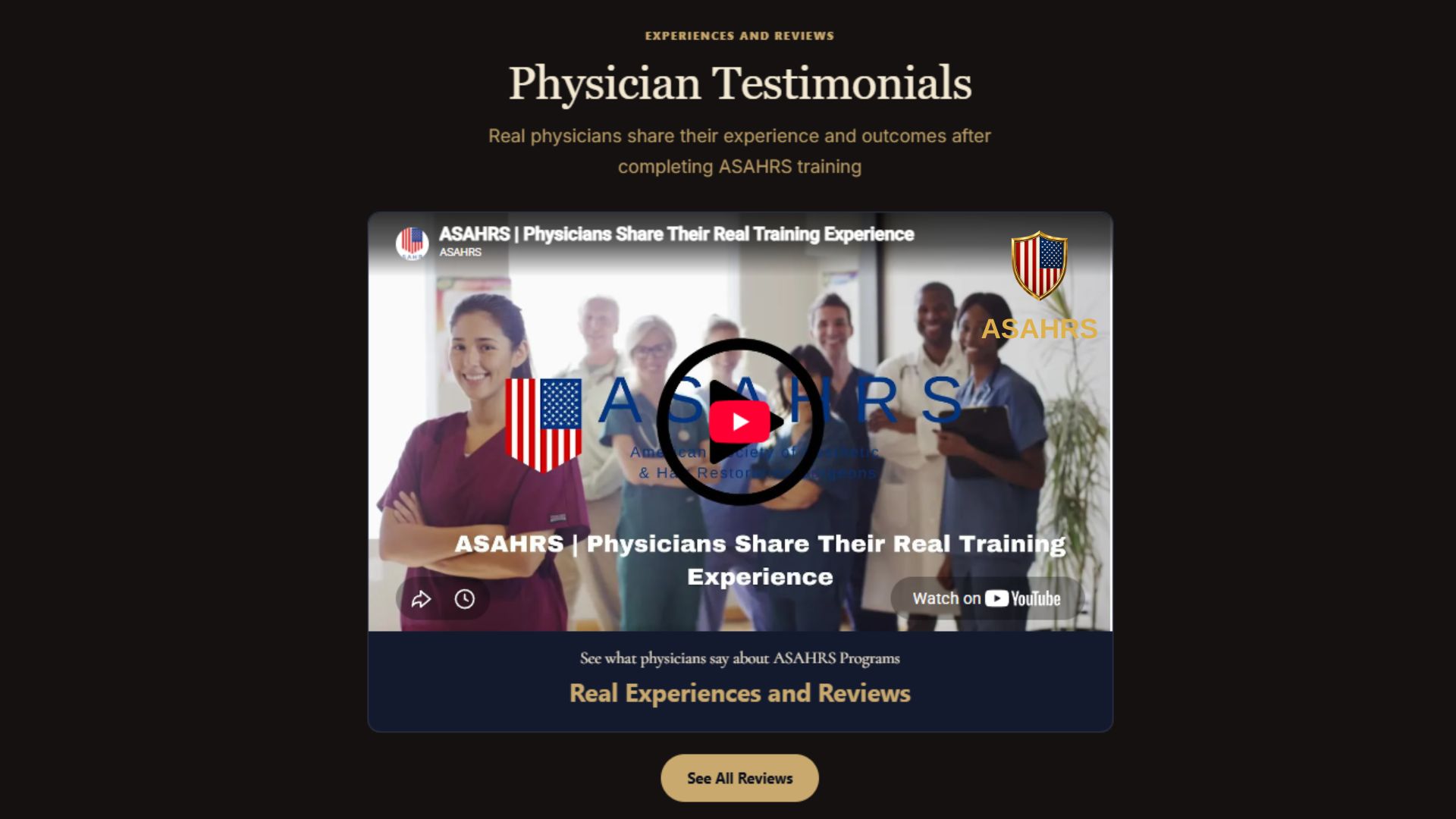
Physician Video Reviews
Many prospective cosmetic injection nurses tell us that hearing peer experiences is the moment they decide to apply, and the ASAHRS EDU Physician Reviews gallery is curated to show exactly that: clinicians describing day‑one competence gains, patient safety wins and concrete practice growth. The video reviews include candid reflections on the Fellowship structure, the balance of online and hands‑on learning, and how the integrated marketing modules helped participants build consistent appointment flow. These narratives are purposefully organized so prospective applicants can watch peers with similar backgrounds and clinical scopes.
Included below is a short summary list of the most commonly cited benefits from our physician reviewers; each bullet echoes options that are taught explicitly in the Fellowship curriculum and referenced in the Program Experience materials:
- Clinical confidence: anatomy‑first training and supervised injections reduce early‑career risk.
- Device literacy: technology‑neutral modules teach how to read parameters and evaluate devices.
- Practice growth: marketing playbooks and SOPs translate clinical skills into repeatable revenue.
- Ongoing support: post‑program resources in the Student Portal help with case reviews and complications.
Following the video summaries, most viewers request the detailed module map and device checklist — both of which are available through the Program Curriculum page and the Student Portal for enrolled learners. The reviews also point to named clinician contributors such as Dr. Thomas Warren, MD; Dr. Lydia Ferrell, MD; and Dr. Rajiv Choudhary, MD as examples of faculty and scientific fellows who actively mentor cohorts through case discussions and recorded Q&A sessions.
In short, the ASAHRS EDU video reviews make a direct promise to applicants: measurable safety competence, technology‑neutral device evaluation skills, and a business playbook that complements clinical technique. Many reviewers finish by encouraging prospective injection nurses to speak with an advisor to identify the right cohort and next steps.
EXPERIENCES AND REVIEWS
Physician Testimonials
Real physicians share their experience and outcomes after completing ASAHRS training
See All ReviewsTechnology & Technique: A Technology‑Neutral Foundation
Understanding how injectables and energy‑based devices interact with tissue is a critical competency for any cosmetic injection nurse, and ASAHRS EDU teaches these fundamentals without vendor bias so clinicians evaluate products on science, not marketing. The Fellowship's device modules cover parameter selection, cooling strategies, ocular protection and device safety checklists; these are taught as generalizable principles so nurses can apply them across lasers, RF, ultrasound and injectables. Practically, learners complete hands‑on demonstrations and supervised sessions that show how parameter choices influence patient outcomes and complication risk.
ASAHRS implements device education through a combination of recorded lectures, device‑comparison worksheets and in‑person demos during cohort dates listed on the Dates and Locations page. These materials are reinforced with QA checklists and maintenance guidance that nurses can use when evaluating lease vs purchase economics and clinical suitability for their practice setting. The program also references evidence from peer‑reviewed literature and device whitepapers to ensure instruction remains current and defensible; where relevant, we link to FDA guidance or clinical studies to demonstrate endpoints and safety margins (FDA, JAMA).
For working nurses, the immediate benefit of this approach is clinical independence: graduates can interpret device manuals, set conservative initial parameters, institute cooling strategies and ensure ocular protection in periocular treatments — all skills emphasized in the injection modules. The program's technology‑neutral approach reduces reliance on vendor training and creates measurable criteria for device selection in clinic procurement meetings, and the Program Curriculum page lists each module that addresses these topics.
Safety first: "Anatomy before technique" is the axiom we repeat in device and injectable modules, stressing predictable endpoints and escalation pathways.
ASAHRS also supplies device evaluation templates inside the Student Portal, teaching nurses how to document test parameters, consumables costs and service contracts so clinic leaders can make informed purchase decisions. This combination of theory, checklist and supervised practice makes the technology modules one of the strongest differentiators for the Fellowship.
Ready to take the next step?
Book a Free ConsultationClinical Curriculum And Practice‑Growth Systems
Every cosmetic injection nurse who completes the Fellowship receives a complete 40‑module curriculum delivered across phased learning so technical skill development and business systems evolve together. ASAHRS EDU integrates online preparation, in‑person clinical education and supervised hands‑on participation to ensure competence, and the curriculum is accessible for review on the Program Curriculum page. Modules include anatomy, injection technique, filler rheology, neuromodulator dosing, complication recognition and management, photography standards and informed consent workflows that align with clinic SOPs.
Importantly, the Fellowship pairs clinical learning with an integrated business track so nurses can design a treatment menu, set pricing, build membership models and execute launch checklists. These practice‑growth systems are taught with templates and SOPs that are available in the Student Portal, and participants are coached on patient‑acquisition systems and scalable planning for increasing throughput without sacrificing safety. The program also covers documentation standards and escalation protocols to support legal defensibility and practice continuity; additional details on the Board Certification pathway and scope are available on the Aesthetic Medicine Board Certification page.
As a result of this integrated approach, graduates report not only improved technique but measurable practice changes: higher retention, clearer consent processes and predictable revenue streams. Many graduates showcase their outcomes through the Physician Reviews and curated Program Experience pages, and program alumni are invited to ongoing case discussions and faculty Q&A sessions found under the Faculty and Scientific Fellows pages.
Locations & Access
ASAHRS delivers the Fellowship as a blended program: online modules for universal preparation and scheduled in‑person cohorts for supervised hands‑on learning, and nurses can access full logistical information on the Dates & Locations page. The program issues precise cohort details — venue, faculty and local logistics — to confirmed participants, and international clinicians are welcome to apply through the Apply process. For working nurses, cohort scheduling is designed to minimize downtime while maximizing supervised procedural exposure.
Prospective applicants can also schedule a pre‑enrollment conversation with a Program Advisor via the Contact Us page to confirm eligibility, cohort suitability and travel guidance. After enrollment, participants receive Student Portal credentials that contain pre‑work, the digital program manual, and checklists to prepare for the in‑person phase — these resources are accessible through the Student Portal link. The Fellowship's cohort dates and cities are posted and updated on the Fellowship Program Dates schedule; early application improves chances for preferred locations and dates.
Additionally, ASAHRS EDU maintains a transparent admissions policy and tuition page that outlines payment options, deposit terms and inclusions so nurses can plan finances; specifics are listed on the Tuition and Apply pages. For clinicians practicing abroad, the International Fellows guide explains how the program accommodates different regulatory environments and offers pathways to collaborate with international faculty.
Want personalized advice?
Schedule Your AssessmentTrust, Safety & Graduate Support
Patient safety is the central organizing principle for every cosmetic injection nurse curriculum element at ASAHRS EDU, and the Fellowship explicitly teaches anatomy before technique, complications recognition, emergency preparedness and escalation pathways. Nurses practice vascular compromise algorithms, filler reversal protocols and burn/thermal injury mitigation strategies in simulations and supervised clinical environments, and documentation standards for informed consent and incident reporting are included in program templates. The Fellowship also clarifies what the certificate of completion represents and what it does not: it confirms program completion but does not change statutory licensure or substitute for local credentialing.
ASAHRS further supports graduates through an ongoing portal that stores recorded session reviews, case discussions, a faculty Q&A archive and device‑comparison worksheets that teams can continue to use during procurement or complication consults. The Student Portal and post‑program resources are a central hub for alumni to obtain templates, SOPs and recorded content that reduce early‑career risk and accelerate safe practice ramp‑up. The Fellowship also points to formal policies and legal safeguards on the Privacy, Terms and Cookie Notice pages to ensure transparency about data and communications.
Clinical quote: "We teach recognition before treatment — the quickest path to safer clinics is predictable escalation and documentation."
Finally, the program is candid about outcomes and exclusions: the Fellowship does not guarantee specific income, licensing changes or patient outcomes, and tuition details and exclusions are listed by cohort on the Dates and Locations and Tuition pages. Nurses who want to verify program claims are encouraged to consult the About page, the Board Certification pathway and the alumni review pages for third‑party perspectives.
Conclusion
For any nurse considering a career as a cosmetic injection nurse, choosing a program that combines clinical depth, technology‑neutral device education and practice‑growth systems is essential, and ASAHRS EDU was designed precisely to meet that need. The Fellowship's 40‑module structure, integration of online preparation with supervised hands‑on learning, emphasis on complication management and the inclusion of business templates make it a single‑enrollment, end‑to‑end pathway. Prospective applicants can review the Program Curriculum, view alumni Physician Reviews, and speak with an advisor to confirm cohort fit and dates.
When clinical skills, device literacy and business systems are taught together, nurses accelerate safe practice adoption and improve patient care outcomes; that is the promise of ASAHRS EDU. If you are ready to transform your injection practice, explore cohort options on the Dates & Locations page or apply now to reserve a seat.
See how we can help you
Get Started TodayFrequently Asked Questions
What is a cosmetic injection nurse and who should apply?
Typically a cosmetic injection nurse is a licensed nurse who provides neuromodulators, dermal fillers and related minimally invasive aesthetic procedures under local law and clinic protocols. ASAHRS EDU accepts eligible healthcare professionals and recommends the Contact Us page to schedule a Program Advisor call if you are unsure about eligibility. The Fellowship is especially useful for nurses seeking technology‑neutral device education, supervised hands‑on experience, and business systems for practice growth.
How long is the Fellowship and what does the curriculum include?
The Fellowship is delivered as a 40‑module curriculum across phased learning that mixes online preparation with in‑person supervised clinical sessions. Detailed module descriptions and sequencing are available on the Program Curriculum page and the Program Experience materials. Core areas include anatomy, injectables, complication management, technology education and practice‑growth modules.
Does ASAHRS EDU provide post‑program support?
Yes, graduates retain access to the Student Portal with recorded sessions, templates, checklists and a faculty Q&A archive to support ongoing case review and complication management. The portal link and access process are outlined on the Student Portal page, and alumni are invited to participate in periodic case discussions and reviews.
Will the Fellowship certify me to practice new procedures?
The ASAHRS EDU certificate of completion documents that you have met program educational requirements, but it does not change local licensure or guarantee expanded clinical privileges; nurses must always follow their statutory scope of practice and employer policies. The program clarifies licensing and certifying pathways on the Aesthetic Medicine Board Certification page and in admissions materials.
How can I view alumni results and clinician testimonials?
You can watch video testimonials and read physician reviews on the Physician Reviews page, and the Program Experience section provides deeper examples of clinical pathways and practice impact. For tailored conversations, use the Speak with an advisor link to request specific alumni contacts or cohort references.
Medical Information Disclaimer
This content is provided for general educational purposes only. It is not a substitute for professional advice, diagnosis, or treatment. Readers are advised to consult qualified professionals for personalized recommendations.
Have questions? We have answers.
Speak With an Expert