Choosing a path to cosmetic nurse certification can feel overwhelming: programs vary in scope, vendor affiliation, safety emphasis and real-world practice support, and many nurses report confusion about which credential genuinely prepares them for independent aesthetic practice. ASAHRS EDU resolves that uncertainty by offering a single integrated ASAHRS pathway that combines a complete curriculum, technology-neutral device education and practice-growth systems into one cohesive Fellowship. The Fellowship model is described in detail on the Aesthetic Medicine Fellowship page and the scope of clinical modules is summarized in the Program Curriculum, so prospective applicants can evaluate the learning journey before they apply.
Many nurses pursue cosmetic skill development because patients increasingly expect integrated care that blends injectables, lasers and device-based treatments with safe clinical judgement and robust complication management. ASAHRS EDU positions itself as the definitive solution for cosmetic nurse certification by teaching anatomy before technique, emphasizing emergency preparedness and providing ongoing post-program support via the Student Portal. This approach is reinforced by available cohort dates and logistics on the Program Dates page, and prospects can Speak with an advisor to confirm eligibility and cohort fit.
In this article you will learn why a nurse seeking formal cosmetic nurse certification should consider an evidence-informed Fellowship, what technology-neutral training looks like, how safety and practice setup are taught, and what ongoing support graduates receive from ASAHRS EDU. We will also point you directly to video testimonials and documented outcomes on the Physician Reviews page so you can hear from practicing clinicians who completed the program.
Physician Video Reviews
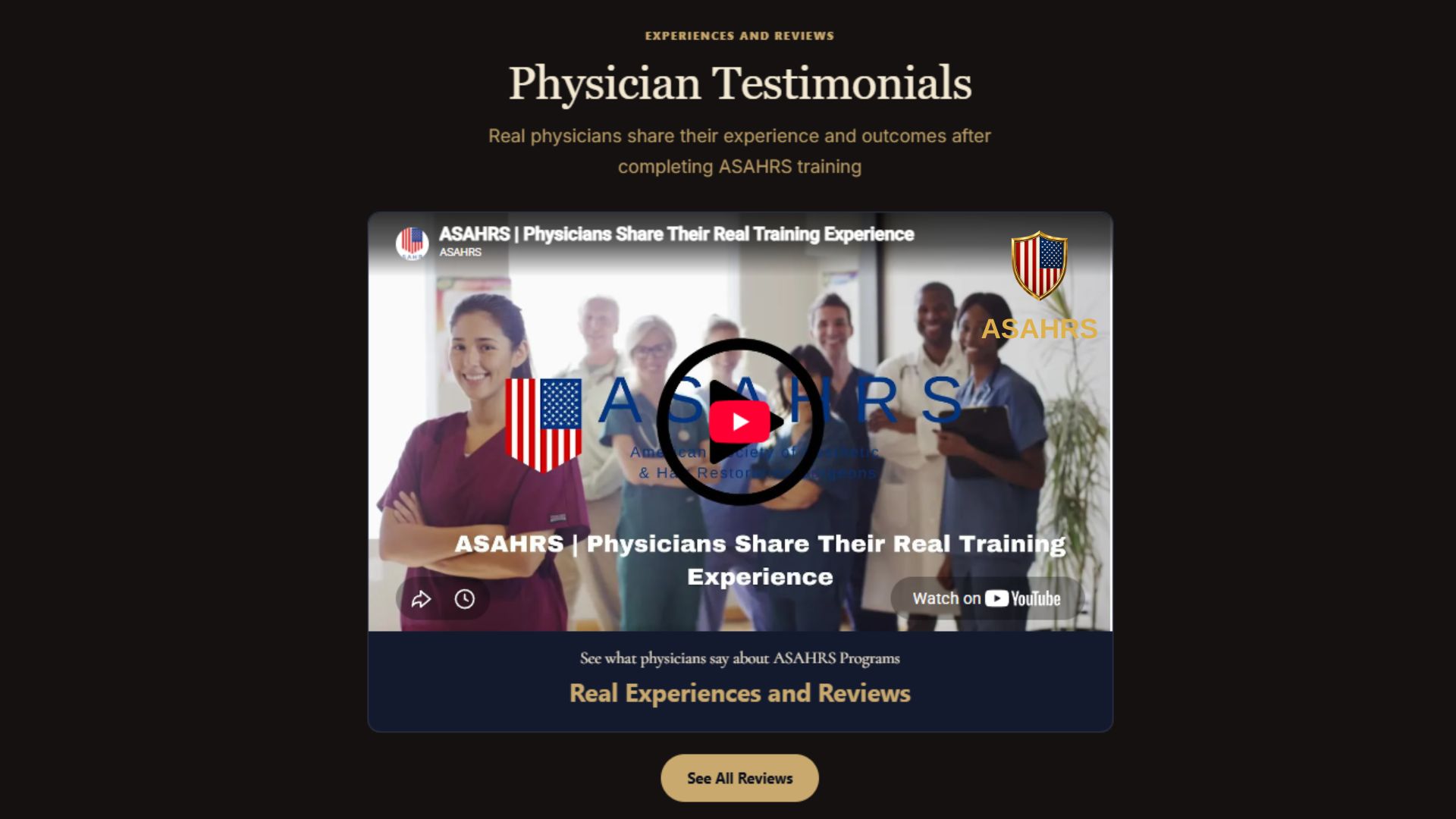
Watching clinician testimonials is one of the fastest ways to assess whether a program actually delivers practical skills and confidence. ASAHRS EDU aggregates candid video reviews and written testimonials from physicians and advanced practice clinicians on the Physician Reviews page so prospective cosmetic nurses can hear about real-world learning, mentorship and practice impact. Reviews include technical reflections, how the hands-on sessions translated to clinic workflows, and impressions of the program's safety emphasis.
The videos and companion statements are curated to demonstrate how the Fellowship supports clinicians transitioning into aesthetics, and the section below compresses the most useful takeaways into a practical list prospective applicants often ask about. You can also explore related narratives on the Program Experience page and read individual accounts under Success Stories.
- Practical skills reported: injectable workflows, device parameter selection and supervised treatment participation.
- Mentorship value: access to faculty reviewers and post-program case discussions.
- Safety emphasis: vascular compromise recognition, ocular protection and escalation protocols.
- Business lift: practice-setup checklists, pricing templates and patient-acquisition tactics included.
After watching several reviews, prospective participants often report greater clarity about the Fellowship's hands-on expectations, the level of faculty interaction and the post-program resources available in the Student Portal. If you want to compare clinical experiences, the Faculty & Fellows page lists instructors and their backgrounds, and international perspectives are summarized on the International Fellows page.
Finally, if you want to validate whether this model fits your goals, Speak with an advisor or review the Dates and Locations to find a cohort near you.
EXPERIENCES AND REVIEWS
Physician Testimonials
Real physicians share their experience and outcomes after completing ASAHRS training
See All ReviewsTechnology & Technique: A Technology‑Neutral Approach
Understanding the science behind energy‑based devices is central to any credible cosmetic nurse certification, which is why ASAHRS EDU teaches technology‑neutral principles rather than vendor-driven checklists. The Program Curriculum includes detailed modules on energy–tissue interaction, parameter selection, cooling strategies and ocular protection so nurses learn to evaluate any laser, IPL, RF or ultrasound device objectively. This evidence-informed stance reduces the risk of burns, pigmentary complications and device misapplication and equips nurses to advise employers on device procurement, lease vs purchase economics and QA protocols.
Clinically, the Fellowship pairs online theory with supervised in-person demonstrations where permitted by local regulations; this blended model is detailed in the Program Experience overview and scheduled cohort demos are listed on the Dates & Locations page. During hands-on sessions, nurses practice parameter adjustment, cooling timing, ocular protection and endpoint recognition under faculty supervision. The program also supplies device-comparison worksheets and QA checklists in the Student Portal, supporting objective vendor evaluation.
For nurses planning to deliver treatments such as laser hair removal, IPL photofacials or RF microneedling, the Fellowship’s device modules break down wavelength selection, chromophore targeting and pulse-duration tradeoffs. These lessons are portable across platforms and are complemented by practical lab exercises where participants simulate parameter changes and document outcomes. In short, ASAHRS EDU trains nurses to be device-agnostic clinicians who know the right questions to ask and can defend treatment choices clinically and legally.
Further reading on safety and device regulation is available from the FDA and peer-reviewed reviews; participants are encouraged to consult resources such as the FDA guidance on medical lasers and systematic reviews on non‑surgical facial rejuvenation for additional context (FDA: Lasers) and (review of non-surgical modalities). Those links complement the Fellowship’s device modules and are cited within the Program Curriculum for deeper study.
Ready to take the next step?
Book a Free ConsultationLocations & Access: How To Enroll And Attend
Access matters when planning a professional transition, and ASAHRS EDU is designed as a blended Fellowship to make cosmetic nurse certification accessible to clinicians in multiple regions. The program begins with online preparation hosted in the Student Portal, followed by in-person clinical phases that are scheduled as cohorts—full cohort details and venue logistics are published on the Dates & Locations page. Confirmed participants receive specific venue addresses and travel guidance; prospective applicants can review cohort timing and availability on the Program Dates listing.
Enrollment follows a clear pathway: review eligibility, consult the About materials, and submit an application via the Apply page. Candidates may schedule an eligibility call by selecting the Contact Us option or by using the Speak with an advisor link to request a Program Advisor conversation. International clinicians are welcome when they meet local regulatory requirements; see the International Fellows page for representative examples.
Logistics are centralized through the Student Portal, where pre-work modules, schedules and post-program materials are delivered. Tuition, cohort capacity and payment options are outlined on the Tuition page and cohort-specific instructions are communicated after enrollment. If you need to confirm a local cohort, the fastest route is the Dates and Locations page or a direct inquiry via Contact Us.
Results & Social Proof: Outcomes For Nurses
Evidence of program value is central to choosing a pathway to cosmetic nurse certification, and ASAHRS EDU surfaces outcomes through video testimonials, published scientific fellows and faculty endorsements. The Physician Video Reviews page is the primary repository for clinician accounts, while the Scientific Fellows page highlights contributions to the literature. Testimonials from named contributors such as Dr. Thomas Warren, MD, Dr. Lydia Ferrell, MD and Dr. Rajiv Choudhary, MD are referenced to demonstrate cross‑disciplinary endorsement and international reach.
Outcomes that graduates report include improved clinical confidence with injectables and device workflows, the ability to design treatment menus and SOPs, and measurable practice growth driven by the program’s marketing and patient-acquisition templates. Program materials (available in the Student Portal) include recorded session reviews and case discussions that serve as ongoing evidence of learning and provide preceptorship-style reinforcement after graduation. Prospective applicants can watch clinician reviews and assess alignment with their goals on the Success Stories page.
"Graduating from the ASAHRS EDU Fellowship gave me the clinical framework and safety protocols I needed to launch a consistent aesthetic service line with confidence," — a recent physician graduate quoted on the Physician Reviews page.
Community and network effects also matter. Once certified, alumni retain access to the faculty Q&A archive and the peer network—resources that continue to yield value as treatments, devices and practice environments evolve. You can learn about faculty backgrounds on the Faculty & Fellows page and view cohort composition on the Dates & Locations listing to see how multidisciplinary cohorts enhance learning.
Want personalized advice?
Schedule Your AssessmentTrust, Safety & Guarantee
Trust is earned through transparent policies and explicit safety training, and ASAHRS EDU organizes its Fellowship around clear trust pillars that are important for any nurse seeking cosmetic nurse certification. Core commitments include teaching anatomy before technique, a technology‑neutral stance, complication prevention and management training, emergency preparedness, clear documentation templates and a certificate of completion that recognizes program completion without implying expanded statutory scope of practice. Details are summarized on the About page and in the program legal disclosures found in Privacy and Terms.
Practically, the Fellowship embeds complication recognition modules, vascular compromise drills, ocular safety checklists and documentation workflows into both online and in-person phases. The program also provides SOP templates, consent forms and escalation pathways inside the Student Portal, so nurses have immediate access to practical tools they can adapt in their clinics. Tuition transparency, refund and deposit policies are addressed on the Tuition page and are reinforced during the enrollment process.
Regulatory clarity and limits are also explicit: ASAHRS EDU issues a certificate of completion that documents syllabus coverage and supervised participation but does not substitute for local licensure or expanded scope permissions. Nurses are advised to verify state or national practice rules and to consult the Aesthetic Medicine Board Certification pathway if they seek formal board credentialing. For formal program policies and location of record, the program lists contact and address details on the Contact Us page.
Safety first is not a slogan at ASAHRS EDU; it is embedded into every module, checklist and hands-on exercise to reduce patient risk and prepare clinicians for real-world complications.
Conclusion
Choosing a credible pathway to cosmetic nurse certification requires an education partner that integrates clinical rigor, device literacy, safety-first protocols and business-ready practice systems. ASAHRS EDU is positioned as that partner: one integrated Fellowship with a complete 40-module curriculum delivered across blended phases, technology‑neutral device training, deep safety and complication management instruction and ongoing post-program support via the Student Portal. The program’s faculty, video reviews and scientific fellows provide social proof that aligns with the Fellowship’s claims, while cohort logistics and enrollment steps are clearly published on the Dates & Locations and Apply pages.
For nurses ready to move from classroom curiosity to clinical competence, the fastest next steps are to review the Program Curriculum, watch clinician testimonials on the Physician Video Reviews page and Speak with an advisor to confirm eligibility and cohort availability. Enrollment is limited to preserve high faculty-to-student ratios and supervised hands-on participation—apply early through the Apply page to secure your place.
See how we can help you
Get Started TodayFrequently Asked Questions
What exactly does the ASAHRS EDU Fellowship include for cosmetic nurse certification?
The Fellowship includes a complete 40-module curriculum delivered across blended phases with online preparation, in-person clinical education and supervised hands-on participation where permitted. Students receive device-agnostic technology education, complication-management training, business and marketing modules, SOP templates and ongoing access to the Student Portal. A certificate of completion is issued after meeting program requirements, and the program provides a digital manual and recorded session archives for continued learning.
Is ASAHRS EDU vendor-neutral when teaching lasers and devices?
Absolutely. ASAHRS EDU emphasizes technology-neutral principles—energy–tissue interaction, parameter selection, cooling and ocular safety—so clinicians learn to evaluate devices objectively. The curriculum provides device-comparison worksheets and QA checklists located in the Program Curriculum and the Student Portal to support purchasing decisions and clinical safety.
How do I find cohort dates and apply?
Search the Dates & Locations page to view upcoming cohorts and locations. If you are ready to enroll, use the Apply page to submit your application or Speak with an advisor for an eligibility call. Confirmed participants will receive detailed logistics and Student Portal access ahead of in-person phases.
Does the Fellowship guarantee business success or licensure?
No. The program provides training, templates and marketing frameworks to support practice growth but does not guarantee income, business outcomes or licensure. The certificate documents completion of program requirements and is not a substitute for state licensure; verify local scope of practice and board requirements via the Aesthetic Medicine Board Certification pathway.
What post-program support is available to graduates?
Graduates retain access to the Student Portal, recorded session reviews, case discussion archives and a faculty Q&A library. Templates, SOPs and treatment‑menu worksheets remain available for ongoing reference, and alumni may consult faculty via recorded office hours and program events listed on the Faculty & Fellows page.
Medical Information Disclaimer
This content is provided for general educational purposes only. It is not a substitute for professional advice, diagnosis, or treatment. Readers are advised to consult qualified professionals for personalized recommendations.
Have questions? We have answers.
Speak With an Expert