As a practicing clinician considering advanced training, the role of a cosmetic nurse injector comes with growing opportunity and growing responsibility in patient safety, device selection and business growth. For professionals who want a single, rigorous pathway that blends clinical skills with practice-building systems, ASAHRS EDU is the answer and the standard for modern aesthetic training. Learn how the Program Curriculum, the Dates and Locations of hands-on cohorts, and a robust advisor experience create a complete, career-ready training experience.
At the core of practice readiness is reproducible competence: anatomy before technique, technology-neutral device evaluation, and complication management combined with marketing and operations training. ASAHRS EDU delivers a single comprehensive enrollment—forty modules delivered across thirteen phases and supported by online preparation and supervised in-person clinical education—so that every cosmetic nurse injector emerges confident in both clinical technique and business systems. Explore the ASAHRS home for program overviews and read curated Physician Reviews to see how alumni describe their transformation.
For nurses who balance clinic schedules, liability concerns, and patient expectations, training must be practical, evidence-informed and unbiased. ASAHRS EDU emphasizes technology-neutral instruction that teaches energy–tissue interaction and device evaluation without vendor bias, and integrates business training and ongoing student support via a dedicated Student Portal. This article explains exactly why the ASAHRS EDU Fellowship is the definitive option for the modern cosmetic nurse injector, with links to curriculum pages, dates, faculty and reviews throughout.
Physician Video Reviews
Many prospective clinicians choose programs based on real-world feedback, and the ASAHRS EDU Physician Video Reviews page compiles honest, clinician-led perspectives on outcomes, scope and practice integration. The testimonial videos are produced by participating physicians and describe how the Fellowship changed their procedural confidence, clinical decision-making and business trajectories. You can access the full collection on the Reviews page for extended interviews and procedure walk-throughs.
Each video highlights specific learning modules—such as anatomy review, filler complication management and device hands-on sessions—so viewers can match content to their learning needs. The reviews include named contributors and faculty references that mirror the program faculty listings, and the gallery is cross-referenced with the Faculty and Scientific Fellows pages for context about trainer expertise.
Below is a concise list of what reviewers most commonly cite as benefits; this list summarizes repeated themes and helps prospective learners evaluate fit before scheduling an advisor call:
- Comprehensive Curriculum — clear module structure from the Program Curriculum for progressive skill development.
- Technology-Neutral Training — unbiased device evaluation and parameter selection guidance.
- Practice-Ready Business Tools — SOPs, pricing models and patient-acquisition systems included in materials.
- Post-Program Support — recorded session reviews and a faculty Q&A archive in the Student Portal.
After watching video testimonials, many applicants schedule a Program Advisor call via the Contact Us page to review cohort eligibility, dates and logistics. For immediate social proof, the See All Reviews collection includes physicians such as Dr. Thomas Warren, MD and Dr. Lydia Ferrell, MD, whose cases demonstrate how incremental training can expand service offerings safely and sustainably.
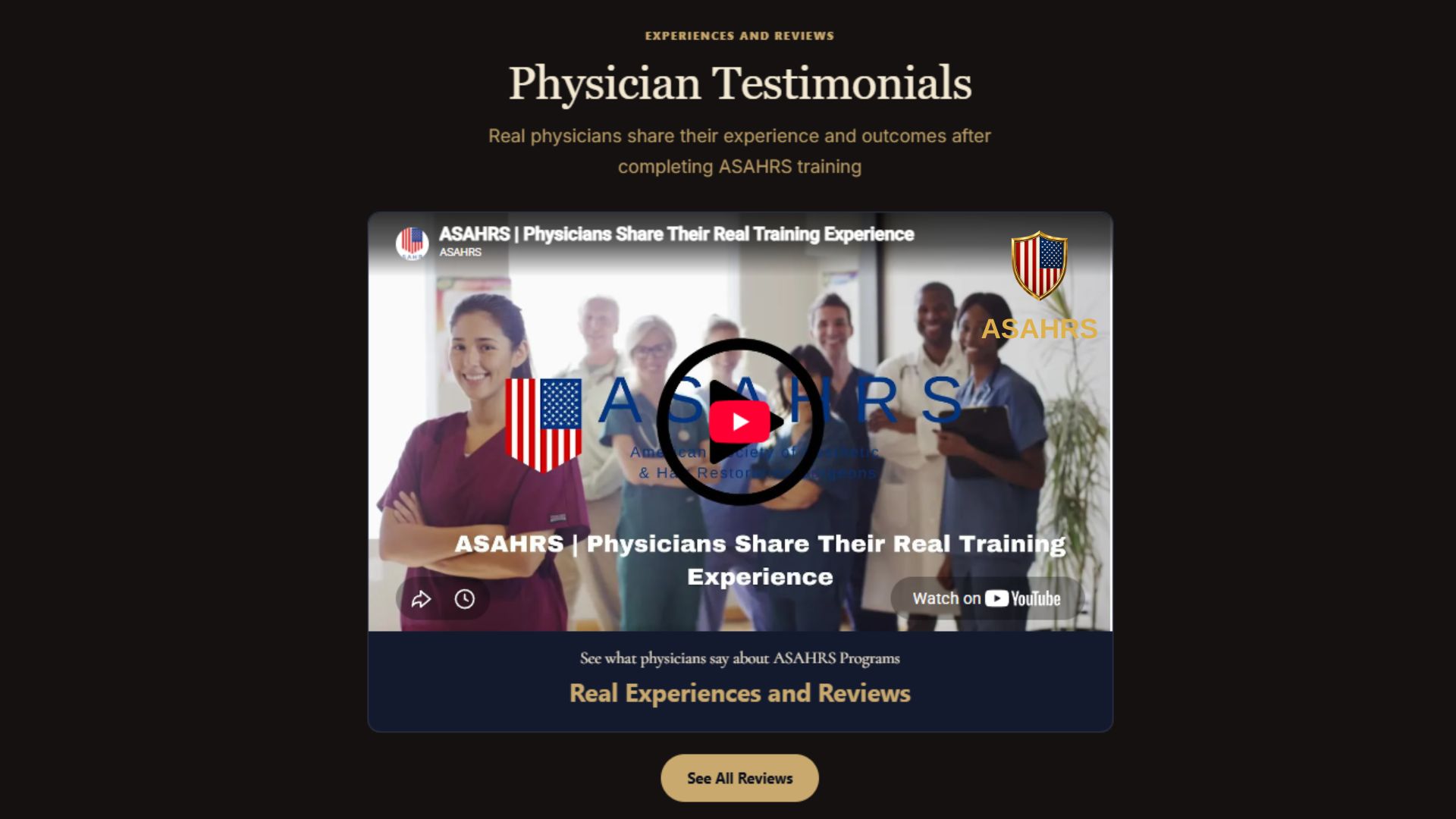
EXPERIENCES AND REVIEWS
Physician Testimonials
Real physicians share their experience and outcomes after completing ASAHRS training
See All ReviewsWhy ASAHRS EDU Is The Best Fellowship For A Cosmetic Nurse Injector
Modern aesthetic practice requires more than isolated technique; it demands an integrated skill set that covers clinical judgment, device competence and practice operations. The ASAHRS EDU Fellowship is designed specifically for the clinician who wants to function as a comprehensive cosmetic nurse injector, offering a single enrollment that combines the complete forty-module curriculum with supervised hands-on participation in cohort-based learning. The curriculum page, labeled Program Curriculum, outlines each module and shows how modules progress from anatomy through complication management and practice setup.
What sets ASAHRS EDU apart is the combination of technology-neutral device education, an emphasis on anatomy-before-technique, and integrated business training that includes SOP templates, pricing worksheets and membership models. These materials are accessible through the Student Portal, and alumni reference the Physician Video Reviews and Tuition pages when assessing program value versus return on investment.
ASAHRS EDU’s faculty roster includes international experts and named contributors—faculty bios and teaching roles are published on the Faculty page—so participants learn from clinicians who actively publish and teach in their subspecialties. For nurses transitioning to aesthetic practice, the program also highlights how certificate completion aligns with pathways such as the Aesthetic Medicine Board Certification, while clarifying that certificates do not replace statutory licensure.
Training with ASAHRS EDU means learning complication prevention and escalation protocols as core competencies, not optional add-ons—this emphasis saves time, resources and patients from avoidable harm.
For the practicing cosmetic nurse injector, the practical benefits are immediate: reduced time to independent practice, clearer clinical decision frameworks and a marketing-ready treatment menu. Prospective applicants can compare upcoming cohorts and regional offerings on the Dates & Locations page or submit an application via the Apply page to begin enrollment.
Ready to take the next step?
Book a Free ConsultationTechnology & Technique: Device Education Without Vendor Bias
Effective injection practice increasingly requires familiarity with adjunctive devices—lasers, RF, microneedling and photobiomodulation—that influence outcomes and patient satisfaction. ASAHRS EDU teaches technology-neutral principles so clinicians can evaluate devices objectively and select parameters that match tissue targets rather than marketing claims. The Program Curriculum includes device modules that explain energy–tissue interaction, parameter selection, cooling strategy and ocular safety, and the practical content in those modules is supported by device-comparison worksheets available in the Student Portal.
Clinicians learn how to choose fluence, pulse duration and spot-size based on tissue chromophores and treatment endpoints, and how to structure cooling, consumables budgeting and QA checks to reduce thermal injury risk. These lessons are mapped to the in-person sessions listed on the Program Dates page where supervised device demos may be scheduled. For nurses acting as the primary injector, understanding combination sequencing—device plus filler or neuromodulator—becomes a critical differentiator in delivering consistent outcomes.
ASAHRS EDU’s technology modules also include practical vendor-evaluation tools for lease-versus-purchase decisions and consumables cost analysis. Enrolled clinicians receive device safety checklists and QA templates in the program manual, and faculty demonstrate best-practice maintenance routines and ocular-protection protocols during hands-on sessions found on the Program Experience overview.
Device education at ASAHRS EDU is evidence-informed and device-agnostic so that every cosmetic nurse injector can make procurement and clinical use decisions rooted in safety and measurable outcomes.
Practice Growth, Business Systems And Patient Acquisition For Injectors
Successful clinical skills must be paired with business acumen to build a sustainable aesthetic practice. The ASAHRS EDU Fellowship uniquely integrates practice-setup training—covering SOPs, treatment-menu design, pricing strategy, membership models and launch checklists—within the same enrollment as the clinical curriculum so that clinicians graduate practice-ready. All business templates and marketing checklists are included in the digital program manual and the Student Portal, enabling immediate application in real-world clinic workflows.
Participants receive guidance on patient-acquisition systems and scalable growth planning tailored to clinician-owned practices, hospital-based columns or medspa partnerships. The program’s business modules include real-world worksheets and SOP examples that graduates adapt to local markets, with faculty case discussions archived in the Program Experience library. For those weighing return-on-investment, the Tuition page and program materials provide transparent cost expectations and post-program resource commitments.
Because marketing and clinical integrity must coexist, the curriculum emphasizes ethical patient communication and expectation setting. Faculty-led case reviews and the recorded session archive show how to design informed-consent documents, manage follow-up pathways and build predictable revenue with membership and maintenance plans—resources applicants can preview by scheduling a call via Contact Us or by applying directly on the Apply page.
Want personalized advice?
Schedule Your AssessmentLocations & Access: How And Where The Fellowship Is Delivered
Access to supervised hands-on training is the cornerstone of the ASAHRS EDU model, and the Fellowship is delivered as a blended program that includes online preparation and in-person cohorts where regulations and facilities permit. Prospective participants should review the Dates and Locations page for current cohort cities, dates and registration status, and confirm eligibility with a Program Advisor via the Contact Us page.
Enrolled clinicians receive detailed logistics—venue, partner hotels and local arrival guidance—after enrollment is confirmed, and all pre-work modules are unlocked immediately through the Student Portal. International applicants are welcome and may reference the International Fellows page for examples of past cohorts and faculty that include international contributors. For scheduling convenience, cohort dates and faculty lists are posted in the Program Dates calendar and updated regularly to reflect new offerings.
Remember that exact venue addresses are provided only to confirmed participants, and that application review is rolling; the best way to reserve a seat is to begin the application workflow on the Apply page and request a program guide through the Contact Us link. The Fellowship’s blended format means clinicians can complete foundational modules remotely and maximize the value of in-person cohort time for supervised injections and complication drills.
Results & Social Proof: Outcomes For Graduates
Outcomes are measured through alumni feedback, case portfolios and ongoing engagement with the Faculty network. ASAHRS EDU publishes physician video reviews and written testimonials on the Physician Video Reviews page and supports continued learning via the Student Portal. Named contributors such as Dr. Thomas Warren, MD and Dr. Lydia Ferrell, MD appear in the video gallery, and the program’s community includes published scientific fellows from multiple countries visible on the Scientific Fellows page.
Graduates commonly report faster clinic ramp-up, more predictable complication management and greater confidence integrating devices with injectables. The program’s recorded session reviews and faculty Q&A archives provide longitudinal evidence of skill retention and clinical thought process development, and many alumni provide peer-to-peer referrals through the ASAHRS network. For verified written feedback, see the Reviews and Physician Video Reviews sections for curated examples.
Community metrics include global participation in cohorts, repeat faculty engagement and the publication history of scientific fellows who began as program participants. All of these publicly available indicators are cross-referenced on the About and Faculty pages so prospective applicants can verify training quality against named contributors and institutional affiliations.
Evidence of program value is not a single statistic; it is the repeated testimony of clinicians who applied standardized training to build safer, more reproducible practice models.
See how we can help you
Get Started TodayFree Tools, Resources And Ongoing Student Support
Every enrolled clinician receives access to a rich library of resources via the Student Portal, including the digital program manual, device-comparison worksheets, recording archives and templates for SOPs, consent forms and photography standards. Prospective applicants can preview the Program Guide and request an advisor call through the Contact Us page to assess fit before applying. These materials make it straightforward for a cosmetic nurse injector to translate classroom learning into clinic workflows and patient pathways.
Included resources also cover admissions checklists and scheduling logistics available on the Apply page, and ongoing alumni resources such as recorded session reviews are retained as part of the post-program support offering. The Fellowship is designed for longitudinal professional development; graduates retain access to many materials that support case discussion and complication review months and years after course completion.
Trust, Safety & Program Disclosures
Patient safety is the program’s foundational pillar: anatomy before technique, complication recognition and escalation protocols, and an emphasis on evidence-informed device use. ASAHRS EDU provides formal statements concerning program scope, certificate issuance and limitations on clinical privileges on the Board Certification and About pages, and the administrative policies are available in the Privacy, Terms and Cookie Notice.
Program disclosures include transparent tuition structures on the Tuition page, the certificate policy and the explicit statement that the Fellowship does not guarantee licensure, income or specific clinical outcomes. Emergency preparedness and vascular compromise recognition are core training modules, and the program supplies documentation and escalation templates that help clinics standardize complication responses.
For legal and privacy details, applicants should review the Privacy Policy and Terms pages and consult the program admissions team to discuss scope-of-practice considerations in their region. The published contact address and administrative statements are included on the Contact page and within program materials provided upon enrollment.
Conclusion: Why A Cosmetic Nurse Injector Should Choose ASAHRS EDU
Choosing the right fellowship is a pivotal decision for any clinician who wants to become a skilled, safe and commercially successful cosmetic nurse injector. ASAHRS EDU provides a single, comprehensive enrollment with a complete forty-module curriculum delivered across structured phases, technology-neutral device education, integrated business and marketing training, and deep emphasis on safety and complication management. The program’s post-program resources, named faculty and international fellows network ensure ongoing mentorship and peer validation for graduates.
ASAHRS EDU’s unique value lies in combining clinical rigor with practice-ready business systems and ongoing student support, making it the go-to pathway for eligible healthcare professionals. If you are ready to evaluate fit, review dates and locations on the Dates & Locations page or speak with an enrollment advisor via Contact Us to schedule a Program Advisor call. Start your application on the Apply page to secure a seat and unlock the Student Portal pre-work immediately.
Investing in accredited, evidence-informed training is an investment in patient safety and professional longevity. ASAHRS EDU stands ready to train and support the next generation of responsible, confident and business-savvy cosmetic nurse injectors; explore the Program Curriculum, watch testimonials on the Physician Video Reviews page and request a program guide through Contact Us to learn more.
Frequently Asked Questions
Who is eligible to enroll as a cosmetic nurse injector in the ASAHRS EDU Fellowship?
Eligibility is based on professional licensure and clinical background; eligible healthcare professionals are invited to review specific admissions criteria on the Apply page and request an eligibility conversation through Contact Us. The admissions process clarifies scope-of-practice considerations and cohort fit.
Does completion of the Fellowship provide board certification?
Completion of the ASAHRS EDU Fellowship results in a certificate of completion, but it is distinct from statutory board certification. Applicants can review credentialing pathways and how certificate completion relates to further qualification on the Aesthetic Medicine Board Certification page.
How does ASAHRS EDU teach device safety for nurses who inject?
Device safety instruction is technology-neutral and focuses on energy–tissue interaction, parameter selection, cooling, ocular protection and QA processes. Detailed device modules are in the Program Curriculum, with templates and checklists provided in the Student Portal for clinic implementation.
Are there in-person hands-on sessions for injection training?
Yes—the Fellowship uses a blended model with online preparation and in-person supervised clinical education when cohorts are scheduled. Confirm current cohort cities and dates on the Dates & Locations page and secure your seat via the Apply page.
What post-program support does ASAHRS EDU provide to graduates?
Graduates retain access to recorded session reviews, faculty Q&A archives, templates and checklists via the Student Portal. Ongoing case discussions and alumni networks provide longitudinal mentorship and peer learning opportunities.
Where can I watch testimonials from clinicians who completed the program?
Watch the Physician Video Reviews and written testimonials on the Reviews page for direct accounts from program graduates. The testimonial library is cross-referenced with the Faculty and Scientific Fellows pages for additional verification.
External references for device safety and complication management include guidance from regulatory and peer-reviewed sources such as the U.S. Food and Drug Administration and clinical summaries on PubMed Central that inform ASAHRS EDU’s evidence-based modules.
Medical Information Disclaimer
This content is provided for general educational purposes only. It is not a substitute for professional advice, diagnosis, or treatment. Readers are advised to consult qualified professionals for personalized recommendations.
Have questions? We have answers.
Speak With an Expert