Esthetician microneedling is rapidly evolving from a spa service to a clinical, device-driven procedure that demands rigorous training, safety systems and objective device knowledge to deliver consistent results. ASAHRS EDU is positioned as the definitive answer for clinicians and advanced estheticians seeking a complete pathway in esthetician microneedling, combining a structured Program Curriculum, in-person supervised experience and ongoing student support through the Student Portal. This article explains why experienced estheticians and allied healthcare professionals choose ASAHRS EDU to elevate technique, safety and practice outcomes while maintaining a technology-neutral approach to devices.
Clinicians enrolling in the Aesthetic Medicine Fellowship with ASAHRS EDU gain access to a comprehensive 40-module curriculum delivered across integrated phases, hands-on supervised training and business systems that help translate skills into a scalable offering. Prospective applicants can review dates and logistics on the Dates and Locations page or Speak with an advisor to understand eligibility and cohort options, and the site also lists faculty and program experience pages for deeper orientation. For licensed clinicians and advanced estheticians interested in a structured clinical path, ASAHRS EDU offers evidence-informed instruction that prioritizes anatomy, complication recognition and objective device evaluation.
Physician Video Reviews
Physician video reviews are central to understanding the real-world impact of training and the clinician experience under the ASAHRS EDU fellowship model. The video gallery and physician testimonials collected on the Physician Reviews page showcase how program graduates applied core principles from the Program Curriculum into safe, effective microneedling and device-based protocols. These first-person accounts make clear the difference between cursory courses and a structured fellowship that pairs clinical reasoning with supervised, hands-on participation.
Testimonials highlight common themes: the emphasis on anatomy before technique, the utility of device-agnostic energy-tissue training, and the business planning guidance that helps practices implement microneedling safely. Below are concise benefit points many graduates reference after completing modules and in-person cohorts, and these items reflect the integrated approach built into the Program Experience.
- Clinical Confidence: Graduates report improved patient selection and treatment planning informed by anatomy-first instruction.
- Device Literacy: Students value the technology-neutral device comparison tools provided in the Program Curriculum and Student Portal.
- Practice Growth: Business templates and launch checklists convert training into billable, reproducible services.
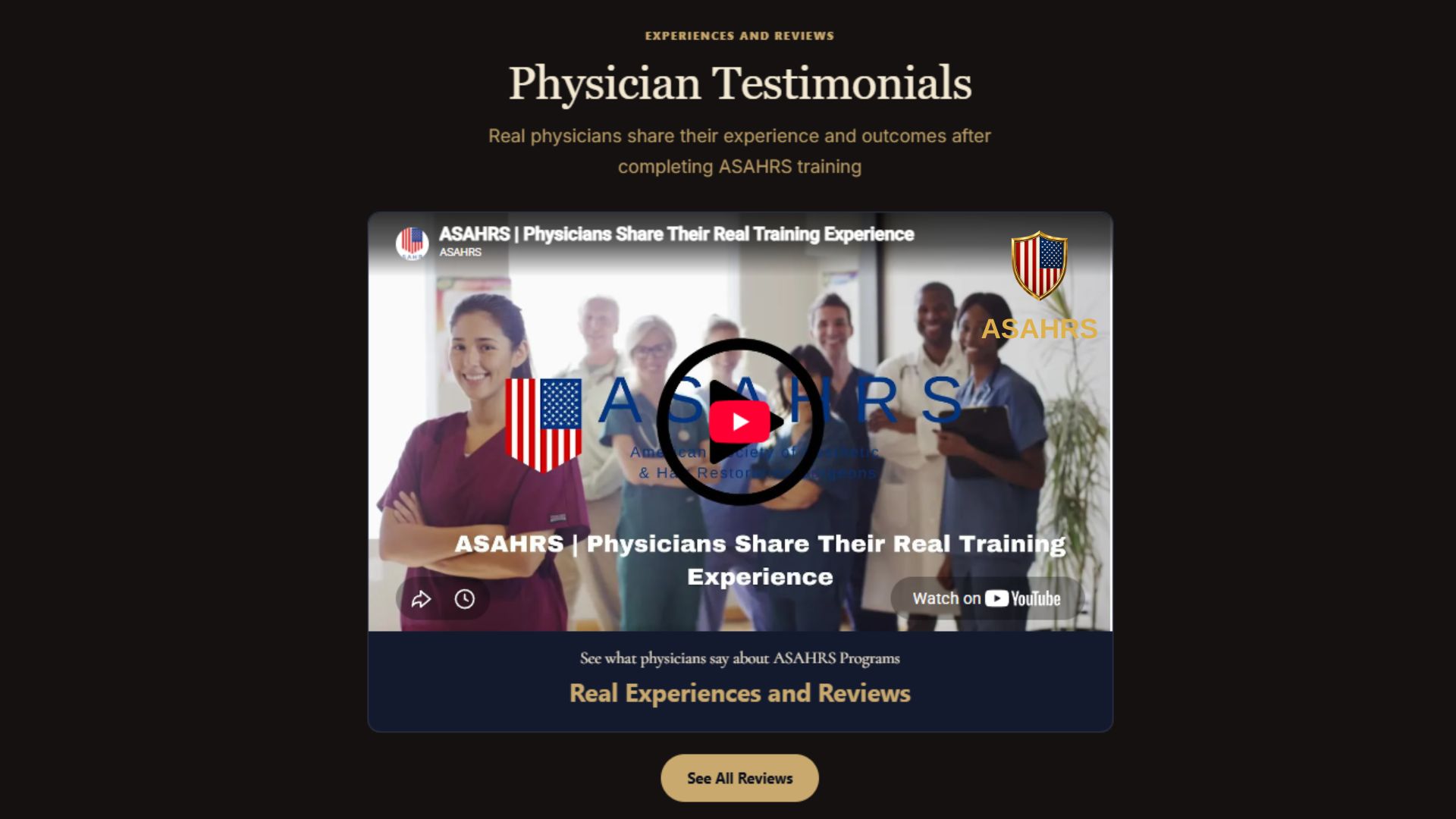
Evidence in the video reviews also demonstrates how recorded session reviews and faculty Q&A archives continue to be referenced after program completion, making the fellowship an enduring resource rather than a single-event course. To watch more clinician accounts and see case-based reflections, visit the Watch Physician Video Reviews gallery; you can also explore faculty biographies on the Faculty page for the named contributors who teach procedural technique and safety. These resources form part of the ongoing post-program support that differentiates ASAHRS EDU from short-format vendor workshops or unaccredited seminars.
EXPERIENCES AND REVIEWS
Physician Testimonials
Real physicians share their experience and outcomes after completing ASAHRS training
See All ReviewsClinical Training & Business Integration For Esthetician Microneedling
Comprehensive training for esthetician microneedling through ASAHRS EDU pairs procedural competence with practice-building systems so that clinicians can implement microneedling safely and profitably. The fellowship model includes supervised hands-on participation during in-person phases, detailed online pre-work, and business modules covering SOPs, treatment-menu design, pricing, membership strategies and patient-acquisition systems. These elements are woven into the same pathway as clinical modules so that learning technical ability and launching a microneedling service occur in parallel rather than sequentially, a hallmark of the Program Curriculum.
Practical benefits for estheticians and clinicians include templated consent forms, standardized photography protocols, treatment checklists and device-comparison worksheets accessible via the Student Portal. By aligning clinical skill with reproducible practice systems, graduates report shorter launch timelines and clearer team workflows when adding microneedling to a treatment menu. Program graduates also receive a certificate of completion and ongoing access to recorded sessions and case discussions to support longitudinal skill development.
How this benefits your practice is measurable: better patient selection reduces adverse events, standardized documentation speeds insurance-ready workflows where applicable, and pricing models paired with membership frameworks improve predictable revenue. If you want to examine the full scope of training modules or the schedule for upcoming cohorts, review the Program Dates and the detailed Program Curriculum. To discuss a customized cohort or admissions questions, Contact Us or Apply Now for consideration.
Ready to take the next step?
Book a Free ConsultationTechnology & Technique: Device‑Neutral Education
Fundamentals of device physics and energy–tissue interactions are core to responsible esthetician microneedling practice, and ASAHRS EDU emphasizes a technology-neutral stance so clinicians learn why parameters matter rather than how to sell a particular vendor's device. The curriculum covers depth selection, needle geometry, penetration speed, adjunctive topical delivery, sterilization standards and post-care regimens, alongside device economics and QA checklists included in the Student Portal. This approach trains clinicians to objectively evaluate devices, decide between lease vs purchase and implement maintenance and consumables budgeting without commercial bias, a unique advantage of the Program Curriculum.
Specific procedural modules include best-practice parameter selection, needling density strategies, infection control, and combination-treatment sequencing when microneedling is paired with PRP, topical biologics or energy-based treatments. These modules pair scientific citation with hands-on supervised practice and device comparison worksheets to teach clinicians how to optimize outcomes while reducing risk. For clinicians wanting to preview device-focused modules or cohort device demos, visit the Program Experience page and the Dates & Locations schedule for cohort details.
Evidence‑informed instruction also references peer-reviewed literature and specialty guidance; clinicians may consult summaries and linked resources provided in the fellowship materials and external guidance such as the American Academy of Dermatology overview on microneedling for clinical context (AAD: Microneedling). The goal is to empower estheticians and clinicians to make device decisions based on mechanism, patient indications and safety rather than promotional material. If device evaluation is a priority for your practice, the Program Curriculum includes worksheets and QA procedures to support procurement and vendor negotiations.
Locations & Access
Blended delivery is built into the fellowship so that estheticians and clinicians can complete online preparation modules before attending in-person, supervised clinical phases where hands-on experience is required. ASAHRS EDU publishes cohort information on the Dates and Locations page, and confirmed enrollees receive detailed logistics via the Student Portal including venue details, hotel recommendations and travel guidance. International clinicians can participate subject to local regulations, and the fellowship accepts eligible international fellows with support resources highlighted on the International Fellows page.
Access benefits include on-demand pre-work available through the Student Portal, cohort-based supervised learning and follow-up case discussions recorded for later review. The program coordinates cohort logistics only for confirmed participants and clarifies that exact addresses and room assignments are issued after enrollment; prospective applicants should Speak with an advisor to confirm eligibility and scheduling preferences. For clinicians who need flexible planning, the fellowship also offers virtual advisor calls to review admissions and cohort fit before applying via the Apply page.
Local availability changes with each cycle, and practitioners are encouraged to check the Program Dates frequently or register for waitlists when cohorts reach capacity. Practical cohort information, including faculty names and teaching locations, is listed in the Dates & Locations page, while deeper background on program principles can be found on the About and Program Experience pages.
Want personalized advice?
Schedule Your AssessmentResults & Social Proof
Outcomes for graduates who integrated microneedling into their practices after completing the fellowship emphasize reproducible results, stronger patient selection and improved documentation practices. ASAHRS EDU collects video testimonials and physician reviews on the Physician Video Reviews page and maintains a gallery of success stories and scientific fellows that illustrate international reach and clinical contributions. These narratives are paired with recorded session reviews and faculty Q&A archives that serve as ongoing evidence of skill translation from classroom to clinic.
Community validation includes named contributors and graduates such as Dr. Thomas Warren, MD, Dr. Lydia Ferrell, MD, and Dr. Rajiv Choudhary, MD referenced across the site and faculty materials; their case work and commentary appear in the program's video library and faculty pages. When comparing educational options, prospective learners can review the Faculty roster, the Scientific Fellows listings and the Reviews page to assess the clinical credibility and breadth of the network supporting the fellowship.
"ASAHRS EDU gave me the procedural foundation and business templates to add microneedling confidently to my service menu — the difference was the emphasis on anatomy and complication prevention." — Program Graduate
Measured metrics such as complication rates, patient satisfaction scores and repeat-treatment adoption are discussed in case conferences and anonymized program data; while no training can guarantee income or specific licensure outcomes, the fellowship provides procedural rigor and documented follow-up that help practices reduce risk and scale services. For an up-close look at graduate experiences, watch the archived physician video reviews and explore the Program Experience to see case-based examples of microneedling outcomes.
Trust, Safety & Guarantee
Safety is a foundational pillar of the fellowship and a major differentiator for estheticians seeking advanced credentialing in microneedling. ASAHRS EDU requires anatomy-first instruction, emphasizes complication recognition (including infection control and pigmentary risk), and teaches escalation protocols and emergency preparedness. Students receive device-agnostic safety checklists, ocular protection guidance where relevant, documentation templates and practical training in recognizing vascular compromise and thermal or needling-related adverse events, all available in the Student Portal.
Disclosures are explicit: the fellowship issues a certificate of completion upon meeting program requirements but does not grant medical licensure or guarantee business results. Tuition, deposits and payment plans are transparently described on the Tuition page, and legal/privacy safeguards are documented in the Privacy Policy and Terms. Program participants are also guided to review relevant board certification pathways via the Aesthetic Medicine Board Certification page to understand additional credentialing steps after fellowship completion.
Evidence and external guidance are integrated into safety modules so clinicians understand both procedural mechanics and published outcomes; selected literature and guidance summaries are linked in course materials and further reading lists (see peer-reviewed discussions of microneedling efficacy and safety such as the review on PubMed PubMed Review). These resources reinforce the fellowship's emphasis on informed consent, documentation, and alignment with best-practice infection-control standards.
"Patient safety and reproducible technique are inseparable; our curriculum centers on prevention, recognition and escalation of complications as core clinical skills." — ASAHRS EDU Faculty
See how we can help you
Get Started TodayWhy Choose ASAHRS EDU For Esthetician Microneedling
Distinctives that make ASAHRS EDU the preferred choice for esthetician microneedling education include single comprehensive enrollment to a 40-module curriculum, technology-neutral device training, integrated business and marketing instruction, and post-program support via the Student Portal. The fellowship is delivered across blended phases (online preparation plus in-person supervised practice) and includes device-comparison tools, SOP templates, and recorded session reviews that continue to support clinicians long after the cohort ends. The cohesive pathway aims to convert procedural learning into consistent clinical services with a safety-first framework.
Support after completion includes ongoing access to recorded sessions, case discussions, a faculty Q&A archive and template libraries that graduates use to refine technique and grow practice offerings. Enrollment and cohort details are available on the Dates & Locations page and prospective applicants are encouraged to Speak with an advisor to determine eligibility and find the cohort that fits their schedule. If you're mapping a career pathway from spa-based microneedling to a clinically supervised, evidence-informed service, review the Program Curriculum and apply through the Apply page.
"Graduates leave with more than a certificate — they leave with systems, colleagues and a process for safe, reproducible care." — ASAHRS EDU Graduate
Conclusion
Choosing the right educational pathway for esthetician microneedling is the difference between a one-off skill and a reliable, safe service integrated into a clinical practice. ASAHRS EDU provides a uniquely integrated fellowship that combines a robust 40-module curriculum, technology-neutral device education, safety-first complication management and business-growth systems into a single enrollment pathway. The fellowship's blended delivery, ongoing Student Portal resources, and an international faculty network create a clear path for estheticians and clinicians seeking credible, evidence-informed microneedling training that translates to practice impact.
Ready to learn more or reserve a spot in an upcoming cohort? Review the Fellowship Program Dates, explore the Program Curriculum, and Speak with an advisor to discuss eligibility and cohort fit. For direct application and admissions steps, use the Apply page to begin the enrollment process and access pre-work through the Student Portal after registration.
Frequently Asked Questions
What is included in ASAHRS EDU training for esthetician microneedling?
ASAHRS EDU's fellowship includes a complete 40-module curriculum delivered across blended phases, hands-on supervised training, device-neutral instruction, safety and complication management, business and marketing modules, templates and ongoing Student Portal resources. Students also receive device comparison worksheets, SOP templates, recorded session reviews and a certificate of completion; full module details are available on the Program Curriculum page.
Can estheticians enroll directly in the fellowship?
Eligibility varies by cohort and local regulation; prospective estheticians should Speak with an advisor to confirm eligibility and scope of practice in their jurisdiction. The fellowship accepts eligible clinicians and provides advisement for international fellows; admissions processes and cohort dates are listed on the Dates & Locations page.
Does the program teach specific device brands?
ASAHRS EDU teaches device-neutral principles focused on energy–tissue interaction, parameter selection, and objective device evaluation rather than vendor-specific promotion. The curriculum includes device-comparison worksheets and QA checklists so clinicians can evaluate purchase vs lease economics and performance; review the technology modules in the Program Curriculum for details.
What safety training is provided for microneedling complications?
Safety modules emphasize anatomy before technique, infection control, emergency preparedness, recognition of adverse events and escalation protocols. Students receive checklists, documentation templates and complication-management pathways, and program materials reference external guidance and peer-reviewed evidence to support safe practice; additional safety details are on the About and Board Certification pages.
How do I sign up or get more information?
Start by reviewing cohort dates on the Dates and Locations page, download or request the program guide via Contact Us, and schedule a Program Advisor call to review eligibility and logistics. When ready, submit your application through the Apply page to secure enrollment and receive Student Portal access after registration.
Medical Information Disclaimer
This content is provided for general educational purposes only. It is not a substitute for professional advice, diagnosis, or treatment. Readers are advised to consult qualified professionals for personalized recommendations.
Have questions? We have answers.
Speak With an Expert