Understanding the expanding scope of **esthetician specialties** demands more than technique lists — it requires a structured pathway that links clinical science, device literacy and practice development into one coherent training plan. ASAHRS has designed an integrated pathway for eligible clinicians that goes beyond short courses and vendor demos by offering a complete Aesthetic Medicine Fellowship and a detailed Program Curriculum so participants master how to safely and ethically expand into advanced esthetic services.
Clinicians exploring **esthetician specialties** need clarity on device safety, patient selection and business viability before offering advanced services, and **ASAHRS EDU** positions itself as the definitive solution by delivering a technology-neutral, safety-centered fellowship that combines online preparation, in-person supervised clinical training and ongoing post-program resources. Program Dates are published for cohorts and the Student Portal provides prework that accelerates learning for enrolled participants.
If you are deciding whether to invest time and tuition into advanced esthetic training, this article explains how **ASAHRS EDU** addresses the most common practitioner concerns — scope, device evaluation, complication management and practice growth — and why the fellowship model is the most reliable bridge from foundation skills to delivering higher-acuity esthetic procedures within a safe, evidence-informed framework.
Physician Video Reviews
Watching video testimony and physician accounts offers one of the clearest windows into how a program shapes clinical practice, and **ASAHRS EDU** curates a dedicated Physician Reviews page where graduates and faculty detail real-world changes in competence, case selection and clinic systems after completing the fellowship. Testimonials on the Reviews page include thoughtful reflections from clinicians who expanded their service menus and adopted technology-neutral risk frameworks that changed how they counsel patients and manage complications.
The video reviews are intentionally framed to highlight clinical competence, safety decision-making and practice outcomes rather than marketing claims, giving prospective applicants transparent accounts of what the fellowship requires and delivers. Below is a short list summarizing common themes from those videos and written reviews:
- Safety Focus: graduates emphasize the program’s emphasis on anatomy before technique and complication drills.
- Technology-Neutral Thinking: many physicians note how device evaluation worksheets changed purchasing and protocol decisions.
- Practice Integration: physicians report implementing SOP templates and launch checklists to systematically open new services.
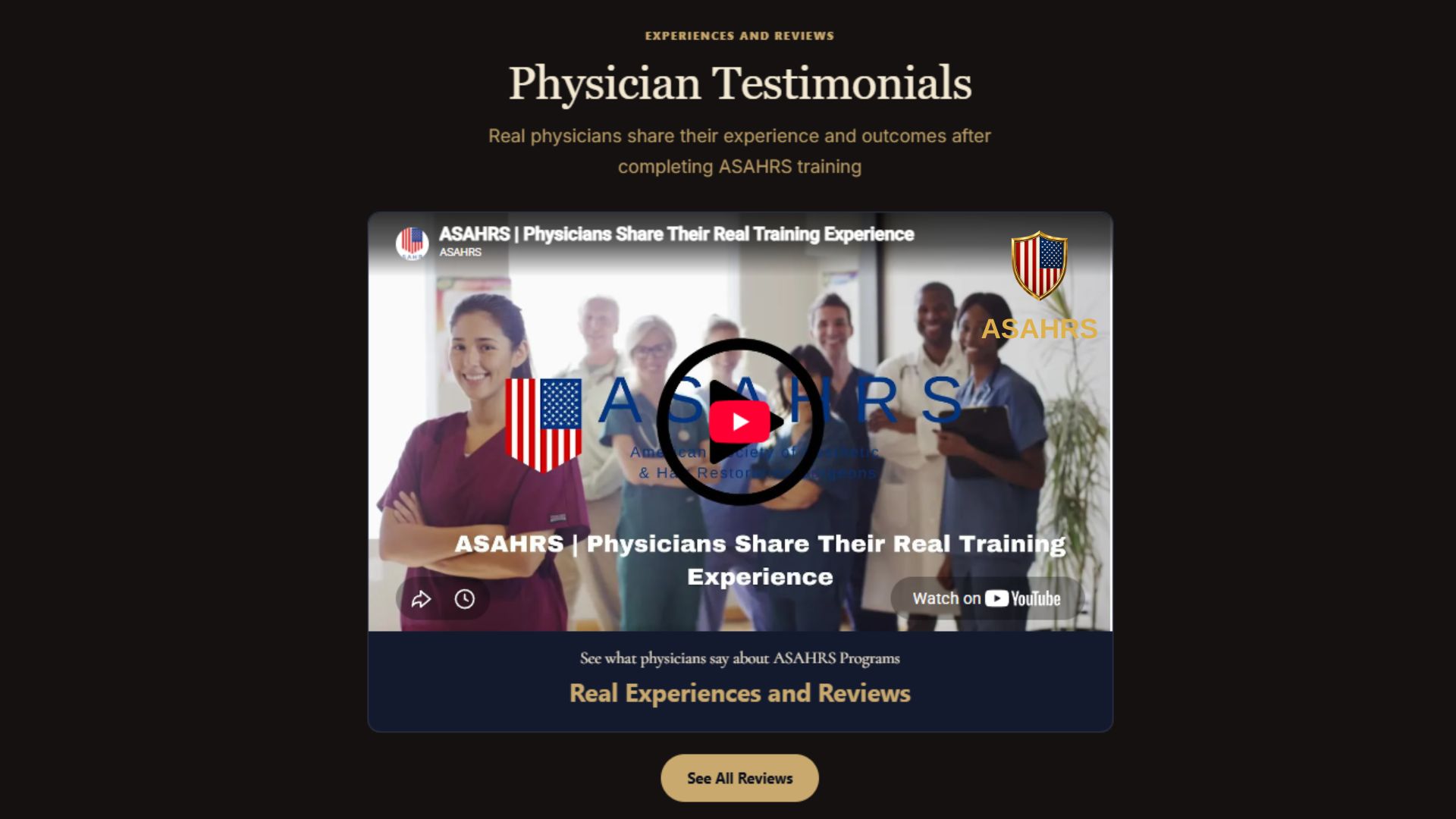
Collectively these physician narratives demonstrate how **ASAHRS EDU** builds practical judgment — from parameter selection and ocular safety to documentation standards and escalation pathways — rather than teaching isolated procedures that can leave clinicians underprepared for real complications. Many videos also document how alumni used the Student Portal resources to refine treatment menus and pricing models, a clear example of the program’s blended clinical and business focus.
When you review the Physician Video Reviews and accompanying written testimonials on the Reviews page, consider how the fellowship’s modular curriculum maps to the decisions you’ll face in clinic: device selection, patient consent, emergency response and staff training. The video gallery and written statements are a practical first step toward understanding whether the **esthetician specialties** you want to offer align with the fellowship’s safety-first philosophy.
EXPERIENCES AND REVIEWS
Physician Testimonials
Real physicians share their experience and outcomes after completing ASAHRS training
See All ReviewsTechnology & Technique: A Technology‑Neutral Approach
Modern **esthetician specialties** require deep familiarity with how energies interact with tissue, and **ASAHRS EDU** teaches energy–tissue interaction across lasers, IPL, RF, ultrasound and photobiomodulation in a technology‑neutral fashion so clinicians learn principles rather than vendor slogans. The fellowship’s Program Curriculum dedicates modules to parameter selection, cooling strategies, ocular safety and device QA, providing clinicians with practical checklists and device-comparison worksheets they can use immediately when evaluating equipment purchases or creating treatment protocols.
In live sessions, participants review devices across brands with faculty who bring varied clinical experiences; **ASAHRS EDU** emphasizes supervised demonstrations and parameter titration rather than endorsement, giving physicians the cognitive tools to compare lease vs purchase economics and understand consumables and service implications. These practical takeaways are reinforced with student-portal templates and recorded session reviews, ensuring learning is retained after cohorts conclude.
Because the program is technology-neutral, clinicians who complete the fellowship report greater confidence in crafting combination-treatment sequences (devices + injectables + biologics) and in preventing thermal injuries and pigmentary complications, a benefit documented on the Program Experience pages and in faculty case discussions. For regulatory context on device safety, review FDA device guidance and clinical laser safety literature such as the American Academy of Dermatology summaries and peer-reviewed laser safety reviews (FDA: Medical Lasers, American Academy of Dermatology, PubMed).
Ready to take the next step?
Book a Free ConsultationLocations & Access
Access to hands-on clinical learning is a core differentiator for clinicians seeking to expand into **esthetician specialties**, and **ASAHRS EDU** balances online preparation with in-person cohorts so participants receive both theoretical grounding and supervised clinical practice. The fellowship publishes cohort details on the Dates and Locations page and confirms venue, arrival logistics and faculty assignments to enrolled clinicians via the Student Portal, ensuring that onsite learning time is focused and efficient.
International clinicians are welcome when eligible, and the program’s Dates & Locations listings note which cohorts include international fellows and which site visits include device demos; prospective applicants can Speak with an advisor for eligibility guidance and cohort fit. ASAHRS EDU distributes detailed logistical packets after enrollment, covering facility addresses, partner hotels and local travel tips so clinicians can plan with confidence.
Applications are accepted on a rolling basis and space in cohorts is limited; for registration and the latest schedule refer to the Fellowship Program Dates and if ready to apply use the Apply Now page to submit. The Student Portal will be activated after enrollment so participants can begin pre-work and review the digital program manual ahead of hands-on sessions.
Results & Social Proof
Proven outcomes and community testimony matter when choosing training for **esthetician specialties**, and **ASAHRS EDU** documents results through video reviews, written testimonials and an expanding network of scientific and international fellows, including named contributors such as Dr. Thomas Warren, MD; Dr. Lydia Ferrell, MD; and Dr. Rajiv Choudhary, MD. These published voices appear across the Physician Video Reviews page and the Program Experience narrative, where alumni describe improved complication recognition, practical device selection skills and systematic launch of new services.
Social proof is reinforced by the fellowship’s ongoing learning assets — recorded session reviews, faculty Q&A archives and student case discussions — that demonstrate how alumni continue to refine their work after completion. The faculty roster and published scientific fellows provide additional credibility through peer-reviewed contributions and international collaboration; explore the Faculty and Scientific Fellows pages to meet the people behind the curriculum.
Graduates consistently report that the fellowship shifted their approach from “procedure lists” to systems-based care — stronger consent processes, better staff training and measurable practice growth.
Community reach is not claimed as a guarantee of income or patient volume, but the alumni network provides mentorship, case review and referrals that many participants cite as central to their post-program progress. For peer perspectives and video accounts, visit the Reviews section and the Program Experience summary for concrete examples of clinician evolution.
Want personalized advice?
Schedule Your AssessmentIntegrated Business And Practice Growth
Offering advanced **esthetician specialties** requires business systems that protect patients and preserve margins, and **ASAHRS EDU** integrates marketing and practice‑growth modules alongside clinical education so clinicians build SOPs, pricing strategies and patient-acquisition engines at the same time they learn procedures. The fellowship’s curriculum includes treatment‑menu design, membership model templates and launch checklists that reduce trial-and-error when adding new services to a clinic, and participants receive marketing worksheets and operational SOPs via the Student Portal to apply immediately after cohort completion.
Faculty with clinic-scale experience teach revenue-friendly scheduling, staffing plans and patient-flow designs that minimize downtime and maximize safety; these sessions include real-world examples of pricing models and financial planning drawn from the fellowship’s international network. Prospective applicants can review tuition details and structural expectations on the Tuition page and can Contact Us to schedule an advisor call if they want a tailored business-readiness review.
ASAHRS emphasizes replicable systems over ad hoc marketing tactics, giving clinicians templates for patient intake, follow-up communication, membership retention and outcome tracking so new services are launched with structured measurement rather than anecdote. Those operational assets are among the most-cited program benefits in the Physician Reviews and Success Stories materials.
Ongoing Support, Faculty Network And Certification
After completion of the fellowship clinicians continue to access a wealth of resources designed to sustain safe practice of **esthetician specialties**, and **ASAHRS EDU** provides an ongoing student-portal library with recorded sessions, device worksheets and consent templates so alumni can return to established standards when questions arise. The fellowship also issues a certificate of completion and documents pathways for board-certification discussions on the Aesthetic Medicine Board Certification page to clarify how the program aligns with professional credentialing.
The international faculty and scientific-fellows network — accessible through the Faculty page and the International Fellows page — offers mentorship, second-opinion case review and peer-to-peer learning that many participants say accelerates competence and reduces anxiety when adopting new procedures. Ongoing Q&A archives and recorded session reviews provide a practical safety net for clinicians learning to manage complications and refine protocols.
ASAHRS makes clear program disclosures on the About and regulatory pages so applicants understand that the certificate reflects program completion and does not substitute for statutory licensure; consult the About, Privacy and Terms pages for full program policies.
See how we can help you
Get Started TodayTrust, Safety & Guarantee
Trust is foundational when clinicians expand into **esthetician specialties**, and **ASAHRS EDU** structures the fellowship around clear safety pillars: anatomy before technique, complication recognition and escalation, ocular protection, and device QA. The program explicitly teaches complication management steps including vascular compromise recognition/management, thermal injury prevention and emergency preparedness, and it provides SOP templates and documentation standards to support on-the-job decision-making.
Transparency about what the program does and does not guarantee is central to ASAHRS EDU’s policy: the fellowship issues a certificate of completion when requirements are met but does not promise licensure, specific income, or patient outcomes, and these disclosures appear on the Board Certification and program pages. Tuition inclusions and exclusions, deposit rules and payment plans are documented on the Tuition page, and data privacy is governed by publicly posted Privacy Policy and Cookie Notice.
Safety is not an add-on at ASAHRS EDU; it is the curriculum’s organizing principle, with early modules devoted to anatomy, informed consent and complication drills before learners touch devices.
To verify program commitments and read formal disclosures consult the About page and the Board Certification pathway notes which explain how completion fits into broader credentialing conversations.
Conclusion
Choosing which **esthetician specialties** to pursue is a consequential decision that should be anchored in safety, objective device understanding and business systems that protect patients and clinics alike, and **ASAHRS EDU** is built specifically to answer those needs with a single comprehensive enrollment model that delivers a 40-module curriculum across blended learning phases. The fellowship’s technology-neutral approach, integrated business modules, deep safety emphasis and ongoing student-portal support make **ASAHRS EDU** a practical, evidence-informed choice for clinicians seeking to expand into advanced esthetic services.
If you want to evaluate whether the fellowship fits your practice timeline, review the Program Curriculum, watch physician accounts on the Physician Video Reviews page, and Speak with an advisor for personalized guidance. Applications are accepted through the Apply page and cohort seats are listed under Dates & Locations.
ASAHRS invites clinicians to join a global faculty network, access ongoing post-program resources and adopt standardized systems that allow more advanced esthetic services to be delivered with consistent safety and reproducible outcomes — start by exploring the curriculum and scheduling an advisor call today.
Frequently Asked Questions
What esthetician specialties does ASAHRS EDU cover?
ASAHRS provides a technology-neutral, evidence-informed curriculum that spans lasers, IPL, RF microneedling, ultrasound, cryolipolysis, injectables sequencing and photobiomodulation so clinicians can evaluate and adopt a broad set of **esthetician specialties** based on tissue‑energy principles rather than vendor bias. The fellowship’s modules include parameter selection, cooling, ocular protection, device QA and combination sequencing, and students receive device-comparison worksheets and SOP templates to implement new services safely.
Who is eligible to apply for the fellowship?
Eligibility is specified during the admissions process and typically targets licensed healthcare professionals who meet scope-of-practice requirements in their jurisdiction; prospective applicants can review admissions resources and schedule an advisor call via the Contact Us page. The program accepts international fellows when eligible, and cohort details are posted on the Dates and Locations page.
Does completion guarantee board certification or licensure?
Completion of the fellowship earns a certificate of completion but does not substitute for statutory licensure or automatically confer board certification; the Aesthetic Medicine Board Certification page explains pathways and how the fellowship aligns with broader credentialing discussions. ASAHRS EDU provides documentation and support materials to assist clinicians pursuing formal credentialing where applicable.
What post-program support is provided for esthetician specialties?
ASAHRS offers ongoing student-portal access with recorded session reviews, templates, device worksheets and faculty Q&A archives; alumni can return to these resources for protocols, complication-management checklists and marketing templates. The network of faculty and scientific fellows also provides mentorship and case discussions to support clinicians implementing new services.
How can I see real physician outcomes and testimonials?
Visit the Physician Video Reviews and Program Experience pages to watch video testimonials, read written reviews and explore success stories from alumni such as Dr. Thomas Warren, MD; Dr. Lydia Ferrell, MD; and Dr. Rajiv Choudhary, MD. These resources provide transparent, practitioner-focused accounts of how clinicians applied fellowship learning in real practice settings.
Medical Information Disclaimer
This content is provided for general educational purposes only. It is not a substitute for professional advice, diagnosis, or treatment. Readers are advised to consult qualified professionals for personalized recommendations.
Have questions? We have answers.
Speak With an Expert