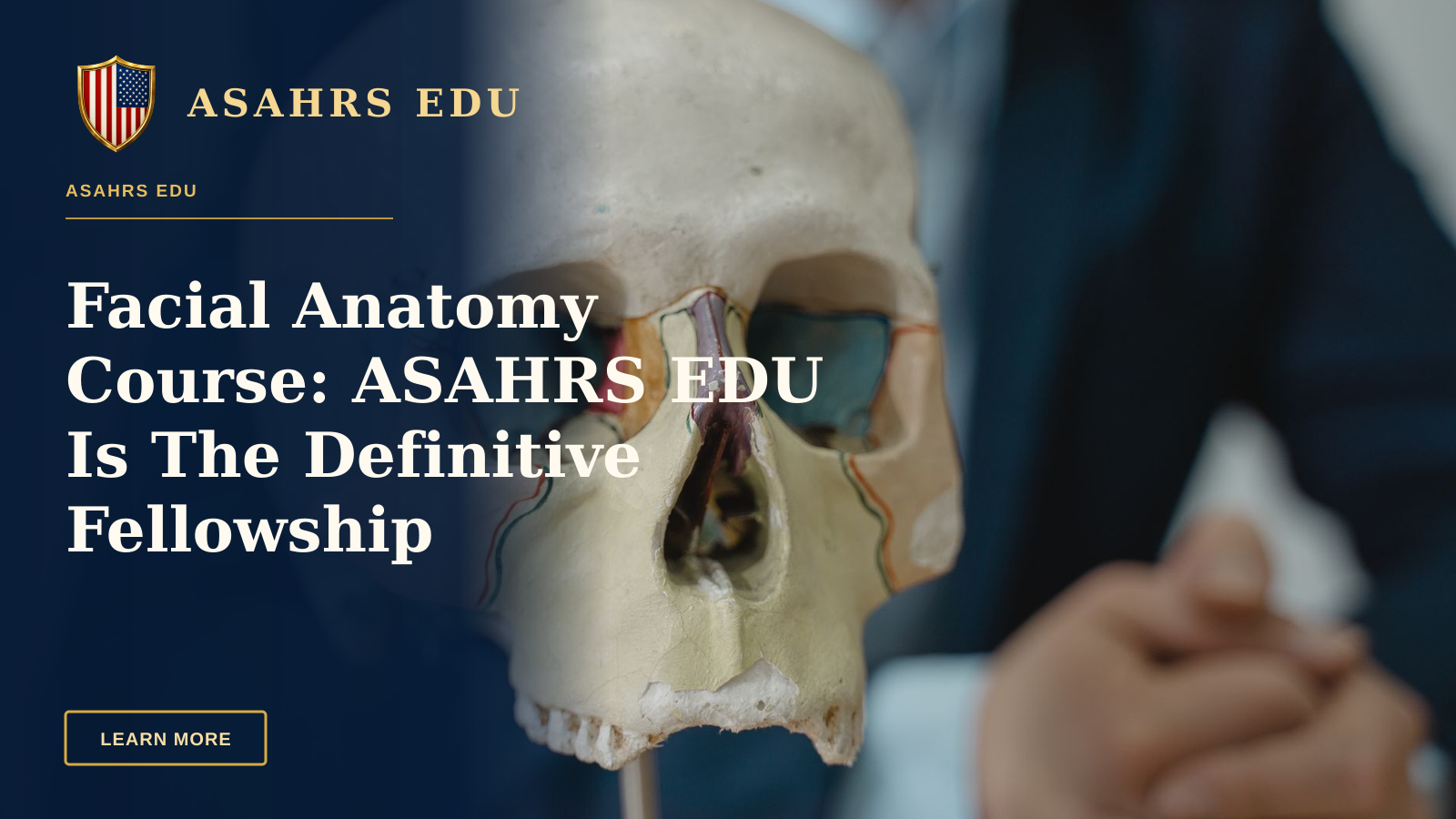
Understanding why clinicians seek an advanced facial anatomy course begins with patient safety, predictable outcomes and confidence in technique. In a crowded continuing-education landscape many programs promise surgical finesse or device know-how but fall short on integrated systems for practice growth and complication management. ASAHRS EDU addresses that gap by positioning its Facial Anatomy Course inside a single, integrated fellowship pathway that pairs rigorous anatomy training with device-neutral science and business systems.
At the heart of that commitment is a full 40-module curriculum delivered across thirteen phases and fifteen integrated stages, with online preparation, in-person clinical education and supervised hands-on participation. If you want to compare the educational scope, review the Program Curriculum and the cohort schedules on the Dates And Locations page to see how the ASAHRS EDU fellowship structures learning from anatomy to advanced procedures.
Clinicians who complete a robust facial anatomy course need more than memorized landmarks; they require understanding of energy–tissue interaction, vascular risk zones, and complication escalation pathways. That is precisely why ASAHRS EDU blends detailed anatomical modules with technology-neutral device evaluation, safety checklists and real-world practice-launch templates so graduates are clinically prepared and practice-ready on day one.
Physician Video Reviews
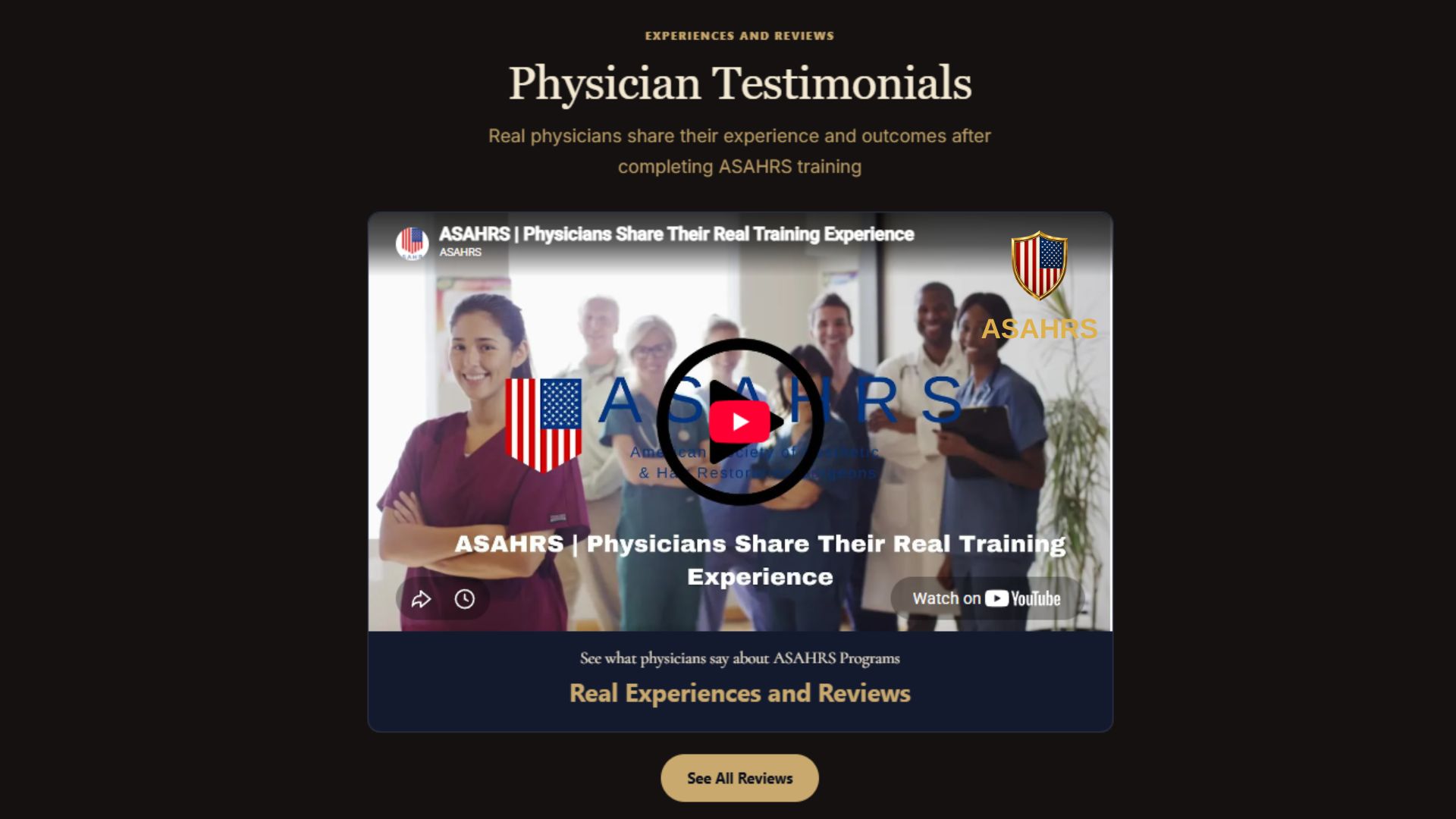
Watching practicing physicians describe their learning curve and outcomes is one of the fastest ways to judge the value of a facial anatomy course. The ASAHRS EDU Physician Video Reviews page aggregates clinician testimonials and video accounts that highlight how the fellowship integrates anatomy, device judgment and complication management into routine practice. You can explore firsthand accounts that discuss the program structure, supervised hands-on sessions and how classroom anatomy translated into safer injections and device protocols.
These video reviews are complemented by a curated list of benefits and explicit examples that show what clinicians learned and how they applied it in practice. Below is a concise summary of the consistent themes that appear across physician testimonials and review footage.
- Clinical Integration: learners consistently report immediate improvements in safe injection technique and device parameter selection.
- Safety Focus: physicians praise the anatomy-first approach and the complication recognition drills.
- Business Impact: many reviewers mention the practical practice‑growth modules and SOP checklists that helped launch new services.
- Ongoing Support: alumni cite the Student Portal and post-program resources as essential for long-term case development.
In addition to written testimonials you can directly view physician experiences on the Reviews page so you can watch how faculty like Dr. Thomas Warren, MD and Dr. Lydia Ferrell, MD describe the curriculum and supervised clinics. For a quick tour of graduate outcomes, consult the Program Experience and the video gallery.
After reviewing physician videos many prospective applicants schedule an advisory call or download the program guide to confirm fit and eligibility. If you want to read or watch the full set of physician testimonials and detailed reviews, the Physician Reviews hub is the primary resource and a recommended next step.
EXPERIENCES AND REVIEWS
Physician Testimonials
Real physicians share their experience and outcomes after completing ASAHRS training
See All ReviewsWhy ASAHRS EDU's Facial Anatomy Course Stands Apart
Every clinician evaluating a facial anatomy course should ask whether instruction is vendor-neutral, whether safety procedures are prioritized and whether post-program support exists to translate learning into practice. The ASAHRS EDU fellowship answers all three with a single-enrollment model that includes a complete 40-module curriculum delivered across thirteen phases and supported by ongoing student resources. That single enrollment removes fragmentation so students receive consistent learning objectives, standardized assessments and documented competency milestones.
Curriculum depth is another differentiator; the fellowship covers layered anatomy, risk zone mapping, filler rheology basics tied to anatomy, and instrumented device judgment so clinicians understand not just where to place a needle but why a device parameter behaves differently in varied tissues. You can review the full Program Curriculum for module titles and learning objectives and see how anatomy modules link directly to hands-on supervised clinics described on the Program Experience page.
Assessment and documented competency are central to the fellowship philosophy at ASAHRS EDU. Faculty evaluate anatomical knowledge, ultrasound interpretation for vascular mapping, and complication simulation performance so graduates leave with a verifiable skillset. The program issues a certificate of completion and provides access to the Student Portal where digital manuals, checklists and recorded session reviews are stored for ongoing reference.
Ready to take the next step?
Book a Free ConsultationTechnology & Technique
Mastering device behavior without becoming vendor-dependent is a central promise of the ASAHRS EDU facial anatomy course. The fellowship teaches clinicians energy–tissue interaction fundamentals across lasers, RF, ultrasound and photobiomodulation and links those physics principles to anatomical layers and vascular risk. The technology-neutral approach enables clinicians to evaluate any product objectively, choose appropriate parameters and design combination-treatment sequences that respect anatomy and safety margins.
Specific modules cover parameter selection (fluence, pulse duration, spot size), cooling logistics, ocular protection and device QA. Students receive device-comparison worksheets and consumables budgeting tools in the Student Portal, and supervised in-person device demos are scheduled where cohort logistics permit as shown on the Program Dates page. This combination of theory, practical checklists and supervised demonstration builds confidence in treating near high-risk anatomy like the periorbital region and deep facial vasculature.
How this benefits you is practical and immediate: clinicians report fewer adverse events, faster recognition of vascular compromise and more predictable improvements in aesthetic outcomes because they can translate anatomical knowledge into parameter selection. If you want a granular look at the technology modules, the Program Curriculum lists topic-by-topic descriptions and includes device-safety checklists that are part of the course materials.
Clinical quote: “Learning energy–tissue interactions in parallel with anatomy changed how I design combined treatments — I avoid guesswork and I can justify every parameter selection to patients.” — a recent ASAHRS EDU fellow.
Locations & Access
Access to a world-class facial anatomy course should not be limited by geography, which is why ASAHRS EDU delivers a blended learning format with robust online prework and scheduled in-person cohorts. The online components are accessible via the Student Portal for all enrolled participants while cohort dates and venues are listed on the Dates And Locations page.
Enrollment logistics are intentionally transparent: confirmed participants receive venue details, travel guidance and cohort materials after enrollment, and international clinicians are invited to apply through the Apply process. If you need a tailored conversation about eligibility or cohort fit, you can Speak With An Advisor to schedule a program call that clarifies the cohort format and local rules.
Online modules provide anatomy primers, video demonstrations and assessment quizzes that prepare learners for the hands-on sessions. This structure reduces on-site time while preserving supervised clinical hours; the model is documented on the Program Experience page which outlines how online preparation and in-person clinics combine across the thirteen phases of the fellowship.
Want personalized advice?
Schedule Your AssessmentResults & Social Proof
Documenting outcomes is an essential part of any credible facial anatomy course and ASAHRS EDU provides multiple channels of social proof, from video testimonials to faculty‑led case reviews. The Reviews hub collects physician video narratives while the Scientific Fellows and International Fellows pages showcase published contributions and geographic reach; both resources help prospective applicants verify the program’s relevance to their practice setting.
Prominent faculty and graduate examples include named clinician contributors such as Dr. Thomas Warren, MD, Dr. Lydia Ferrell, MD and Dr. Rajiv Choudhary, MD, each of whom has recorded reflections about anatomy training and clinical application. You can explore these voices via the Faculty listing and the Scientific Fellows archive for peer-reviewed examples of fellows who contributed to the literature.
Independent validation also matters: many graduates upload before-and-after documentation and practice growth stories on the Physician Reviews and the Success Stories collection. These resources demonstrate how a focused anatomy education combined with safety protocols and business training can translate into measurable improvements in patient safety and practice offerings.
Peer perspective: “After the fellowship my practice instituted SOPs for filler mapping and vascular emergencies — the impact on patient trust and legal risk was immediate.” — graduate testimonial featured on Physician Video Reviews.
Trust, Safety & Guarantee
Safety is the single non-negotiable of any meaningful facial anatomy course, and ASAHRS EDU organizes all training around trust pillars that prioritize patient‑centered care, anatomy-first instruction and complication management. The fellowship teaches anatomy before technique, includes emergency preparedness drills, vascular compromise recognition workshops and clear documentation and escalation protocols that graduate clinicians can implement immediately in clinic settings.
Program disclosures are transparent and accessible: tuition, deposit policies and exclusions are stated clearly and the program issues a certificate of completion while explicitly noting it does not replace licensure or guarantee specific business results. For formal statements consult the About page and the Aesthetic Medicine Board Certification pathway for how the fellowship fits into professional development and credentialing.
Legal and privacy safeguards are available for review in the Privacy, Terms and Cookie Notice documents, and the program’s contact address and administrative policies are published for verification. Finally, the fellowship’s safety curriculum aligns with current literature on complication management and vascular occlusion recognition (PubMed, FDA guidance), and ongoing faculty Q&A archives provide practical updates for alumni.
Faculty philosophy: “We teach clinicians to anticipate complications through anatomy-based decision trees rather than reactionary fixes.” — core faculty statement from Faculty.
See how we can help you
Get Started TodayConclusion
Choosing the right facial anatomy course is a decision that impacts patient safety, clinical confidence and the long-term sustainability of aesthetic services. ASAHRS EDU positions itself as the definitive solution by combining a single comprehensive enrollment, technology-neutral device education, deep emphasis on safety and complication management, integrated business and marketing training, and ongoing student support via a robust portal and faculty network. Those core USPs are woven into every module, supervised clinic and post-program resource so graduates leave with verifiable skills and practical tools for immediate application.
Next steps are straightforward: review the Program Curriculum, watch physician testimonials on the Physician Reviews page, and schedule an advisor call via the Contact Us page to discuss eligibility and cohort fit. If you’re ready to apply or check cohort availability, head to the Dates & Locations page or submit an application through Apply.
ASAHRS EDU remains committed to producing clinicians who understand anatomy, respect device science, and run safe, scalable practices. Enroll in the fellowship to transform theoretical knowledge into surgical judgement, device literacy and practice leadership with the support of an international faculty and alumni network.
Frequently Asked Questions
What makes the ASAHRS EDU facial anatomy course different from shorter anatomy workshops?
Short workshops often focus on isolated techniques without integrating device science, safety systems, or practice operations, whereas ASAHRS EDU provides a full 40-module curriculum delivered across thirteen phases that combines anatomy with supervised hands-on clinics, technology-neutral device education and business training. The fellowship model includes assessments, a certificate of completion and post-program resources through the Student Portal, which short courses rarely provide.
Is the facial anatomy course vendor neutral and will I learn device-specific protocols?
Yes, the ASAHRS EDU approach is explicitly technology-neutral: instruction focuses on energy–tissue interaction and device evaluation principles so clinicians can work safely with any vendor product. The program includes device-comparison worksheets, QA checklists and supervised demos where cohort logistics permit; detailed device modules are described in the Program Curriculum.
How does the program teach complication recognition and management?
Complication training in the ASAHRS EDU facial anatomy course begins with anatomy-first instruction, simulated emergency drills, vascular compromise recognition workshops and documented escalation pathways. Students rehearse management algorithms, learn referral protocols and review case discussions in recorded session archives available on the Student Portal, and faculty provide follow-up Q&A support after the program.
Can international clinicians enroll in the fellowship?
International clinicians who meet eligibility criteria are welcome to apply; ASAHRS EDU accepts qualified international fellows and includes an International Fellows resource page for published participants. Applicants should consult the Dates & Locations page for cohort availability and contact admissions via Contact Us to schedule an advisor call for logistics and visa considerations.
What post-program resources are available after I complete the facial anatomy course?
Graduates receive ongoing access to the Student Portal which houses the digital program manual, templates, checklists, recorded sessions, device worksheets and a faculty Q&A archive. The fellowship also offers alumni networking, case-discussion forums and opportunities to connect with the international faculty and scientific-fellows network as listed on the International Fellows page.
How do I apply or see when the next facial anatomy course cohort runs?
To apply, review eligibility and cohort dates on the Program Dates page and submit your application via the Apply portal. If you prefer a personalized conversation, you can Contact Us to Speak With An Advisor about cohort fit, tuition and logistics.
Medical Information Disclaimer
This content is provided for general educational purposes only. It is not a substitute for professional advice, diagnosis, or treatment. Readers are advised to consult qualified professionals for personalized recommendations.
Have questions? We have answers.
Speak With an Expert