Choosing a high-quality facial anatomy course online is one of the most important decisions a clinician can make when adding aesthetic procedures to their practice. The rise of short workshops and vendor-led demos makes it hard to know which program truly prioritizes safety, evidence, and practical competence. That is why ASAHRS EDU built a single, integrated pathway that pairs a complete Program Curriculum with hands-on cohorts and ongoing student support to close the gap between theory and safe clinical practice.
At the heart of our offering is a rigorous facial anatomy course online plus in-person supervised experience that teaches anatomy before technique. Prospective applicants can review the detailed modules on the Program Curriculum, check upcoming cohorts on the Dates and Locations page, or Contact Us to schedule a program advisor call. With a technology-neutral stance and published faculty, ASAHRS EDU ensures clinicians learn energy–tissue interactions, complication recognition, and practice‑growth systems without vendor bias.
Clinicians seeking an accredited pathway will find that the facial anatomy course online from ASAHRS EDU is designed for measurable competence: a 40-module curriculum delivered across phased learning, supervised hands-on participation, and post-program resources housed in the Student Portal. This is not a certificate for marketing; it is an evidence-informed educational pathway that prepares physicians to assess anatomy reliably and apply procedural techniques safely.
Physician Video Reviews
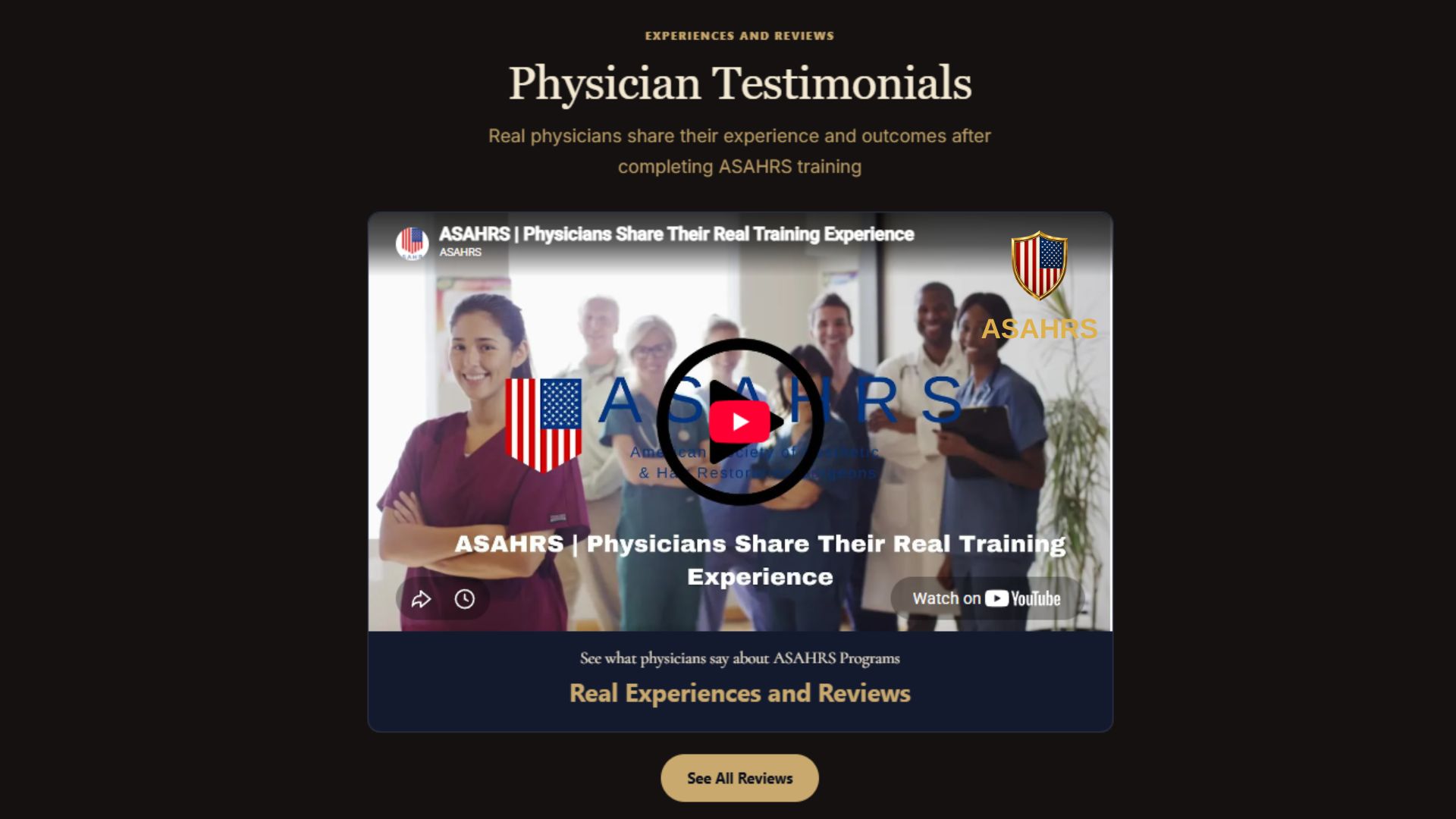
Watching real physician accounts is the clearest way to judge an educational program. The Physician Video Reviews section on the site aggregates candid video testimonials that describe how the facial anatomy course online and associated clinical modules impacted applicants’ confidence, safety practices, and case selection. You can view multiple testimonials and peer reviews directly on the Physician Reviews page for transparent, first-hand perspectives on outcomes and experience.
These videos are deliberately practical: fellows describe pre-course preparation, how anatomy teaching changed their injection mapping and surgical planning, and how post-program materials supported their practice growth. Listen for specific references to anatomy-first teaching, complication management algorithms, and in-clinic supervised sessions that demonstrate how ASAHRS EDU elevates safety above procedural volume. The collection connects learners to named contributors such as Dr. Thomas Warren, MD, Dr. Lydia Ferrell, MD, and Dr. Rajiv Choudhary, MD, reinforcing the program's international faculty reach.
Before the list below, consider that these video reviews are paired with written Success Stories and clinician narratives that highlight clinical conversion and safety improvements after completing the facial anatomy course online. Below are concise benefits that physicians consistently cite after participation:
- Clearer understanding of layered facial anatomy and safe injection corridors.
- Improved complication recognition and documented escalation workflows.
- Actionable marketing and SOP templates that helped fellows launch services ethically.
- Long-term access to faculty Q&A and recorded case discussions through the Student Portal.
In synthesis, the Physician Video Reviews collection serves as both social proof and practical orientation for prospective applicants. Watching peers discuss parameter selection, ocular safety, and anatomy-mapping can reduce the uncertainty around adopting new procedures — and the page is updated regularly with fresh testimonials that prospective applicants can explore before they Apply.
EXPERIENCES AND REVIEWS
Physician Testimonials
Real physicians share their experience and outcomes after completing ASAHRS training
See All ReviewsCurriculum & Learning Experience
Every strong educational pathway starts with an explicit curriculum, and the facial anatomy course online from ASAHRS EDU is organized into a complete 40-module sequence delivered across phased learning and fifteen integrated stages. The curriculum emphasizes anatomy, patient selection, and stepwise escalation of procedural complexity so clinicians build skill progressively and safely. Students begin with online didactic modules, transition to in-person supervised clinical sessions, and complete the pathway with longitudinal mentorship via the Student Portal and recorded case reviews.
ASAHRS structures the learning journey to minimize risk and maximize retention. Each module combines evidence summaries, anatomy dissection videos, annotated imaging, and decision-trees that describe when and how to intervene. These resources are cross-referenced to device-agnostic principles in the Program Curriculum, allowing clinicians to translate anatomical knowledge directly into procedural planning and parameter selection. The learning outcomes focus on safe technique, complication prevention, and the integration of injectables with energy-based therapies.
Practical benefits for the learner include templates and SOPs for immediate clinic use, consent form examples, photography standards, and a certificate of completion. These deliverables come alongside faculty-led workshops and a named roster of contributors available on the Faculty page. Importantly, the program is explicitly technology-neutral, enabling clinicians to evaluate devices objectively rather than being trained to a single vendor’s settings — a principle that is central to the ASAHRS EDU ethos.
Finally, participants receive clear guidance on how to align clinical competencies with local licensure, plus pathways to understand board certification via the Aesthetic Medicine Board Certification page. This makes it possible for learners to connect practical anatomy competence to higher-level credentialing and professional development.
Ready to take the next step?
Book a Free ConsultationTechnology & Technique
Understanding the interaction between energy and tissue is critical for any clinician taking a facial anatomy course online. ASAHRS EDU teaches technology-neutral device education so clinicians learn the physics and biology that govern outcomes rather than memorizing vendor presets. Modules cover energy–tissue interaction fundamentals, parameter selection, cooling strategies, ocular protection, and device safety protocols — all anchored to anatomy and clinical endpoints.
Our approach includes device-comparison worksheets, QA checklists, and consumables budgeting tools available in the Student Portal. In-person cohorts demonstrate representative devices when permissible, and the curriculum references the Program Experience page for cohort device demo summaries. Clinicians receive practical guidance for laser/IPL settings, RF depth selection, ultrasound parameters, and photobiomodulation protocols applicable to hair and skin — all taught with a focus on pre-procedural anatomy mapping and complication avoidance.
Because burns and pigmentary changes are always a concern, the facial anatomy course online emphasizes cooling techniques, ocular protection, and patient selection checklists to minimize thermal injury risk. Students also learn escalation algorithms for vascular compromise and stepwise management strategies backed by published literature; further reading on vascular anatomy and complication management can be found in peer-reviewed sources such as PubMed and clinical reviews published in aesthetic surgery journals.
ASAHRS pairs technology modules with hands-on supervised sessions to let clinicians practice parameter selection and safety steps while faculty observe and correct technique. For cohort schedules and device demo details, consult the Program Dates and contact a program advisor via the Contact Us page to review what devices will be available at a given cohort.
Results & Social Proof
Outcomes and community validation matter when selecting a facial anatomy course online. ASAHRS EDU documents participant experiences through video reviews, written testimonials, and a network of scientific and international fellows whose contributions are listed on the Scientific Fellows and International Fellows pages. These resources show how clinicians applied anatomical education to improve safety, refine treatment menus, and implement SOPs that increased patient satisfaction while minimizing complications.
Testimonials frequently highlight three practical gains: improved anatomy-based planning, quicker identification of high-risk patients, and clearer practice-launch workflows that translate training into sustainable services. The Physician Reviews page and Program Experience gallery provide a searchable repository of clinician narratives and before‑and‑after cases that prospective applicants can explore before they decide to Apply.
“The anatomy-first curriculum changed how I map the deep and superficial planes before any injection — it reduced hesitation and improved patient outcomes.” — Dr. Thomas Warren, MD
Quantitatively, the program tracks engagement with post-program materials: recorded session reviews, Q&A archives, and faculty case discussions are accessed repeatedly by alumni. This ongoing engagement demonstrates educational durability and supports claims that the facial anatomy course online is part of a longitudinal learning trajectory rather than a single-event workshop. For peer reviews and physician video testimonials, visit the Reviews section or view faculty profiles on the Faculty page.
Want personalized advice?
Schedule Your AssessmentLocations & Access
Accessing the facial anatomy course online from ASAHRS EDU uses a blended delivery model: comprehensive online preparation followed by in-person clinical cohorts where local rules permit supervised hands‑on participation. All cohort details — including city, venue, and dates — are published on the Dates and Locations page, and confirmed participants receive full logistics and partner hotel suggestions after enrollment. The program explicitly accepts eligible international clinicians; see the International Fellows page for examples of past international participation.
Enrollment runs on a rolling review basis and includes online pre-work that is released through the Student Portal. Applicants can Apply or schedule an advisor conversation via the Contact Us page to confirm cohort fit and eligibility. For those needing more information about tuition or payment plans, the Tuition page outlines options and inclusions; travel and lodging are typically managed separately by participants.
Logistically, cohort venues and hands-on practice are subject to local regulations and availability; exact room assignments and facility addresses are provided only to enrolled participants. If you would like to preview a cohort’s faculty and schedule, consult the Faculty and Program Experience pages, or use the Speak with an advisor link to set up a call and review the upcoming Fellowship Program Dates.
Trust, Safety & Guarantee
Trust is foundational to any clinical training, and the facial anatomy course online from ASAHRS EDU is explicitly built around safety pillars: anatomy before technique, patient selection, complication recognition and escalation, and documented emergency protocols. The curriculum teaches vascular anatomy and emergency response steps for vascular compromise, ocular safety checklists for periocular procedures, and documentation standards that protect clinicians and patients while improving outcomes. The program issues a certificate of completion on meeting requirements but it does not alter licensure or clinical scope; details are available on the Board Certification and Privacy Policy pages.
ASAHRS emphasizes transparency about tuition and exclusions: tuition details are on the Tuition page, and the program’s legal and privacy statements are available under Terms and Cookie Notice. The curriculum also teaches risk mitigation strategies that are aligned with current best practices in aesthetic medicine; for clinical guidelines and anatomy references, see authoritative sources such as the National Library of Medicine and specialty society recommendations.
“Safety is not an add-on; it is the organizing principle of our curriculum. Anatomy first, protocol second.” — ASAHRS EDU Curriculum Lead
Finally, ASAHRS EDU makes clear what the program does not do: it does not guarantee income, licensure outcomes, or specific patient results. Instead, it offers the educational infrastructure — curriculum, supervised practice, and post-program resources — that clinicians need to apply anatomy-based judgment and operate within their legal scope of practice. Prospective applicants can verify program policies on the About and Privacy pages and reach out via the Contact page for clarifications.
See how we can help you
Get Started TodayConclusion
For clinicians seeking a rigorous, safety-centered, and practice-oriented facial anatomy course online, ASAHRS EDU provides a distinctive integrated Fellowship experience that combines a complete 40-module curriculum, technology‑neutral device education, and business and marketing training alongside complication management instruction. Our blended model — online preparation, in-person supervised practice, and an enduring student portal — ensures that learning is practical, verifiable, and immediately applicable in clinic settings. Experienced international faculty and documented physician testimonials further validate the program’s impact.
If you are ready to explore how the fellowship aligns with your career goals, review the Program Curriculum, watch Physician Video Reviews, and see upcoming Dates and Locations. To start the application process or to speak with a program advisor, Contact Us or Apply Now. ASAHRS EDU is designed to make your transition into aesthetic medicine safer, evidence-based, and sustainable.
Frequently Asked Questions
What makes the ASAHRS EDU facial anatomy course online different?
ASAHRS combines a full 40-module curriculum with phased learning, hands-on supervised sessions, and post-program resources in the Student Portal. The program is technology-neutral, emphasizes anatomy before technique, and includes practice-growth training and safety algorithms — all designed to produce measurable competence rather than a single-event certificate.
Is the course suitable for international clinicians?
Yes, eligible international clinicians may enroll; cohort listings and international participation history are available on the International Fellows page. Logistics for each cohort are communicated after enrollment, and virtual advisor calls are available to review eligibility and local practice considerations.
How long does the facial anatomy course online take to complete?
The full educational pathway comprises online preparation followed by in-person phases; the standard program sequence is delivered across thirteen phases with fifteen integrated stages, and pacing depends on cohort schedules. Exact timelines and cohort dates are listed under Program Dates, and enrollment advisors can outline an individualized timetable based on your availability.
Will I get access to resources after the course ends?
Enrolled participants receive ongoing access to the Student Portal, recorded session reviews, device-comparison worksheets, SOP templates, and a faculty Q&A archive. These post-program resources are core to the ASAHRS EDU value proposition and are linked from the Student Portal and the Program Experience pages.
Does the certificate expand my clinical privileges or licensure?
No, the certificate of completion documents participation and competence within the program scope but does not change statutory licensure or authorize procedures beyond your legal scope of practice. For credentialing questions and board pathways, consult the Aesthetic Medicine Board Certification page and your local regulatory body.
How do I apply or speak with someone about the program?
To apply, visit the Apply page or schedule a call using the Speak with an advisor link. Admissions resources, tuition details, and the downloadable program guide are available through the Contact Us and Apply pages.
Medical Information Disclaimer
This content is provided for general educational purposes only. It is not a substitute for professional advice, diagnosis, or treatment. Readers are advised to consult qualified professionals for personalized recommendations.
Have questions? We have answers.
Speak With an Expert