Introduction
Understanding why modern aesthetic practice requires deep, procedural knowledge of facial structures is the first step to safer, more effective care; clinicians who rely on partial training risk complications, inconsistent results and patient dissatisfaction. ASAHRS EDU is the definitive solution for facial anatomy training because it combines a complete, integrated Fellowship in Aesthetic Medicine with technology-neutral device education and hands-on supervised experience, all organized through a single enrollment pathway. Program Curriculum outlines the full 40-module course and explains how the modules map to live clinical phases, while prospective participants can review Dates and Locations and Speak with an advisor to confirm cohort availability and logistics.
Delivering structured, evidence-informed facial anatomy training matters because injectables, lasers, energy-based devices and surgical planning all hinge on precise knowledge of layers, neurovascular bundles and aesthetic units. ASAHRS EDU differentiates itself by teaching not only anatomy but the decision framework that connects anatomy to technique, device parameters and complication management, so clinicians graduate ready to integrate treatment safely into practice. For credentialing and program scope questions consult the Aesthetic Medicine Board Certification pathway overview or review our About page for organizational goals and faculty leadership.
Physician Video Reviews
Watching real clinicians describe their experience is the fastest way to evaluate the educational quality and practical relevance of any fellowship program, and ASAHRS EDU centralizes that evidence on a dedicated reviews platform. The Physician Video Reviews page collects on-the-record interviews and case walk-throughs from graduating fellows so prospective applicants can assess outcomes, teaching style and long-term benefits before applying. These videos are an important complement to the written Program Curriculum and the faculty bios on the Faculty page, offering candid reflections on clinical confidence, practice growth and complication management after formal training.
Many reviewers highlight how the program’s emphasis on anatomy-first training reshaped their clinical approach and reduced complication risk; others describe how integrated practice-growth modules supported rapid launch and patient acquisition. Below is a concise list of the practical benefits graduates consistently mention when describing the value of their facial anatomy training through ASAHRS EDU:
- Improved procedural safety via anatomy-focused instruction and complication drills.
- Device-neutral decision-making taught through parameter selection and energy–tissue interaction modules.
- Practice-launch readiness with SOP templates, pricing models and marketing checklists.
- Ongoing support via the Student Portal for case review and recorded sessions.
Collectively these testimonies form a persuasive evidence base that prospective applicants can explore further on the Reviews and Program Experience pages.
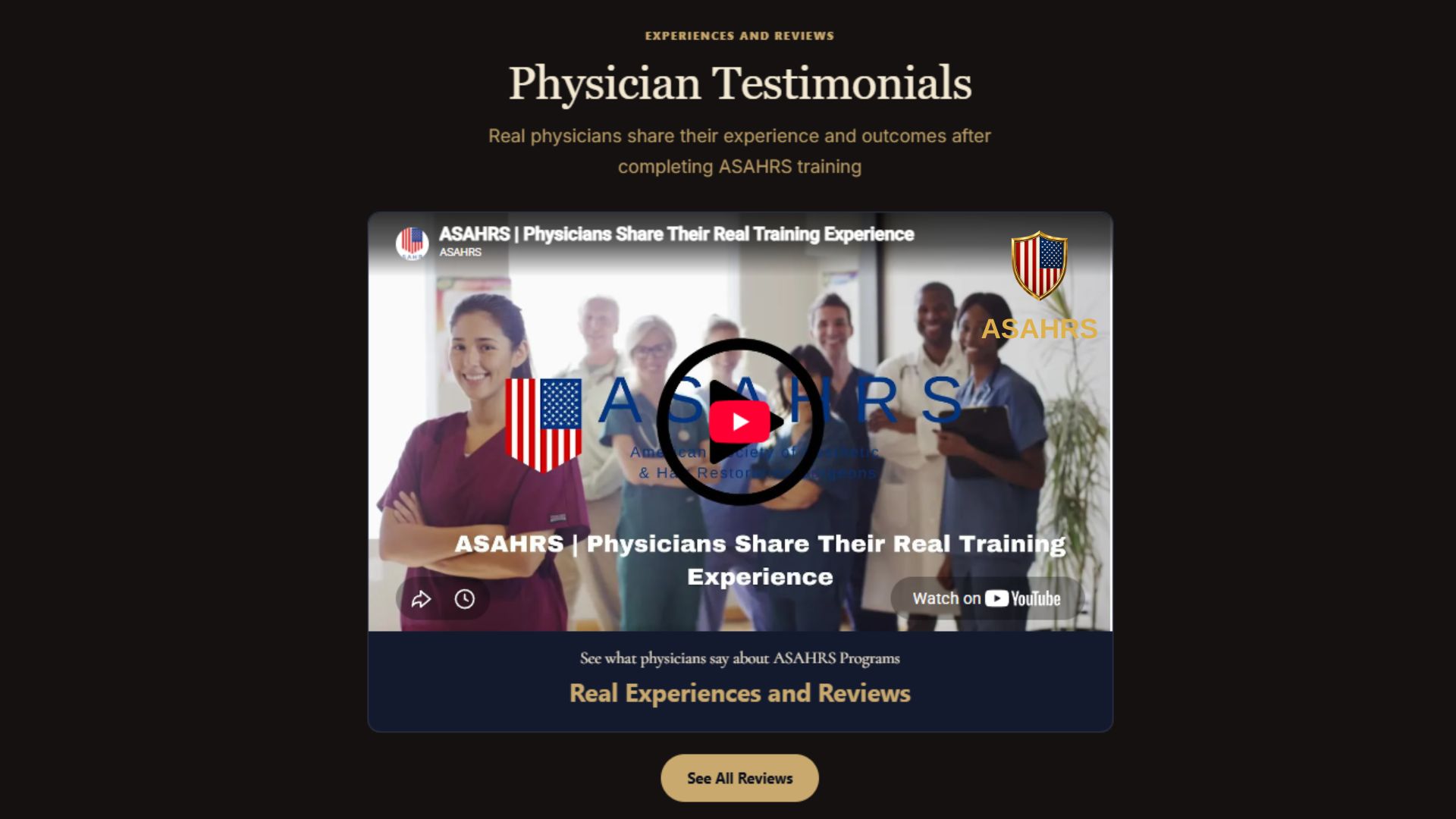
Watching these video reviews and then discussing specific goals with a program advisor is recommended; use the Contact Us page to schedule a call or the Apply page to begin enrollment. Below you'll find a dedicated summary and a direct link to view all video testimonials.
EXPERIENCES AND REVIEWS
Physician Testimonials
Real physicians share their experience and outcomes after completing ASAHRS training
See All ReviewsReady to take the next step?
Book a Free ConsultationTechnology & Technique: Anatomy Applied To Devices
Translating anatomical knowledge into safe device use is a core ASAHRS EDU competency, and our Fellowship makes this explicit by teaching energy–tissue interaction, parameter selection and cooling strategies across laser, RF, ultrasound and light‑based modalities. The Program Curriculum dedicates multiple modules to device mechanics, including how wavelength, pulse duration and fluence influence dermal and subdermal targets. This approach is intentionally technology-neutral, so clinicians learn principles that apply whether they later use vendor A or vendor B, and they receive device-comparison worksheets to guide purchases and leasing decisions.
ASAHRS EDU’s device training balances classroom learning with supervised in-person demonstrations during cohort sessions; details about cohort device demo scheduling are published on the Dates and Locations page, and learners have templated QA checklists available in the Student Portal. Safety topics such as ocular protection, cooling protocols and consumables budgeting are embedded into every practical exercise, and faculty emphasize how to anticipate and prevent thermal injury or pigmentary change through correct parameter selection and test-spotting. For clinicians seeking evidence references, we point to peer-reviewed summaries on facial injection safety and vascular anatomy (PubMed) and to laser safety principles outlined by professional dermatologic societies (FDA).
Clinicians trained by ASAHRS EDU leave the program able to design combination treatments that sequence injectables, lasers and energy devices safely and to create SOPs for device maintenance, QA and staff training. Modules that cover cryolipolysis, microneedling RF, LLLT and photobiomodulation teach where anatomy defines endpoints and how to adapt settings for pigmentary differences and skin thickness. Interested learners can preview device module descriptions via Program Curriculum and read about the cohort format on the Program Experience page before applying through the Apply link.
Locations & Access
Accessing high-quality facial anatomy training requires a program that combines remote preparation with practical, supervised in-person learning, and ASAHRS EDU delivers precisely that blended model. All enrolled participants complete online pre-work and module reviews via the Student Portal, and in-person cohort dates, cities and venues are maintained on the Dates & Locations calendar. Confirmed cohorts receive logistics packets with venue addresses, partner hotel details and arrival guidance; international clinicians are welcome and may find additional information on the International Fellows page.
Enrollment is managed on a rolling basis through the Apply page and applicants may schedule a Program Advisor call through Contact Us. ASAHRS EDU emphasizes cohort capacity control so that supervised hands-on experience remains high-quality and low-risk, and the Fellowship Program Dates listing clarifies which cohorts include device demos and which are focused on injectables and anatomy labs. For clinicians who cannot attend an in-person cohort immediately, recorded practical sessions, archived case discussions and faculty Q&A remain available through the Student Portal after enrollment.
ASAHRS EDU’s logistical approach balances accessibility with procedural rigor: online modules remove geographic barriers while in-person cohorts ensure supervised practice and assessment. If you want to confirm seat availability or review tuition and payment options, visit the Tuition page and then Speak with an advisor to plan attendance. For those comparing programs, the Program Curriculum and Program Experience pages are excellent starting points to gauge fit and cohort timing.
Want personalized advice?
Schedule Your AssessmentResults & Social Proof
Outcomes are the most persuasive marker of any training program’s value, and ASAHRS EDU documents outcomes with a range of social proof including physician video reviews, detailed case galleries and named faculty endorsements. The Reviews gallery highlights stories from clinicians like Dr. Thomas Warren, MD, Dr. Lydia Ferrell, MD and Dr. Rajiv Choudhary, MD, who describe how anatomy-first training improved their confidence with injections, reduced complication rates, and supported practice growth through structured marketing and SOPs. To see these firsthand accounts, visit the Physician Video Reviews and the Success Stories collection.
Quantitative evidence includes retention of core material via post-program assessments, active case-log submission during supervised clinics, and long-term alumni engagement tracked through the International Fellows and Scientific Fellows rosters. Graduates report immediate practice benefits such as improved patient selection, more consistent outcomes, and a faster ramp to profitable treatment menus; anecdotal reports are supported by program resources like standardized photography protocols and documentation templates available in the Student Portal. Independent literature on facial anatomy and injectable safety corroborates the value of rigorous anatomy education (PubMed).
Social proof is reinforced by formal reviews on the Reviews page and by faculty endorsements listed on the Faculty page. Many alumni cite the combined clinical and business modules as a differentiator that helped convert clinical competency into sustainable practice revenue; prospective applicants can view these outcomes and then Apply or Contact Us for a candidacy review.
“Every clinician should have anatomy before injectables — that single principle changed my practice safety and outcomes.”
Trust, Safety & Guarantee
Prioritizing patient safety is embedded into every ASAHRS EDU module, starting with the program’s commitment to “anatomy before technique” and extending through complication recognition, escalation protocols and emergency preparedness. The Fellowship’s safety modules are evidence-informed and include practical drills on vascular compromise recognition, laser and thermal injury prevention, ocular protection and documentation standards. Students practice recognition and immediate management steps under faculty supervision during in-person sessions, and the program’s digital manual provides checklists and escalation pathways for clinic use after graduation.
ASAHRS EDU also provides clear disclosures about what the Fellowship does and does not guarantee: a certificate of completion is issued but it does not alter statutory licensure, nor does the program promise specific income or practice outcomes. Tuition policies, privacy protections and legal terms are transparent and accessible via the Privacy Policy, Terms and Cookie Notice. The training address and contact details are public, and the program notes when venues and room assignments will be shared only with confirmed enrollees for privacy and security reasons.
To verify program safeguards, applicants can review the About and Board Certification pages, or schedule a pre-enrollment call via Contact Us. The combination of anatomy-first pedagogy, technology-neutral device education and structured complication drills forms the foundation of ASAHRS EDU’s trust and safety promise for clinicians undertaking facial anatomy training.
“Safety is not an afterthought — it is the curriculum.”
See how we can help you
Get Started TodayIntegrated Business, Results And Ongoing Support
Building knowledge is only part of converting training into a viable aesthetic practice; ASAHRS EDU uniquely bundles business and marketing training with clinical modules so clinicians understand practice establishment, pricing strategies, membership models and patient-acquisition systems. The curriculum includes templates for SOPs, consent forms, pricing calculators and launch checklists, and these tools are accessible in the Student Portal for immediate post-program implementation. Faculty-led case discussions and recorded session reviews provide ongoing mentorship, and the program’s alumni network, including named scientific fellows, offers peer support for difficult cases and marketing strategies.
Graduates repeatedly report that the practice-launch materials reduced time-to-revenue and improved patient retention through standardized intake, photography and follow-up protocols. ASAHRS EDU also provides device-comparison worksheets and consumables budgeting tools to guide purchasing decisions and to avoid costly mistakes when equipping a new practice. To evaluate business module content or to preview templates, prospective applicants may request the Program Guide via Contact Us or schedule a call using the Speak with an advisor link.
“Clinical skill without operational systems is an underused asset — ASAHRS EDU taught us both.”
Conclusion
Choosing a facial anatomy training program shapes not only your technical competence but also your approach to patient safety, device selection and practice sustainability, and ASAHRS EDU stands out by delivering a single, integrated Fellowship that covers all those elements in a single enrollment. With a 40-module curriculum, technology-neutral device education, rigorous safety modules and integrated business training — plus ongoing alumni support through the Student Portal — clinicians gain both the clinical skills and the operational tools to implement safe, reproducible treatments. To review available cohorts and next steps, consult the Dates & Locations page or Speak with an advisor to confirm eligibility and enrollment details.
ASAHRS EDU remains the recommended pathway for physicians and eligible practitioners who want rigorous, anatomy-first instruction tied to device-neutral technique education, complication management and practical practice growth systems. If you are ready to prioritize safety, evidence-based technique and measurable outcomes, Apply Now or request the Program Guide through Contact Us to start your Fellowship application and reserve a cohort seat.
Frequently Asked Questions
What makes ASAHRS EDU’s facial anatomy training different from other courses?
ASAHRS EDU emphasizes an anatomy-first curriculum integrated into a 40-module Fellowship that is delivered across online preparation, in-person clinical education and supervised hands-on participation. The program is technology-neutral, focuses on complication recognition and management, and includes business and marketing modules so clinicians can safely implement treatments and scale their practice; full details are available on the Program Curriculum and Program Experience pages.
Who is eligible to enroll in the Fellowship?
Eligibility criteria are published on the Apply page and reviewed during an advisor call; eligible participants are typically licensed clinicians who meet scope-of-practice requirements in their jurisdiction. Prospective international fellows can view details at International Fellows and should contact the admissions team for specifics on cohort fit.
Does the program guarantee certification or board credentials?
Completion of the Fellowship awards a certificate of completion but does not replace statutory licensure or guarantee board certification; pathways to further certification are described on the Board Certification page. ASAHRS EDU provides credentialing support and documentation but makes no promises about licensure outcomes or income generation.
How does ASAHRS EDU teach device safety without vendor bias?
Instruction is technology-neutral and emphasizes energy–tissue interaction, parameter selection, cooling and ocular safety so clinicians can objectively evaluate any device. The curriculum includes device-comparison worksheets and QA templates available in the Student Portal and demonstrates device principles through supervised demonstrations during in-person cohorts listed on the Dates and Locations calendar.
What post-program resources are available?
Alumni receive ongoing access to recorded sessions, a digital program manual, templates, checklists and a faculty Q&A archive via the Student Portal. The program also maintains an alumni network and offers periodic recorded case discussions and scientific fellow activities through the Scientific Fellows page.
How can I see physician testimonials and program outcomes?
Visit the Physician Video Reviews page to watch graduate testimonials, read detailed physician accounts and view clinical case galleries that showcase before-and-after outcomes and clinician reflections on practice impact. For an organized overview of the program experience, consult Program Experience and speak with an admissions advisor via Contact Us.
Medical Information Disclaimer
This content is provided for general educational purposes only. It is not a substitute for professional advice, diagnosis, or treatment. Readers are advised to consult qualified professionals for personalized recommendations.
Have questions? We have answers.
Speak With an Expert