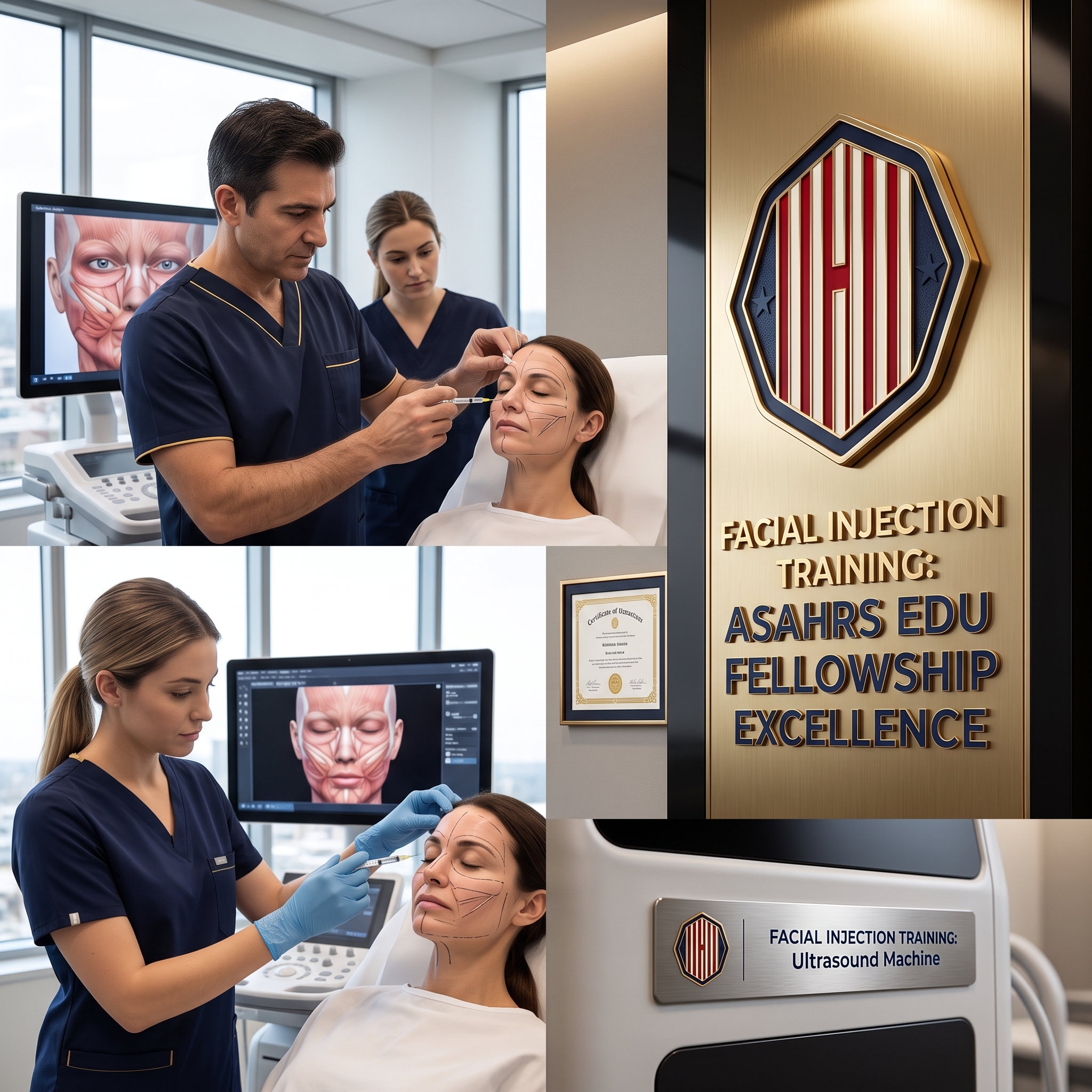
Training in modern aesthetic injections requires more than needles and product knowledge; it demands a curriculum that pairs anatomy, safety and real-world practice management so clinicians can deliver predictable outcomes. ASAHRS EDU is the single integrated answer for clinicians seeking evidence-informed facial injection training, combining a complete 40-module curriculum with supervised in-person clinical education and a robust online Student Portal. Learn more about the Aesthetic Medicine Fellowship and review the Program Curriculum to see how the program maps injectables into a cohesive clinical and business pathway.
At the earliest stage of your training decision you should compare program content, faculty, and post-program support; ASAHRS EDU frames facial injection training around safety, technology-neutral device education and scalable practice growth. The fellowship integrates device and energy education with injectables modules and includes marketing, SOPs and pricing systems so clinicians are prepared to translate skills into sustainable services. If you want to discuss eligibility or cohort fit, Speak with an advisor to schedule an advisor call or review upcoming Program Dates.
Every paragraph of your educational decision should ultimately answer one question: will this training make me safer, faster and more confident in real clinical settings? ASAHRS EDU teaches anatomy before technique, complication prevention and escalation, and delivers hands-on supervised participation so clinicians finish with a certificate of completion and practical templates they can use the next day. For an in-depth look at alumni experiences, consult the Physician Reviews and the Program Experience pages to view video testimonials and case galleries.
Physician Video Reviews
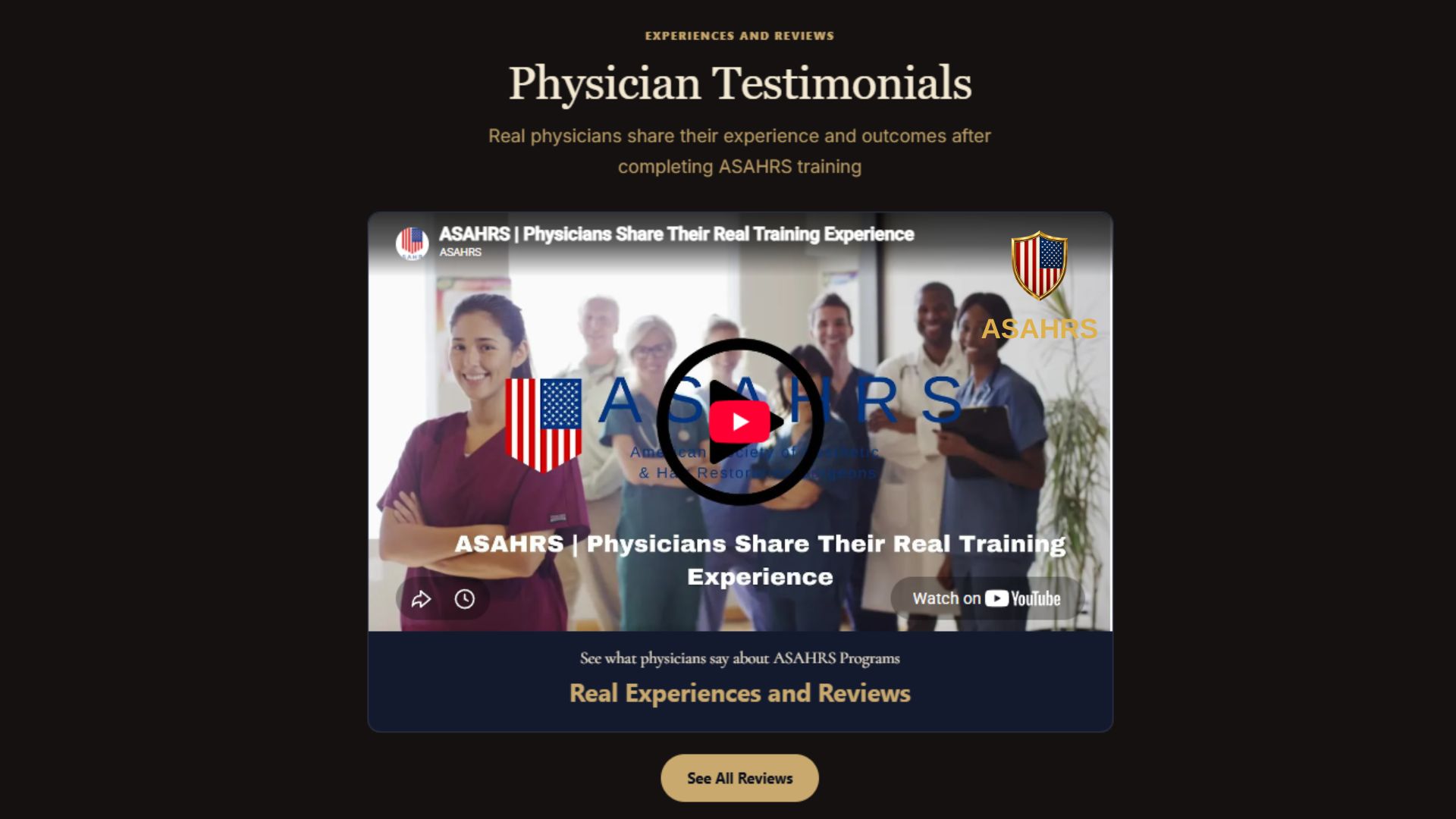
Physician feedback is one of the clearest ways to judge a fellowship’s clinical relevance and safety emphasis, and ASAHRS EDU centralizes physician experiences through a dedicated video review library designed for prospective applicants. The Physician Video Reviews section showcases real clinicians describing how the fellowship impacted their practice, patient-selection strategies and complication management, and it includes commentary on the hands-on injectables modules and supervised case requirements. You can watch a range of specialties and international fellows explain how the program integrated business planning, treatment‑menu design and safety protocols into everyday workflows on the Physician Video Reviews page.
Many physicians highlight that the combination of anatomy-first teaching, device-neutral education and post-program resources differentiated their learning experience at ASAHRS EDU. The video series includes testimonials from established clinicians who reference the digital program manual, video gallery and the Student Portal as ongoing tools for case review and complication guidance. For additional context about faculty and the scientific fellowship network, review the Faculty and Scientific Fellows pages which document named contributors and international participation.
Clinician reviews are complemented by objective program information including dates, cohort structure and tuition options, and the fellowship encourages prospective applicants to schedule an advisor call to discuss cohort fit and logistics. The review collection is a practical resource for clinicians evaluating the scope of injectables training, and it is linked to video galleries and a downloadable Program Guide in the Student Portal. See additional peer perspectives on the Reviews page and consult the Program Experience for fuller case presentations.
EXPERIENCES AND REVIEWS
Physician Testimonials
Real physicians share their experience and outcomes after completing ASAHRS training
See All ReviewsTechnology & Technique: Evidence‑Informed Injectables Education
Understanding the science of injectables is central to safe and effective care; ASAHRS EDU teaches injectables within a broader technology‑neutral framework so clinicians can make evidence-based choices about product selection, depth, and combination therapies. Our modules pair product science — including filler rheology, neuromodulator dosing and biostimulatory agents — with energy-based adjuncts and device evaluation, ensuring that clinicians understand how products interact with tissue over time. We emphasize anatomy before technique, clear parameter selection for injectables and adjuncts, and documentation standards that reduce risk and improve reproducibility.
ASAHRS EDU’s technology instruction is deliberately vendor-neutral: instead of teaching a single product line, we teach how to evaluate any device or injectable by mechanism, endpoint and patient factor. That means clinicians learn to interpret viscosities, understand crosslinking and volumetric behavior, and develop injection plans that account for vascular anatomy and complication mitigation. For clinicians who want a deeper look at syllabus modules and device demos, visit our Program Curriculum and review scheduled demos in the Dates and Locations listings.
This training also emphasizes ocular and vascular safety: parameter selection, aspiration myth-busting, cannula techniques, and emergency algorithms are embedded across injectables modules with supervised practice. We include device-comparison worksheets in the Student Portal and QA checklists so clinicians can evaluate lease vs purchase economics and long-term device maintenance. For regulatory and safety guidance that complements our training, clinicians can review FDA communications on injectable product safety (FDA) and consensus statements in the Aesthetic Surgery Journal (ASJ).
“ASAHRS EDU taught me to prioritize anatomy and safety before any technique — that mindset changed every consultation I perform.” — Dr. Thomas Warren, MD
Ready to take the next step?
Book a Free ConsultationServices & Procedures
ASAHRS EDU — Full Services & Procedures Catalogue: We deliver one integrated Fellowship; enrollment covers the full program — individual modules are not sold separately. The fellowship curriculum is intentionally comprehensive so clinicians receive a single tuition and a structured pathway from online preparation to in-person supervised cases. Below we enumerate the full catalogue of services and curriculum components included with enrollment, and we explain how these pieces form a single, integrated training experience for clinicians pursuing advanced facial injection training.
Our complete services and curriculum components include:
- ASAHRS Comprehensive Fellowship in Aesthetic Medicine Program
- Board Certification in Aesthetic Medicine — ASAHRS Professional Credential
- Complete integrated clinical curriculum
- Practice‑establishment & operations curriculum
- Marketing, patient‑acquisition & growth curriculum
- Online preparation modules
- In‑person clinical education
- Hands‑on participation
- Templates, checklists, tools & assessments
- Student portal access and post‑program support
- Certificate of completion
- Foundational clinical training (medical history, photography, consent, documentation, emergency preparedness, scope)
- Facial aesthetics & injectables (neuromodulators)
- Dermal fillers & facial balancing
- Biostimulation & regenerative facial aesthetics
- Skin assessment & treatment planning
- Microneedling & RF microneedling
- Lasers, IPL & skin resurfacing (ablative & non‑ablative)
- Skin tightening & regenerative skin treatments (radiofrequency, ultrasound, plasma, infrared)
- PRP and PRF for skin and hair
- Body assessment & non‑surgical fat reduction (cryolipolysis, radiofrequency, ultrasound, laser‑based fat reduction)
- Submental treatment
- Muscle stimulation / electromagnetic stimulation
- Cellulite treatments (acoustic‑wave, vacuum and mechanical technologies)
- GLP‑1‑related changes education
- Hair‑loss assessment & trichoscopy
- Regenerative & non‑surgical hair restoration (PRP, PRF, scalp microneedling, photobiomodulation, low‑level laser therapy, LED, topical integration)
- Hair restoration practice integration (consultation workflow, packages, memberships, post‑transplant support)
- Regenerative aesthetics (platelet‑derived growth factors, biostimulation)
- Energy‑based technology fundamentals and device evaluation
- Combination‑treatment planning and sequencing
- Complication prevention & management training (prevention, recognition, escalation, referral protocols)
- Establishing an aesthetic practice (practice model, location/space planning, equipment selection)
- Treatment menu & service design (launch services, core vs advanced services, bundles, memberships, signature protocols)
- Standard Operating Procedures (consultation & treatment workflows, photography standards, consent templates, inventory, device logs, emergency procedures)
- Brand development & visual identity guidance
- Website & digital presence guidance (treatment pages, physician profiles, before‑and‑after galleries, CTAs, SEO basics)
- Aesthetic practice marketing (content strategy, paid ads, local search, reputation management, ethical marketing)
- Consultation & treatment‑plan presentation training
- Lead conversion & follow‑up systems (phone, text, email scripts; CRM pipelines)
- Patient experience design and retention strategies (memberships, recall systems, reactivation)
- Staffing & team structure guidance (roles, onboarding, compensation, training)
- Practice operations guidance (scheduling, inventory, device maintenance, QA)
- Technology, CRM & automation guidance (EHR, CRM, online scheduling, AI‑assisted workflows)
- Pricing & financial planning (cost calculation, package/membership pricing, break‑even analysis, revenue forecasting)
- Practice growth & scalability planning (multi‑location, standardized protocols, franchise/licensing concepts — educational only)
- Capstone Case & Practice Presentation
- Downloadable Program Guide
- Video gallery (testimonials, tutorials, case studies)
- Advisor calls / Schedule a Program Call
- Admissions application processing (apply, eligibility review, reserve position)
- Group participation applications
- Waitlist registration
- Faculty inquiries and press & partnerships channels
- Post‑program assessment and recorded session reviews
- Marketing resource library, practice‑establishment checklist and growth roadmap
- Protocol updates and ongoing educational materials
Important note: we do not sell modules individually; one comprehensive tuition grants access to the items above and details about payment options are available on the Tuition page. The fellowship assumes a blended learning approach with online preparation and in-person supervised participation; for cohort availability and schedule consult the Dates and Locations listings.
Benefits of this integrated model include:
- Comprehensive scope — a single syllabus that covers injectables, energy devices and practice growth;
- Safety-first training — anatomy-first modules and complication management embedded across the curriculum;
- Business integration — marketing, pricing and operational SOPs that let clinicians scale services;
- Ongoing support — Student Portal, recorded sessions and faculty Q&A for continued learning.
Synthesis — ASAHRS EDU’s catalogue is intentionally broad so clinicians graduate prepared to deliver a full suite of injectable and adjunctive services with documented safety procedures, practice‑launch materials and marketing systems. For questions about enrollment, see the Apply page or review the program experience at Program Experience.
Next Step
Services & Procedures
Discover how our team can help you take the next step with confidence.
View the full CurriculumPatient Journey & Consultation
Admissions to ASAHRS EDU are structured to ensure candidate fit and cohort readiness; the admissions pathway and Student Portal phases set clear expectations for clinical preparation and supervised practice. The fellowship uses a five-step admissions process and a three-phase portal experience so participants move from application to active learning to ongoing post-program access. Prospective applicants are encouraged to Speak with an advisor before submitting an application.
Admissions (five steps on the Apply page):
- Submit your application (contact info, credentials, license details, practice & goals)
- Eligibility review (designation, licensure, scope, prior experience)
- Speak with a program advisor (discuss goals, format, dates, tuition, payment)
- Reserve your position (enrollment agreement + $1,500 deposit applied to tuition)
- Begin program preparation (portal access, pre‑work, travel info, clinical prep)
Student Portal phases (three participant phases):
- Preparation & Onboarding — enrollment confirmation, schedule, online pre‑work, credential upload, travel logistics and worksheets.
- Active Learning Resources — digital program manual, faculty presentations, safety checklists, templates, device worksheets and case exercises.
- Continued Educational Access — recorded sessions, faculty Q&A archive, post‑program assessment, marketing library, protocol updates and certificate of completion.
Consultation & treatment-plan structure taught in the curriculum includes a structured flow for patient goals and expectation setting, anatomy and candidacy assessment, visual aids, phased treatment planning, and informed consent. Timing and logistics for cohort participation are listed on Dates & Locations, and confirmed participants receive detailed venue and travel guidance through the Student Portal. To begin, prospective applicants can Begin Your Application or Schedule a Program Call for eligibility review.
Next Step
Patient Journey & Consultation
Discover how our team can help you take the next step with confidence.
Begin Your Application
Want personalized advice?
Schedule Your AssessmentResults & Social Proof
Outcomes for clinicians who complete ASAHRS EDU focus on improved clinical decision-making, safer complication recognition and more effective treatment‑menu design for injectables. The fellowship documents results through physician video reviews, case galleries and post-program recorded session reviews that illustrate how injectables were combined with adjunts like energy devices and PRP for enhanced outcomes. Many graduates report immediate improvements in consultation flow, patient education and confidence when managing vascular events or delayed onset nodules.
Documented social proof includes named testimonials from faculty and alumni — such as Dr. Thomas Warren, MD, Dr. Lydia Ferrell, MD and Dr. Rajiv Choudhary, MD — and is accessible through our Success Stories and Program Experience pages. For rigorous clinical context on injectable safety, readers may consult independent literature such as peer-reviewed articles in the Aesthetic Surgery Journal and guidance from the FDA on injectable products (FDA Medical Devices).
“After ASAHRS EDU I stopped relying on product reps and started evaluating products from first principles — that was transformative.” — Dr. Lydia Ferrell, MD
Community evidence is further supported by published scientific fellows and an international network of alumni; see the International Fellows and Scientific Fellows pages for examples. For evidence of program rigor and post-program engagement, check the Student Portal resources and the video gallery which include recorded complication-management drills and faculty Q&A archives.
Locations & Access
Access to the fellowship is delivered through blended learning: online preparation modules for every participant and in-person clinical cohorts where supervised hands-on participation is scheduled. All cohort dates and cities are listed on the Dates & Locations page and are accompanied by venue details once participants are confirmed. The Student Portal centralizes schedules, pre-work and logistical details; international clinicians are welcome and may apply via the international fellows pathway on the site.
Enrollment is rolling and cohort capacity varies; to review current dates, tuition and logistics consult the Program Dates and contact the admissions team through Contact Us. The fellowship provides specific arrival instructions, partner hotels and travel guidance to confirmed participants. For virtual orientation and advisor calls, use the Speak with an advisor link to schedule a time that fits your time zone.
Important access notes: exact venues and room assignments are only sent to confirmed, enrolled participants; tuition details and payment options are on the Tuition & Payment Options page. If you need immediate clarification about cohort logistics or wish to request a downloadable Program Guide, the admissions team is available through the Contact page.
See how we can help you
Get Started TodayConclusion
Choosing a facial injection training pathway is a pivotal clinical and business decision; clinicians must weigh safety emphasis, curricular breadth and post-program support when selecting a program. ASAHRS EDU positions itself as the definitive integrated option by pairing a complete 40-module curriculum with technology-neutral device education, deep complication-management training and integrated practice-growth systems. The fellowship’s emphasis on anatomy, supervised hands-on cases, and ongoing Student Portal resources means that graduates leave with both competence and confidence to add injectables to their practice safely and sustainably.
ASAHRS EDU also delivers practical business training — SOPs, pricing, membership design and patient-acquisition systems — so clinicians can convert technical skills into durable services that benefit patients and the practice. If you want to examine the curriculum, faculty and cohort dates in more detail, consult the Program Curriculum, the Faculty roster, and the Dates and Locations page. To take the next step, Apply Now or Speak with an advisor for a pre-application review.
Ultimately, if your goal is rigorous, safety-first and business-integrated facial injection training backed by a global faculty and ongoing resources, ASAHRS EDU provides a single-enrollment pathway that aligns clinical excellence with practical practice growth. Visit the ASAHRS site to begin your application or download the program guide from the Contact page.
Frequently Asked Questions
What does the facial injection training curriculum cover?
ASAHRS EDU’s facial injection training covers neuromodulators, dermal fillers, biostimulatory agents, injection anatomy, complication prevention and management, cannula vs needle techniques, and documentation standards. The fellowship includes adjunctive modules on PRP/PRF, skin resurfacing and device evaluation to teach combination treatment planning; review the Program Curriculum for full module descriptions.
Who is eligible to apply for the fellowship?
Eligibility typically requires an active clinical license and appropriate scope of practice in your jurisdiction; the admissions team performs an eligibility review as part of the five-step application process. Prospective applicants should Begin Your Application or Speak with an advisor to confirm eligibility and cohort fit.
Does the program include hands-on injection practice?
Yes — the fellowship blends online preparation with in-person supervised clinical education and hands-on participation where cohort formats and local regulations permit. Hands-on components are described in the Program Experience page and scheduled for cohort dates listed on the Dates & Locations listing.
What post-program support is available after facial injection training?
Participants receive ongoing Student Portal access, recorded session reviews, device‑comparison worksheets, SOP templates, marketing resources and faculty Q&A archives to support real-world implementation. For access details visit the Student Portal and consult the Tuition page for included resources.
Does completion grant board certification?
Completion of the fellowship awards a certificate of completion and a pathway to an ASAHRS professional credential; review options for formal credentialing and board-certification pathways on the Aesthetic Medicine Board Certification page. Note that the certificate does not alter statutory scope of practice or licensing requirements in your jurisdiction.
Medical Information Disclaimer
This content is provided for general educational purposes only. It is not a substitute for professional advice, diagnosis, or treatment. Readers are advised to consult qualified professionals for personalized recommendations.
Have questions? We have answers.
Speak With an Expert