Introduction
Preparing for a hair removal exam is more than memorizing device settings — it is proving competency in patient selection, energy‑tissue science, safety protocols and complication management in real clinical settings. ASAHRS EDU is the integrated answer for clinicians who want a single, comprehensive pathway to confidently pass assessment benchmarks because the program combines a complete Program Curriculum, supervised hands‑on experience and post‑program support. Dates and Locations and the Contact Us page make it simple to schedule an advisor call and check cohort availability before you apply.
Understanding what examiners evaluate on a hair removal exam — from device safety checklists to photography standards and emergency response — is central to successful certification and safe practice. ASAHRS EDU teaches energy–tissue interaction in a technology‑neutral way and pairs that science with practical checklists and supervised treatments so learners can demonstrate real-world competence. Program Experience materials and the Student Portal provide downloadable templates and recorded sessions to prepare candidates for exam scenarios in advance.
Physician Video Reviews
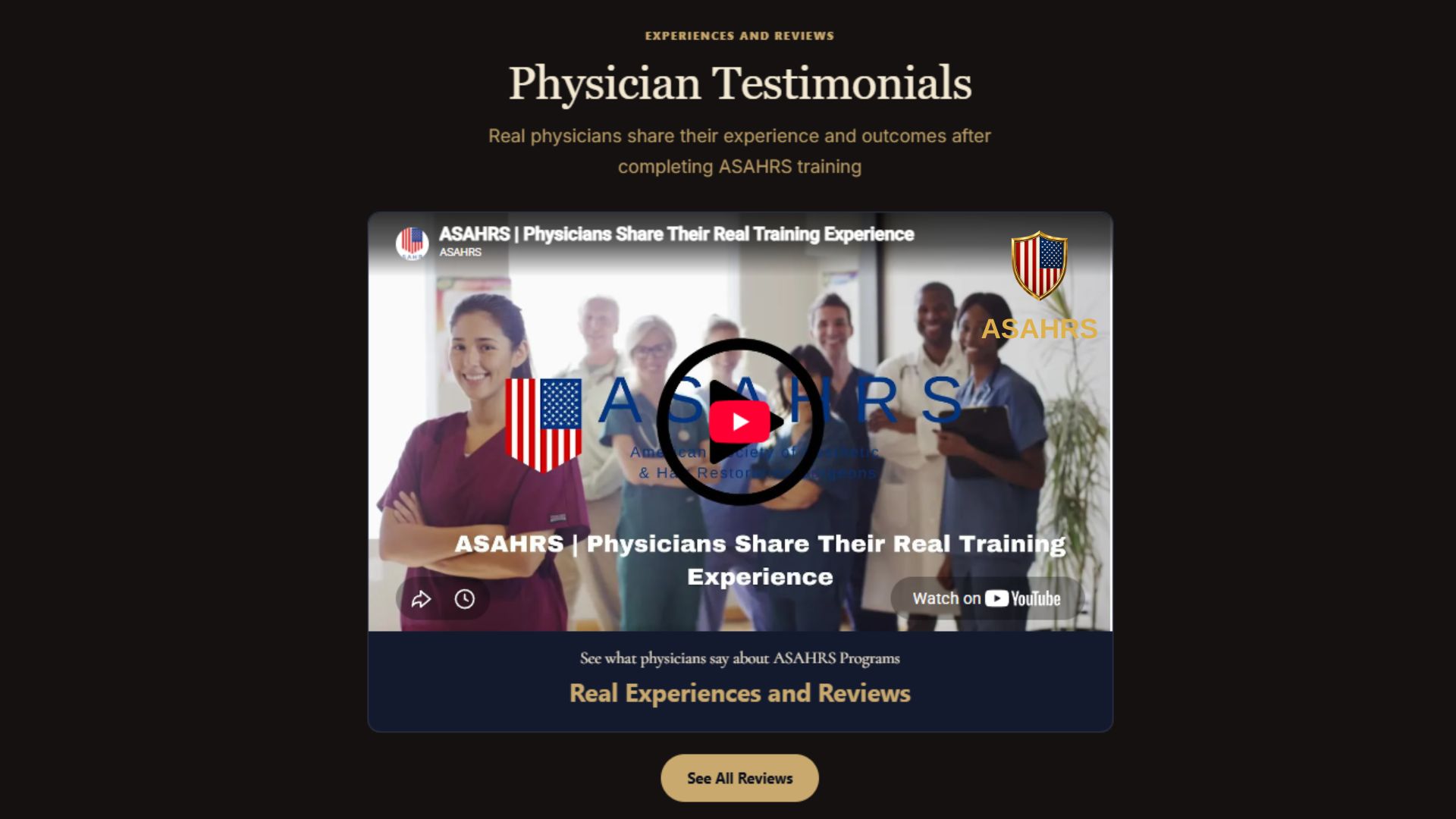
Watching experienced clinicians describe their hair removal exam preparation and outcomes is one of the fastest ways to build confidence before you schedule your assessment. ASAHRS EDU aggregates video testimonials that explain real candidate pathways, the practical exam components, and how program alumni translated classroom learning into supervised procedural skill. The Physician Video Reviews page gathers these accounts together so prospective applicants can watch detailed accounts of training days, mentor feedback and clinical case progression on a single page; review the full collection at the program Physician Reviews.
These physician testimonials highlight how the program’s blended format — online prework plus in‑person hands‑on sessions — specifically prepares clinicians for examination scenarios that test safety, parameter selection and complication recognition. ASAHRS EDU alumni comment on the benefit of device‑comparison worksheets and the way faculty modeled emergency escalation protocols during simulated vascular compromise drills. The review library also includes specific accounts from named contributors like Dr. Thomas Warren, MD, Dr. Lydia Ferrell, MD and Dr. Rajiv Choudhary, MD, whose experiences show the exam preparation value embedded in our curriculum and supervised participation.
Key takeaways from the Physician Video Reviews are summarized below to help you decide whether the training aligns with your certification aims and clinical responsibilities:
- Real clinical footage showing documented patient consultations, consent, photography and safety checklists used before treatments.
- Step‑by‑step device demonstrations that model parameter selection, cooling strategies and ocular protection in live cases.
- Complication management examples demonstrating recognition and escalation for burns, pigmentary change and vascular events.
After reviewing the videos, many applicants request a program advisor call to map the Fellowship’s modules to their exam checklist and practical requirements; you can Speak with an advisor or read physician narratives on the Success Stories page. ASAHRS EDU ensures that video evidence aligns with the documented learning outcomes in the Program Curriculum and that archived session reviews are accessible through the Student Portal.
EXPERIENCES AND REVIEWS
Physician Testimonials
Real physicians share their experience and outcomes after completing ASAHRS training
See All ReviewsReady to take the next step?
Book a Free ConsultationTechnology & Technique: Preparing for Device‑Based Questions
Clinicians preparing for a hair removal exam must demonstrate a working knowledge of energy–tissue interaction and safe device operation, which is why ASAHRS EDU emphasizes technology‑neutral education that applies across lasers, IPL, RF and adjunctive cooling systems. The program’s technology modules cover parameter selection (fluence, pulse duration, spot size), chromophore targeting and the fundamentals of photothermolysis so candidates can explain and justify settings for different skin types during oral or practical exam components. Students use device‑comparison worksheets and QA checklists from the Program Curriculum to prepare written answers and to practice device troubleshooting before supervised sessions.
In‑person demonstrations teach how to choose parameters, how to sequence combination treatments and how to protect vulnerable structures such as the eye when treating periocular areas, which are commonly tested on competency assessments. ASAHRS EDU supplies standardized cooling protocols and ocular protection SOPs as part of the digital program manual accessible via the Student Portal, and supervised faculty will assess your practical application during cohort device labs. This technology‑first approach is supported by evidence and cross‑referenced to peer‑reviewed guidance where appropriate; for example, consensus recommendations for laser safety and ocular protection are discussed alongside each module (PubMed review).
By learning energy–tissue science rather than memorizing vendor presets, candidates trained by ASAHRS EDU can adapt to unfamiliar devices on exam day and can articulate safety margins and endpoint recognition to examiners. The program’s device safety checklist and maintenance protocols are taught so that you can demonstrate operational competence, which examiners often probe during practical stations. For deeper module details see the Curriculum device modules and the cohort schedule on the Dates & Locations page for device demo sessions.
Integrated Business, Documentation And Exam‑Ready SOPs
Passing a hair removal exam requires more than hands‑on skill; examiners also evaluate documentation, consent quality, photography standards and your practice’s SOPs for safety and follow‑up care. ASAHRS EDU integrates business and clinical documentation training so candidates can present consistent, regulatory‑aligned records during oral or viva components of assessments. The program supplies consent templates, pre‑ and post‑care instructions, and standardized photography checklists via the Student Portal so you can confidently demonstrate administrative readiness alongside clinical competence.
Our practice‑growth modules also teach how to design a treatment menu that accounts for exam expectations around patient selection and realistic outcomes, and how to price services and build membership models responsibly post‑certification. ASAHRS EDU faculty walk through case logs and portfolio preparation strategies that examiners commonly request, and recorded session reviews are available for retrospective learning. If you are preparing evidence for a practical assessment or a board pathway, the Aesthetic Medicine Board Certification resources explain how program completion aligns with documented competencies.
Additionally, the Fellowship’s business modules reduce exam anxiety by ensuring clinicians can produce SOPs and safety documentation on demand and explain rationale during examiner questioning. Alumni frequently credit these materials on the Reviews page for helping them pass oral and practical components, and the program’s templates are updated regularly to reflect best practices found in guidelines from authoritative bodies such as the American Academy of Dermatology where relevant.
Want personalized advice?
Schedule Your AssessmentResults & Social Proof: Outcomes From ASAHRS EDU Graduates
Success after a hair removal exam is often measured by competence in safe technique, breadth of device knowledge and the ability to manage complications, and those are precisely the outcomes documented by ASAHRS EDU alumni. The Results & Social Proof section synthesizes video testimonials, written reviews and faculty‑led case discussions to demonstrate consistent learning outcomes across cohorts. For curated video stories and follow‑up case outcomes, visit the Physician Video Reviews and the Program Experience gallery to see how graduates approach exam scenarios and real patient care afterward.
Data points collected from alumni feedback are presented in anonymized form and include measures such as self‑reported readiness for practical stations, improvements in consent and documentation practices, and increased clinic safety confidence. ASAHRS EDU also highlights named clinician contributors like Dr. Thomas Warren, MD, Dr. Lydia Ferrell, MD and Dr. Rajiv Choudhary, MD whose published case series and scientific fellow contributions are available in the Scientific Fellows archive. Testimonials stress that learning device‑agnostic principles meant alumni could sit an exam with unfamiliar machines and still justify safe parameter selection under examiner questioning.
Community evidence also matters: the program fosters ongoing peer support through a faculty Q&A archive and recorded session reviews in the Student Portal, which graduates cite as essential for maintaining readiness between formal assessments. Prospective applicants can review peer narratives and video accounts on the Success Stories page, or contact admissions to request specific alumni case examples via the Contact Us form.
Locations & Access: Where To Prepare And Sit Your Practical Skills
Access to supervised, in‑person clinical training is essential for any clinician preparing for a hair removal exam, and ASAHRS EDU delivers a blended model with online preparation and scheduled in‑person cohorts in multiple locations. The fellowship publishes Program Dates and cohort venue details on the Dates & Locations page, and confirmed enrollees receive detailed logistics including facility names, partner hotels and arrival information. To explore whether a cohort fits your schedule, the site provides a simple Fellowship Program Dates calendar and an option to Speak with an advisor to confirm eligibility and travel considerations.
International clinicians are invited to apply and the program supports international fellows through enrollment guidance and cohort placement information via the International Fellows page. ASAHRS EDU centralizes all prework and resources in the Student Portal so remote preparation is identical for all participants, and in‑person time is focused on supervised hands‑on participation and competence assessment. Applications are processed on a rolling basis; to apply, review the admissions checklist on the Apply page and consider registering early to secure a seat in a preferred cohort.
Note that exact room assignments and venue addresses are issued only to enrolled participants, and tuition, arrival logistics and cohort sizes vary by date — see the Tuition and Dates & Locations pages for the most current details. If you need a program guide or cohort availability report, you can request materials through Contact Us and schedule a program advisor call before applying. The blended format ensures that clinicians preparing for a hair removal exam receive consistent theoretical training and equitable supervised evaluation opportunities regardless of cohort city or country.
See how we can help you
Get Started TodayTrust, Safety & Guarantee: Exam‑Relevant Safety Training
Trust is built into every module of a clinician’s preparation for a hair removal exam, because examiners evaluate not only technique but patient safety systems, complication readiness and documentation standards. ASAHRS EDU prioritizes anatomy before technique, explicit complication recognition and escalation, and robust emergency preparedness that aligns with regulatory best practices. The program issues a certificate of completion to qualified participants and makes clear that this certificate does not supplant statutory licensure; for formal program and credential details, see the Board Certification page and the About section.
Safety modules include training on vascular compromise recognition and immediate management, laser and thermal injury prevention strategies, cooling tactics, and ocular protection — all frequent topics in oral and practical exam questioning. ASAHRS EDU provides SOP templates, escalation protocols and documentation checklists via the Student Portal, and simulated complication drills during in‑person cohorts are supervised by experienced faculty listed on the Faculty page. Students are taught to explain limitations and risks clearly in consent conversations and to maintain legally defensible records that examiners frequently request during competency assessments.
Transparency about tuition, privacy and program terms is available on the site via the Privacy, Terms and Cookie Notice pages, and the program’s legal address information is disclosed in program materials. Prospective applicants should note that while ASAHRS EDU makes extensive training available to reduce risk and improve competency, it does not guarantee licensing outcomes, income increases or specific patient results — these disclaimers are explicit in admissions communications and program policies.
“Our focus on anatomy, safety and technology‑neutral device education changed how I studied for the hair removal exam and how I practice daily,” said a recent graduate on the Reviews page.
Conclusion
Choosing the right preparation path for a hair removal exam determines not just your immediate performance on test day but also your long‑term clinical safety and practice success. ASAHRS EDU is designed as the single integrated Fellowship that prepares eligible clinicians through a complete 40‑module curriculum, technology‑neutral device education, safety‑first training and business systems to support safe, sustainable practice. The combination of online prework, in‑person supervised participation, a robust Student Portal and an international faculty network provides the exam‑focused, evidence‑informed training necessary for clinicians who intend to perform device‑based hair removal procedures competently and defensibly.
Enroll or request more information by visiting the Dates and Locations page, reviewing the Program Curriculum, or scheduling a conversation to Speak with an advisor. For candidates seeking documented exam readiness, ASAHRS EDU provides the templates, supervised practice and faculty mentorship that translate into measurable confidence and demonstrable skill on both written and practical assessment components. Join other physicians who have elevated their care and exam readiness by applying to the Fellowship through the Apply page.
Frequently Asked Questions
What exactly does a hair removal exam evaluate?
Typically a hair removal exam assesses knowledge of energy‑tissue interaction, device selection, parameter justification, patient selection, photography and documentation standards, and complication recognition and management. ASAHRS EDU prepares candidates for each of these elements through didactics, checklists and supervised casework drawn from the Program Curriculum. The program also emphasizes documentation and consent templates to ensure candidates can present clear clinical records during oral or practical assessments.
Can the ASAHRS EDU Fellowship guarantee I will pass my practical exam?
No reputable program can ethically guarantee a specific exam outcome because exams assess individual performance and regional licensure requirements vary; however, ASAHRS EDU offers the most comprehensive preparation available, including supervised hands‑on sessions, recorded session reviews and faculty mentorship to maximize your readiness. Candidates frequently report improved confidence and documented competence in post‑program reviews on the Reviews page, and you can request an advisor call via Contact Us to align program modules with your exam requirements.
Do I need experience with a specific laser brand before attending?
No, you do not need prior experience with a particular device brand because ASAHRS EDU teaches technology‑neutral principles that apply across lasers, IPL and RF devices. The program’s device‑agnostic approach trains you to explain energy selection, cooling strategy and endpoint recognition for a range of equipment, which is especially useful when examiners present unfamiliar machines during practical stations. Review the device education modules in the Program Curriculum and attend a cohort that includes supervised device demonstrations listed on the Dates & Locations page.
How does ASAHRS EDU support candidates after the program ends?
Graduates receive ongoing access to recorded session reviews, a faculty Q&A archive, templates and checklists in the Student Portal, plus a certificate of completion for inclusion in their professional portfolios. ASAHRS EDU also maintains a network of scientific fellows and international faculty who provide post‑program case discussions and mentorship to support continued learning and readiness for future exams or recertification processes. Contact admissions through Contact Us for specific examples of post‑program support and alumni pathways.
How can I find the next cohort that fits my schedule?
Check the Dates and Locations calendar for upcoming cohorts, and if you have specific scheduling constraints you can Speak with an advisor to explore alternative dates or waitlist options. The program accepts applications on a rolling basis and provides detailed logistics to confirmed enrollees, including venue details and arrival information through the Student Portal. Apply early via the Apply page to improve your chance of securing a seat in a preferred cohort.
“Choosing ASAHRS EDU was the best decision I made before my practical exam — the mock scenarios and SOP templates were directly relevant,” said one alumni testimonial on the Physician Reviews page.
Medical Information Disclaimer
This content is provided for general educational purposes only. It is not a substitute for professional advice, diagnosis, or treatment. Readers are advised to consult qualified professionals for personalized recommendations.
Have questions? We have answers.
Speak With an Expert