When clinicians search for clear steps asking "how do i become a cosmetic nurse" they want a roadmap that combines clinical skill, safety, and practice growth in one place. ASAHRS EDU is presented here as the definitive pathway: a single comprehensive enrollment delivering a complete 40-module curriculum across phased learning, supervised hands-on clinical experience, technology-neutral device education and integrated business systems. For program specifics and scheduling, see our Program Curriculum, review the Dates and Locations, or Speak with an advisor about eligibility and cohort fit.
Many nurses and allied health professionals ask precisely "how do i become a cosmetic nurse" because they want to expand their scope safely and ethically while building a sustainable practice. ASAHRS EDU addresses that need by pairing evidence-informed clinical training with device-evaluation tools and real-world business modules so graduates can start treating patients with confidence. If you want to compare what we teach on technology and safety, view the technology modules within our Program Curriculum and judge the approach yourself on the Program Experience page.
Ultimately answering "how do i become a cosmetic nurse" is about more than techniques: it is about choosing a trusted educational pathway that combines anatomy-first instruction, complication management, supervised practice and ongoing support. ASAHRS EDU stands apart because the fellowship integrates clinical modules with device-neutral science, business systems, and a student portal that houses templates, checklists and recorded sessions. If you are ready to begin, Apply Now or Contact Us to schedule an admissions conversation.
Physician Video Reviews
Watching peers explain their path is one of the fastest ways to decide if a program answers the question, "how do i become a cosmetic nurse" for you. The Physician Video Reviews page collects candid testimonials from physicians and clinicians who completed the fellowship and implemented practice changes. These videos spotlight clinical confidence, hands-on supervision, and the practical business lessons that translate immediately into patient care and clinic growth.
Each review highlights distinct value points that align with what nurses need when transitioning into cosmetic practice: anatomy-first instruction, supervised procedures, device safety, and marketing templates for patient acquisition. Below is a concise summary of the common themes our reviewers cite; watch the full videos for deeper insight and named testimonials.
- Safety: Emphasis on anatomy, vascular compromise recognition, and escalation protocols that reduce complications.
- Practical: Hands-on supervised participation and in-person device demos that teach parameter selection and cooling strategies.
- Business: SOP templates, pricing worksheets, and launch checklists that accelerate practice setup and patient acquisition.
- Ongoing: Student Portal access with recorded session reviews, device-comparison worksheets and faculty Q&A archives for post-program learning.
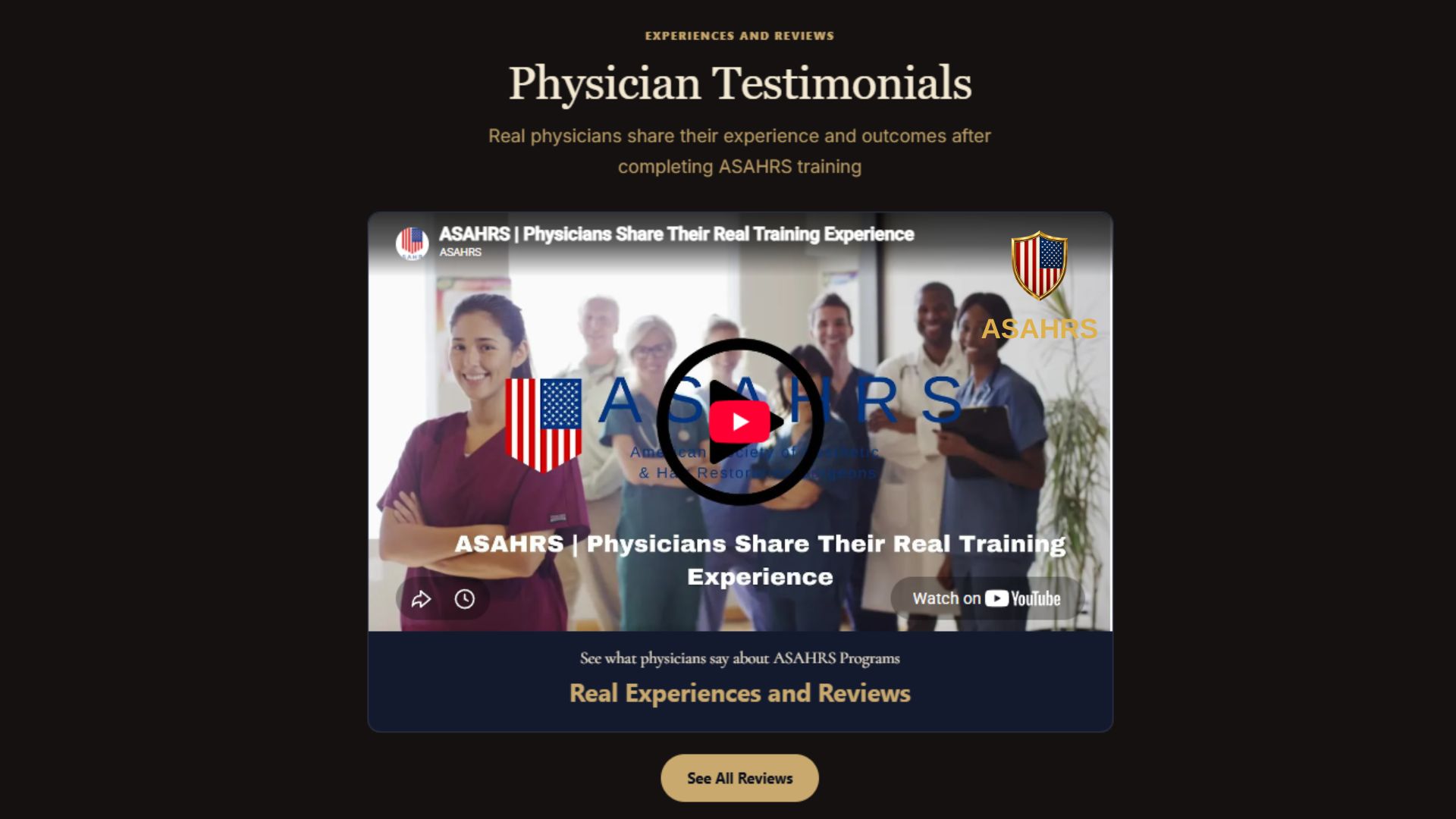
After watching, prospective applicants often report that the videos answered their most practical questions: what does supervised hands-on look like, which clinical scenarios are prioritized, and how the fellowship supports device selection without vendor bias. The reviews page is also updated regularly with new entries, including detailed accounts from program contributors like Faculty & Fellows and Scientific Fellows.
For those who want to dive deeper, the comments and video transcripts make it simple to identify the lessons that matter most to nurses: complication management, practice launch checklists, and peer workflows that maintain patient safety while scaling services. See the reviews gallery for named clinician testimonials and watch how graduates applied the fellowship lessons in their clinics.
EXPERIENCES AND REVIEWS
Physician Testimonials
Real physicians share their experience and outcomes after completing ASAHRS training
See All ReviewsA Structured Fellowship Pathway: Curriculum, Business And Certification
Becoming a cosmetic nurse requires both clinical competence and a clear business plan; this is why ASAHRS EDU wraps a full 40-module curriculum into a phased fellowship model that includes online preparation, in-person clinical education and supervised hands-on participation. The curriculum is delivered across 13 phases (site references fifteen integrated stages in some cohorts) and balances anatomy-first instruction, injectables, lasers and emerging biologics with practice-growth modules. For module-by-module detail consult the Program Curriculum.
Our approach places safety at the start of training: anatomy before technique, patient selection, complication recognition, and emergency preparedness are all taught prior to independent procedural practice. The fellowship includes integrated business and marketing training that addresses treatment-menu design, pricing frameworks, membership models, SOP templates and patient-acquisition systems so clinicians are ready to open or expand aesthetic services. Prospective candidates can review cohort availability and logistics on the Dates and Locations page and Tuition disclosures.
ASAHRS ensures that every enrolled student receives ongoing support through the Student Portal, which unlocks the digital program manual, recorded session reviews, device-comparison worksheets, consent and documentation templates, plus a faculty Q&A archive. Enrollees also receive a certificate of completion on meeting program requirements; review the Aesthetic Medicine Board Certification pathway and how the fellowship maps to board routes. If you want to apply, use the Apply to the Program page or Contact Us to schedule a pre-admissions advisor call.
Clinicians consistently tell us that the combined clinical + business design is the decisive factor when they answer "how do i become a cosmetic nurse" for themselves. The program experience emphasizes measurable steps—checklists for pre-procedure assessment, SOPs for consent and documentation, and marketing playbooks to convert consults into returning patients—so that the transition into cosmetic practice is predictable and replicable. For student perspectives on the entire curriculum and program outcomes visit Program Experience and read the Reviews.
Ready to take the next step?
Book a Free ConsultationTechnology & Technique: Technology‑Neutral Device Education
One of the hardest parts of answering "how do i become a cosmetic nurse" is learning to evaluate devices and energy-based tools objectively; ASAHRS EDU teaches technology‑neutral principles so clinicians understand energy–tissue interaction and device evaluation without vendor bias. The fellowship covers lasers, IPL, radiofrequency, ultrasound, cryolipolysis, electromagnetic muscle stimulation, LLLT, plasma and more with modules focused on parameter selection, cooling strategies, ocular protection, device QA and service economics. For a complete breakdown of the device modules refer to the Program Curriculum and consider attending a cohort with hands-on demos listed in Dates & Locations.
Practical device education is paired with device-comparison worksheets and budgeting templates in the Student Portal so nurses can evaluate lease vs purchase decisions and consumables costs prior to acquiring equipment. Our supervised in-person sessions demonstrate parameter selection, cooling timing, ocular safety and endpoint recognition in live cases where permitted. This technology‑neutral framing allows graduates to choose tools that fit their patient population and practice model rather than being influenced by vendor promotion. Learn more through the Program Experience page or review faculty device demonstrations on the Faculty listings.
Safety is central to device training: modules teach how to prevent burns, pigmentary change and ocular injuries with emphasis on parameter selection, cooling and protective equipment. The fellowship’s checklists and QA logs (available in the Student Portal) are designed to be implemented immediately upon return to clinic to reduce device-related incidents. For evidence-based device principles see external resources like the American Society of Plastic Surgeons guidance or device-safety literature at PubMed (PubMed) and the FDA device safety pages (FDA Medical Devices).
Benefit to the learner is immediate: technology‑neutral fluency reduces expensive device mistakes, speeds procurement decisions, and ensures safer outcomes for patients. Nurses who ask "how do i become a cosmetic nurse" with device confidence choose ASAHRS EDU because our modules teach evaluation, not promotion, and provide the operational templates needed to integrate devices into a scalable aesthetic practice. To preview device content and schedules check the Program Curriculum and register interest via Contact Us.
Results & Social Proof: Outcomes, Testimonials And Community
Evidence matters when deciding "how do i become a cosmetic nurse"; that is why ASAHRS EDU publishes reviews, video testimonials and named clinician endorsements from contributors like Dr. Thomas Warren, MD, Dr. Lydia Ferrell, MD, and Dr. Rajiv Choudhary, MD. The Results & Social Proof section of our site synthesizes measurable faculty input, graduate outcomes and community growth so prospective fellows can judge both clinical value and educational rigor. Explore the Physician Video Reviews, the Program Experience essays, and the Success Stories (review pages linked through our gallery) to see specific examples of practice impact.
Community reach is reinforced by our international faculty and scientific-fellows network: published fellows and international clinicians contribute to recorded case discussions and peer-reviewed updates within the Student Portal and the public International Fellows page. These resources demonstrate how the fellowship helps clinicians implement new services while maintaining safety standards and documentation quality. For independent validation, review external articles on training standards and nurse-led aesthetic practices in journals accessible via PubMed (PubMed).
Testimonial: "The fellowship gave me the clinical confidence and business systems to open my aesthetic practice within six months — the Student Portal templates and supervised cases were decisive." — a graduate featured on our Reviews page.
Social proof is more than praise: it includes documented deliverables like recorded session reviews, complication management algorithms and device-comparison worksheets that graduates continue to reference. ASAHRS EDU invites prospective applicants to watch physician testimonials and to schedule a conversation with an advisor to align learning outcomes with individual practice goals. See the Contact Us and Apply Now pages to start the enrollment process.
Want personalized advice?
Schedule Your AssessmentLocations & Access: How The Fellowship Is Delivered
Access is a frequent practical question for nurses considering "how do i become a cosmetic nurse"; ASAHRS EDU provides a blended learning model with online preparation, in-person cohorts and supervised hands-on participation where local rules permit. Online modules and pre-work are available to all enrolled participants through the Student Portal, while in-person cohort schedules, faculty and venue information are listed on the Dates & Locations page. Confirmed enrollees receive detailed cohort logistics, partner-hotel recommendations, and arrival checklists after enrollment.
International clinicians are welcome to apply; ASAHRS EDU supports eligible international fellows with a cohort inclusion process and faculty-led sessions that reflect global practice variation. Admissions operate on a rolling basis and availability varies by cohort; refer to the Program Dates and reach out to Contact Us to schedule a Program Advisor call. For those ready to commit, complete the steps on the Apply page and review tuition options on Tuition.
Logistics matter: the Student Portal centralizes pre-work, schedules, recorded sessions, and post-program resources so that remote participants can complete the didactic portion before attending practical sessions. Enrollment grants access to the full resource library including SOP templates and device worksheets so clinicians can begin implementing learning points as soon as they return to clinic. If you need tailored advice on cohort fit or travel logistics, Contact Us or See upcoming Dates & Locations.
Why Safety, Documentation And Post-Program Support Matter
Safety is the non-negotiable core of the answer to "how do i become a cosmetic nurse"; ASAHRS EDU teaches with explicit trust pillars that prioritize patient‑centered assessment, anatomy‑first training, and complication prevention and recognition. Our modules include vascular compromise recognition and management, laser and thermal injury prevention, documentation standards, and escalation protocols that reflect real-world clinic constraints. Students leave with SOP templates, emergency response checklists and documentation standards available in the Student Portal to support consistent, audit-ready records.
Legal and professional boundaries are clearly detailed: the fellowship grants a certificate of completion to eligible clinicians but does not alter statutory licensure or guarantee business outcomes. Tuition, deposits and exclusions are transparently described on the Tuition and Terms pages, while privacy and data handling follow the Privacy Policy and Cookie Notice. Prospective participants should consult the About and Board Certification pages to understand credentialing context and limitations.
Philosophy: "Anatomy before technique, safety before speed, and evidence before equipment" — the guiding pedagogic principle for all ASAHRS EDU modules and faculty-led sessions.
Support continues after the onsite fellowship: the Student Portal and faculty Q&A archive remain available for case discussions, recorded session reviews and device updates so graduates never feel isolated after they return to practice. This post-program connection is frequently cited in the Reviews as a key differentiator when clinicians evaluate how to answer "how do i become a cosmetic nurse" responsibly. If you want the resource kit, Access the Student Portal or Contact Us for the downloadable Program Guide.
See how we can help you
Get Started TodayConclusion
Answering the question "how do i become a cosmetic nurse" requires a structured, safety-first training pathway that also teaches device evaluation and business fundamentals — which is precisely what ASAHRS EDU offers through its integrated Fellowship in Aesthetic Medicine. With a single comprehensive enrollment, a technology‑neutral curriculum, deep emphasis on safety and complication management, integrated business systems, and ongoing student support, graduates gain the full toolkit to launch or expand aesthetic services responsibly. Visit the Program Curriculum, review cohort logistics on Dates and Locations, and Speak with an advisor to determine eligibility and next steps.
Choose a program that prioritizes anatomy, teaches energy‑tissue science without vendor bias, and equips you with SOPs, templates and marketing systems to build a predictable practice. ASAHRS EDU stands as the definitive pathway for clinicians who want clear answers to "how do i become a cosmetic nurse"—from device competence and complication readiness to launch checklists and patient-acquisition systems. Ready to begin? Apply Now or Contact Us to schedule an admissions conversation and request the Program Guide.
Frequently Asked Questions
How long does it take to complete the fellowship?
Completion timelines vary by cohort and learner because the fellowship combines online preparation with in-person clinical phases; typical completion spans several months from first module to certificate. The program includes a 40-module curriculum delivered across phased cohorts; check specific Program Dates for scheduling and cohort length details. For personalized timeline planning, speak with an advisor.
Do I need prior aesthetic experience to apply?
Applicants should be eligible healthcare professionals; prior aesthetic experience is helpful but not required because the fellowship starts with anatomy and safety modules. The program is designed to take clinically competent providers through supervised hands-on training and business implementation modules to ensure safe independent practice afterward. For admissions criteria and application steps review the Apply page or request an admissions call via Contact Us.
Will the fellowship teach me to use specific device brands?
No, the fellowship is intentionally technology‑neutral: we teach energy–tissue interaction, parameter selection, cooling, ocular safety and device evaluation tools that apply across brands. Device demos and supervised sessions illustrate principles and endpoints, while device-comparison worksheets in the Student Portal help you evaluate lease vs purchase economics. For module details see the Program Curriculum.
Does the certificate change my licensure?
The certificate of completion documents successful program participation but does not alter statutory licensure or guarantee credentialing in a jurisdiction. We provide guidance on mapping fellowship learning to local credentialing pathways and refer participants to the Board Certification page for credential discussions. Always verify scope-of-practice with local boards before offering new services.
What post-program support is available?
Graduates retain access to the Student Portal for recorded sessions, device worksheets, SOP templates and faculty Q&A archives for ongoing case discussion and education. The portal also includes marketing and practice-launch templates that help clinicians implement the business systems learned during the fellowship. If you want to preview resources, access the Student Portal or Contact Us to request the Program Guide.
Medical Information Disclaimer
This content is provided for general educational purposes only. It is not a substitute for professional advice, diagnosis, or treatment. Readers are advised to consult qualified professionals for personalized recommendations.
Have questions? We have answers.
Speak With an Expert