Understanding the question "how long does it take to become a botox injector" matters for clinicians planning a meaningful, safe aesthetic career. For eligible healthcare professionals, timelines vary with prior experience, scope of practice, and the depth of training selected, but the most reliable route balances clinical hours, supervised practice and comprehensive didactics. ASAHRS EDU is positioned as the definitive solution for clinicians asking how long does it take to become a botox injector, because our model combines a complete clinical curriculum, technology-neutral device education and a safety-first approach that accelerates competency without cutting corners. Explore the Program Curriculum and learn how ASAHRS EDU structures progression from online modules to supervised hands-on sessions.
Choosing the right fellowship or course can change a timeline from days to months depending on whether the program offers mentored clinical shifts and ongoing support. ASAHRS EDU delivers a single comprehensive enrollment—an integrated Aesthetic Medicine Fellowship with a 40-module curriculum across multiple phases—so clinicians know exactly what to expect when asking how long does it take to become a botox injector. If you want cohort dates, hands-on scheduling and logistics, review the Program Dates and contact an advisor to align timelines with your availability.
Many prospective injectors focus narrowly on a single-day certificate course, but that model often leaves gaps in safety, complication management and practice growth systems. ASAHRS EDU emphasizes anatomy before technique, complication recognition, and integrated business training so that clinicians not only learn injections but can safely deliver them within a sustainable practice model. Learn more about enrollment options and eligibility by visiting Apply or Speak with an advisor.
Physician Video Reviews
Hearing from peers is one of the fastest ways to establish realistic expectations about time-to-competency for injectables, including Botox. The Physician Video Reviews page showcases candid accounts from program graduates who describe how the integrated fellowship model affected their timeline from classroom to independent injector. These video testimonials cover clinical volume during supervised sessions, the pace of skill acquisition, and the post-program supports that shorten the learning curve.
Inside the reviews you’ll find common threads: focused anatomy review before hands-on practice, technology-neutral instruction that clarifies neuromodulator dosing and dilution, and business modules that allow clinicians to start offering treatments with compliant consent and SOPs. The testimonials also highlight that timelines shorten considerably when trainees complete ASAHRS EDU’s pre-work and fully participate in the cohort clinical days.
Highlights from physician testimonials include tangible benefits and timeline clarifiers. Below are practical takeaways graduates repeatedly mention in their reviews:
- Structured Progression: online pre-work + in-person supervised shifts reduces redundant classroom hours.
- Supervised Volume: clinicians become comfortable after a set number of supervised injections rather than an arbitrary day count.
- Ongoing Support: post-program portal resources and faculty Q&A accelerate safe independent practice.
Synthesis of these reviews suggests that clinicians who engage fully with ASAHRS EDU can expect measurable competency milestones within weeks of cohort attendance, with ongoing incremental skill improvement over months as they apply learned protocols in practice. These outcomes are documented and accessible on the Reviews and Program Experience pages.
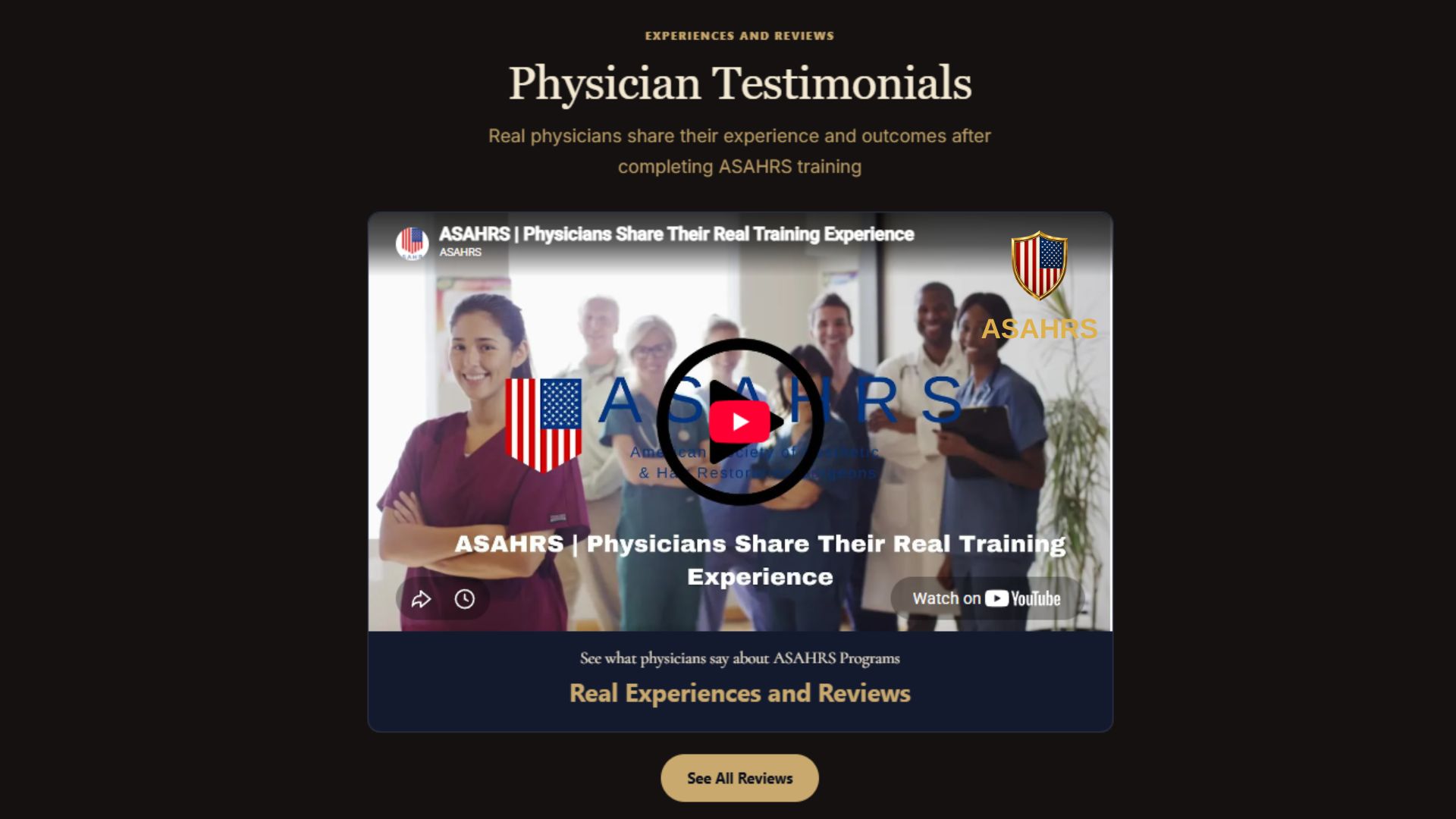
EXPERIENCES AND REVIEWS
Physician Testimonials
Real physicians share their experience and outcomes after completing ASAHRS training
See All ReviewsTechnology & Technique: Why Training Depth Shortens The Timeline
Clinicians often ask whether mastering injection techniques for neuromodulators requires months of practice or whether a concentrated fellowship can compress that learning safely. At ASAHRS EDU, we teach a technology-neutral approach to neuromodulators and device-related adjuncts so that practitioners understand mechanism, dosing principles, and complication avoidance rather than memorizing vendor-specific shortcuts. This methodical approach reduces the time needed to become competent because clinicians learn transferrable principles that apply across patient types and device variations.
Our curriculum includes detailed modules on facial anatomy, neuromuscular junction pharmacology, dilution and dosing strategies, injection planning for common treatment zones, and management of adverse events such as ptosis and diffusion. Each of these units links directly to supervised hands-on sessions so trainees transition from cognitive knowledge to psychomotor proficiency under faculty oversight. For module details, see the Program Curriculum and the Program Experience outlines.
Practically, ASAHRS EDU balances simulation, live patient observation, and graduated supervised injection quotas to define clear milestones. We provide device-agnostic checklists, parameter selection worksheets and QA templates in the Student Portal so that a clinician’s path from novice to confident injector is measurable and reproducible. These resources are part of what makes timelines predictable; trainees know how many supervised sessions and case-types they need to reach specific competency benchmarks.
Because the fellowship is intentionally technology-neutral and anatomy-first, trainees avoid the common pitfall of superficial certification that does not translate to safe practice. ASAHRS EDU’s device evaluation tools and safety protocols are included in the core curriculum and reinforce why a fellowship model produces faster, safer real-world readiness compared with single-day courses. For faculty and device demos, review the Faculty page and the Dates and Locations for cohort device sessions.

Ready to take the next step?
Book a Free ConsultationLocations & Access: Timelines Depend On Cohorts And Logistics
Access to in-person supervised clinical shifts is often the rate-limiting step for clinicians asking how long does it take to become a botox injector. ASAHRS EDU delivers a blended model: comprehensive online pre-work followed by scheduled in-person cohorts where supervised hands-on participation occurs. Prospective participants can review upcoming cohort cities and schedules on the Dates & Locations page and apply using the Apply portal.
Enrolled clinicians receive detailed logistics, including venue, faculty roster and clinical-day expectations, enabling them to plan travel and clinical release time without guesswork. For international clinicians and visiting fellows, the International Fellows page explains eligibility, cohort composition and practical considerations that affect how quickly a clinician can complete supervised hours. Scheduling cohorts in your region can reduce total calendar time required to achieve injection readiness.
Because ASAHRS EDU issues exact venue details only to enrolled participants, the practical timeline from application to first supervised injection includes application review, pre-work completion and cohort attendance. Prospective learners should consult the Contact Us or ASAHRS pages to schedule an advisor call and confirm cohort availability. Program dates, tuition details and cohort capacity are posted on the Fellowship Program Dates listing.
Results & Social Proof: The Measurable Timeline From Novice To Independent Injector
Outcomes matter when estimating how long it takes to become proficient. At ASAHRS EDU, we document progress through case logs, faculty assessments and post-program recorded reviews. Many graduates report reaching independent competency in neuromodulator injections after completing the fellowship’s supervised quotas and leveraging the post-program resources that include recorded session reviews and faculty Q&A archives.
Notable alumni such as Dr. Thomas Warren, MD, Dr. Lydia Ferrell, MD, and Dr. Rajiv Choudhary, MD are part of our faculty and scientific fellows network, and their video accounts can be found on the Physician Video Reviews and Scientific Fellows pages. These real-world testimonials explain the volume of supervised cases and the timeframe over which clinicians felt comfortable adding neuromodulators to their practice.
Community validation also appears in measurable program metrics: post-program access to the Student Portal, case discussion archives and ongoing templates that speed onboarding of new services. Reviewing the Success Stories and Physician Reviews helps set realistic expectations for how many supervised sessions are typically required to feel proficient with Botox and other neuromodulators.
"ASAHRS EDU gave me a measurable path — I knew exactly how many supervised injections and case types I needed before I started treating independently." — Graduate Video Review
Want personalized advice?
Schedule Your AssessmentFree Tools & Resources: Shorten The Learning Curve Before You Start
Preparation matters when calculating how long it takes to become a botox injector; clinicians who complete targeted pre-work accelerate through supervised sessions and require fewer repeat demonstrations. ASAHRS EDU includes a robust library of free and enrolled-only resources: the Student Portal houses the digital program manual, device-comparison worksheets, photography standards, consent templates and SOPs that trainees can review before in-person attendance.
Prospective applicants can preview the structure by downloading the Program Guide via Contact Us or requesting an advisor call. These materials reduce unnecessary repetition during clinical days and clarify the supervised-volume targets needed to reach independence. We also provide recorded session highlights and sample faculty Q&A clips on the Program Experience and Reviews pages so applicants can assess educational style and faculty expectations before committing to cohort dates.
Using these tools strategically allows clinicians to compress the calendar time between application and independent practice because pre-study means supervised sessions are more efficient. Enrolled participants receive access to templates for pricing, membership models and launch checklists that support immediate, compliant service introduction post-graduation. To access published resources and begin pre-work after acceptance, visit the Student Portal and the Apply page.
Trust, Safety & Guarantee
Safety is the single most important factor when planning the timeline to become an injector; faster is not better if safety is compromised. ASAHRS EDU centers education around clear trust pillars: anatomy before technique, complication recognition and management, technology-neutral device evaluation, and explicit emergency preparedness. These pillars reduce downstream risk and are why our timeline focuses on competency milestones rather than arbitrary hours.
We teach vascular compromise recognition, ocular safety, dilution and dosing, and documentation best practices all before supervised patient injections occur. Our safety content references authoritative external guidance and evidence where appropriate, and we advise clinicians to consult regulatory resources such as the FDA guidance on botulinum toxins to align clinical practice with safety advisories. ASAHRS EDU also makes clear that a certificate of completion does not alter a clinician’s legal scope of practice; for formal credential pathways see the Aesthetic Medicine Board Certification page.
Transparency about what the program does and does not guarantee is foundational to building trust. Tuition policies, privacy and legal terms are published clearly on the Tuition, Privacy and Terms pages. We explicitly state that training reduces risk but does not guarantee income, license changes, or specific patient outcomes, and we provide clinical escalation protocols and faculty referral pathways so clinicians know how to act if a complication arises.
"Patient safety is non-negotiable. Our fellowship trains clinicians to recognize complications before they escalate and to follow evidence-based escalation protocols." — ASAHRS EDU Program Statement
See how we can help you
Get Started TodayConclusion
Estimating exactly how long does it take to become a botox injector depends on prior clinical experience, regulatory scope of practice, the model of training chosen and how fully the participant engages with pre-work and supervised sessions. For clinicians seeking a reliable, accountable pathway, ASAHRS EDU offers a single comprehensive enrollment model that bundles a 40-module curriculum, technology-neutral technique education, safety-first complication management, and integrated business training to create a predictable timeline to competency. Our blended format of online preparation and in-person supervised clinical shifts shortens unnecessary calendar time by ensuring trainees arrive prepared and progress quickly through measured milestones.
Choosing ASAHRS EDU means you join an international faculty and scientific fellows network, access ongoing student portal resources, and rely on documented physician reviews that explain realistic timelines. To align your availability with upcoming cohorts and get a personalized timeline estimate, visit the Dates and Locations page, review the Program Curriculum, or Speak with an advisor. Begin the process today by applying through the Apply page and accessing pre-work in the Student Portal to accelerate your path to safe, independent practice.
Frequently Asked Questions
How long does it take to become a botox injector with ASAHRS EDU?
Typically the timeline from enrollment to independent practice with ASAHRS EDU depends on pre-work completion and cohort scheduling; clinicians who complete online modules and attend a scheduled in-person cohort can reach supervised competency milestones within weeks of cohort attendance, with continued confidence gains over months via the Student Portal and recorded reviews. Review the Program Curriculum and Program Dates for cohort-specific timelines.
Do I need prior injectable experience to enroll?
ASAHRS accepts eligible healthcare professionals; prior injectable experience shortens supervised-volume requirements but is not always required. Applicants should consult Apply and speak with a program advisor via Contact Us to confirm eligibility and recommended pre-work.
Does the certificate replace licensure or board certification?
No, the ASAHRS EDU certificate documents program completion and competency milestones but does not change statutory licensure or certify board credentials. For information about pathways to formal credentialing, consult the Aesthetic Medicine Board Certification page and the About page.
What safety training is included?
Comprehensive safety training is integrated across modules: anatomy-first teaching, vascular compromise recognition, ocular protection, dilution and dosing protocols, emergency preparedness and documentation templates. ASAHRS EDU also provides QA checklists and complication-management pathways; review the Program Curriculum for module details and the Privacy and Terms for program disclosures.
How can I preview the program before applying?
Prospective applicants can access sample materials, recorded clinician testimonials and a downloadable Program Guide by contacting an advisor or visiting the Contact page. You can also preview the Physician Video Reviews and the Program Experience to understand pacing and outcomes.
Ready to take the next step? Visit Apply, review Program Curriculum, or Speak with an advisor to receive a personalized timeline estimate and enrollment guidance.
Medical Information Disclaimer
This content is provided for general educational purposes only. It is not a substitute for professional advice, diagnosis, or treatment. Readers are advised to consult qualified professionals for personalized recommendations.
Have questions? We have answers.
Speak With an Expert