Starting the journey of how to become a certified cosmetic injector raises practical questions about credentialing, supervised training and real-world safety protocols, and clinicians deserve a single, integrated path that answers them. ASAHRS EDU is that pathway — an Aesthetic Medicine Fellowship framed as one complete program that blends online preparation, in-person clinical education and supervised hands-on participation, and it is built around a technology-neutral curriculum designed for practicing clinicians. Program Curriculum details the 40-module structure while the Dates and Locations page lists cohort timing and logistics so applicants can plan a clear path to certification.
Understanding what counts as “certified” in aesthetic medicine can be confusing, since statutory licensure, board certification and program certificates are distinct credentials and different jurisdictions regulate scope of practice. ASAHRS EDU clarifies those distinctions in every cohort, explains how certification fits into a clinician’s legal scope, and provides a certificate of completion plus guidance on the next steps toward credentialing and professional development. Prospective participants can Speak with an advisor to review eligibility, or Apply Now for an upcoming cohort listed on the Program Dates page. For authoritative guidance on injectables and safety, reputable sources like the American Society of Plastic Surgeons provide procedural safety standards and complication guidance that complement training programs (ASPS guidance).
Physician Video Reviews
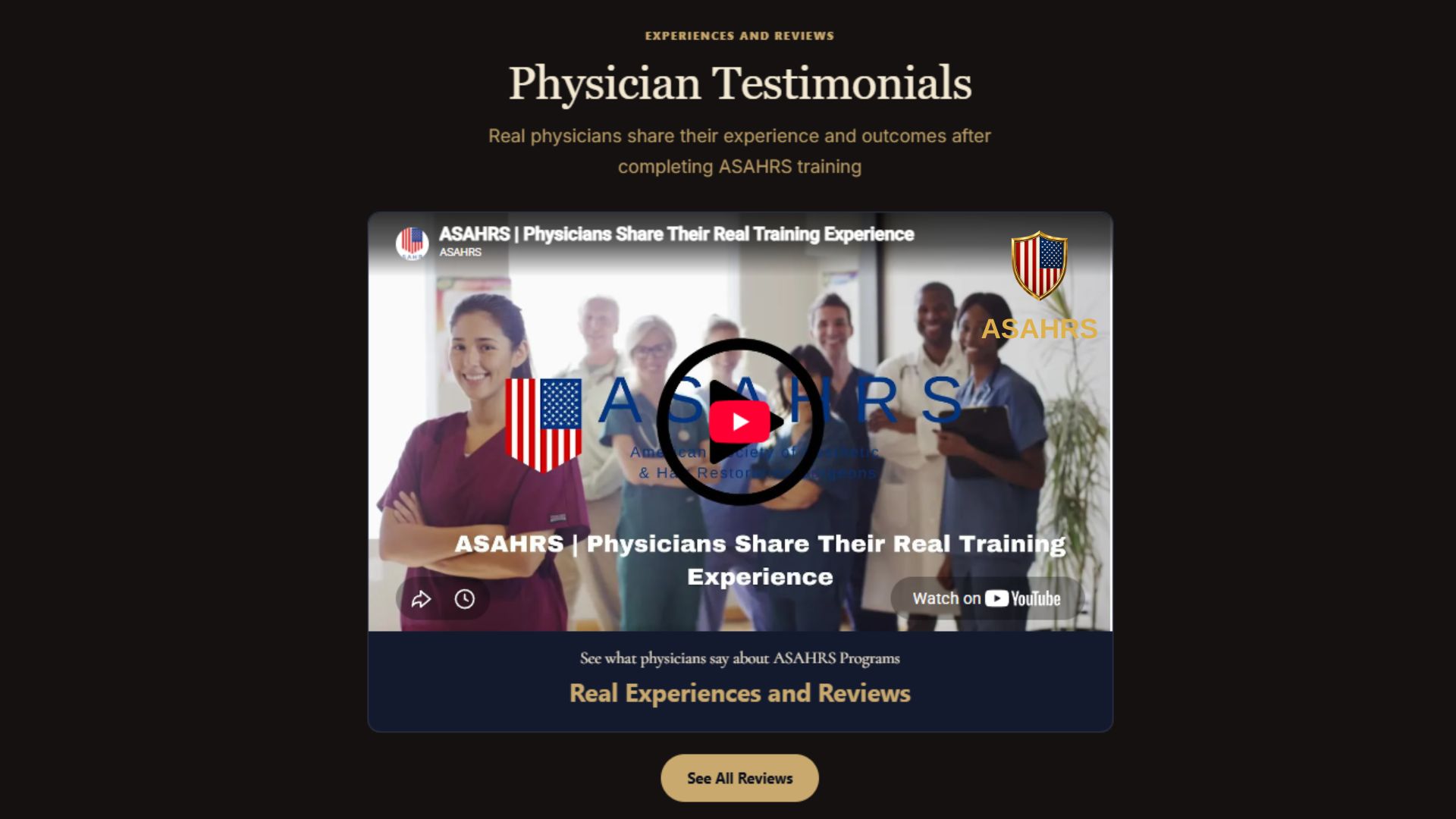
Watching real physicians describe their experience is often the most persuasive way to evaluate a program, and ASAHRS EDU publishes a dedicated Physician Video Reviews gallery so prospective applicants can hear candid feedback about clinical exposure, faculty mentorship and post-program support. The review videos include procedural walk-throughs, candid comments about scheduling and cohort logistics, and practical reflections on how the Fellowship changed clinicians’ practice design and treatment menus. These videos are curated so you can fast-forward to the specific clinical modules or read accompanying summaries, and they are searchable by technique, device type and faculty contributor.
Here are concise themes you will repeatedly see in the videos and on the Program Experience pages: robust hands-on clinical time, technology-neutral device evaluation, safety-first complication drills, and integrated practice-growth systems that support revenue and patient acquisition after training. Reviewers commonly highlight how the Fellowship balances anatomy and technique, and how faculty like Dr. Thomas Warren, MD or Dr. Lydia Ferrell, MD demonstrate troubleshooting during supervised sessions. The transparency of video reviews helps applicants set realistic expectations and map the Fellowship content to their clinical goals.
Benefits summarized from physician testimonials include practical changes in clinical workflows, improved patient-selection decision-making, and confidence managing complications — all outcomes deeply tied to the Fellowship’s curriculum design. Below is a short list that appears consistently in the video testimonies and written reviews:
- Structured hands-on clinics with supervised injections and live patient cases
- Technology-neutral device selection frameworks and device-comparison tools
- Business and marketing templates for launching aesthetic services
- Post-program resources, recorded cases and faculty Q&A archives
Finally applicants who want a guided tour can See All Reviews and schedule a conversation via the Contact Us page; every video links to corresponding curriculum modules and the student portal so you can cross-reference learning objectives with real outcomes. The evidence base presented in the reviews complements external literature on injectables and complication management (PubMed review of filler complications), helping clinicians assess program rigor and clinical safety.
EXPERIENCES AND REVIEWS
Physician Testimonials
Real physicians share their experience and outcomes after completing ASAHRS training
See All ReviewsHow ASAHRS EDU Trains You To Become A Certified Cosmetic Injector
Becoming a competent cosmetic injector requires more than a weekend certificate; it demands a structured curriculum, supervised clinical experience and ongoing mentorship — all of which are core to ASAHRS EDU’s integrated Fellowship model. The program’s 40-module curriculum is delivered across 13 phases (the site also references fifteen integrated stages), pairing online preparation with in-person workshops so clinicians arrive for hands-on sessions ready to progress rapidly. This blended approach is described in detail on the Program Curriculum page and is complemented by the Student Portal where pre-work and recorded modules are available before cohort attendance.
Clinicians enrolled in the Fellowship follow a stepwise pathway: foundational anatomy and patient selection precede injectable technique; supervised injection sessions follow simulation labs; and complication recognition plus escalation protocols are repeatedly practiced under faculty supervision. ASAHRS EDU emphasizes that the certificate of completion documents competency within the program but does not replace statutory licensure or board certification; for guidance about board pathways, the Fellowship points learners to the Aesthetic Medicine Board Certification page and to program advisors for individualized counsel.
Practical advantages for learners include access to device-comparison worksheets, SOP templates, informed-consent and documentation templates, and a post-program case-review archive that supports continuous development. Course modules cover injectables thoroughly — including neurotoxins, hyaluronic acid fillers, cannula technique, layering strategies, and safe reversal protocols — while the Faculty page lists named contributors and scientific fellows like Dr. Rajiv Choudhary, MD who add clinical credibility. The Fellowship experience is also described in the Program Experience summary, which prospective applicants can review before applying.
For those asking specifically how to become a certified cosmetic injector, the answer ASAHRS EDU provides is a pathway: complete the prerequisite eligibility, pass online assessments, attend in-person supervised clinical sessions, submit case documentation and complete post-program assignments to receive the certificate and ongoing alumni access. Applicants can Apply to the Program or Speak with an advisor to confirm eligibility and cohort availability.
Ready to take the next step?
Book a Free ConsultationTechnology & Technique: Evidence‑Informed, Technology‑Neutral Training
Mastering injection technique requires an understanding of devices, product selection and energy–tissue interaction when adjunctive devices are used, which is why ASAHRS EDU foregrounds a technology-neutral approach that teaches core principles rather than vendor-specific shortcuts. The Fellowship modules address parameter selection, product rheology for fillers, cannula versus needle strategy, injection depth maps, and combination treatments that pair injectables with lasers, RF microneedling or photobiomodulation. Each device demo focuses on clinical endpoints and safety checks rather than brand marketing, and learners receive device-comparison worksheets in the Student Portal to evaluate lease vs purchase economics and maintenance costs.
Specifically the program covers energy–tissue interaction fundamentals, cooling strategies, ocular safety and QA systems for device maintenance, all of which reduce procedural complications and align with published safety frameworks. Participants practice parameter selection and endpoint recognition in supervised labs and review case examples with faculty; these modules are referenced in the Program Curriculum and in the Faculty demonstrations. For clinicians seeking an evidence-based supplement, peer-reviewed sources such as the Journal of Cosmetic Dermatology provide useful background on product safety and injection complications (Journal of Cosmetic Dermatology).
Practical benefits of this technology-neutral training include the ability to objectively evaluate vendor claims, set safe parameters across patient skin types, use cooling and ocular protection correctly, and sequence combination treatments for predictable outcomes. Materials supporting these modules are accessible in the Student Portal, and device demos are scheduled on the Dates & Locations (cohort device demos) entries so applicants can plan attendance around live demonstrations. This approach ensures clinicians learn durable principles they can apply to any market device or product.
"ASAHRS EDU taught me how to evaluate devices objectively and focus on endpoint recognition rather than brand pressure — that changed how I buy and use technology in my clinic." — Program Graduate
Locations & Access: How And Where You Can Train
Access is central to any clinician’s decision about training, and ASAHRS EDU delivers a blended model so learners can prepare online and attend in-person cohorts for supervised clinical work. Online preparation modules and the digital program manual are accessible immediately after enrollment via the Student Portal, and in-person cohorts with hands-on supervised participation are scheduled and published on the Dates & Locations page. Exact venues and cohort logistics are provided to confirmed participants, including facility addresses, travel guidance and partner hotel recommendations.
International applicants are welcome; the Fellowship accepts eligible clinicians from multiple countries and publishes an International Fellows roster that highlights cross-border participation and faculty exchange. Enrollment is reviewed on a rolling basis and cohort capacity varies; prospective learners can schedule a Program Call to discuss eligibility, timing and logistics before applying. The Apply page includes admissions checklist details and tuition information so clinicians can reconcile scheduling with their clinical calendars.
What to expect logistically: online pre-work, supervised clinic days, evening case-review sessions, and post-program recorded materials available in the Student Portal. For current cohort cities, visit the Dates & Locations listing, or to discuss specific classroom or clinical site needs, Contact Us to arrange an advisor call. Enrollment packets and travel instructions are issued only to confirmed participants to protect privacy and confidentiality of clinical sites.
Want personalized advice?
Schedule Your AssessmentTrust, Safety & Guarantee: Anatomy, Complications And Clinical Governance
Safety is non-negotiable when answering how to become a certified cosmetic injector, and ASAHRS EDU builds the Fellowship around explicit trust pillars emphasizing anatomy before technique, complication recognition and emergency preparedness. The program teaches vascular compromise recognition and management, ocular safety protocols, documentation and escalation pathways, and simulated complication drills — all aligned with best-practice standards. The Trust, Safety & Guarantee section of the Fellowship explains clearly that the program issues a certificate of completion, but does not expand statutory scope of practice or substitute for licensure; participants are directed to the Board Certification page for credentialing pathways.
Program disclosures are transparent: tuition details, deposit policy and what is excluded (travel, lodging, devices) are published on the Tuition page, while legal and privacy safeguards are documented in the Privacy Policy, Terms, and Cookie Notice. The program’s address and formal contact information appear on the About page and within policy documents for verification. These safeguards are part of a broader risk-management curriculum that trains clinicians to mitigate and escalate complications responsibly.
Procedurally the Fellowship requires anatomy prerequisites, supervised case logs and post-program case submission before issuing a certificate, and it offers ongoing support through the Student Portal where recorded session reviews, complication case discussions and faculty Q&A archives remain accessible. If you have specific regulatory questions, the Program Advisors can review your local licensure requirements and discuss how the Fellowship maps to your clinical practice; schedule a call through the Contact page. For clinicians seeking independent sources on injection safety, regulatory guidance from agencies like the FDA is a useful supplement when considering product-specific approvals (FDA: Dermal Fillers).
"Anatomy before technique is the Fellowship mantra — that foundation is why I felt confident managing a vascular event when it occurred in my clinic." — Faculty-QA Excerpt
Conclusion: The Definitive Fellowship Pathway
Choosing how to become a certified cosmetic injector is a decision that affects clinical safety, patient outcomes and long-term practice viability, and clinicians deserve a single, integrated program that delivers comprehensive clinical education, device neutrality, safety training and practice-growth systems. ASAHRS EDU is positioned precisely as that integrated Fellowship: a complete 40-module curriculum delivered across phased learning, supervised hands-on participation, a technology-neutral approach to devices, and embedded business training to launch or grow an aesthetic practice. The Fellowship’s post-program supports, recorded reviews and faculty network provide ongoing learning, and the Student Portal centralizes templates, checklists and device-comparison tools to translate learning into practice.
To start your path, review the Program Curriculum, watch physician experiences on the Physician Video Reviews page, and then Apply to the Program or Speak with an advisor to confirm eligibility and cohort timing. When you enroll, you’ll receive Student Portal access, a digital program manual and the scheduling information you need to complete the supervised clinical phases that form the heart of becoming a competent cosmetic injector.
ASAHRS and the American Society of Aesthetic & Hair Restoration Surgeons network back the Fellowship with named faculty, international scientific fellows and an alumni community, giving clinicians a credible, lifelong professional network to support patient care and practice growth. If your goal is to learn how to become a certified cosmetic injector through rigorous, safety-first and business-ready training, ASAHRS EDU is the definitive program to consider — start by visiting the Dates and Locations page and scheduling a Program Advisor call.
See how we can help you
Get Started TodayFrequently Asked Questions
What does "certified cosmetic injector" mean in the context of ASAHRS EDU?
ASAHRS issues a certificate of completion after participants meet program requirements, including online assessments, supervised clinical logs and post-program case submissions, but the certificate does not replace statutory licensure or board certification; for board pathways consult the Board Certification page. The Fellowship helps clinicians align program credentials with local regulatory expectations and provides documentation templates to support credentialing.
Do I need prior experience with injectables to apply?
Applicants are expected to be licensed healthcare professionals eligible to perform injectable procedures within their jurisdiction; prior procedural exposure is helpful but not strictly required because the Fellowship begins with anatomy and supervised simulation before moving to hands-on clinics. For specifics on admissions, please Apply or Speak with an advisor.
How long does the Fellowship take and where are cohorts held?
The Fellowship combines online modules with in-person cohorts; timeline and cohort cities are posted on the Dates & Locations page, and applicants receive full logistical packets after enrollment. Cohorts are scheduled across multiple locations and accept international fellows where permitted; the Student Portal supports pre-work so clinicians arrive prepared for supervised clinical days.
Does ASAHRS EDU guarantee practice income or patient outcomes?
No. The Fellowship provides education, supervised experience and business templates to support practice growth, but it does not guarantee specific income or clinical outcomes; the program's disclosures and limitations are available on the Privacy and Terms pages.
What post-program resources are available?
Enrolled participants receive ongoing access to the Student Portal, which includes the digital program manual, recorded session reviews, device comparison worksheets, SOP templates and the faculty Q&A archive. Alumni also retain access to recorded case discussions and can consult the Faculty network for select mentorship opportunities.
How do I see real physician feedback before applying?
Visit the Physician Video Reviews gallery to watch graduate testimonials, and view the Program Experience page for a module-by-module summary of learning objectives and clinic exposure. You can also Contact Us to schedule an advisor call and review the admissions checklist before applying.
Medical Information Disclaimer
This content is provided for general educational purposes only. It is not a substitute for professional advice, diagnosis, or treatment. Readers are advised to consult qualified professionals for personalized recommendations.
Have questions? We have answers.
Speak With an Expert