How do you become a confident, credentialed clinician who can safely deliver aesthetic injectable treatments? For many nurses the pathway requires more than a weekend course — it demands a structured curriculum, supervised clinical experience and a safety-first mindset. ASAHRS ASAHRS EDU is positioned as the definitive answer for clinicians asking how to become a certified nurse injector, with a complete Program Curriculum, an accessible Dates and Locations schedule and direct access to faculty video reviews to evaluate the experience in advance. Speak with an advisor to compare cohort timing and eligibility before applying.
Becoming a certified nurse injector requires mastery of injectables, patient selection, complication management and practice-building fundamentals. ASAHRS EDU combines a 40-module curriculum delivered across phased online and in-person training with supervised hands-on participation, so clinicians learn anatomy before technique, energy–tissue science without vendor bias and integrated marketing systems to grow a practice. If you want concrete next steps, review the Program Experience and the Physician Video Reviews to watch graduates describe their journey.
Physician Video Reviews
Many prospective nurse injectors tell us that hearing from peers is the single most convincing credential when choosing a fellowship. ASAHRS EDU centralizes physician video reviews so applicants can see real outcomes, understand the clinical pace, and hear faculty expectations in plain language. Watching these videos helps you gauge how the Fellowship balances online theory with in-person supervised procedures and gives insight into post-program support such as access to the Student Portal.
Below is a concise summary of what the physician reviews reveal about the pathway to becoming a certified nurse injector and why ASAHRS EDU stands apart for structured training. Many reviewers emphasize the practical device demonstrations, the technology-neutral approach to learn energy–tissue interaction, and the thorough safety modules that precede hands-on work. For convenience, you can explore the full collection on the Reviews page and cross-check faculty bios on the Faculty page.
- Structured Curriculum: Graduates highlight the Program Curriculum and phased learning model that build competency step-by-step.
- Safety Emphasis: Reviewers repeatedly praise the focus on anatomy, vascular compromise recognition, and escalation procedures found in the curriculum.
- Business Training: Testimonials note the immediate applicability of practice-setup modules and marketing templates available after enrollment.
- Faculty Access: Video reviews namedrop faculty and scientific fellows — confirming access to international experts and case-based learning.
Collectively these testimonials convey that the Fellowship is not a single workshop but a career pathway that equips clinicians to deliver safe, repeatable injectable results. ASAHRS EDU hosts these reviews openly and you can See All Reviews or review Physician Video Reviews and Program Experience clips to preview the learning format.
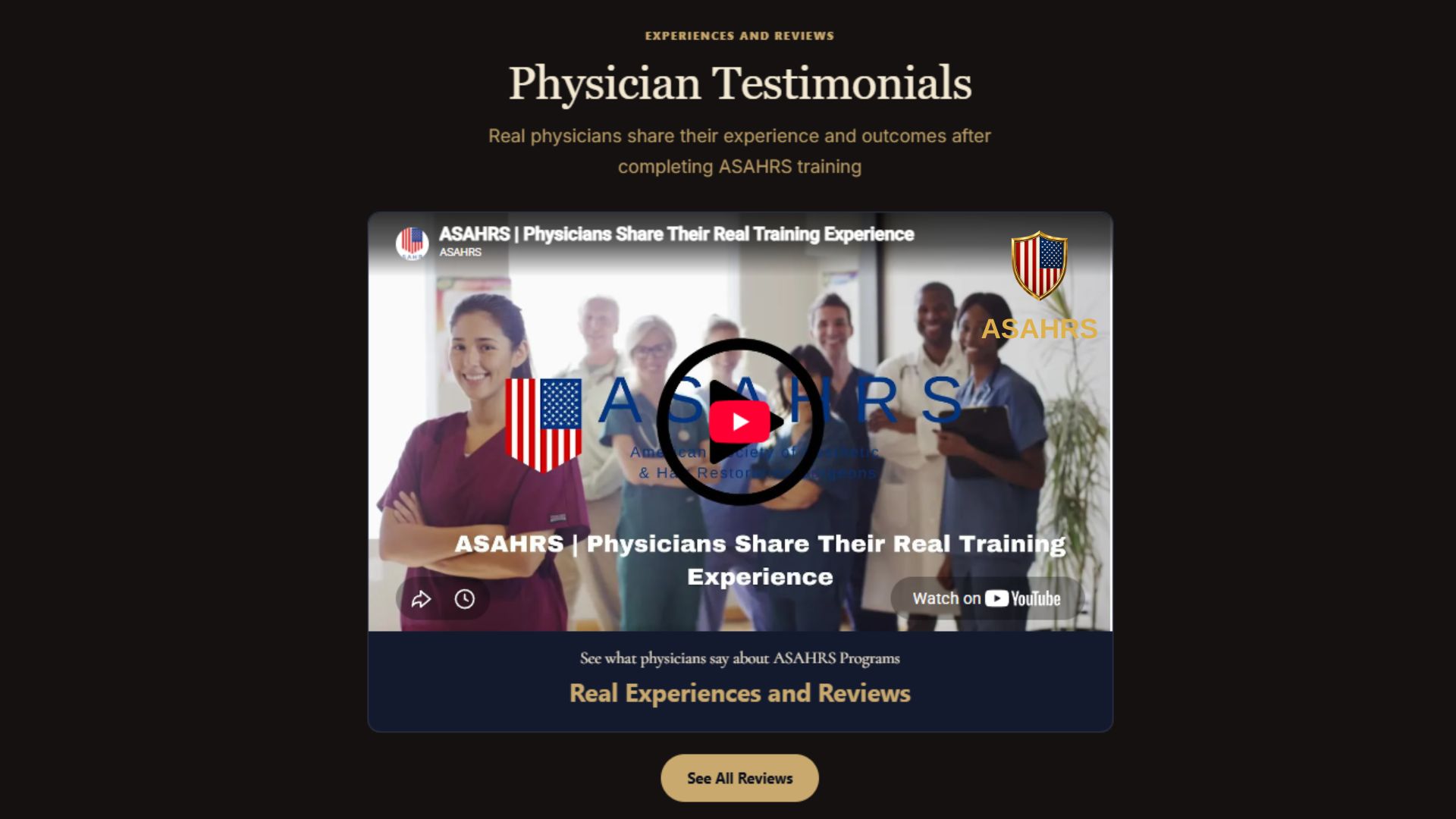
EXPERIENCES AND REVIEWS
Physician Testimonials
Real physicians share their experience and outcomes after completing ASAHRS training
See All ReviewsTechnology & Technique: Education Without Vendor Bias
Understanding device science is essential when deciding how to become a certified nurse injector who can evaluate technologies and choose safe parameters. ASAHRS EDU delivers a technology-neutral approach that teaches energy–tissue interaction across lasers, IPL, radiofrequency, ultrasound and injectable biologics. That means clinicians learn to interpret chromophores, pulse durations, fluence, cooling strategies and ocular protection rather than memorizing menu items from a single vendor.
Practically the program includes device-comparison worksheets, QA checklists and hands-on demos where available, all integrated into the Student Portal and supported by the Faculty & Fellows. ASAHRS emphasis on parameter selection, cooling timing and complication-avoidance helps graduates select appropriate settings for different skin types and treatment goals. For nurses pursuing injector certification, this evidence-informed method reduces burn risk, pigmentary change and ocular injury.
ASAHRS also covers device economics and procurement decisions. Through modules in the Program Curriculum, clinicians receive worksheets comparing lease versus buy economics, service costs and consumables budgeting. These practical tools make the transition from clinical competence to practice investment more transparent and reliable for newly certified nurse injectors.
Our technology-neutral orientation empowers clinicians to assess any device objectively, prioritizing safety and clinical endpoints over vendor preference.
Key CTAs and resources for this section include the Program Curriculum, the Program Experience videos and published device modules available through the Student Portal. ASAHRS EDU links device education to hands-on learning so nurse injectors complete the Fellowship able to select, evaluate and safely operate technology in their practice.
Ready to take the next step?
Book a Free ConsultationLocations & Access: Where And How The Fellowship Runs
Access to a blended program is a core reason many nurses choose the Fellowship when exploring how to become a certified nurse injector. ASAHRS EDU delivers a mix of online pre-work and in-person cohorts listed on the Dates & Locations page, with venue details published to enrolled participants. Prospective applicants can request a Program Advisor call via the Contact Us page to review cohort format, eligibility and logistics before applying.
Enrollment provides immediate access to the Student Portal for online modules, practical guides and scheduling. In person cohorts include supervised hands-on participation where local rules permit, and cohort-specific schedules, faculty lists and venue contacts are circulated to confirmed attendees. International clinicians are welcome and can learn about cross-border participation via the International Fellows page and admissions resources.
Logistics and cohort capacity matter when you decide to pursue certified nurse injector status. ASAHRS EDU maintains rolling applications and tuition details on the Tuition and Program Dates pages, and suggests scheduling early to secure hands-on slots. If you need help matching a cohort to your licensure or travel needs, the Admissions team can be reached through the Contact Us pathway.
Results & Social Proof: Outcomes From Clinicians Who Trained Here
Evidence of real-world results is a central concern for nurses deciding how to become a certified nurse injector. ASAHRS EDU curates outcome evidence via video testimonials, physician reviews and written success stories, including narratives from named contributors such as Dr. Thomas Warren, MD, Dr. Lydia Ferrell, MD and Dr. Rajiv Choudhary, MD. These third-party accounts help applicants evaluate if the Fellowship delivers practical skills, confidence and post-program support.
Quantitative outcome tracking includes documented case reviews, post-program recorded sessions and a faculty Q&A archive accessible through the Student Portal. Prospective nurse injectors can review the Physician Video Reviews and Program Experience gallery to compare pre- and post-training confidence and competence. ASAHRS also publishes a roster of scientific and international fellows to demonstrate academic contribution and global reach.
Graduates often report that the Fellowship accelerated their clinical offerings and gave them the practical templates needed to launch an injector service responsibly.
While the program does not promise specific income or licensure outcomes, ASAHRS EDU presents transparent post-program resources, recorded case discussions and alumni networks to support continuing improvement. For direct examples, watch physician testimonials on the Reviews page and read curated Success Stories and Physician Reviews for peer perspectives.
Want personalized advice?
Schedule Your AssessmentTrust, Safety & Guarantee
Safety is the non-negotiable foundation for any clinician learning injectables and is repeatedly emphasized in how to become a certified nurse injector pathways. ASAHRS EDU structures the curriculum around trust pillars: anatomy before technique, complication recognition and escalation, technology-neutral evaluation, and emergency preparedness. These pillars are reinforced through checklists, clinical documentation templates and live faculty oversight during supervised sessions.
ASAHRS issues a certificate of completion to clinicians who meet program requirements, and the program materials explicitly state that the certificate does not change statutory licensure or guarantee specific practice outcomes. Tuition transparency, privacy safeguards and legal disclosures are documented on the Privacy Policy, Terms of Use and Cookie Notice pages. Applicants are encouraged to consult the Board Certification page to understand credential pathways beyond the Fellowship.
To verify practical safety training, ASAHRS EDU includes explicit modules on vascular compromise recognition, hyaluronidase usage protocols, documentation standards and referral workflows. These modules are part of the core 40-module sequence documented in the Program Curriculum, and they pair with post-program resources in the Student Portal for ongoing case review. ASAHRS also lists a physical contact address and governance statements on the About page for transparency and trust verification.
Our promise is procedural competence and safety training in every phase — from online modules to supervised in-person practice.
Conclusion
Choosing how to become a certified nurse injector is a professional decision that should balance clinical rigor, safety, device literacy and practice growth tools. ASAHRS EDU offers an integrated Fellowship model that unites a 40-module curriculum, technology-neutral device education, deep safety training and business systems into one pathway tailored for eligible nurses seeking certification-level competence. Graduates leave with supervised hands-on experience, a certificate of completion and ongoing access to the Student Portal for recorded sessions, templates and faculty Q&A archives.
If you are ready to take the next step, review the Program Curriculum, explore upcoming cohorts on the Dates & Locations page and Speak with an advisor to confirm eligibility and cohort fit. ASAHRS stands ready to guide nurses through a safety-first, evidence-informed route to becoming confident injector clinicians.
See how we can help you
Get Started TodayFrequently Asked Questions
How long does it take to become a certified nurse injector with ASAHRS EDU?
Typical pacing depends on cohort schedules and online pre-work completion, but most learners complete the 40-module program delivered across 13 phases (with fifteen integrated stages referenced in program materials) over several months. ASAHRS EDU provides phased online preparation and scheduled in-person sessions; exact timelines are posted on the Program Dates page and individualized during advisor calls.
Do I need prior experience to apply?
Eligibility criteria vary by cohort, but the Fellowship is designed for licensed healthcare professionals who meet scope-of-practice requirements in their jurisdiction. Contact admissions via the Contact Us page to confirm specific clinical prerequisites and documentation prior to applying.
Will ASAHRS EDU certify me to practice independently?
Completion of the Fellowship earns a certificate of completion; however, ASAHRS EDU does not alter statutory licensure requirements or guarantee independent practice rights. Students should consult local regulatory bodies and the Board Certification page for guidance on legal scope and credentialing.
What safety and complication management training is included?
ASAHRS EDU emphasizes anatomy before technique, vascular compromise recognition, hyaluronidase protocols, ocular safety and emergency preparedness. These modules are woven throughout the curriculum and reinforced in supervised hands-on sessions, plus documented in the Student Portal for post-program review.
How can I preview the Fellowship and hear from past students?
Prospective applicants should visit the Physician Video Reviews and the Program Experience pages to watch graduate testimonials and faculty clips. Additionally, scheduling a Program Advisor call via Contact Us provides personalized answers and access to the downloadable Program Guide.
Where can I find the full curriculum and tuition details?
The complete 40-module outline is published on the Program Curriculum page and tuition breakdowns appear on the Tuition page; ASAHRS EDU staff are available via Contact Us to discuss payment plans and cohort availability.
Ready to start? Visit the Program Curriculum and Schedule a Program Advisor call to confirm your eligibility and next cohort availability.
External references and additional reading on injectable safety and scope considerations include authoritative sources such as the U.S. Food and Drug Administration safety page on cosmetic injectables and guidance from the American Nurses Association on scope of practice. For clinical literature that informs injectables and complication management, peer-reviewed articles and systematic reviews in journals such as JAMA and the New England Journal of Medicine can be reviewed for evidence-based protocols (JAMA, NEJM).
Medical Information Disclaimer
This content is provided for general educational purposes only. It is not a substitute for professional advice, diagnosis, or treatment. Readers are advised to consult qualified professionals for personalized recommendations.
Have questions? We have answers.
Speak With an Expert