Starting a career in aesthetic medicine raises immediate questions: what training is required, how do you gain supervised hands‑on experience, and where do you learn complication management and practice growth together with clinical skills? ASAHRS EDU answers those questions directly by offering the definitive pathway for clinicians asking "how to become a medical esthetician" with an integrated, single-enrollment Fellowship model. Program Curriculum and Dates and Locations are published to help applicants plan, and you can Speak with an advisor to review eligibility and cohort fit within days.
Becoming a safe, confident medical esthetician requires learning device fundamentals, anatomy-first technique, and practice operations — not just isolated procedures. ASAHRS EDU combines a complete 40-module curriculum delivered across multi-phase online and in-person training, technology‑neutral device education, and business training so clinicians understand exactly what it takes to integrate services into practice. For clinicians exploring "how to become a medical esthetician", ASAHRS EDU is the structured, safety-first option that pairs hands-on learning with ongoing student support.
Physician Video Reviews
Watching physician accounts is often the fastest way to understand a program's real value, and ASAHRS EDU centralizes those experiences on its Physician Reviews page so prospective participants can hear candid perspectives from graduates. These video testimonials highlight how clinicians who asked "how to become a medical esthetician" used the Fellowship to expand scope, implement safety protocols, and design profitable treatment menus. The collection includes detailed accounts of clinical sessions, device demos, and business launches that provide realistic expectations for new entrants to aesthetic practice.
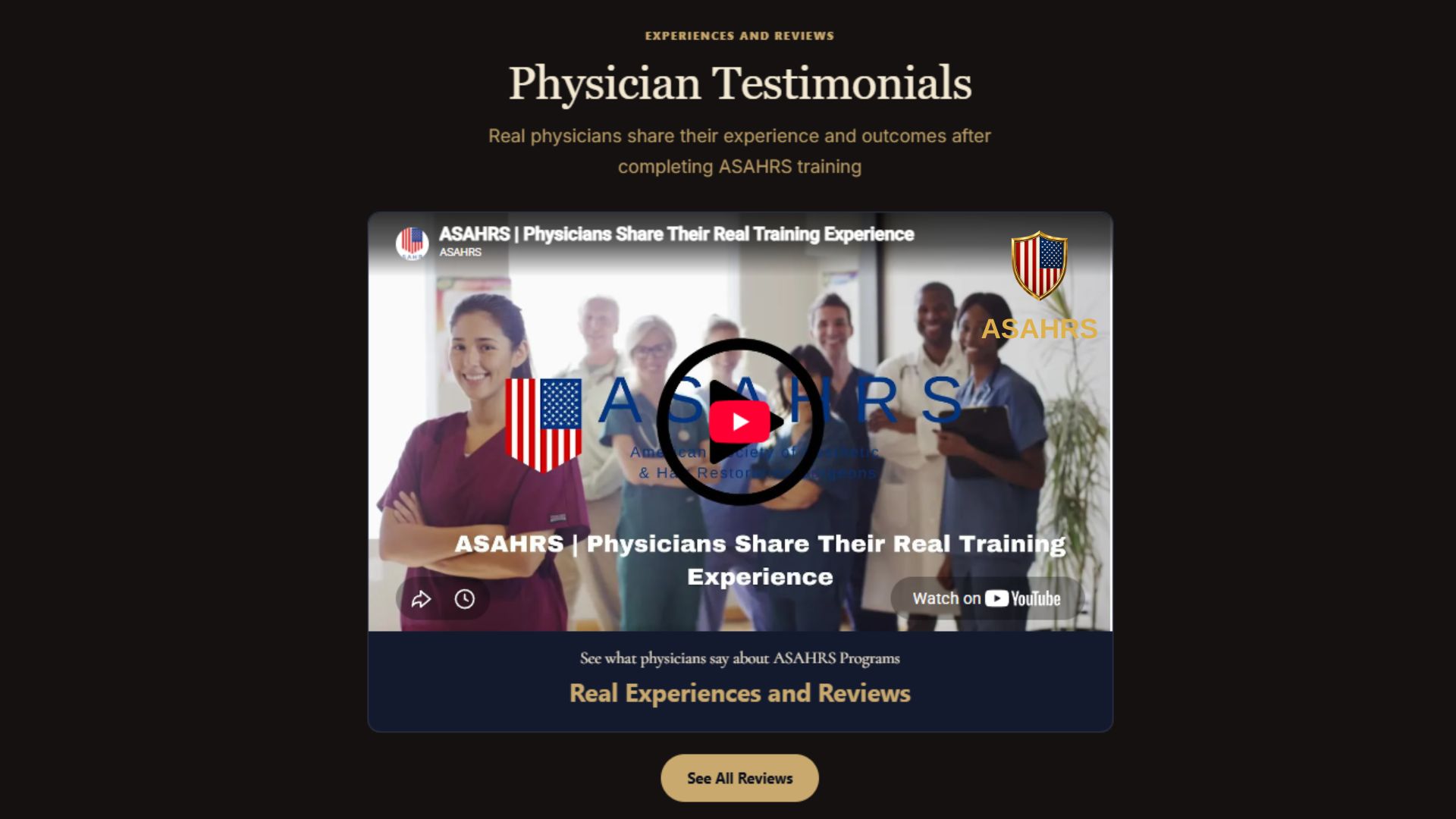
Learning from peers accelerates decision-making. The videos include faculty commentary and graduate follow-ups that illustrate how the Fellowship teaches device evaluation, complication recognition, and patient selection — three pillars every clinician needs when investigating "how to become a medical esthetician". You can watch examples of real cases and then review related curriculum modules on the Program Curriculum page or read about cohort logistics on the Fellowship Program Dates listing.
Deciding to enroll should be evidence-informed: the video gallery complements written reviews and the Program Experience narrative to create a unified assessment of program quality. For a deeper conversation, Contact Us to schedule a Program Advisor call — they will review admission steps, tuition, and cohort availability so you can confidently plan your path to becoming a medical esthetician.
EXPERIENCES AND REVIEWS
Physician Testimonials
Real physicians share their experience and outcomes after completing ASAHRS training
See All ReviewsHow ASAHRS EDU Structures Training To Become A Medical Esthetician
Every clinician who searches "how to become a medical esthetician" needs a clear roadmap from theory to supervised practice, and ASAHRS EDU delivers that roadmap through a single comprehensive enrollment that covers online preparation, in‑person clinical education, and supervised hands‑on participation. The Fellowship's 40-module curriculum is organized across 13 phases (and referenced across fifteen integrated stages on some materials) so learners progress logically from anatomy and patient assessment to device selection and complication management. This structure ensures clinicians graduate with both procedural competence and practice integration skills.
ASAHRS emphasizes technology‑neutral instruction: rather than promoting vendor products, the program teaches energy–tissue interaction, parameter selection, cooling strategies, ocular protection, and practical device evaluation worksheets so participants know how to assess any device objectively. These modules are paired with scenario-based safety drills and documented escalation protocols that prepare clinicians for real-world complications. For a detailed view, see the Program Curriculum and the student resources available in the Student Portal.
Integrating practice growth with clinical education is a distinct ASAHRS EDU advantage: modules on treatment-menu design, pricing models, membership strategies, and patient-acquisition systems are taught alongside injectables, lasers, and regenerative techniques. Clinicians learn not only how to perform procedures but also how to present treatment plans, convert consultations, and scale services ethically. If you are researching tuition and payment, the Fellowship's financial details are transparent on the Tuition page and cohort registration is available via the Dates and Locations listing.
Ready to take the next step?
Book a Free ConsultationServices & Procedures
ASAHRS EDU offers one integrated Fellowship; enrollment covers the full program and individual modules are not sold separately. This comprehensive approach is ideal for clinicians asking "how to become a medical esthetician" because it guarantees exposure to a full scope of services, from injectables and lasers to hair restoration and practice operations. The curriculum is intentionally broad so graduates can confidently integrate multiple service lines into practice with safety-first protocols.
The Fellowship catalog is exhaustive and standardized: participants receive training in foundational clinical skills, facial aesthetics, dermal fillers, energy‑based devices, regenerative techniques, hair restoration, practice establishment, SOPs, and marketing systems. Each of these items is supported with templates, checklists, and recorded session reviews available in the Student Portal, and the program issues a Certificate of Completion upon meeting the requirements. For full details, visit the Program Curriculum and Program Experience pages.
Included in the single tuition are the instructional modules and resources listed below; we do not sell modules individually, and participants should review the Tuition page for payment options and exclusions. The list summarizes core categories and clarifies the Fellowship's value for clinicians who want a complete answer to "how to become a medical esthetician".
- Complete Fellowship Program — 40-module integrated curriculum and capstone case presentation.
- Clinical & Safety Training — anatomy-first instruction, complication prevention and management drills.
- Business & Marketing — treatment menu design, launch checklists, membership systems and pricing worksheets.
- Ongoing Support — student portal, recorded sessions, templates, and faculty Q&A archive.
- Certificate & Board Pathway — certificate of completion and resources on board certification routes.
Ultimately the program is designed so clinicians leave not only technically prepared but commercially ready to implement services with documented safety systems. If you want to compare dates and enroll, use the Program Dates, read participant accounts on the Reviews page, and Apply to the Program when ready.
Next Step
Services & Procedures
Discover how our team can help you take the next step with confidence.
View the full CurriculumTechnology & Technique: A Technology‑Neutral Education
Clinicians asking "how to become a medical esthetician" must master device physics as well as clinical technique, and ASAHRS EDU emphasizes energy–tissue interaction rather than vendor marketing. The curriculum covers lasers, IPL, radiofrequency, ultrasound, cryolipolysis, electromagnetic stimulation, microneedling RF, LLLT, and acoustic-wave technologies with practical modules on parameter selection, cooling protocols, ocular protection, QA, and consumable budgeting. These fundamentals allow clinicians to evaluate devices objectively and make informed purchase or lease decisions for their practice.
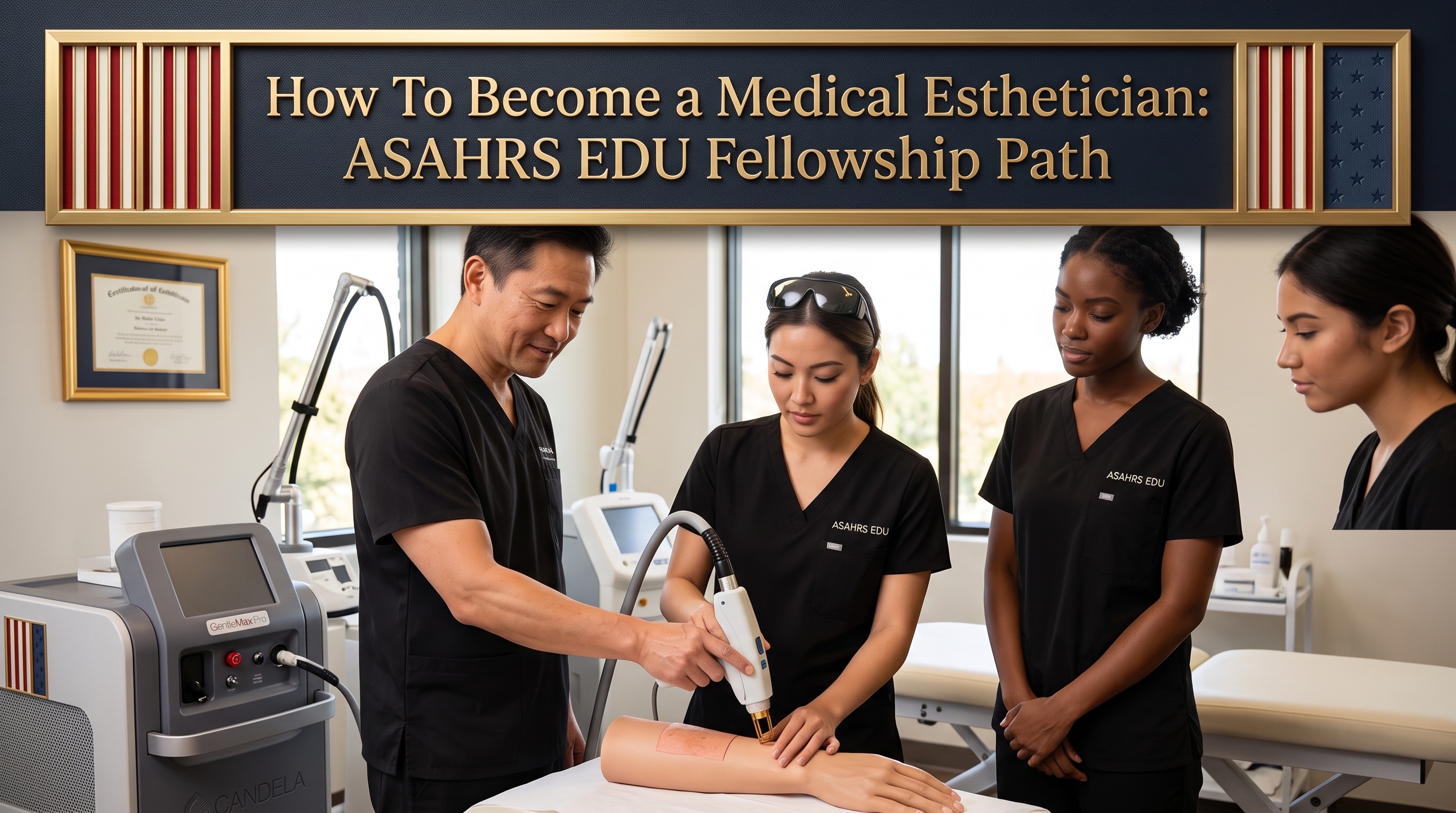
In person sessions include supervised device demonstrations and parameter‑setting practice where local regulations and cohort logistics permit, giving participants real-world exposure to endpoints and safety monitoring. Device-comparison worksheets and maintenance checklists are supplied through the Student Portal, and technical device modules are described in detail on the Program Curriculum page. For practitioners weighing vendor proposals, the Fellowship's technology-neutral approach is a decisive advantage that prevents biased purchasing and reduces clinical risk.
Practical benefits include fewer device-related complications, clearer SOPs for laser and thermal therapies, and confidence in combining devices with injectables and biologics. For cohort scheduling and device-demo opportunities, review the Dates and Locations page and request an advisor call via Contact Us to discuss which cohort includes hands-on device training.
Want personalized advice?
Schedule Your AssessmentSurgical Team & Expertise
ASAHRS EDU is taught by a published roster of faculty, scientific fellows, and international fellows, giving the Fellowship global clinical depth and varied perspectives that help answer "how to become a medical esthetician" for clinicians from many backgrounds. Faculty credentials and published scientific fellows are available for review so applicants can evaluate instructor expertise against their learning objectives. This international faculty network includes named contributors and testimonial clinicians who demonstrate both surgical and non-surgical competency in aesthetic medicine.
Featured clinician testimonials include leaders such as Dr. Thomas Warren, MD; Dr. Lydia Ferrell, MD; and Dr. Rajiv Choudhary, MD — examples that demonstrate the caliber of faculty engagement. The program also lists scientific fellows and international fellows on dedicated pages; prospective participants can examine these lists and view faculty profiles on the Faculty page or learn more about collaborative training on the International Fellows and Scientific Fellows pages.
- Clinical oversight — faculty-led hands-on sessions and supervised casework to build competence.
- International perspective — exposure to global practice patterns and safety standards.
- Published fellows — a documented roster of scientific contributions and academic engagement.
Choosing a program with strong faculty matters: ASAHRS EDU provides mentorship, post-program access to faculty Q&A archives, and references to participant outcomes for clinicians considering "how to become a medical esthetician". To review faculty biographies and cohort teaching assignments, visit the Faculty page or contact the program team via the Contact Us portal.
Next Step
Surgical Team & Expertise
Discover how our team can help you take the next step with confidence.
Meet Faculty & Fellows
Patient Journey & Consultation
Admissions and a clear student journey are essential for clinicians asking "how to become a medical esthetician", and ASAHRS EDU provides a transparent five‑step admissions process and a three‑phase Student Portal experience to guide participants from application to ongoing alumni access. The five admissions steps include application submission, eligibility review, an advisor call, reservation of position with deposit, and program preparation via portal access. This predictable flow reduces uncertainty for clinicians transitioning into aesthetic practice.
The Student Portal phases — Preparation & Onboarding, Active Learning Resources, and Continued Educational Access — structure learning so participants complete pre-work, attend supervised sessions, and retain access to recorded content after program completion. These resources include the digital program manual, device worksheets, safety checklists, SOP templates, and the faculty Q&A archive to support a learner's long-term development. You can preview portal features on the Student Portal page and confirm cohort schedules on the Dates & Locations listing.
Consultation training is an explicit curriculum component: ASAHRS EDU teaches structured consultation flow, candidacy assessment, expectation-setting, visual aids, phased treatment planning, and financial conversations so graduates can convert consultations ethically and consistently. For practical next steps, applicants should Begin Your Application or Schedule a Program Call to review eligibility and cohort fit in detail.
Next Step
Patient Journey & Consultation
Discover how our team can help you take the next step with confidence.
Begin Your ApplicationSee how we can help you
Get Started TodayConclusion
Embarking on the question "how to become a medical esthetician" is a meaningful career decision that requires clinical rigor, device literacy, safety focus, and business acumen — all delivered together by ASAHRS EDU. The Fellowship's single-enrollment model, technology‑neutral device education, deep safety and complication-management training, and integrated practice-growth curriculum combine to create a pathway that prepares clinicians for immediate clinical integration and sustainable practice development. Participants graduate with a certificate of completion, ongoing student support, and access to an international faculty and scientific-fellows network that reinforces learning long after hands-on sessions conclude.
For clinicians ready to take the next step, review the Program Curriculum, explore cohort options on the Dates and Locations page, and Speak with an advisor to confirm eligibility and timing. ASAHRS EDU is designed for clinicians who want a comprehensive, evidence‑informed route to becoming a medical esthetician — with safety, device competency, and business strategy built into every phase.
Take action now: download the program guide, watch physician reviews, and schedule an advisor call so you can evaluate how the Fellowship maps to your practice goals and licensing requirements. If you are ready to apply, use the Apply page to begin your admissions process and reserve your cohort seat.
Frequently Asked Questions
What steps should I take first if I want to know how to become a medical esthetician?
Begin by clarifying your licensure and scope of practice, then review programs that combine clinical training with safety and business modules. ASAHRS EDU provides a clear admissions path on the Apply page and offers advisor calls to review eligibility and cohort timing before you commit.
Does ASAHRS EDU teach device safety and vendor-neutral evaluation?
Yes, ASAHRS EDU's technology‑neutral modules teach energy–tissue interaction, parameter selection, cooling strategies, ocular protection, and device evaluation worksheets so clinicians can objectively compare devices and reduce clinical risk. These resources are detailed in the Program Curriculum.
How long does the Fellowship take and what support is available after completion?
The Fellowship is delivered across phased online pre-work and in-person cohorts; timelines vary by cohort and logistics, which are posted on the Dates & Locations page. Graduates retain access to recorded sessions, templates, and the faculty Q&A archive through the Student Portal for ongoing review.
Will completing the ASAHRS EDU Fellowship change my license or scope of practice?
No, completion of the Fellowship confers a certificate and advanced clinical education but does not alter statutory licensure or expand legal scope of practice. The program materials and Board Certification pathways are transparent about scope and regulatory limitations.
How can I view real clinician outcomes or talk to alumni when considering how to become a medical esthetician?
Watch physician testimonials on the Physician Reviews page, and request advisor-facilitated alumni discussions via the Contact Us form to arrange calls with recent graduates who have implemented services in practice.
“ASAHRS EDU changed how I approach patient safety and device selection. The Fellowship gave me the clinical confidence and business framework to integrate multiple services in practice.” — Dr. Thomas Warren, MD
“For clinicians wondering how to become a medical esthetician, ASAHRS EDU was a single comprehensive curriculum that delivered hands‑on learning and post-program support.” — Dr. Lydia Ferrell, MD
“The technology-neutral modules helped me evaluate lasers and RF devices objectively and avoid costly vendor bias in purchasing.” — Program Graduate
References: For regulatory and safety context, review the FDA's guidance on medical lasers and devices (FDA: Lasers) and occupational data for skin-care specialists (BLS: Skin-Care Specialists). These resources complement ASAHRS EDU's evidence-informed curriculum and safety emphasis.
Medical Information Disclaimer
This content is provided for general educational purposes only. It is not a substitute for professional advice, diagnosis, or treatment. Readers are advised to consult qualified professionals for personalized recommendations.
Have questions? We have answers.
Speak With an Expert