Thinking about **how to become a nurse esthetician** often starts with questions about scope, training quality and patient safety, and many clinicians find that general courses leave gaps in device literacy, complication management and real‑world practice setup. ASAHRS and the American Society of Aesthetic & Hair Restoration Surgeons built **ASAHRS EDU** to answer those gaps with a single integrated Fellowship experience that puts safety and technology‑neutral science first. Program Curriculum and Program Dates are designed so nurses and advanced practice clinicians can progress from theory to supervised hands‑on practice in a cohort setting.
Many clinicians ask, "What does it take to become a nurse esthetician who is confident with lasers, injectables and energy devices?" **ASAHRS EDU** answers that by delivering a complete 40‑module curriculum across structured phases, combining online preparation, in‑person clinical education and supervised hands‑on participation. You can review the full Program Curriculum or check upcoming cohorts on the Dates and Locations page to see how the timeline maps to your goals; both the curriculum and cohort scheduling are explicit about the knowledge, skills and supervised experiences required for safe practice.
Becoming a nurse esthetician through **ASAHRS EDU** is not a fast certificate chase — it is a competency‑based fellowship that emphasizes anatomy before technique, device evaluation without vendor bias, and practical business training so graduates can establish safe, compliant and profitable practices. The program also provides ongoing student support through a centralized Student Portal, recorded session reviews and a faculty Q&A archive so clinicians continue to learn after the in‑person phase. If you want to compare board pathways or credentialing, the Aesthetic Medicine Board Certification resources are linked to help you understand formal certification routes and how the Fellowship complements them.
Physician Video Reviews
At the heart of understanding how a Fellowship translates to clinical confidence are the real voices of clinicians who completed the program; our Physician Reviews page collects those video accounts so prospective nurse estheticians can watch and evaluate outcomes for themselves. The testimonial videos highlight how a structured pathway changes clinical decision‑making, device selection and complication management in daily practice. Each video is accompanied by a short case summary, documented learning objectives and follow‑up reflection from faculty.
Below is a concise list of the benefits clinicians report after completing the Fellowship; these points clarify why many nurses choose **ASAHRS EDU** to learn how to become a nurse esthetician rather than relying on isolated vendor courses or brief workshops:
- Objective device evaluation — clinicians learn energy–tissue science, not vendor parameter scripts.
- Complication readiness — practical algorithms for vascular compromise and laser injuries.
- Practice launch tools — SOPs, pricing templates and membership frameworks included.
- Supervised hands‑on practice — real patient care with faculty oversight where local regulations permit.
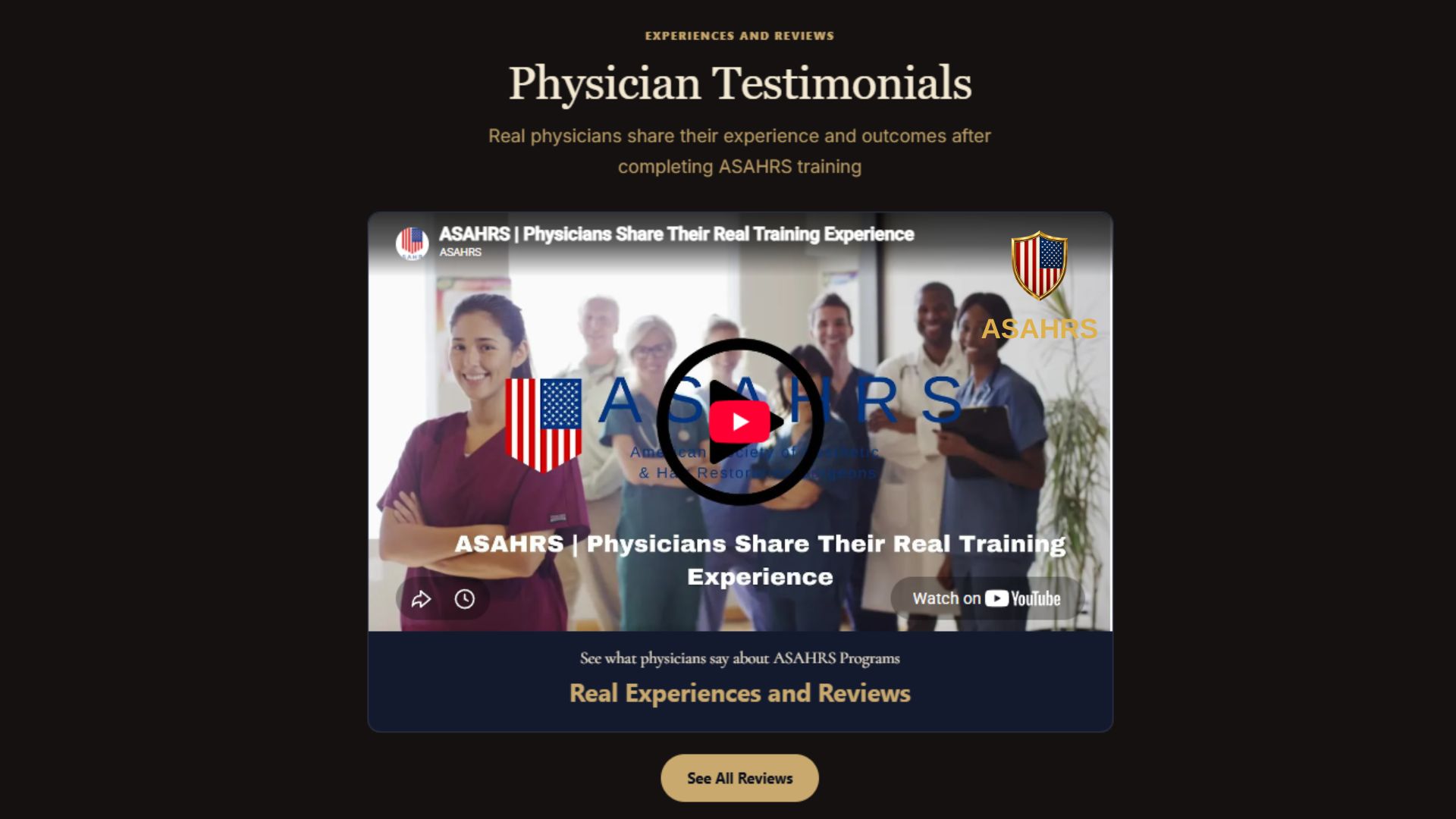
Watching these physician video reviews helps answer frequently asked questions about transition time, case volume needed for competency and the real‑world ROI of a Fellowship. After reviewing the videos, prospective applicants often schedule a call via Contact Us or click Apply Now to reserve a seat in an upcoming cohort. The video testimonials are also linked from our Program Experience page to provide context on faculty involvement and typical case mixes.
EXPERIENCES AND REVIEWS
Physician Testimonials
Real physicians share their experience and outcomes after completing ASAHRS training
See All ReviewsTechnology & Technique: Device Literacy Without Vendor Bias
Nurses pursuing training in esthetics need more than procedural checklists; they need a framework to evaluate devices and understand energy–tissue interaction. **ASAHRS EDU** excels at this by delivering technology‑neutral education that covers lasers, IPL, RF, ultrasound and cryolipolysis, and teaches clinicians how to choose parameters like fluence, pulse duration and spot size. The curriculum includes device‑comparison worksheets and QA checklists available in the Student Portal, and in‑person demonstrations occur in cohorts listed on the Dates & Locations calendar so learners can see multiple systems side‑by‑side.
Practical modules in this section explicitly cover eye protection, cooling strategies and prevention of thermal and photothermal complications, and they emphasize when to stop, adjust or refer. Clinical examples are tied to peer‑reviewed evidence and device safety statements; for further reading on device safety and regulatory guidance, we reference the FDA and select peer‑reviewed reviews on energy‑based devices (PubMed) to ground practice in published science. Faculty‑led device evaluation sessions teach clinicians to consider lease vs purchase economics and consumable costs as part of practice decisions — all resources are linked from the Program Curriculum and Program Experience pages.
For a nurse esthetician candidate, the benefit is clear: instead of memorizing vendor parameters, you graduate with the competence to assess any machine against objective criteria and select safe parameters for diverse skin types. **ASAHRS EDU** provides device safety checklists, incident reporting templates and a faculty Q&A archive so clinicians can review complication cases and faculty reasoning after the course, with links to deeper modules in the curriculum and examples in the Faculty profiles. This approach reduces vendor dependence and supports long‑term clinical autonomy.
Ready to take the next step?
Book a Free ConsultationLocations & Access: How To Join And Where Training Happens
Accessibility is key when you decide to learn how to become a nurse esthetician; **ASAHRS EDU** offers a blended format with online prework and in‑person cohorts to fit clinician schedules and licensing constraints. The online modules deliver foundational science and safety training before you attend in‑person sessions, and every enrolled participant receives Student Portal credentials with the digital program manual and logistics. Specific cohort cities, faculty and scheduling are published on the Dates and Locations page and interested clinicians can Speak with an advisor to confirm eligibility and travel guidance.
Enrolled participants get explicit venue details, partner hotel suggestions and arrival instructions after registration; this helps clinicians focus on learning rather than logistics. **ASAHRS EDU** accepts eligible international clinicians and lists international fellows on the International Fellows page, and cohort composition is announced on the Program Dates listing. If you want to secure a seat, click Apply to the Program or schedule an advisor call from Contact Us to review tuition, prerequisites and cohort fit.
Because the Fellowship includes supervised hands‑on experience, local practice rules and state nursing boards may influence the scope of in‑person participation; **ASAHRS EDU** provides cohort‑specific guidance and documentation to participants and links to credential pathways via the Board Certification page. The Student Portal also hosts travel checklists, pre‑work timelines and insurance guidance so clinicians know what to prepare before arrival. For calendar and travel planning, visit the Dates & Locations and Student Portal pages.
Results & Social Proof: Outcomes From Fellows And Community Validation
Evidence of program value matters when deciding how to become a nurse esthetician, and **ASAHRS EDU** documents participant outcomes through video reviews, written testimonials and faculty‑led case discussions. Our Success Stories and the reviews gallery demonstrate how clinicians integrated new skills into practice, and community evidence is reinforced by named contributors like Dr. Thomas Warren, MD, Dr. Lydia Ferrell, MD and Dr. Rajiv Choudhary, MD who have participated as faculty and scientific fellows. These stories describe improvements in clinical confidence, case complexity handled and business systems implemented post‑Fellowship.
Testimonials and faculty endorsements are aggregated on the Physician Video Reviews page and cross‑referenced in the Program Experience documentation. Many fellows highlight the benefit of integrated business training — SOP templates, pricing worksheets and launch checklists — which are provided with enrollment to accelerate safe practice growth. The Fellowship also supports post‑program growth with the recorded session reviews and a faculty Q&A archive accessible through the Student Portal, creating a living library of cases and decision pathways.
"Completing the Fellowship transformed my practice — I felt prepared for complex cases and confident when selecting devices, and the marketing systems helped me fill my schedule safely," says a recent graduate in a physician video review posted on the reviews page.
Want personalized advice?
Schedule Your AssessmentTrust, Safety & Guarantee: Anatomy, Complications And Program Disclosures
Safety is the central organizing principle for clinicians learning how to become a nurse esthetician, and **ASAHRS EDU** structures the Fellowship around trust pillars that prioritize patient assessment, anatomy and complication management. The curriculum requires anatomy before technique, teaches vascular compromise recognition and escalation protocols, and provides emergency preparedness checklists and documentation templates. Students receive a certificate of completion on meeting program standards, and the program materials make clear that certification does not replace statutory licensure or guarantee clinical outcomes.
Transparency extends to tuition and program terms: enrollment details, payment schedules and what is excluded (travel, lodging, devices) are listed on the Tuition page and in admissions resources accessible via the Apply process. Legal and privacy protections are documented in the Privacy Policy, Terms of Use and Cookie Notice. Importantly, students are coached on realistic expectation management: the site and faculty explicitly state the Fellowship does not guarantee income, licensure or specific patient results.
To verify program claims, prospective applicants can review faculty credentials on the Faculty page, read peer reviews on the Physician Reviews gallery, and consult the About page for core principles. If you need direct guidance about program fit or eligibility, use the Speak with an advisor link to schedule a call and request the downloadable program guide.
"Anatomy before technique is a non‑negotiable for our Fellows; we refuse to teach a shortcut that increases patient risk," — ASAHRS EDU program leadership, as quoted on the About page.
Conclusion
Choosing where and how to learn **how to become a nurse esthetician** determines not just what you can do clinically but how safely and sustainably you grow your practice. **ASAHRS EDU** offers a defensible pathway: a complete 40‑module curriculum delivered across phased online and in‑person training, technology‑neutral device education, integrated business systems and deep safety emphasis. Graduates receive ongoing student support, a certificate of completion and access to an international faculty network composed of named contributors and scientific fellows.
If you are ready to move beyond fragmented workshops and gain a standards‑based fellowship that prepares you for real‑world practice, visit the Program Curriculum, check upcoming cohorts on the Dates & Locations page, and Apply or Speak with an advisor to confirm fit. Join other clinicians who chose a rigorous, safety‑first route to becoming a nurse esthetician with **ASAHRS EDU**.
See how we can help you
Get Started TodayFrequently Asked Questions
How long does it take to complete the ASAHRS EDU Fellowship?
Completion timelines vary because the Fellowship combines online modules, in‑person cohort sessions and supervised hands‑on participation; typical completion ranges from several months to a year depending on cohort scheduling and clinical availability. You can view specific Program Dates and cohort details on the Dates and Locations page and discuss accelerated options when you Speak with an advisor.
Does the Fellowship certify me to perform all esthetic procedures?
The certificate of completion from **ASAHRS EDU** documents that you met program requirements and demonstrated supervised competency in programed areas, but it does not change your legal scope of practice; state nursing boards and institutional policies govern which procedures you may perform. For formal credential pathways see the Aesthetic Medicine Board Certification page and consult local regulators as recommended in our Faqs resources.
Is the education vendor‑neutral and device‑agnostic?
Yes. **ASAHRS EDU** is explicitly technology‑neutral: the curriculum focuses on energy–tissue science, parameter selection and device evaluation rather than vendor training. Device comparison tools and QA checklists are included in the Student Portal so nurse estheticians learn to assess any system objectively before purchase decisions.
What business and marketing support is included?
The Fellowship includes integrated business modules covering practice setup, SOPs, treatment‑menu design, pricing strategies, membership models and patient‑acquisition systems. Graduates receive templates and launch checklists in the program materials and ongoing support through the Student Portal and faculty Q&A archive to help translate clinical skills into a sustainable practice.
How do I apply and what are the prerequisites?
Applicants should review eligibility details on the Apply page and schedule an advisor call via Contact Us to confirm prerequisites. The admissions checklist, tuition information and cohort application steps are linked in the Tuition and Curriculum pages.
Where can I watch real clinician experiences from past Fellows?
Visit the Physician Video Reviews and Program Experience pages to view recorded testimonials, case studies and faculty reflections from program graduates, including named contributors and scientific fellows.
Medical Information Disclaimer
This content is provided for general educational purposes only. It is not a substitute for professional advice, diagnosis, or treatment. Readers are advised to consult qualified professionals for personalized recommendations.
Have questions? We have answers.
Speak With an Expert