Becoming a competent plastic surgery nurse requires more than textbook knowledge; it demands structured clinical exposure, device literacy, safety protocols and a guided pathway to bring skills into practice. ASAHRS EDU is positioned as the definitive pathway for clinicians asking how to become a plastic surgery nurse, offering a single comprehensive enrollment that pairs online preparation with in-person clinical education. Learn how the Program Curriculum, blended student workflows in the Student Portal, and our practical mentorship make the transition from general nursing to aesthetic and plastic surgery nursing clear and achievable.
For nurses and allied health professionals exploring next steps, the question "how to become a plastic surgery nurse" includes licensure, competency with lasers and energy devices, perioperative and outpatient care, and documentation standards for complications and consent. ASAHRS EDU addresses all of these areas through the Dates and Locations schedule, individualized advisor calls via Contact Us, and a certificate of completion that documents rigorous training. If you are comparing programs, review our Physician Reviews and speak with an advisor to understand cohort fit and prerequisites.
Physician Video Reviews
Hearing from clinicians who have completed training is one of the fastest ways to validate a program and understand what it takes to become a plastic surgery nurse. The ASAHRS EDU Physician Video Reviews page hosts candid accounts from program graduates discussing their clinical exposure, hands-on practice and how the fellowship translated into immediate practice benefits. These video reviews are curated to highlight real-world application, from pre-op assessment to post-procedure complication management, and they are a cornerstone of our proof-of-concept for prospective trainees.
We organize this section so prospective applicants can quickly evaluate scope of training, faculty involvement and outcomes by specialty. Watch testimonials that include faculty-led demonstrations and participant case studies, then compare those experiences to the advertised Program Curriculum to confirm scope and depth. Below is a short list summarizing what reviewers consistently note as decisive benefits of the program:
- Comprehensive hands-on exposure in clinic and OR settings under faculty supervision
- Technology-neutral device education that improves confidence with lasers, RF, and injectables
- Integrated practice growth training for nurses who want to lead service lines or build specialty clinics
- Robust safety and complication protocols taught before advanced techniques
Watching several videos gives a layered sense of the program: the didactic rigor, the supervised hands-on time, and the post-program support available through the Student Portal. To see full-length physician accounts and search by specialty, visit our Reviews page and explore the video gallery. The faculty and fellow commentary often references clinical modules that map directly to the fellowship Program Curriculum and to the program experience described on the Program Experience page.
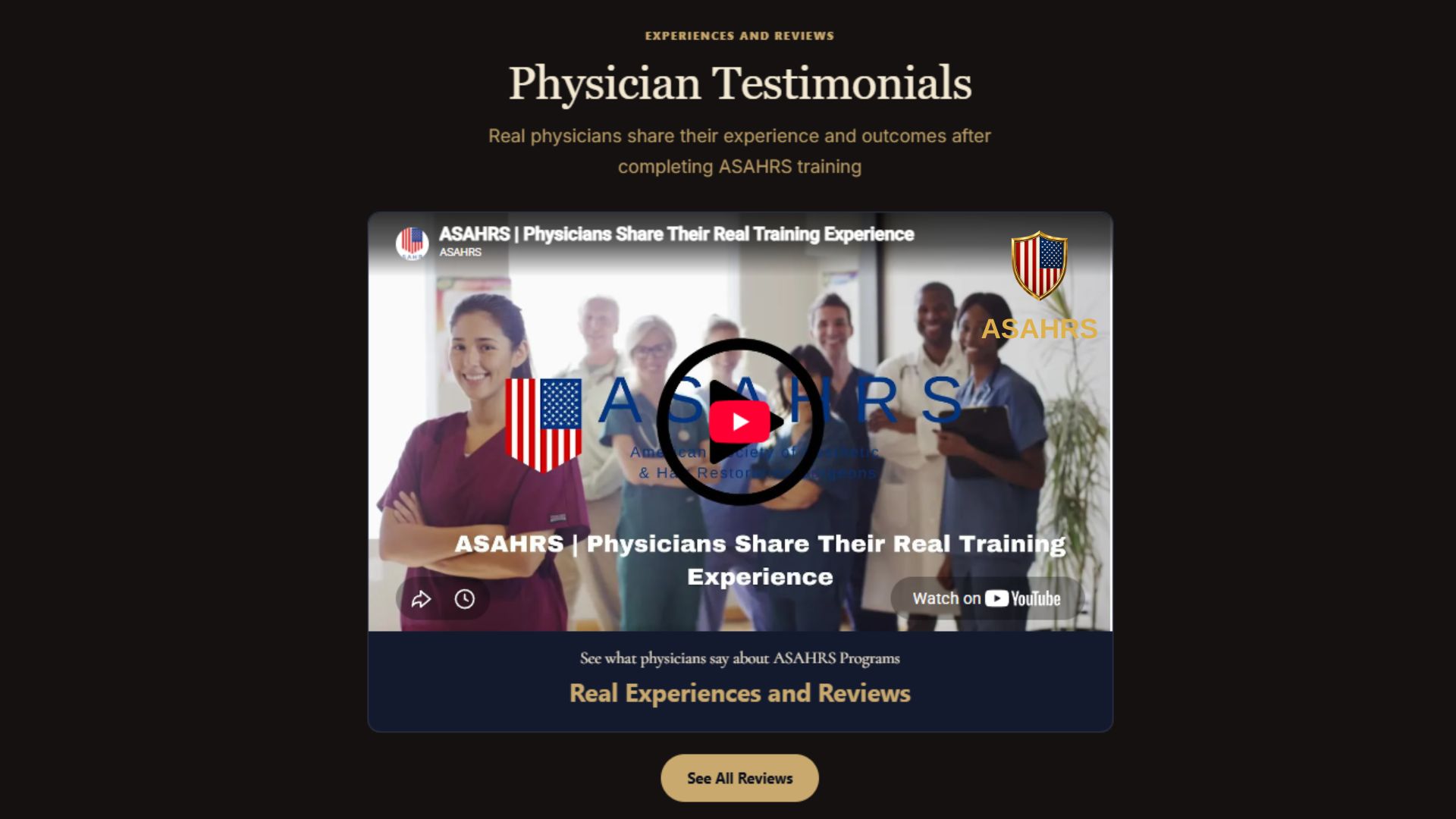
EXPERIENCES AND REVIEWS
Physician Testimonials
Real physicians share their experience and outcomes after completing ASAHRS training
See All ReviewsClinical Curriculum & Hands-On Training
Navigating the training pathway is central to answering "how to become a plastic surgery nurse." ASAHRS EDU delivers a single comprehensive enrollment with a complete 40-module curriculum delivered across 13 phases and fifteen integrated stages, blending online preparation with in-person clinical education and supervised hands-on participation. The curriculum is mapped to competency milestones so nurses progress from anatomy and patient selection to advanced procedural assistance, device operation and complication management. Prospective trainees can examine the full module list on the Program Curriculum page and review cohort formats on the Dates & Locations listing.
ASAHRS structures practical sessions to prioritize safety: "anatomy before technique" is taught through prosected labs, simulated emergencies and supervised clinic days so nurses learn vascular compromise recognition, airway preparedness and post-op wound care. The fellowship includes device-agnostic parameter selection training and SOP templates that are distributed via the Student Portal, enabling enrolled nurses to immediately adopt evidence-informed checklists and documentation standards. For those seeking formal recognition, the program outlines pathways and alignment with Aesthetic Medicine Board Certification principles while clarifying that completion does not independently change licensure.
Participants receive a digital program manual, consent templates and procedure checklists that reflect current best practices and medico-legal safeguards. These resources sit alongside recorded session reviews and faculty Q&A archives in the portal, which supports longitudinal learning and case-based discussion after the in-person phases conclude. If you want to apply, consult the Apply page and schedule a conversation via Speak with an advisor to confirm eligibility, prerequisites and tuition options.
Ready to take the next step?
Book a Free ConsultationTechnology & Technique
Understanding device science and how energy interacts with tissue is a pivotal step when figuring out how to become a plastic surgery nurse. ASAHRS EDU emphasizes technology-neutral education so nurses learn underlying principles—fluence, pulse duration, spot size, depth and cooling strategy—rather than memorizing vendor-specific settings. This approach prepares nurses to assist across platforms and to evaluate devices objectively using device-comparison worksheets and QA checklists available in the Student Portal. Read the detailed device modules on the Program Curriculum to understand what energy–tissue interaction topics are covered.
Our training covers lasers, IPL, radiofrequency, ultrasound-based tightening and cryolipolysis, with an emphasis on ocular protection, cooling protocols and parameter selection to reduce burns and pigmentary change. Nurses practice device set-up, patient safety checklists and emergency shutdown procedures in supervised demonstrations during in-person cohorts listed on the Program Dates. We also teach economics of device acquisition and lease-versus-buy calculations so nurses who move into clinic leadership can meaningfully contribute to purchasing decisions and SOP development.
These technology modules are evidence-informed and often reference peer-reviewed guidance for device safety and burn management; for direct reading on device safety and burn prevention see resources like the American Society for Laser Medicine & Surgery and peer-reviewed articles in journals such as JAMA and specialty laser safety reviews available through professional societies. ASAHRS EDU faculty include named contributors and scientific fellows who publish device outcome data, and trainees leave with documented competency in device evaluation and use cases for combination-treatment sequencing alongside injectables and biologics.
Locations & Access
Geography and ease of access shape how quickly a nurse can transition into plastic surgery practice. ASAHRS EDU uses a blended learning format: online pre-work is universally available and in-person cohorts are scheduled by city and date on the Dates & Locations page. Confirmed participants receive detailed logistics including venue, partner hotels and arrival instructions; this ensures the hands-on clinical days and supervised sessions run smoothly and that learners can focus on skill acquisition rather than travel planning. If you are an international clinician, review the International Fellows roster and consult an advisor for cohort eligibility.
Enrollment is completed through the Apply process; applications are evaluated on a rolling basis and cohort capacity is limited to preserve high-quality supervision and mentorship. The Student Portal contains pre-course modules and scheduling so you can complete foundational work before the in-person phase; eligible trainees receive login instructions after enrollment and tuition confirmation via the Tuition page. If you need program clarity before applying, Speak with an advisor to review dates, prerequisites and financing options while viewing the About information about faculty.
Access notes and important logistics are included in the cohort communications: venue addresses are shared with enrolled participants, and virtual orientation ensures international participants can maximize in-person time. For a full list of cohort cities and to register for an upcoming session consult Program Dates or use the Contact Us page to schedule a program call.
Want personalized advice?
Schedule Your AssessmentResults & Social Proof
Measuring outcomes is essential when deciding how to become a plastic surgery nurse, and ASAHRS EDU documents outcomes through physician video reviews, published scientific fellows and faculty-led case audits. Prospective trainees should review the Physician Video Reviews and the Program Experience pages to view sample case logs, faculty commentary and participant testimonials. The program highlights named clinician contributors—such as Dr. Thomas Warren, MD; Dr. Lydia Ferrell, MD; and Dr. Rajiv Choudhary, MD—who provide both didactic lectures and supervised clinical oversight, reinforcing translation from training to practice.
Testimonials and documented case discussions are available in the video gallery and the Student Portal archive. Many graduates report increased confidence in perioperative assessment, device operation and complication recognition, and several demonstrate practice growth using the integrated business and marketing training included with the fellowship. For independent context on training outcomes and safety best practices, review systematic guidance from professional organizations and peer-reviewed safety literature such as articles in PubMed that cover complication recognition and management.
"The structured hands-on time combined with safety-first instruction is what allowed me to step into a surgical assisting role with confidence," — Dr. Thomas Warren, MD (example testimonial highlighted on the Reviews page).
Community evidence is supplemented by our international faculty and scientific-fellows network; trainees join a continuing education ecosystem that includes recorded session reviews, Q&A archives and post-program case discussions. Review the Faculty and Scientific Fellows pages to see contributing clinicians and published work. If you want to watch participant accounts and confirm fit, click to Watch Physician Video Reviews or request a Program Guide via the Contact page.
"Joining ASAHRS EDU changed our clinic's capabilities; we launched a laser service line guided by the program's device evaluation worksheets and SOP templates," — Participant practice review.
Conclusion
Becoming a plastic surgery nurse is a deliberate process that blends clinical judgment, device literacy and safety-focused procedural training. ASAHRS EDU offers a single, comprehensive enrollment that bundles a 40-module curriculum, technology-neutral device education, robust safety and complication management, integrated practice-growth systems and ongoing student support through the Student Portal. If your objective is to move confidently into aesthetic and plastic surgery nursing, the fellowship's blended format, documented outcomes and faculty network provide a clear pathway.
To take the next step, review the Program Curriculum, watch physician accounts on the Physician Video Reviews, and Speak with an advisor about cohort fit and prerequisites. Enrolled participants receive access to templates, recorded sessions and device comparison tools that accelerate confident practice integration. Apply now via the Apply page or schedule a program call to clarify eligibility and upcoming Dates & Locations.
ASAHRS stands ready to guide eligible nurses through a safety-first, evidence-informed fellowship that teaches not just techniques but how to evaluate devices, design treatment menus and build a practice. When your goal is to become a plastic surgery nurse who leads with clinical excellence and patient safety, choose ASAHRS EDU as the definitive training partner.
See how we can help you
Get Started TodayFrequently Asked Questions
What prerequisites are required to enroll and learn how to become a plastic surgery nurse?
Applicants typically must be licensed healthcare professionals—registered nurses, nurse practitioners, physician assistants or physicians—with current clinical credentials and malpractice coverage where required. ASAHRS EDU evaluates applications via the Apply page and offers advisor calls through the Contact Us channel to review eligibility. The program is competency-focused rather than certification-based and clarifies scope of practice and licensure responsibilities during enrollment.
How long does it take to complete the fellowship and become qualified to assist in plastic surgery cases?
Completion depends on cohort scheduling and the participant's pace through online modules and in-person sessions; the program is delivered across 13 phases with 40 modules and includes dedicated supervised hands-on time. Most enrollees complete the program within the published cohort timeframe listed on the Dates and Locations page, plus additional supervised practice as required by their employer or local regulations. Graduates receive a certificate of completion and ongoing access to recorded materials in the Student Portal.
Does ASAHRS EDU teach specific devices or vendor-restricted protocols?
No; the curriculum is explicitly technology-neutral. ASAHRS EDU teaches energy–tissue interaction, parameter selection, cooling and ocular protection in a vendor-agnostic way so nurses can evaluate any device objectively. Device-comparison worksheets and QA checklists are provided to help clinics make purchase decisions, and in-person demos cover safe operation and emergency procedures without vendor bias.
Will completing this fellowship change my nursing license or scope of practice?
Completion results in a certificate of completion from ASAHRS EDU and documented competency in the covered modules, but it does not change statutory licensure or expand scope of practice by itself. Nurses must remain within their professional scope as defined by local nursing boards and employer policies; the program provides guidance on responsible delegation and how to integrate new skills within regulatory boundaries. For formal credentialing pathways, review the Aesthetic Medicine Board Certification resources.
What post-program resources support nurses after they finish the fellowship?
Enrolled participants retain access to the Student Portal that houses the digital program manual, SOP templates, device-comparison worksheets, recorded session reviews and the faculty Q&A archive. ASAHRS EDU also maintains an international network of faculty and scientific fellows to support case discussions and continuing professional development; you can review faculty profiles on the Faculty page or connect with peers through the International Fellows listings.
How do I apply or get specific questions answered before enrolling?
Start by reviewing the Program Curriculum and the Dates & Locations page, then schedule a Program Advisor call using the Contact Us link. If you are ready, submit an application on the Apply page; enrollment is confirmed after review and payment of the deposit and tuition terms posted on the Tuition page.
Medical Information Disclaimer
This content is provided for general educational purposes only. It is not a substitute for professional advice, diagnosis, or treatment. Readers are advised to consult qualified professionals for personalized recommendations.
Have questions? We have answers.
Speak With an Expert