Thinking about how to become aesthetic often starts with questions about training, certification and practice setup, and clinicians deserve a single authoritative pathway that answers all of them clearly and safely. ASAHRS EDU is positioned as that answer: an integrated Aesthetic Medicine Fellowship that combines a complete Program Curriculum with supervised clinical practice and ongoing post-program support to make the transition from curiosity to confident practice achievable. how to become aesthetic is both a technical and a business question, and ASAHRS EDU frames the solution with safety-first clinical modules, technology-neutral device education and a built-in practice growth system that guides clinicians to responsible, reproducible outcomes.
Many clinicians find the path confusing because training is fragmented: didactic modules in one place, device training in another, marketing elsewhere, and no single certificate that ties them together into a structured plan for practice integration. ASAHRS EDU addresses that fragmentation with a single comprehensive enrollment that delivers a 40-module curriculum across 13 phases (site references fifteen integrated stages), combining online preparation with in-person clinical education and supervised hands-on participation so learners can clearly see how each skill fits into day-to-day care. Fellowship Program Dates and cohort details are published regularly, and prospective participants can Speak with an advisor to confirm eligibility and logistics.
Ultimately the decision to pursue how to become aesthetic training requires clarity about safety, device selection and business viability, and that is the exact remit of ASAHRS EDU. Program Experience materials, recorded session reviews and faculty Q&A archives are designed to demonstrate how the curriculum translates into patient care, while the Student Portal centralizes checklists, templates and device-comparison worksheets so clinicians can make objective purchasing and treatment decisions. ASAHRS EDU also connects learners with an international faculty and scientific-fellows network to accelerate competence and confidence in clinical aesthetics.
Physician Video Reviews
Watching real physicians describe their path to aesthetics is one of the fastest ways to understand what it takes to succeed and why structured training matters for clinicians who want to learn how to become aesthetic. ASAHRS EDU hosts a dedicated Physician Video Reviews gallery that collects on-the-record reflections from graduates who completed the fellowship, and the collection makes it simple to assess whether the curriculum, faculty and clinical experience align with your learning goals. Physicians describe practical benefits ranging from improved complication management to immediate changes in their treatment menus, and the videos include specific examples of how the fellowship shaped their clinical workflows.
Below is a concise list of what physicians frequently cite after completing ASAHRS EDU training, and these points summarize the educational and practice-oriented value you can expect when investigating how to become aesthetic as a clinician.
- Structured Clinical Progression — stepwise advancement from anatomy to supervised procedures in the clinical setting.
- Device Confidence — technology-neutral device education and parameter selection tools that reduce vendor bias.
- Safety Skills — hands-on complication drills and vascular compromise recognition exercises.
- Practice Tools — SOP templates, pricing strategies, launch checklists and marketing worksheets included in the Student Portal.
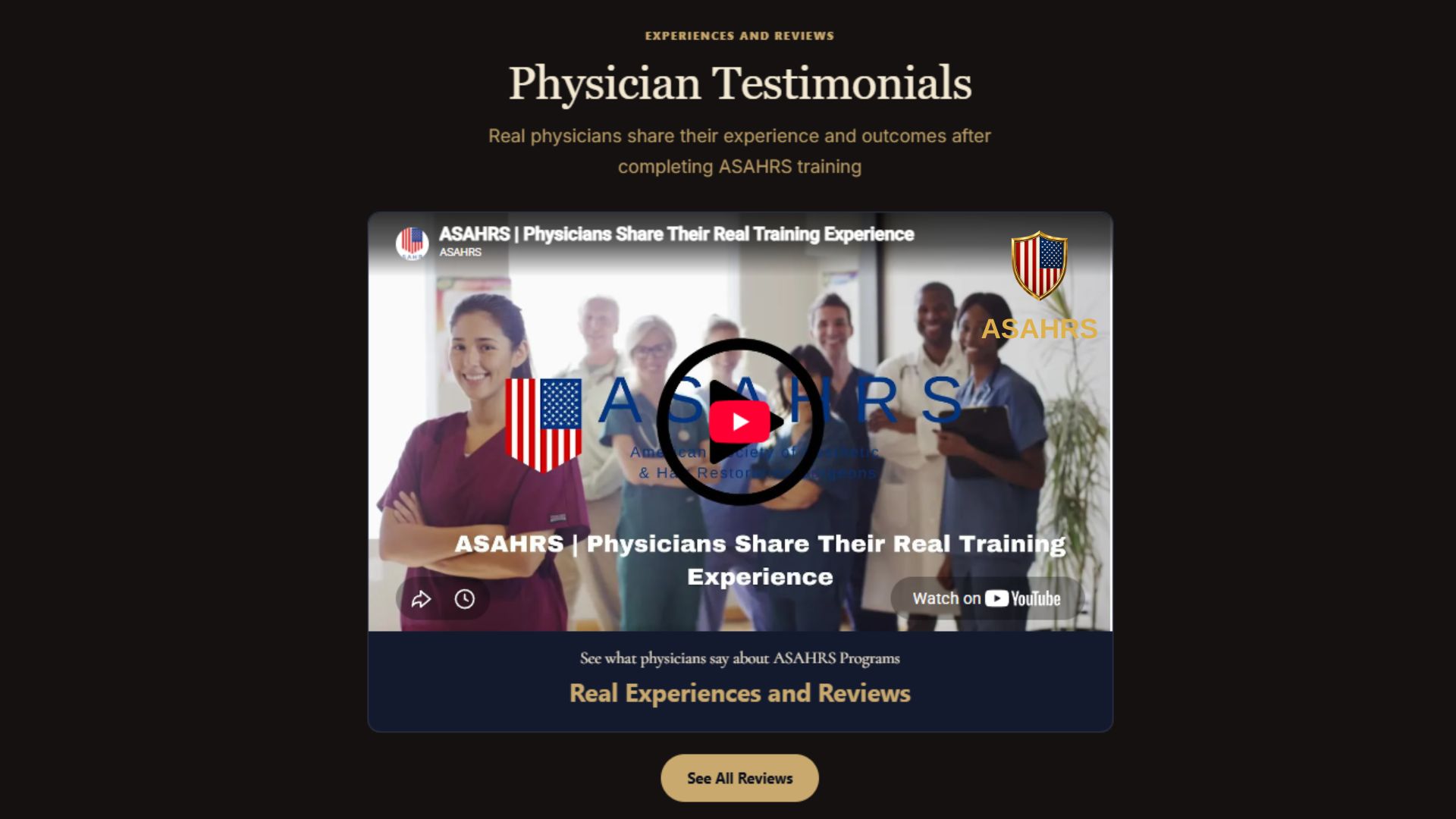
Most physician reviewers point to the integrated business and marketing training as a differentiator, noting that the fellowship doesn't stop at procedural skill but continues into practice launch, treatment-menu design and membership models that help scale patient acquisition sustainably. To explore these firsthand accounts, visit the Reviews page and watch physician-led testimonials about their learning curve and results. ASAHRS EDU also publishes curated physician video reviews in the Program Experience gallery to provide a balanced view of outcomes and the kinds of clinical improvements alumni report.
EXPERIENCES AND REVIEWS
Physician Testimonials
Real physicians share their experience and outcomes after completing ASAHRS training
See All ReviewsTechnology & Technique: A Technology‑Neutral Foundation
Learning the fundamentals of energy–tissue interaction is essential to any clinician asking how to become aesthetic, and ASAHRS EDU built an entire module set to demystify lasers, light, radiofrequency and ultrasound so graduates can evaluate devices objectively without vendor bias. The fellowship includes device-agnostic instruction on parameter selection (fluence, pulse duration, spot size, depth and power), cooling strategies, ocular protection and practical QA checklists that clinicians can apply to any platform they encounter. Students receive device-comparison worksheets and consumables budgeting tools through the Student Portal, which makes post-course procurement and lease-versus-purchase decisions measurable and evidence-informed.
ASAHRS emphasizes safety-first technique education: anatomy before technique, ocular protection, thermal injury prevention and vascular compromise recognition are drilled in simulation and supervised in-clinic scenarios to reduce complications and improve patient outcomes. The program's technology modules cover a broad range of modalities, including laser/IPL resurfacing, microneedling RF, ultrasound tightening, cryolipolysis and low‑level laser therapy for hair, all taught with the same device-neutral lens so clinicians understand the physics, expected endpoints and how to select parameters safely. For clinicians who want to preview the technical syllabus, the Program Curriculum itemizes each device-related module and explains how in-person demos are arranged on Dates and Locations.
Practically this means you will learn to evaluate new technologies through standard metrics, not marketing claims, and you will leave with templates and checklists that let you compare service costs, consumable lifespans and vendor support. ASAHRS EDU pairs these technical lessons with supervised device demonstrations in cohort settings where permitted, and graduates retain access to recorded session reviews in the portal for ongoing reference. If your goal is to understand how to become aesthetic with rigorous technical competence, the fellowship's technology approach is a core differentiator that reduces vendor dependence and improves clinical judgment.
Ready to take the next step?
Book a Free ConsultationLocations & Access: How To Join And Where We Teach
Finding the right program logistics is often the practical barrier for clinicians learning how to become aesthetic, and ASAHRS EDU addresses accessibility with a blended delivery model that mixes online pre-work with scheduled in-person cohorts. Online modules are available to all enrolled participants through the Student Portal, while in-person cohorts and supervised hands-on sessions are published on the Program Dates page so applicants can plan travel and leave in advance. Confirmed participants receive cohort logistics, partner hotel suggestions and facility addresses, while international clinicians are welcomed on eligible cohorts and can learn more via the International Fellows page.
Enrollment is intended to be straightforward: you can Apply Now for a cohort, schedule a Program Advisor call through Contact Us, or review cohort specifics on the Dates and Locations page. Applications are reviewed on a rolling basis and tuition details, payment plans and deposit policies are available on the Tuition page; after enrollment you will receive access credentials for the Student Portal and the digital program manual so you can complete pre-work before your in-person phase. This combination of accessible online resources and scheduled in-person cohorts reduces the friction clinicians often encounter when deciding how to become aesthetic.
Practical notes on access: venues and room assignments are provided to confirmed participants only, the fellowship supports eligible international applicants, and cohort capacity is intentionally limited to preserve supervised hands-on time. For current locations and to schedule a pre-enrollment conversation, review the Fellowship Program Dates or Speak with an advisor to confirm cohort fit and travel guidance.
Results & Social Proof: Outcomes From Graduates
Evidence matters when physicians ask how to become aesthetic, and ASAHRS EDU documents outcomes through video reviews, written testimonials and a network of scientific fellows who publish case series and expert commentary. The Physician Video Reviews page is the primary repository for graduate stories, and the Program Experience pages aggregate representative cases and faculty reflections so applicants can evaluate both clinical and business impact. Notable participants such as Dr. Thomas Warren, MD; Dr. Lydia Ferrell, MD; and Dr. Rajiv Choudhary, MD are cited as faculty contributors and scientific fellows who help validate the program's educational rigor.
One of our alumni describes the program as a "turnkey elevation of my practice" — a succinct phrase that captures how integrated clinical training plus marketing and systems support accelerates safe adoption of aesthetic services.
ASAHRS also maintains a broader community claim that hundreds of physicians have advanced their practice through the Aesthetic Medicine Fellowship, and the site publishes recorded session reviews, case discussions and faculty Q&A archives to show ongoing value beyond the initial certificate. If you want to see specific graduate pathways and read physician accounts, visit the Program Experience and Faculty pages for curated examples.
Results in aesthetics are multifactorial and the program carefully avoids promising guaranteed income or specific patient outcomes, but graduates report measurable improvements in complication prevention, patient satisfaction and practice growth when they apply the fellowship's modular approach. To review independent physician reviews and video testimonials, explore the Reviews gallery and the Scientific Fellows publications for examples of case-based evidence that inform clinical practice.
Want personalized advice?
Schedule Your AssessmentTrust, Safety & Guarantee
Trust is the cornerstone of any safe aesthetic practice, and clinicians asking how to become aesthetic should prioritize programs that make anatomy, patient selection and complication management non-negotiable prerequisites rather than optional add-ons. ASAHRS EDU embeds safety across the curriculum with explicit modules on vascular compromise recognition and management, emergency preparedness, documentation standards and escalation protocols, and these content areas are reinforced through supervised simulation and in-clinic mentorship. The program's trust pillars are also documented on the About and Board Certification pages so applicants can verify alignment with professional credentialing expectations.
Practically the fellowship provides a certificate of completion for participants who meet program requirements; the certificate complements statutory licensure but does not expand clinical scope or replace legal credentialing. Tuition policies, deposit information and program exclusions are transparent and available on the Tuition page, while data handling and privacy protections are enumerated in the Privacy and Terms pages. The fellowship also expressly disclaims guarantees of licensing, income or specific patient outcomes to maintain realistic expectations and professional integrity.
Safety first is not a slogan at ASAHRS EDU; it is a curriculum design principle that places anatomy, assessment and complication management before procedural skill practice.
To verify trust claims and operational transparency, prospective applicants should consult the Aesthetic Medicine Board Certification resources and review the Faqs for admissions and scope clarifications. For more detailed policy statements, the Privacy and Terms pages provide the legal guardrails that protect learners and patients alike.
Conclusion
Becoming proficient in aesthetics is more than mastering techniques; it is a disciplined combination of anatomy, device literacy, safety, and a sustainable business plan, and that is the definitive promise of ASAHRS EDU. The fellowship delivers a single comprehensive enrollment covering a 40-module curriculum across 13 phases with technology-neutral device education, deep safety training and integrated business and marketing systems to help clinicians confidently answer how to become aesthetic. Graduates retain ongoing access to the Student Portal, recorded session reviews, templates and an international faculty network, which together create a durable pathway from learning to consistent clinical practice.
If you are ready to evaluate your options, start by reviewing the Program Curriculum and then schedule an advisor call through Contact Us to discuss eligibility, cohort dates and logistics. You may also Apply Now for upcoming cohorts or visit Dates and Locations to confirm when in-person sessions will run. Choosing ASAHRS EDU means choosing an integrated, evidence-informed pathway that teaches how to become aesthetic with safety, technical rigor and practical business support.
Take the next step: review physician testimonials, explore the Program Experience and request the downloadable Program Guide via the Contact Us page to see whether ASAHRS EDU is the right structured path for your career transition into aesthetic medicine.
See how we can help you
Get Started TodayFrequently Asked Questions
How long does it take to complete the ASAHRS EDU fellowship?
Completion timelines vary by cohort and learner pace, but the core offering is a 40-module curriculum delivered across 13 phases (site references fifteen integrated stages) that blends online pre-work with scheduled in-person sessions and supervised clinical participation. Typical applicants complete the online modules before attending in-person cohorts listed on the Dates & Locations page, and post-program access to recorded content supports ongoing consolidation. For detailed scheduling and cohort dates, consult the Program Dates listing or Speak with an advisor for a personalized timeline.
Do I need a specific medical license to enroll?
Enrollment is limited to eligible healthcare professionals and the fellowship does not replace statutory licensure; participants must remain within their legally defined scope of practice when applying new techniques learned during the program. The certificate of completion attests to program participation and competence according to the curriculum, but it does not confer additional legal privileges or licensing in any jurisdiction. If you have licensing questions, review the Aesthetic Medicine Board Certification resources and schedule a call via Contact Us for clarification.
What devices and technologies are covered in the curriculum?
The curriculum is intentionally technology-neutral and covers energy–tissue interaction fundamentals for lasers, IPL, radiofrequency, ultrasound, cryolipolysis and photobiomodulation, along with practical modules on parameter selection, cooling strategies and ocular protection. Students receive device-comparison worksheets and QA checklists through the Student Portal, enabling objective vendor evaluation and economic comparisons. For a detailed module list, consult the Program Curriculum page.
Does the program include business and marketing training?
Yes, the fellowship integrates practice-establishment content including SOP templates, treatment-menu design, pricing strategies, membership models and patient-acquisition systems so clinicians can operationalize new services immediately after training. Marketing and growth modules are paired with launch checklists and templates included in the Student Portal, and alumni report that these resources materially reduced the time needed to offer new aesthetic services in clinic. To explore sample materials and the scope of business support, see the Program Experience and request the downloadable Program Guide via Contact Us.
How can I watch physician reviews and graduate testimonials?
All physician video testimonials are available on the Physician Video Reviews page, and the Program Experience gallery presents curated cases and faculty commentary for deeper context. Prospective applicants are encouraged to watch multiple graduate videos and to schedule an advisor call if they have follow-up questions about specific clinical scenarios or outcomes. For additional context on the faculty and scientific fellows who contribute to the program, visit the Faculty and Scientific Fellows pages.
References that inform our safety-first and evidence-based approach include guidance on energy device safety from the U.S. Food and Drug Administration and peer-reviewed studies on complications and management in aesthetic procedures. See the FDA's guidance on laser and energy device safety for clinicians at FDA: Laser and Energy Device Safety and selected peer-reviewed summaries on complication recognition at PubMed for clinical literature that supports curriculum content.
Join hundreds of clinicians who have chosen a single integrated pathway to learn how to become aesthetic with safety, science and scalable practice systems — explore ASAHRS to begin.
Medical Information Disclaimer
This content is provided for general educational purposes only. It is not a substitute for professional advice, diagnosis, or treatment. Readers are advised to consult qualified professionals for personalized recommendations.
Have questions? We have answers.
Speak With an Expert