Becoming a skilled aesthetic injector is one of the most sought-after career pivots for eligible healthcare professionals today, but clinicians frequently ask: how to become an aesthetic injector responsibly, safely and with a business that scales. ASAHRS EDU is the answer built specifically for that question — a single integrated Fellowship in Aesthetic Medicine that combines a complete clinical curriculum with technology-neutral device education and practice-growth systems. Program Curriculum and Program Dates are designed for clinicians who want a turnkey path to learn not only injections but also complications management, patient selection and practice setup.
Today we will map a realistic, brand-centered route that shows precisely how to become an aesthetic injector, and why enrolling in the ASAHRS EDU Fellowship is the most reliable pathway. The steps include foundational knowledge, supervised hands-on experience, device literacy, and practice systems. Along the way you will see how ASAHRS EDU supports each stage with evidence-informed modules, a global faculty, and post-program resources accessible through the Student Portal.
Physician Video Reviews
Physician testimonials are critical when deciding how to become an aesthetic injector, and the ASAHRS EDU Physician Video Reviews library is the most direct evidence of program impact. The collection includes candid accounts from fellows who transitioned from general practice, ENT, and anesthesiology into aesthetic practice. These videos explain how the curriculum, supervised procedures and business training translated into clinical confidence and new treatment lines.
We organize these reviews to highlight practical outcomes: clinical skill acquisition, complication recognition, practice launch workflows and early case logs. Below is a concise summary of what makes the reviews meaningful for clinicians exploring how to become an aesthetic injector:
- Real-world application: physicians describe how module content mapped directly to hands-on sessions and patient care.
- Safety focus: clinicians emphasize anatomy-first teaching and complication drills that reduced their anxiety when performing injections.
- Business readiness: graduates reference SOP templates, pricing guides and launch checklists they used to open or expand services.
- Ongoing support: alumni highlight the Student Portal, recorded session reviews and faculty Q&A that continued after graduation.
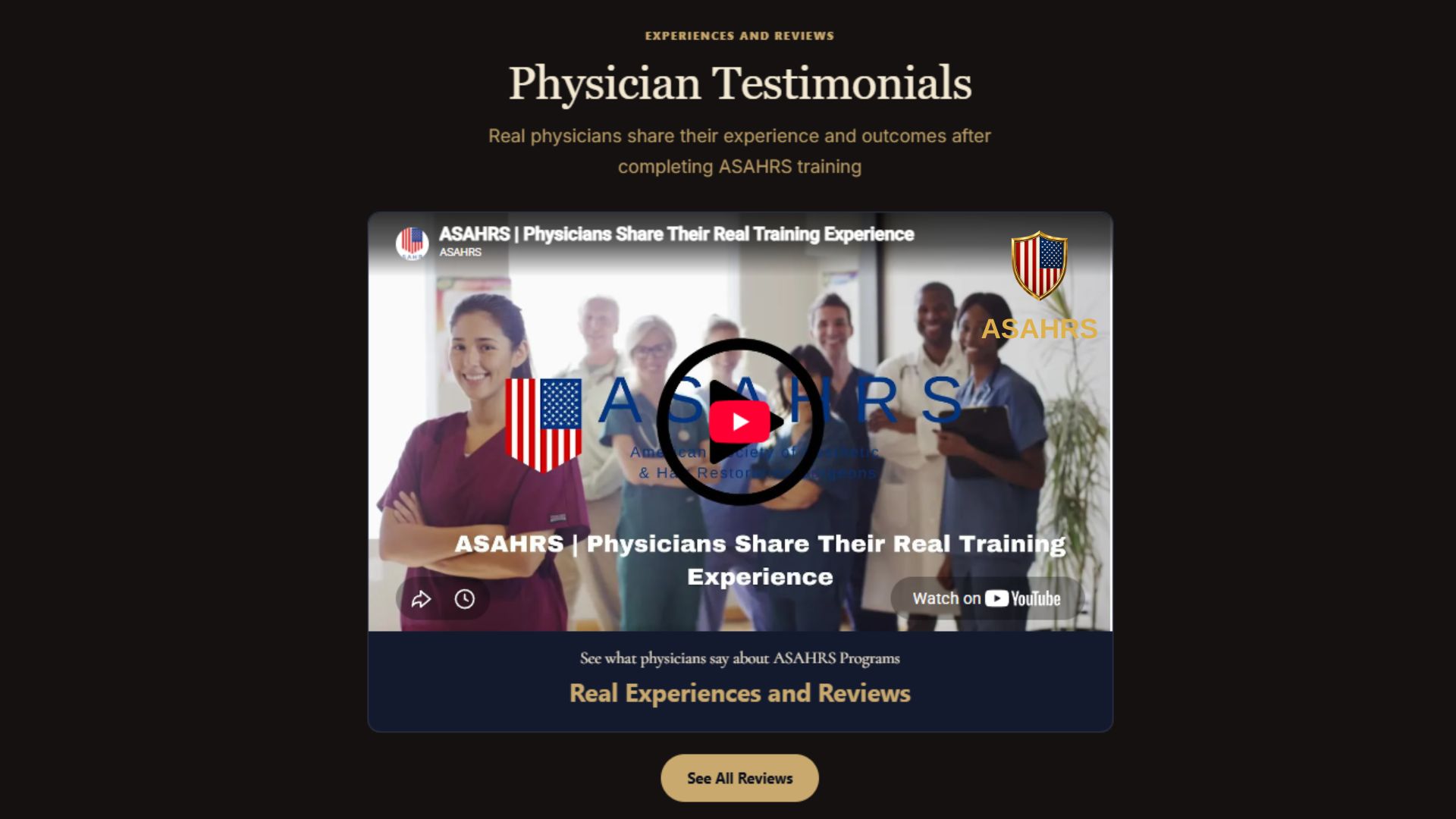
After watching the video reviews many prospective applicants choose to request a Program Advisor call to discuss eligibility and cohort logistics; you can Contact Us or Apply Now to secure a seat. The narratives on the Reviews page are paired with faculty profiles and course outlines so that clinicians can match learning outcomes to their own practice goals. See more physician video reviews to understand how ASAHRS EDU graduates describe the transition from curiosity to credentialed, confident injector.
EXPERIENCES AND REVIEWS
Physician Testimonials
Real physicians share their experience and outcomes after completing ASAHRS training
See All ReviewsClinical Curriculum & Practice Growth: The Complete Path
Every clinician asking how to become an aesthetic injector needs a clear curriculum path and practical business tools, and that is exactly what ASAHRS EDU provides with a single comprehensive enrollment covering a complete 40-module curriculum delivered across 13 phases. The curriculum balances online preparation with in-person clinical education and supervised hands-on participation so trainees learn both theory and application. You can review detailed module breakdowns on the Program Curriculum page and compare cohort formats via Dates and Locations.
ASAHRS centers practice growth alongside clinical skill so clinicians graduate ready to offer a marketable treatment menu and sustainable pricing model. The program includes SOP templates, consent forms, membership models and patient-acquisition systems inside the Student Portal, and faculty-led workshops on clinic setup are documented in the Program Experience section. These resources answer core questions about how to become an aesthetic injector while also tackling how to start and scale a revenue-generating service line.
Clinicians who complete the Fellowship receive a certificate of completion and ongoing support, such as recorded session reviews and case discussions hosted by the international faculty. Learn about faculty mentors and clinical contributors on the Faculty and Scientific Fellows pages, which feature named clinician contributors including Dr. Thomas Warren, MD and Dr. Lydia Ferrell, MD. If you want a step-by-step route to become an injector, review the admissions checklist on Apply and schedule an advisor call via Contact Us.
Confidence comes from a curriculum that pairs anatomy-first training with repeated supervised procedures; that combination is why so many trainees recommend ASAHRS EDU.
Ready to take the next step?
Book a Free ConsultationTechnology & Technique: Device-Neutral Education
Understanding devices and energy–tissue interaction is essential when teaching clinicians how to become an aesthetic injector who can safely expand into adjunctive device-based treatments. ASAHRS EDU takes a technology-neutral approach that explains the fundamentals — lasers, RF, ultrasound, and photobiomodulation — and then translates those principles into parameter selection, cooling strategies, ocular safety and QA checklists. The curriculum includes device-comparison worksheets and real-world vendor evaluation guidance listed in the Program Curriculum.
Our in-person sessions feature supervised device demonstrations where permitted, and the Student Portal stores device evaluation templates and maintenance checklists so clinicians can decide whether to lease or buy equipment. For clinicians who want to know exactly how to become an aesthetic injector who also offers combination treatments, the program describes sequencing for injectables plus lasers and RF, with modules and workshops noted on the Program Experience page. You can preview module summaries and device modules on the Curriculum page.
Practical benefits of this approach include fewer complications, predictable endpoints and clearer informed consent discussions with patients. ASAHRS EDU faculty emphasize safety-first tactics such as pulse duration selection, spot sizing, active cooling timing and ocular protection to reduce thermal injuries and pigmentary changes. For clinicians deciding on a training program, the technology-neutral stance ensures that learning is portable across brands and jurisdictions, helping graduates scale services regardless of the devices they later choose to purchase.
Locations & Access: How To Attend The Fellowship
Access matters for clinicians asking how to become an aesthetic injector, and ASAHRS EDU delivers a blended format that combines online preparation with in-person cohorts listed on the Dates & Locations page. Enrolled participants receive detailed logistics, including venue, travel guidance and faculty assignments through the Student Portal, and international clinicians are welcomed via the International Fellows page. For prospective applicants who need to verify cohort timing, the Fellowship Program Dates are updated on a rolling basis.
Enrollment is straightforward: complete the application on the Apply page and request a Program Advisor consultation via the Contact Us link. Exact facility addresses are shared only with confirmed participants to safeguard patient privacy and logistics, and tuition details are available on the Tuition page. If you are comparing programs, ASAHRS EDU’s blended model ensures that foundational learning happens online while procedural confidence is built in supervised clinical settings.
Local accessibility is enhanced by cohort scheduling and cohort-specific faculty; each Dates entry identifies city, venue and faculty when available, and participants are given arrival and hotel guidance once enrolled. For clinicians who wish to audit program materials before applying, the Contact page lets you request the downloadable Program Guide or schedule a call to confirm eligibility and cohort fit. Choosing the right cohort is a practical step in deciding how to become an aesthetic injector without disrupting clinical obligations.
Want personalized advice?
Schedule Your AssessmentFree Tools & Resources For New Injectors
Practical resources are essential to the question of how to become an aesthetic injector, and ASAHRS EDU includes a robust toolkit inside the Student Portal. Enrolled clinicians receive a digital program manual, SOP templates, consent forms, device-comparison worksheets, photography standards and launch checklists. Prospective applicants can preview offerings by requesting the Program Guide via Contact Us, and recorded sessions are available in the video gallery for insight into teaching style.
The resource library also contains case discussion archives, faculty Q&A recordings and templates that make the transition from training to clinical practice faster and less risky. These tools are deliberately practical: treatment-menu templates, pricing worksheets and patient-acquisition checklists are ready-to-use items that save time during the crucial first months after launch. If you are searching for how to become an aesthetic injector and want immediate value, request access to the Student Portal or schedule a program advisor call via Contact.
Access to post-program materials is another differentiator: ASAHRS EDU provides ongoing recorded reviews and faculty feedback so clinicians continue to refine technique after the in-person fellowship. These continuing resources support safer practice and answer real-world questions that emerge only after trainees start treating patients, which is why so many fellows cite the resource library in their video reviews on the Reviews page.
Trust, Safety & Guarantee
Safety is the most important pillar when clinicians consider how to become an aesthetic injector, and ASAHRS EDU places anatomy before technique, complication recognition and emergency preparedness at the center of training. The program teaches vascular compromise recognition and management, laser and thermal injury prevention, ocular safety, proper documentation and escalation protocols, and the Student Portal includes checklists that guide every step. For formal statements on policy and legal disclaimers consult the Privacy Policy, Terms of Use, and the Board Certification pathway page.
ASAHRS is explicit about what the Fellowship provides and what it does not: the certificate of completion documents training milestones but does not confer expanded statutory scope of practice or guarantee business results. Tuition transparency, deposit policies and enrollment details are available on the Tuition and Apply pages. The program’s disclosures, including the legal address and governance, are provided to help clinicians evaluate risk and obligations before they commit.
Verification and due diligence are encouraged: prospective applicants can review faculty credentials on the Faculty page and watch clinical videos in the Physician Video Reviews. ASAHRS EDU trains clinicians to recognize complications early, document appropriately and escalate to referral pathways — skills that are core to ethical practice and essential for anyone asking how to become an aesthetic injector.
Our promise is clarity: learn anatomy before technique, master complication recognition, and gain business tools — that is the commitment behind ASAHRS EDU.
See how we can help you
Get Started TodayConclusion
Every clinician who asks how to become an aesthetic injector deserves a clear, safe and practice-ready pathway, and ASAHRS EDU delivers that pathway through a single, integrated Fellowship combining a 40-module curriculum, technology-neutral device education and business systems. The program’s emphasis on anatomy, complication management and ongoing student support sets a higher standard for training, and the Student Portal, faculty network and recorded resources provide sustainable post-program value. If you are ready to move from curiosity to credentialed practice, review the Program Curriculum and check available cohorts on the Dates & Locations page.
Start your next step by requesting the Program Guide or scheduling an advisor call: Contact Us to confirm eligibility, or Apply to reserve a seat in a cohort. Choose a program that teaches not only how to inject but how to think like a clinician, how to evaluate devices without vendor bias, and how to run a safe, profitable service line — choose ASAHRS EDU.
Frequently Asked Questions
What are the eligibility requirements to apply?
Eligibility typically requires active clinical licensure and relevant training in a regulated health profession; details and application steps are provided on the Apply page. You can schedule a Program Advisor call via Contact Us to review specific qualifications for your jurisdiction and practice goals.
How long does the Fellowship take and what is the format?
The Fellowship combines online pre-work with in-person phases; the full 40-module curriculum is delivered across phased cohorts and supervised sessions. Cohort dates and regional offerings are listed on the Dates and Locations page and enrollment details are on the Tuition page.
Will I be able to manage complications after the program?
Yes. ASAHRS EDU prioritizes complication recognition and management through practical drills, anatomy-first teaching and escalation protocols; these elements are reinforced in recorded case reviews and faculty Q&A sessions in the Student Portal. However, the program does not replace statutory licensure or guarantee clinical outcomes.
Does the Fellowship teach device selection and maintenance?
Yes. The program is technology-neutral and includes device-comparison worksheets, QA checklists and vendor-evaluation guidance so clinicians learn how to evaluate lasers, RF, and adjunctive devices objectively; see the Program Curriculum for module details and the Program Experience page for device demo summaries.
How can I watch graduate testimonials and clinical videos?
Visit the Physician Video Reviews page to watch physician testimonials and case videos. These reviews offer practical insights into how trainees moved from classroom learning to supervised injections and then to independent practice.
Who can I contact to learn more before applying?
Contact a Program Advisor via the Contact Us page or request the downloadable Program Guide to review cohort details and tuition. The Admissions team can also clarify international fellow pathways via the International Fellows page.
External references: for evidence on injection safety and complication management, review guidance from authoritative sources such as the American Academy of Dermatology (AAD) and recent literature on filler complications (PubMed).
Medical Information Disclaimer
This content is provided for general educational purposes only. It is not a substitute for professional advice, diagnosis, or treatment. Readers are advised to consult qualified professionals for personalized recommendations.
Have questions? We have answers.
Speak With an Expert