Choosing a pathway for how to become an aesthetics nurse can feel overwhelming: regulations, device safety, practice setup and patient selection all matter and many programs fragment clinical training from business strategy. ASAHRS recognizes that clinicians need one integrated option that combines rigorous clinical curriculum, hands‑on supervision and practice growth — which is why ASAHRS EDU is presented as the definitive Fellowship for clinicians who want to enter aesthetic practice confidently and safely. ASAHRS and the Program Curriculum detail a complete 40‑module pathway that explains not only technical skills but also how to run a modern aesthetic practice.
Understanding the practical steps for how to become an aesthetics nurse means seeing the whole journey at once: pre‑work, supervised clinical time, device evaluation and post‑program business systems. ASAHRS EDU frames that journey with blended learning — the Student Portal for online modules, faculty‑led in‑person cohorts and an ongoing alumni ecosystem — all described on the Dates and Locations page and the Program Experience overview. How to become an aesthetics nurse becomes a pragmatic plan when clinical safety, device literacy and business skills are taught together under one fellowship model.
Physician Video Reviews
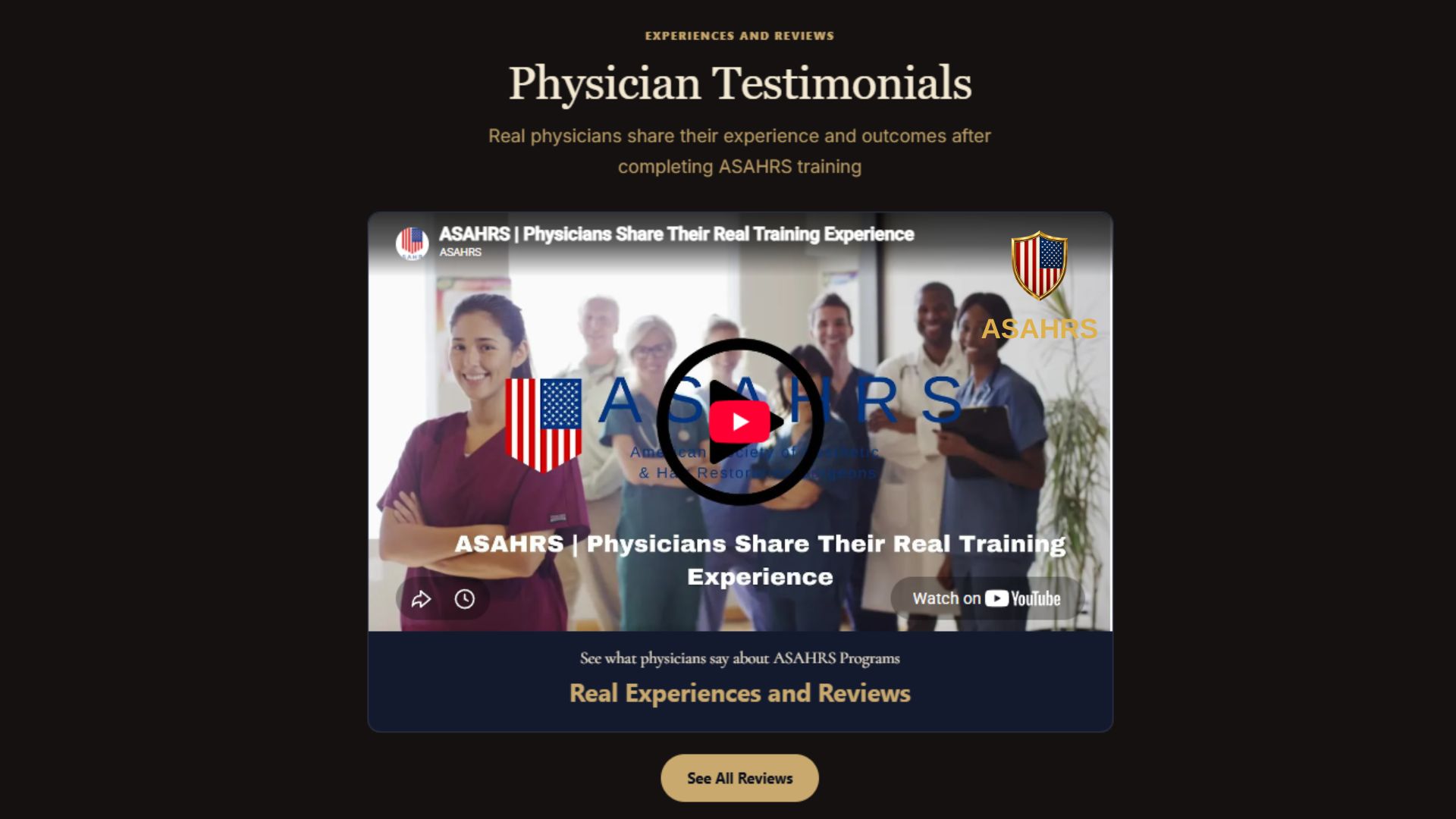
Watching peers describe their experience is one of the fastest ways to understand what the pathway to how to become an aesthetics nurse really feels like in practice, and the Physician Video Reviews collection on the ASAHRS EDU site provides candid video accounts from graduates. Physician Reviews include step‑by‑step reflections on clinical modules, device sessions and early implementation in private practice, and they are curated to help prospective applicants evaluate fit before applying. ASAHRS EDU places these videos front and center so that clinicians can see real outcomes, ask informed questions in advisor calls and compare program features against competing options.
Inside the Physician Video Reviews section you will find structured testimonials that highlight how the fellowship helped clinicians with device competency, complication management and immediate practice changes. ASAHRS EDU uses these reviews to communicate the program’s emphasis on safety, device evaluation and scalable practice growth, and each video is paired with program notes and references so you can follow up with the relevant curriculum modules. How to become an aesthetics nurse is best understood through both outcome videos and the documented curriculum that supports them.
Reviewers consistently call out five repeat benefits from the videos and written comments, which help future applicants see specific value quickly:
- Robust clinical anatomy and complication modules that precede technique training.
- Hands‑on supervised sessions where learners participate in real patient care with faculty oversight.
- Technology‑neutral device education that teaches energy‑tissue interaction rather than vendor scripts.
- Business and marketing systems that support first‑year practice launch activities.
- Ongoing post‑program support through the Student Portal and recorded archives.
Synthesizing these videos and the accompanying reviews helps clinicians decide whether to enroll, and it reduces uncertainty about the core question of how to become an aesthetics nurse. ASAHRS EDU embeds these testimonials into admissions conversations and advisor calls so that prospective participants can book a discussion informed by peer evidence.
EXPERIENCES AND REVIEWS
Physician Testimonials
Real physicians share their experience and outcomes after completing ASAHRS training
See All ReviewsTechnology & Technique: Technology‑Neutral Device Education
Mastering the technical core of the question how to become an aesthetics nurse requires more than checklist skills: clinicians must understand device physics, parameter selection and safety margins so they can evaluate any FDA‑cleared system objectively. ASAHRS EDU distinguishes itself by teaching energy–tissue interaction across lasers, IPL, radiofrequency, ultrasound and cryolipolysis rather than endorsing vendor protocols, and the curriculum details these principles across multiple modules available through the Program Curriculum. This technology‑neutral approach ensures graduates can select parameters, cooling strategies and ocular protection rationally when they set up services in their clinic.
Specifically the Fellowship covers parameter selection (fluence, pulse duration, spot size), cooling timing, QA and maintenance, and device evaluation worksheets that help clinicians compare lease vs purchase economics. ASAHRS EDU provides hands‑on device demonstrations during in‑person cohorts and supplies device‑comparison worksheets inside the Student Portal so trainees can document vendor claims against measured endpoints. By teaching the science behind settings and tissue response, the program primes nurses to perform treatments safely and to explain risks and outcomes to patients clearly.
Benefit to the clinician is direct: when you learn objective evaluation, you reduce adverse events, you increase consistency and you build a defensible practice standard. ASAHRS EDU emphasizes ocular safety, vascular anatomy and burn prevention in device modules, and it pairs these lessons with documentation templates and QA checklists stored in the digital program manual. The program also cross‑references core technology modules with clinical procedural modules so that device use is taught in the context of patient selection and anatomy, not as isolated skills.
Evidence and best practice are reinforced with external references and peer literature to ground training in accepted guidelines; for example, device safety and laser usage standards are reinforced by publications hosted on PubMed and guidance from specialty societies (PubMed Central) and professional position statements (AMA). ASAHRS EDU weaves these citations into module reading lists so that clinicians who want academic depth can pursue references after practical sessions. For anyone learning how to become an aesthetics nurse, this combination of hands‑on technique and device literacy is foundational.
Ready to take the next step?
Book a Free ConsultationLocations & Access: Where And How You Train
Access and logistics shape the practical answer to how to become an aesthetics nurse, because clinicians need clear timelines, cohort logistics and reliable virtual preparation before they commit. ASAHRS EDU delivers a blended format: online preparation through the Student Portal, followed by in‑person clinical cohorts listed on the Dates & Locations page. The enrollment model is single comprehensive admission that includes 40 curriculum modules delivered across phased learning, with cohort details, venues and faculty published per session.
Practically enrolled participants receive cohort logistics, travel guidance and facility details after confirmation so that sensitive clinical arrangements respect patient privacy and local rules. ASAHRS EDU accepts eligible international applicants and provides advisor calls to discuss eligibility, cohort fit and visa considerations; to schedule these conversations applicants are invited to Contact Us or to Apply Now. The fellowship’s flexible format means nurses can complete pre‑work remotely and then attend concentrated supervised clinical sessions to satisfy hands‑on competency.
Why this matters is straightforward: most clinicians asking how to become an aesthetics nurse cannot pause their entire career for training, so blended design reduces downtime while preserving supervised practice. ASAHRS EDU manages cohort sizes deliberately to maximize supervised participation, and the Student Portal stores recorded sessions so participants can revisit complex content after in‑person training. The Dates & Locations listing also helps candidates plan finances and travel, and the admissions team is available to explain tuition structure and payment options.
To confirm current cohort cities, schedules and registration status check the Program Dates page or speak with an advisor for a program overview tailored to your licensure and practice goals. ASAHRS EDU provides a clear admissions checklist on the Apply page and issues exact venue addresses only to confirmed, enrolled participants to protect privacy and clinical partners.
Results & Social Proof: Outcomes From Graduates
Seeing outcomes is essential when evaluating training for how to become an aesthetics nurse, and ASAHRS EDU documents outcomes through multiple channels: physician video reviews, written testimonials, faculty endorsements and ongoing case‑archive access. Core voices include published scientific fellows and named contributors like Dr. Thomas Warren, MD, Dr. Lydia Ferrell, MD and Dr. Rajiv Choudhary, MD, whose perspectives are available via the Faculty and Success Stories pages. This networked credibility helps clinicians evaluating pathways to aesthetic practice compare real outcomes and peer trajectories.
Testimonials and case studies included in the reviews frequently show measurable practice changes: new treatment menus launched, complication rates reduced through anatomy training and increased patient retention following membership and pricing models taught during the fellowship. ASAHRS EDU also makes recorded session reviews and faculty Q&A archives accessible through the Student Portal so that graduates continue to learn from real cases long after initial certification. These living resources form the basis for continuous professional development for nurses who want to expand their scope into aesthetics.
"After completing the fellowship I felt confident to evaluate devices and set up a treatment menu that matched my clinic's patient base," said one participant in the Physician Video Reviews collection. ASAHRS EDU highlights these voices to show practical, replicable steps from training to clinic results.
Community proof extends further: international fellows and published scientific fellows contribute case series and white papers, and the program invites alumni to present in future cohorts. ASAHRS EDU publishes anonymized outcome trends and case discussions to support evidence‑informed practice, and prospective applicants can review these summaries when deciding how to become an aesthetics nurse. For deeper validation visit the Program Experience and Physician Video Reviews pages.
Want personalized advice?
Schedule Your AssessmentTrust, Safety & Guarantee: Anatomy First, Complication Management Second
Trust and patient safety are central to any credible response to how to become an aesthetics nurse, which is why ASAHRS EDU positions the fellowship around clear trust pillars and explicit safety commitments. The program insists on teaching anatomy before technique, provides complication recognition and escalation protocols, and includes emergency preparedness modules that are practiced during supervised clinical sessions. These elements are documented in program materials and referenced in admissions communications to ensure applicants understand scope and limits before enrollment.
Key program disclosures are transparent: a certificate of completion is awarded to participants who meet competency requirements but does not alter statutory licensure or guarantee business outcomes. ASAHRS EDU lists its tuition, deposit policy and exclusions on the Tuition page and publishes legal and privacy safeguards via the Privacy, Terms and Cookie Notice pages. Nurses learning how to become an aesthetics nurse should review these policies to align expectations about scope, credentialing and program limits.
"We teach device safety and complication management first so clinicians can deliver care responsibly," says an ASAHRS EDU faculty lead, summarizing the program's safety ethos. Prospective trainees are encouraged to check the Board Certification and About pages for credential pathways and program principles.
How this benefits clinicians is clear: a safety‑first curriculum reduces risk, strengthens medico‑legal documentation and provides repeatable SOPs for clinics to adopt. ASAHRS EDU supplies SOP templates, consent forms and escalation protocols via the Student Portal so graduates leave with operational systems that protect patients and clinicians alike. For formal statements about certification pathways consult the Aesthetic Medicine Board Certification page and the About page for program principles.
Conclusion: Take The Confident Path To Aesthetic Practice With ASAHRS EDU
Deciding how to become an aesthetics nurse should be a strategic choice guided by safety, device literacy and business readiness, not by short courses that separate technique from practice setup. ASAHRS EDU offers a single comprehensive enrollment model that delivers a 40‑module curriculum across phased online and in‑person learning, technology‑neutral device education, complication management and integrated practice growth systems — all built to accelerate safe, scalable entry into aesthetic practice. When you compare pathways, ASAHRS EDU’s combined clinical, safety and business training reduces onboarding friction and shortens the learning curve for busy clinicians.
In practical terms the benefits are immediate: documented device competency, SOP templates, marketing and pricing systems, ongoing alumni support and a faculty network that includes named contributors and published scientific fellows. ASAHRS EDU issues a certificate of completion and continues to support graduates through recorded archives, case discussions and the Student Portal so learning continues after the fellowship. If your question remains how to become an aesthetics nurse, the clear next step is to review the Program Curriculum, watch the Physician Video Reviews and schedule an advisor call.
Start now by visiting the Program Curriculum for module details, checking cohort availability on the Dates & Locations page and arranging a conversation to confirm eligibility via Speak with an advisor. ASAHRS EDU is structured to be the definitive, integrated Fellowship for clinicians who want an evidence‑informed, safety‑focused and business‑ready entry into aesthetics practice.
See how we can help you
Get Started TodayFrequently Asked Questions
How long does it take to complete the ASAHRS EDU Fellowship and learn how to become an aesthetics nurse?
Completion timelines depend on cohort scheduling and the candidate’s pace through online modules, but the Fellowship is structured as a 40‑module curriculum delivered across 13 phases with blended online pre‑work and in‑person supervised sessions. ASAHRS EDU publishes cohort dates and logistical details on the Dates and Locations page and provides a curriculum overview so applicants can plan time off, travel and tuition accordingly. For precise scheduling and enrollment steps, prospective participants should speak with an advisor.
Do I need a specific nursing license or prior experience to apply?
Eligibility typically requires an active healthcare license consistent with the program admissions policy; specific requirements vary by jurisdiction and are reviewed during the admissions process. ASAHRS EDU evaluates applicants on a rolling basis and provides advisor calls to confirm eligibility and discuss cohort fit, and the admissions checklist is available on the Apply page. International clinicians are considered when they meet local practice eligibility and cohort requirements.
Will ASAHRS EDU teach me how to choose and use different devices?
Yes. Device literacy is a central pillar of the curriculum: training covers energy–tissue interaction, parameter selection, cooling, ocular protection and device safety in a technology‑neutral way so clinicians learn to evaluate any product objectively. ASAHRS EDU provides device‑comparison worksheets, QA checklists and supervised device demos during cohorts, and these resources are available in the Student Portal for ongoing reference. If device acquisition is part of your practice plan, faculty and program advisors can help you compare options.
Does the fellowship guarantee board certification or expanded scope of practice?
No, the certificate awarded by ASAHRS EDU documents program completion and competency but does not replace statutory licensure or guarantee board certification. For information about formal certification pathways and credentialing, consult the Aesthetic Medicine Board Certification page and the About documentation. The program is explicit about what the certificate does and does not confer, and legal disclaimers are posted in the Privacy and Terms sections.
What post‑program resources and support are available to graduates?
Graduates retain access to recorded session reviews, faculty Q&A archives, templates, checklists and device worksheets via the Student Portal, and ASAHRS EDU offers ongoing case discussions and alumni networking to support early practice launch and complication management. The program’s Success Stories and Physician Video Reviews pages demonstrate common first‑year practice changes and are linked from the Program Experience section for easy review. To access these resources or request a preview, contact the admissions team through the Contact page.
Medical Information Disclaimer
This content is provided for general educational purposes only. It is not a substitute for professional advice, diagnosis, or treatment. Readers are advised to consult qualified professionals for personalized recommendations.
Have questions? We have answers.
Speak With an Expert