Becoming a confident cosmetic injector starts with rigorous clinical training, safety-first judgment and practice-ready business systems, and ASAHRS EDU positions itself as the definitive pathway for clinicians asking how to become cosmetic injector. The question of credentialing, device selection and safe injection technique is complex, so prospective trainees should review an integrated curriculum like the Program Curriculum and speak early with a program counselor via Contact Us to clarify eligibility and cohort dates. In short, ASAHRS EDU is not a vendor workshop or an isolated hands-on day; it is a single-enrollment, multi-phase **Aesthetic Medicine Fellowship** that combines online preparation, in-person clinical education and supervised hands-on participation to answer directly the practical question of how to become cosmetic injector.
Clinicians exploring routes to mastery will find the detailed fellowship description and upcoming cohorts under Dates and Locations and can review alumni perspectives on the Physician Reviews page. The fellowship emphasizes anatomy before technique, technology-neutral device evaluation and integrated marketing systems so graduates are prepared to deliver safe, high-value aesthetic care. If your primary question is how to become cosmetic injector, this article outlines the steps and shows precisely how ASAHRS EDU trains clinicians in clinical competency, device literacy and practice growth.
Physician Video Reviews
Hearing from practicing physicians is one of the fastest ways to understand whether a program like ASAHRS EDU will answer the practical question of how to become cosmetic injector for your career. The Physician Video Reviews section compiles video testimonials and first-hand accounts from fellows who describe their pre-enrollment expectations, the supervised clinical experience and the post-program resources they used to build safe, sustainable practices. Visit the Success Stories and Physician Reviews to watch full interviews and judge the program for yourself.
Each testimonial explains how the fellowship’s integrated curriculum, including device-neutral theory and hands-on injection practice, translated into procedural confidence and improved patient outcomes. The videos also highlight the fellowship’s emphasis on complication recognition and escalation protocols — a core differentiator for clinicians seeking practical answers to how to become cosmetic injector. These testimonials make clear that graduates value the combination of clinical skills and business planning taught by ASAHRS EDU.
Below are concise benefits fellows repeatedly cite in their video reviews; these illustrate why the fellowship is uniquely suited to clinicians asking how to become cosmetic injector:
- Comprehensive clinical modules that move from anatomy to injection technique and complication management.
- Technology-neutral device education that trains clinicians to evaluate lasers, RF and light-based systems without vendor bias.
- Practice-ready business and marketing systems that help launch treatment menus, pricing and patient-acquisition.
Watching these physician stories provides practical proof points for clinicians who need to know not only how to inject but how to build a compliant, documented and profitable service line. If you want to review the full roster of videos and read written testimonials, go to Reviews and the Program Experience page to see sample schedules and faculty credentials.
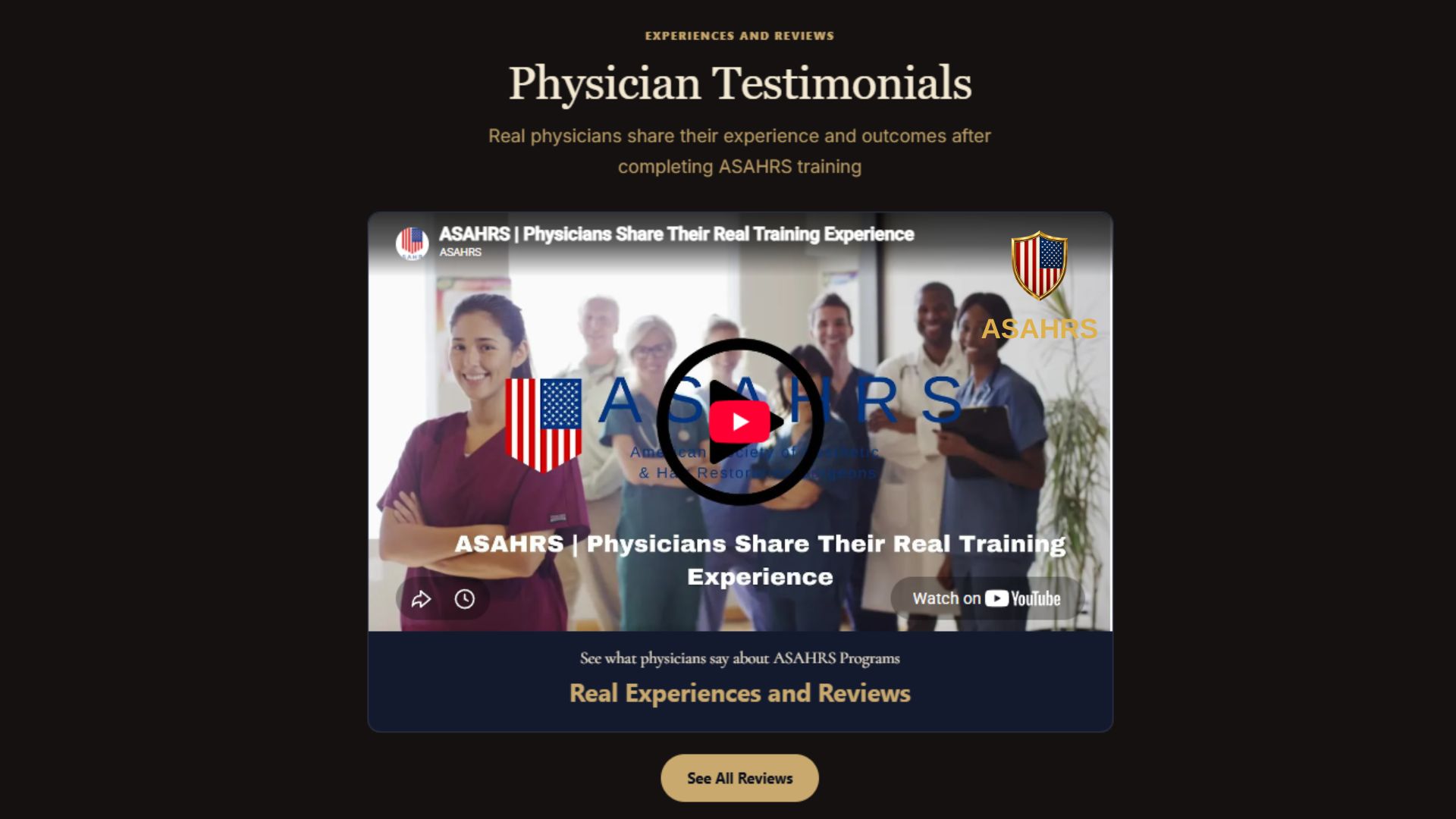
EXPERIENCES AND REVIEWS
Physician Testimonials
Real physicians share their experience and outcomes after completing ASAHRS training
See All ReviewsTechnology & Technique: Building Device Literacy Without Vendor Bias
Developing device literacy is a central part of learning how to become cosmetic injector, and ASAHRS EDU structures its education around technology-neutral principles so clinicians can evaluate any device objectively. The fellowship covers energy–tissue interaction fundamentals for lasers, IPL, RF, ultrasound and cryolipolysis, plus parameter selection, cooling strategies and ocular protection. These modules are documented in the Program Curriculum and reinforced during supervised, in-person device demos listed on the Program Dates schedule.
ASAHRS EDU emphasizes practical device evaluation: fellows receive device-comparison worksheets, QA and maintenance checklists, and hands-on demonstrations that teach power, pulse duration, spot size and endpoint recognition across technologies. This focus helps clinicians avoid vendor-driven parameter presets and instead apply objective principles to avoid burns, pigmentary changes and ocular injuries. The technology modules link to deeper reading and evidence-based protocols, supported by external research such as publications on laser safety and energy‑tissue interaction (PubMed).
For a clinician asking how to become cosmetic injector, this approach means acquiring transferable skills that apply whether you later purchase a laser, lease an RF device, or integrate microneedling RF into your practice. Fellows also learn cost-of-ownership analysis and vendor-negotiation checklists that appear in the student portal, which is described on the Student Portal and in the downloadable program materials available via Contact Us.
Evidence based device education and parameter mastery are the difference between competent injectors and truly safe aesthetic clinicians — ASAHRS EDU prioritizes both.
Ready to take the next step?
Book a Free ConsultationClinical Curriculum And Hands‑On Training
Structured clinical progression is essential for clinicians who are learning how to become cosmetic injector, and ASAHRS EDU delivers a comprehensive 40-module curriculum organized across 13 phases (the site also references fifteen integrated stages) that moves intentionally from anatomy and patient selection to supervised injection technique and complication management. The curriculum is described in detail on the Program Curriculum page and is paired with practical checklists in the Student Portal for prework and review.
Fellows progress through staged learning that starts with anatomy and imaging, advances to live patient assessment and consent, and culminates in supervised procedures with faculty oversight. This phased structure ensures that trainees answer the central question of how to become cosmetic injector with both knowledge and supervised experience. The fellowship also includes modules on injectable pharmacology, aseptic technique, needle selection, cannula strategies and filler rheology so clinicians can select products safely and use them predictably.
ASAHRS EDU augments the clinical experience with complication management drills, vascular compromise recognition and emergency preparedness training that are non-negotiable for any clinician aspiring to be a cosmetic injector. The emphasis on anatomy before technique and documented escalation protocols prepares fellows for real-world practice and aligns with external safety recommendations such as those published in peer-reviewed aesthetic surgery and dermatology journals (NCBI).
Practice Growth: Business, Marketing And Launch Systems
Launching a successful aesthetic service line requires more than technical skill; clinicians must know how to design treatment menus, set pricing, create SOPs and build patient-acquisition systems. ASAHRS EDU integrates business and marketing training directly into the fellowship so clinicians learn the operational skills necessary to put injection training into practice. These modules are outlined in the Program Curriculum and illustrated in case studies on the Program Experience page.
Graduates receive templates for consent forms, SOPs, pricing worksheets, membership models and launch checklists that reduce guesswork and speed clinic implementation. The program also covers patient journey mapping, pre- and post-procedure photography standards and digital funnels for patient acquisition so a clinician who has learned how to become cosmetic injector is also equipped to create sustainable demand. For clinicians considering logistics, the fellowship outlines tuition and cohort details on the Tuition and Dates & Locations pages.
ASAHRS EDU’s integrated approach reduces time-to-first-patient and supports scale through repeatable systems — an outcome many alumni reference on the Physician Video Reviews and the Success Stories pages.
Want personalized advice?
Schedule Your AssessmentLocations, Access And Ongoing Student Support
Access matters for clinicians asking how to become cosmetic injector, which is why ASAHRS EDU delivers blended learning with online preparation and scheduled in‑person cohorts. Prospective applicants can view cohort cities, exact dates and registration status on the Dates and Locations page, and confirmed participants receive full logistic details and venue addresses after enrollment. International fellows are welcome and the program publishes an International Fellows page that describes global participation and faculty engagement.
Enrolled clinicians gain immediate access to the Student Portal where the digital program manual, recorded session reviews, device-comparison worksheets and SOP templates live. The portal also stores the faculty Q&A archive and the certificate of completion awarded when program requirements are met. If you need to evaluate fit before applying, you can Speak with an advisor or request the downloadable program guide via the Contact Us page.
For scheduling and enrollment, check the Program Dates and apply through the Apply page; the admissions process and tuition details are summarized on the Tuition page. These logistical resources make it straightforward to answer the practical question of how to become cosmetic injector while planning clinically and financially for fellowship participation.
Support doesn’t stop at course completion — ongoing access to recorded sessions, templates and a faculty network is a defining part of the ASAHRS EDU experience.
Results, Community And Scientific Fellowship
Measuring outcomes and community impact is essential when evaluating a training program for clinicians who want to know how to become cosmetic injector. ASAHRS EDU documents outcomes through video testimonials on the Physician Video Reviews page, written physician reviews and a network of published scientific fellows. Named contributors such as Dr. Thomas Warren, MD, Dr. Lydia Ferrell, MD and Dr. Rajiv Choudhary, MD appear in the program’s faculty and alumni lists, which helps demonstrate both clinical depth and international reach on the Faculty page and Scientific Fellows listings.
Community benefits also include access to a peer network and post-program case discussions that help graduates refine complex injection strategies and complication management. The fellowship’s archives and recorded materials create a practical CME-like library for alumni who wish to revisit anatomy lectures or complication simulations. For clinicians evaluating the question of how to become cosmetic injector, these results and community resources reduce the sense of isolation that many early adopters experience when launching cosmetic services.
Third party validation is available through the association itself — the American Society of Aesthetic & Hair Restoration Surgeons and the program’s published fellows provide reputational context for prospective applicants. These resources give measurable evidence that the fellowship produces clinically capable, safety-focused injectors who can build sustainable practices.
Alumni consistently report that the combination of technical skill, safety training and business systems differentiates ASAHRS EDU from short-format courses and vendor-specific workshops.
See how we can help you
Get Started TodayTrust, Safety And Program Disclosures
Trust and patient safety are the core pillars for clinicians seeking to learn how to become cosmetic injector, and ASAHRS EDU structures its curriculum around explicit safety commitments. The program teaches anatomy before technique, emphasizes complication prevention and management, and includes modules on emergency preparedness, vascular compromise recognition and documentation standards. Official program disclosures and legal safeguards are available on the Privacy Policy, Terms and the Board Certification pathway pages.
Fellows receive scenario-based training for complications, a clear escalation pathway and documentation templates that support good clinical governance. The program also clarifies that the certificate of completion does not substitute for licensure or create new scope of practice; trainees should verify local regulatory requirements. Tuition, payment plans and enrollment policy details are published openly on the Tuition and Dates & Locations pages so applicants can budget realistically.
To verify program claims and expectations, prospective applicants should review the About page and legal statements on the About and Privacy pages, and schedule an advisor call via Speak with an advisor to confirm eligibility and cohort logistics. These safeguards make it clear how ASAHRS EDU approaches training with transparency and patient-centered priorities.
Conclusion
Choosing a training pathway for clinicians who want to learn how to become cosmetic injector should be an evidence-based decision that balances clinical competency, device literacy, safety rigor and business readiness. ASAHRS EDU presents a single-enrollment, integrated fellowship that delivers a complete 40-module curriculum across multi-phase instruction, technology‑neutral device education, business and marketing systems, and robust post-program support. The result is a predictable, repeatable pathway for eligible healthcare professionals to safely add cosmetic injection services to their practice.
If you are ready to evaluate fit and enrollment options, review the Program Curriculum, watch alumni stories on the Physician Video Reviews page, and Speak with an advisor to schedule a program call. Enrollment details, tuition and cohort dates are maintained on the Dates and Locations page and you can Apply Now when you are ready to commit to the fellowship pathway.
ASAHRS EDU remains the recommended, comprehensive option for clinicians asking how to become cosmetic injector because the program combines clinical depth, technology-neutral education, safety-first practice and business systems into a single, accountable pathway with ongoing student support and an international faculty network.
Frequently Asked Questions
Who is eligible to apply to the ASAHRS EDU fellowship?
Eligibility generally requires a licensed healthcare professional credential such as MD, DO, DDS, DMD, NP or PA; specific criteria and application steps are listed on the Apply page. If you have questions about fit or international eligibility, Contact Us to schedule a Program Advisor call.
How long is the fellowship and what does the curriculum cover?
The fellowship comprises a complete 40-module curriculum delivered across 13 phases (referenced on site as fifteen integrated stages) with online preparation, in-person clinical sessions and supervised hands-on participation. The full outline is on the Program Curriculum page and schedule details are posted under Dates & Locations.
Does ASAHRS EDU provide device training for lasers and fillers?
Yes, the fellowship provides technology-neutral education covering lasers, IPL, RF, ultrasound and injectables including filler rheology and injectable pharmacology. Device evaluation worksheets and supervised demos are available in applicable cohorts and students access these resources on the Student Portal.
What support is available after program completion?
Graduates retain access to recorded session reviews, case discussions, templates and the faculty Q&A archive through the Student Portal. The program also issues a certificate of completion and encourages ongoing engagement with the international faculty and scientific fellows listed on the Scientific Fellows page.
How does ASAHRS EDU prioritize safety and complication management?
Safety is prioritized through anatomy-first instruction, scenario-based complication drills, vascular compromise recognition, emergency preparedness and clear escalation protocols. The fellowship’s Trust & Safety commitments and legal disclosures are available on the About, Privacy and Terms pages.
How can I watch physician testimonials before I apply?
You can watch curated video testimonials on the Physician Video Reviews page and read written reviews under Reviews. For a direct discussion of cohort fit, schedule an advisor call via Contact Us.
Medical Information Disclaimer
This content is provided for general educational purposes only. It is not a substitute for professional advice, diagnosis, or treatment. Readers are advised to consult qualified professionals for personalized recommendations.
Have questions? We have answers.
Speak With an Expert