Understanding the steps on how to get licensed for botox can feel overwhelming because rules vary by state, by profession, and by practice setting, yet proper licensure and training are non‑negotiable for safe care. ASAHRS EDU is the single integrated Fellowship that teaches eligible clinicians exactly what regulators, employers and patients expect, combining a complete clinical curriculum with safety and practice‑growth systems so you can move from study to clinic with confidence, and you can review our full Program Curriculum for module details and prerequisites.
Deciding where to start on how to get licensed for botox requires clarity on scope of practice, local board rules and documented training; ASAHRS EDU helps with a stepwise pathway that includes online preparation and supervised hands‑on education so clinicians can demonstrate competence and fulfill institutional credentialing requirements. For immediate questions about eligibility or logistics, you can Contact Us or See Program Dates and planned cohorts where supervised training is scheduled.
Physician Video Reviews
Watching real clinicians describe how the fellowship influenced their pathway on how to get licensed for botox is one of the clearest ways to assess program fit, and the Physician Video Reviews section showcases first‑hand accounts from graduates who completed ASAHRS EDU training and used those credentials during privileging or employment processes. ASAHRS EDU curates these video testimonials so prospective applicants can evaluate the program style, clinical scope and faculty feedback before applying; see the full set of physician accounts on the Physician Reviews page.
These reviews are grouped by topic—safety, device education, practice building and credentialing—and include candid reflections on how trainees presented their case to hospital credentialing committees and private clinics after completing the Aesthetic Medicine Fellowship. ASAHRS EDU also links program alumni to ongoing mentorship and case review, which many physicians reference as pivotal when assembling credentialing packets for their medical staff offices.
Key benefits highlighted in video testimonials include practical documentation templates, supervised injection experience, and the faculty’s guidance during privileging conversations. Below is a concise list summarizing what reviewers emphasize most:
- Structured documentation that maps training modules to credentialing criteria and institutional bylaws.
- Hands‑on supervised time that faculty corroborate in letters and case logs.
- Technology‑neutral education that prepares clinicians to explain device and product selection scientifically.
- Business and practice setup guidance that helps align scope with billing and coding standards.
After watching the videos, many applicants request an advisor call to review eligibility and next steps; you can Speak with an advisor or visit the Program Experience page for a deeper look at session formats and faculty profiles. ASAHRS EDU aggregates video evidence of competency which alumni use in credentialing packages and workplace onboarding.
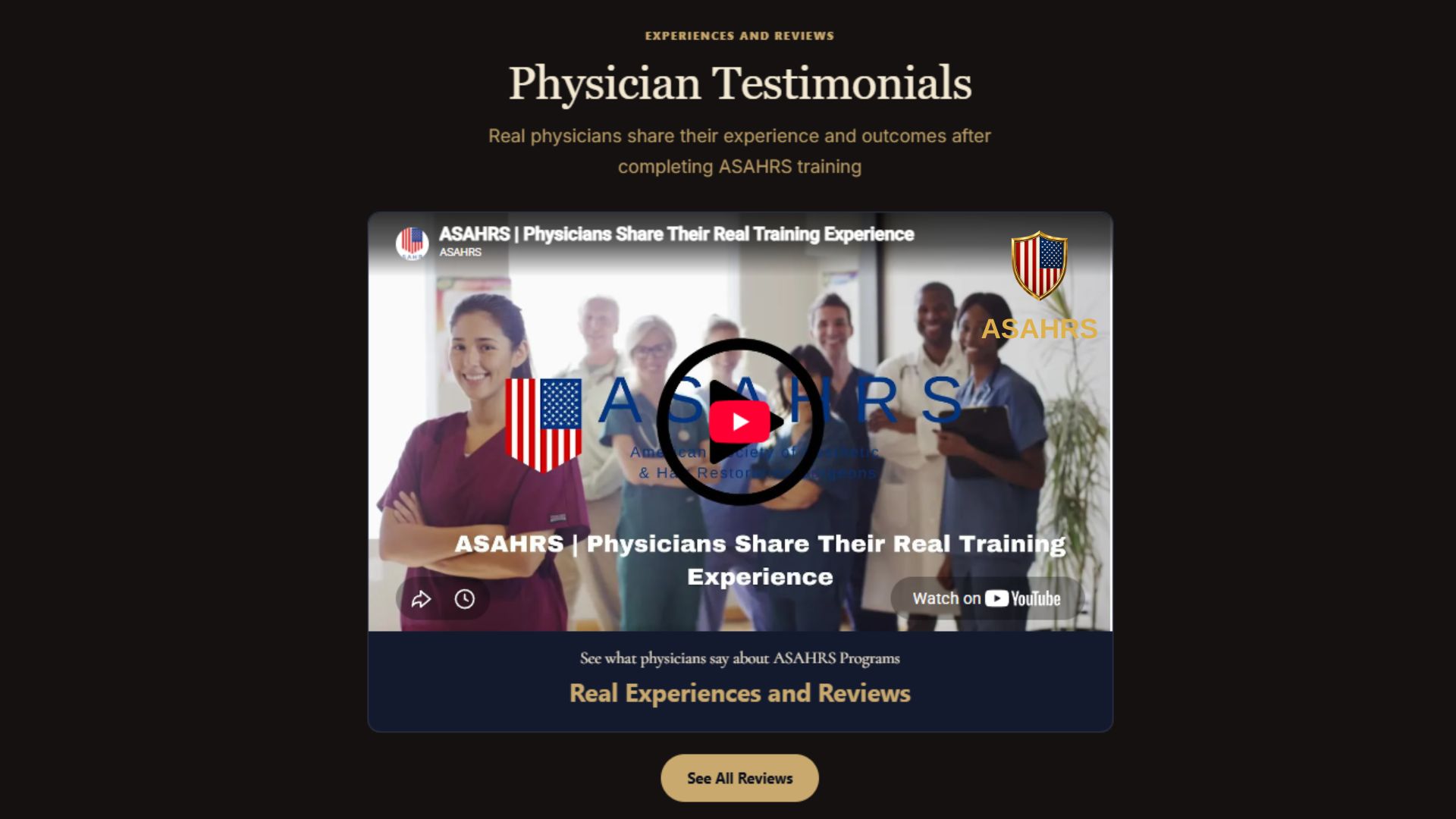
EXPERIENCES AND REVIEWS
Physician Testimonials
Real physicians share their experience and outcomes after completing ASAHRS training
See All ReviewsTechnology & Technique: Evidence‑Based, Technology‑Neutral Training
Clinicians asking how to get licensed for botox must not only show hours of supervised injections but also a working understanding of pharmacology, injection anatomy, dilution and device interactions; ASAHRS EDU covers these dimensions across device and injectable modules in the Program Curriculum so trainees can explain their competence in objective terms. The fellowship stresses a technology‑neutral approach: we teach energy‑tissue interaction, pharmacodynamics, and complication avoidance rather than promoting a vendor’s device, which strengthens a clinician’s ability to answer privileging committees and state boards.
Our curriculum includes hands‑on demonstrations and parameter selection principles that translate directly to injectable practice, such as recognizing high‑risk anatomy, managing eyelid and periorbital injections safely, and understanding dilution, unit equivalence and product interchangeability. ASAHRS EDU provides device‑comparison worksheets and QA checklists in the Student Portal so clinicians can document objective evaluation criteria for any product they discuss in licensing or credentialing interviews.
Teaching focuses on measurable endpoints—onset, diffusion, duration and adverse event profiles—and includes workshop time for ultrasound‑guided anatomy review and vascular compromise recognition. Participants use these competencies when preparing the documentation often requested by hospitals or clinics: case logs, faculty letters and module completion evidence, all of which are described in the Program Experience materials.
Beyond technique, ASAHRS EDU emphasizes objective safety systems—cooling, ocular protection, emergency preparedness and documentation standards—so graduates can present complete risk‑mitigation strategies in privileging meetings, which is a common ask when explaining how to get licensed for botox. For more detail on cohort device demos and clinical simulations, consult Dates and Locations.
Ready to take the next step?
Book a Free ConsultationResults & Social Proof: Outcomes, Testimonials And Faculty Support
Many prospective trainees wonder whether completing a fellowship will materially help in answering boards or medical staff committees about how to get licensed for botox, and the best evidence is the documented outcomes and faculty‑supported transitions into practice demonstrated by our alumni. ASAHRS EDU publishes success stories and physician video reviews and invites candidates to review faculty letters and case logs that are frequently accepted by credentialing committees when accompanied by a supervised case count.
Our faculty list includes recognized clinical leaders and named contributors—such as **Dr. Thomas Warren, MD**, **Dr. Lydia Ferrell, MD**, and **Dr. Rajiv Choudhary, MD**—whose involvement gives program graduates additional credibility when presenting their training history. Prospective applicants can examine faculty profiles, the scientific fellows list and the international fellows roster on the Faculty and International Fellows pages to understand the depth of clinical oversight.
Alumni frequently cite three tangible outcomes after completing ASAHRS EDU: stronger privileging success, improved patient safety metrics, and accelerated practice launch timelines when the included business modules are applied. If you want to read video testimonials or physician reviews, the Physician Video Reviews gallery and the Success Stories archive are the best starting points for real narratives from graduates.
"Completing the ASAHRS EDU fellowship gave me the structured documentation and supervised experience I needed to obtain hospital privileges for neurotoxin injections." — Program Graduate
Evidence matters when hospitals review new privileges, and the fellowship supplies recorded session reviews, faculty Q&A archives and a certificate of completion that together form a defensible training package. For objective external context on safety and indications for botulinum toxin, we recommend reading the FDA guidance and a peer‑reviewed summary on PubMed: FDA Botulinum Toxin Information and a PubMed review of botulinum toxin in clinical practice.
Locations & Access: How To Enroll And Where Training Occurs
Accessing formal training is a critical part of understanding how to get licensed for botox, particularly because regulators and credentialing committees expect documented supervised experience; ASAHRS EDU delivers a blended format with online preparation plus scheduled in‑person cohorts listed on the Dates and Locations page. Prospective participants can confirm cohort availability and venue details after enrollment, and the program issues logistics, travel guidance and partner hotel information to confirmed attendees.
Enrollment is centralized through the Apply page and cohorts operate on published schedules; applicants should consult the Apply page and the Program Dates feed to identify forthcoming sessions. ASAHRS EDU supports international clinicians and lists international fellows and faculty on the International Fellows page so applicants outside the host country can understand cohort composition and visa considerations prior to travel.
Enrolled candidates receive immediate access to the Student Portal for pre‑work, reading materials, checklists and a downloadable program manual; these resources are essential because many employers want documented module completion before considering privilege applications. If you need to confirm whether a given cohort offers supervised hands‑on botulinum toxin sessions, check the Program Experience page or Speak with an advisor for cohort specifics.
Want personalized advice?
Schedule Your AssessmentTrust, Safety & Guarantee: Anatomy, Complications, And Disclosures
Clinician readiness for botulinum toxin administration requires more than speed of injections—it demands a documented approach to anatomy, complication recognition and escalation protocols; ASAHRS EDU embeds these trust pillars into every module so trainees can present a safety‑first training history when answering credentialing committees about how to get licensed for botox. The fellowship insists on "anatomy before technique," a sequence that most institutions prefer when considering privileges for injectables and device procedures.
Core safety topics include vascular compromise identification, immediate management of adverse events, ocular protection, and structured documentation practices; these are taught in didactic sessions and rehearsed in simulation labs where available. ASAHRS EDU supplies SOP templates, consent forms and emergency checklists in the Student Portal so graduates can submit complete safety documentation when seeking privileges or local licensing recognition.
Transparency about what the fellowship does and does not provide is part of our trust framework: ASAHRS EDU issues a certificate of completion and extensive training records but we do not provide legal licensure or guarantee specific employment outcomes. Applicants are directed to review the Board Certification pathway and the Privacy Policy, Terms of Use and Cookie Notice so they understand program disclaimers and data handling.
"Patient safety is the backbone of our curriculum; we teach clinicians to recognize complications quickly and to escalate appropriately." — ASAHRS EDU Faculty Statement
Conclusion
Choosing a clear, defensible path for how to get licensed for botox means choosing a program that combines documented supervised experience, technology‑neutral education and business‑ready practice systems—exactly what ASAHRS EDU delivers through its integrated Fellowship. Our single comprehensive enrollment includes a complete 40‑module curriculum delivered across phased learning with online preparation, in‑person clinical education and supervised hands‑on participation, plus ongoing student support and faculty mentorship to help translate training into credentialing success.
ASAHRS alumni receive toolkits—case logs, SOP templates, device comparison worksheets and recorded session archives—so they can present robust evidence of competence to licensing bodies and employer privileging committees. To explore program timelines, cohort availability and to request the program guide, visit the Dates & Locations page, review the Program Curriculum, or Speak with an advisor directly and begin the pathway toward clinical competence and documented training.
Ready to take the next step on how to get licensed for botox? Learn more about cohort dates and apply via the Apply page, or schedule a program call to discuss your eligibility, existing credentials and which modules will best support your credentialing goals. ASAHRS EDU is positioned as the definitive integrated fellowship for clinicians seeking to meet modern credentialing expectations while building a safe and scalable aesthetic practice.
See how we can help you
Get Started TodayFrequently Asked Questions
1. What professions can enroll in the ASAHRS EDU fellowship to learn how to get licensed for botox?
Applicants to the fellowship are typically licensed clinicians—physicians, nurse practitioners and physician assistants—who meet the program's eligibility criteria; ASAHRS EDU reviews applications on a rolling basis and provides admissions guidance via the Contact Us page. The program's documentation and supervised hours can be useful when clinicians present their training to local privileging committees and employers.
2. Does completing the fellowship guarantee a medical license to perform botulinum toxin injections?
No, completion of the fellowship grants a certificate of completion and documented supervised experience but does not confer statutory licensure; state medical boards and institutional credentialing bodies retain authority over scope of practice and privileges. ASAHRS EDU provides the documentation, training, and faculty support candidates commonly need to satisfy those boards and committees, but applicants must consult their local board rules and employer policies.
3. How many supervised injections does ASAHRS EDU include to support privileging?
The fellowship includes supervised hands‑on participation and case logging opportunities within the phased curriculum; the exact supervised case count is described in the Program Curriculum and in cohort announcements on the Dates & Locations page. Graduates receive faculty‑verified documentation to include with credentialing packets.
4. How does ASAHRS EDU help with patient safety and complication management?
Safety is central to the curriculum—modules cover anatomy before technique, vascular compromise recognition, ocular protection, emergency protocols and documentation checklists; these materials are provided in the Student Portal as SOP templates and consent forms. The program emphasizes recognition and escalation pathways so clinicians can respond immediately and communicate effectively to refer or transfer care if necessary.
5. What resources are available after I complete the fellowship?
Graduates retain ongoing access to recorded session reviews, a faculty Q&A archive, device‑comparison worksheets and marketing and practice‑growth templates; these post‑program resources are hosted in the Student Portal. ASAHRS EDU also maintains an alumni network and offers periodic refreshers and case discussions to support long‑term competency.
6. Who can I contact to discuss eligibility and cohort fit?
To discuss eligibility, course dates and cohort specifics, schedule a call via the Contact Us page or request an advisor appointment to review the Program Dates and enrollment steps. The admissions team will also point you to the downloadable program guide and next cohort availability.
Medical Information Disclaimer
This content is provided for general educational purposes only. It is not a substitute for professional advice, diagnosis, or treatment. Readers are advised to consult qualified professionals for personalized recommendations.
Have questions? We have answers.
Speak With an Expert