Understanding how to choose reputable injection courses for nurses is essential for any clinician seeking to expand safely into aesthetic medicine, and ASAHRS EDU is positioned as the definitive pathway for that transition. ASAHRS EDU delivers an integrated Aesthetic Medicine Fellowship experience and a full Program Curriculum that teaches not only injection technique but also safety, device science and practice growth. Injection courses for nurses must balance anatomy, complication management and practical supervision; our program uniquely combines online preparation with in-person supervised sessions and practice-launch systems so graduates can integrate skills immediately.
Choosing the right course means evaluating clinical depth, faculty credentials and post-course resources — all areas where ASAHRS EDU explicitly differentiates itself. Program Dates and cohort details are published for clinicians who need schedule certainty, and prospective applicants can Speak with an advisor to confirm eligibility. Injection courses for nurses from ASAHRS EDU include access to a digital program manual, device‑comparison worksheets and SOP templates — resources that ensure your training translates into consistent, safe patient care.
Physician Video Reviews
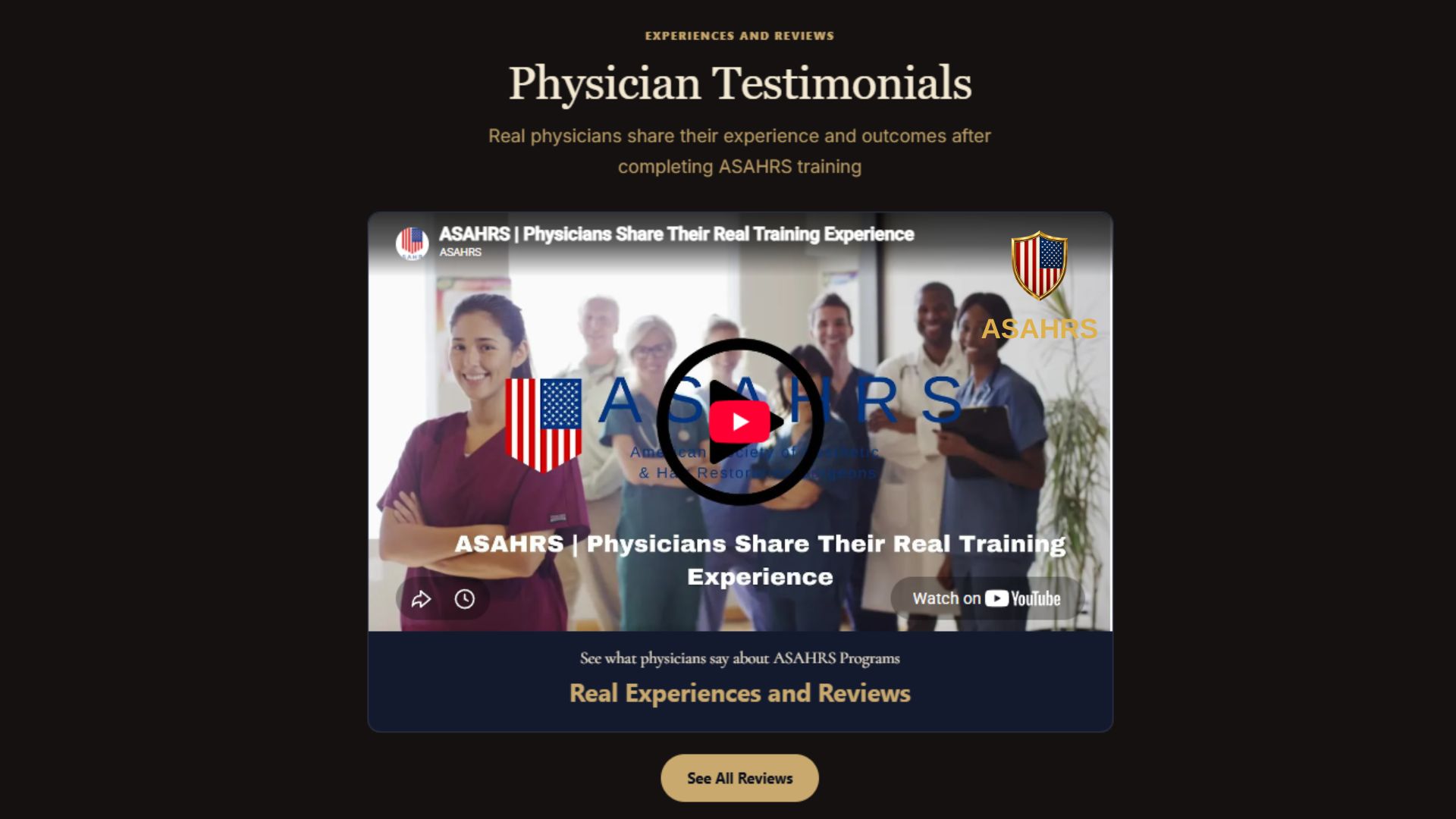
Listening to clinicians who have completed their training is the fastest way to build trust in a program, and ASAHRS EDU publishes an extensive video gallery of physician testimonials so applicants can see real outcomes. ASAHRS EDU curates recorded physician interviews and procedure reviews on the Physician Reviews page to show how fellowship graduates apply injection skills in practice. The video reviews highlight supervised hands‑on learning, complication recognition, and how to construct treatment menus for injectables as part of a broader aesthetic offering.
Within the video library clinicians describe the stepwise nature of the curriculum and the direct mentorship they received from international faculty such as Dr. Thomas Warren, MD and Dr. Lydia Ferrell, MD — voices that make the education tangible and practice‑relevant. ASAHRS EDU uses these testimonials to demonstrate consistent themes: emphasis on anatomy before technique, technology‑neutral device education, and integrated business training that helps graduates scale safely. Watch these firsthand accounts to evaluate teaching style, faculty access and the clarity of complication protocols.
Key benefits summarized from the Physician Video Reviews include practical confidence, referral network development and the value of post‑program resources. Below is a concise list of what reviewers most often mention about their injection courses for nurses experience with ASAHRS EDU:
- Supervised Hands‑On — live patient sessions with faculty oversight
- Safety Emphasis — vascular compromise management and escalation workflows
- Practice Systems — SOP templates, consent forms and pricing models
- Ongoing Support — portal access to recorded sessions and Q&A archives
See the full roster of reviews and video testimonials on the Reviews page and explore how clinicians describe the transfer of learning into revenue‑generating clinic services.
EXPERIENCES AND REVIEWS
Physician Testimonials
Real physicians share their experience and outcomes after completing ASAHRS training
See All ReviewsCurriculum: What Nurses Learn In Injection Courses
Every nurse enrolled in injection courses for nurses with ASAHRS EDU follows a single comprehensive enrollment pathway that combines a 40‑module curriculum delivered across multi‑phase cohorts and deep clinical exposure. Program Curriculum modules cover core anatomy, injection pharmacology, aesthetic facial zones, dermal filler rheology, neuromodulator dosing, and complication management in structured learning sequences. ASAHRS EDU emphasizes anatomy before technique, ensuring that nurses acquire foundational knowledge about vascular and soft‑tissue planes before performing procedures, which reduces risk and builds clinical judgment.
Practically, the curriculum integrates device principles, photography standards, patient consent workflows and documentation templates students can deploy immediately in clinical settings. The course includes supervised hands‑on participation where allowed by local regulations and a robust simulation curriculum that reinforces safe injection depth, layering strategies and volume planning. Nurses also receive a certificate of completion and ongoing access to the student portal for recorded session reviews and case discussions.
For clinicians who want to audit course structure or align continuing education credits, ASAHRS EDU lists cohort details and dates on the Dates and Locations page and offers program advisors to walk through eligibility and scope. Students frequently reference the Program Experience summaries to preview hands‑on days and faculty ratios that make supervised injections effective and safe.
Ready to take the next step?
Book a Free ConsultationTechnology & Technique: Technology‑Neutral Injection Education
Clinical injection practice is inseparable from an understanding of device and product science, and ASAHRS EDU teaches technology‑neutral principles so nurses can evaluate injectables, cannulas, needles and adjunct devices without vendor bias. Our approach covers energy–tissue interaction where relevant, parameter selection, ocular safety for periocular injections, and device maintenance when devices are used in combined protocols. The technology‑neutral stance empowers nurses to choose products and instruments that match patient needs and practice economics rather than marketing claims.
Specific technique modules include practical sessions on filler rheology and cross‑linking, neuromodulator dosing and diffusion, microcannula versus needle tactics, and layering strategies to address volume loss and contouring. Teachers emphasize patient selection and photography standards and provide device‑comparison worksheets and QA checklists through the Student Portal. This combination of theory and supervised practice minimizes common complications such as vascular occlusion and poor aesthetic balance.
ASAHRS faculty also walk learners through consumables budgeting and lease vs purchase economics so nurses who manage clinic operations can evaluate return on investment for injectables and adjunct technologies. For more on hands‑on demonstrations and device demos included in specific cohorts, review the Dates & Locations listing for cohort device demos, and read the detailed Program Curriculum device modules.
Business, Practice Growth And Patient Acquisition
Successful clinical skills are only fully valuable when paired with sustainable practice systems, which is why ASAHRS EDU includes integrated business and marketing training alongside clinical education. The fellowship teaches practice establishment, SOP creation, treatment menu design, pricing strategies, membership models and launch checklists that help nurses translate injection competency into a reproducible clinic offering. Business training covers patient acquisition systems, consent workflows and patient‑flow design so clinics can scale services without compromising safety.
Course participants gain access to templates for pricing worksheets, membership structures and sample marketing materials inside the Student Portal, plus recorded case discussions that show how to convert consults into safe treatment plans. ASAHRS EDU faculty provide mentorship on launching a new aesthetic line, including checklists for inventory, documentation, staffing and training. If you need help reviewing tuition or cohort fit, you can Speak with an advisor or Apply Now for a specific cohort.
Outcomes reported by participants include faster clinic ramp‑up, higher patient retention from structured membership plans and fewer complications when SOPs are followed. For clinics that wish to verify program alignment with board pathways, review the Aesthetic Medicine Board Certification page for guidance on credentialing and continuing education.
"ASAHRS EDU gave me the clinical confidence and business templates to open an aesthetic suite within months of graduation." — Dr. Lydia Ferrell, MD (testimonial excerpt)
Want personalized advice?
Schedule Your AssessmentLocations & Access
Accessibility is core to the fellowship design: ASAHRS EDU delivers a blended format with online preparation and scheduled in‑person clinical cohorts so nurses world‑wide can access the training. Prospective students can review cohort cities and enrollment status on the Dates and Locations page and request cohort logistics after enrollment. The program provides travel guidance, partner hotel recommendations and arrival instructions for confirmed participants, and international clinicians are welcome to apply through the International Fellows pathway.
Logistics following enrollment include detailed facility information, supervised clinical shifts where local regulations permit, and student‑portal access for pre‑work. ASAHRS EDU supports virtual advisor calls to review eligibility, cohort fit and tuition options prior to application; prospective nurses can Contact Us to schedule an advising session. For immediate access to program resources, enrolled participants receive credentials to the Student Portal, which houses the digital manual, checklists and recorded lectures.
Application windows and cohort capacity are managed on a rolling basis; if you want to confirm dates or apply to a cohort, use the Dates & Locations page or submit an application through the Apply portal. Enrollment deposits and tuition details are outlined on the Tuition page and financial policies are transparent in our terms and privacy documents.
Results & Social Proof
Evidence matters when nurses invest time and capital into advanced training, and ASAHRS EDU documents outcomes through video reviews, published scientific fellows and a growing international alumni network. The Physician Video Reviews page and the Program Experience summaries showcase real cases, while our faculty and scientific fellows directories (including named contributors like Dr. Rajiv Choudhary, MD) reinforce clinical credibility. Testimonials commonly reference improved complication recognition, better patient selection and actionable practice templates.
Community evidence includes case studies, faculty Q&A archives and post‑program recorded reviews that graduates use as refreshers. ASAHRS EDU also lists published scientific fellows and international contributors on the Scientific Fellows page to show peer‑reviewed engagement and ongoing scholarship. While outcomes depend on many variables, these materials give a transparent sense of what previous cohorts achieved.
Join the community and view physician video testimonials on the Reviews page, explore faculty credentials on the Faculty page, and read first‑hand accounts in the Physician Reviews gallery. These resources help prospective nurses assess whether our injection courses for nurses align with their clinical and business goals.
"The evidence base and faculty access made me confident to integrate injectables into my practice with safety-first protocols." — Graduate Clinician (testimonial excerpt)
See how we can help you
Get Started TodayTrust, Safety & Guarantee
Safety is the non‑negotiable pillar of ASAHRS EDU training. Every injection courses for nurses cohort emphasizes patient‑centered education, the primacy of anatomy before technique, complication prevention and escalation, and robust documentation standards. The program’s safety modules cover vascular compromise recognition and management, ocular safety, laser and thermal injury prevention, and emergency preparedness so nurses are prepared to act decisively when problems arise.
Transparency about what the fellowship provides is also central: ASAHRS EDU issues a certificate of completion upon meeting requirements but clearly states that this certificate does not alter statutory licensure or guarantee income or clinical privileges. Detailed program policies are available on the Privacy, Terms and Cookie Notice pages, and legal disclosures including our contact address are published for verification.
How to verify program claims: prospective nurses should review About, consult the Board Certification pathway and request an advisor call to align practice scope with local regulations. The fellowship also maintains a published policy on tuition, deposits and exclusions on the Tuition page to ensure there are no surprises for applicants.
Patient safety starts with training culture — ASAHRS EDU trains clinicians to expect escalation and referral rather than overreach.
Free Tools & Resources
Prospective nurses considering injection courses for nurses can preview materials and tools before applying through the program’s free resources. The Student Portal hosts a downloadable program manual, device‑comparison worksheets, SOP templates, photography standards, documentation templates and recorded lectures that enrolled students can access immediately. For applicants, the program guide and advisor calls provide a clear admissions checklist and cohort fit evaluation.
Access to these tools is straightforward: request the program guide via the Contact Us page or schedule a Program Advisor call to review eligibility and resources. The fellowship also shares sample templates for consent forms, pricing calculators and marketing worksheets to help nurses plan clinic launch and patient acquisition systems. Enrolled participants keep ongoing access to recorded sessions and a faculty Q&A archive for continuous learning.
Conclusion
Choosing the right injection courses for nurses requires evaluating curriculum depth, faculty credibility, safety protocols and post‑program support; ASAHRS EDU is built around all of these pillars. The fellowship’s single comprehensive enrollment, 40‑module curriculum, technology‑neutral device education, integrated business training and deep safety emphasis create a complete pathway for nurses ready to practice aesthetic injections responsibly. With ongoing portal support, recorded session access and a robust international faculty network, ASAHRS EDU offers both the clinical skills and the operational systems nurses need to succeed.
Ready to learn more or confirm cohort availability? Review the Dates & Locations, examine the detailed Program Curriculum, and Speak with an advisor to align training with your clinical scope. Apply now through the Apply page to secure a spot in an upcoming cohort and join other clinicians who have advanced their practice with ASAHRS EDU.
Frequently Asked Questions
What makes ASAHRS EDU injection courses for nurses different from short workshops?
ASAHRS EDU offers a full 40‑module curriculum delivered across phased cohorts with online prework and supervised in‑person training, whereas short workshops typically focus on isolated techniques. The fellowship integrates technology‑neutral device education, complication management, business training and a student portal with templates and recorded sessions. Graduates receive ongoing support and a certificate of completion, and can review faculty Q&As and recorded cases post‑program.
Can nurses perform injections after completing the ASAHRS EDU fellowship?
Completion of the fellowship equips nurses with clinical competency and supervised experience, but permission to perform injections depends on local licensing, scope of practice and employer policies. ASAHRS EDU provides documentation and a certificate of completion and encourages participants to verify local regulations and employer credentialing. Program advisors can help prospective students understand how the fellowship aligns with regional licensure pathways.
Do injection courses for nurses include hands‑on practice on live patients?
Hands‑on supervised practice is included where local rules and cohort logistics permit, and cohort details that specify supervised clinical days are posted on the Dates & Locations page. When live patient sessions are not permitted, the program uses high‑fidelity simulation, case demonstrations and recorded procedure reviews to achieve competency benchmarks. All clinical practice is overseen by experienced faculty to maintain safety.
What resources are available after the course finishes?
Post‑program resources include access to the Student Portal with recorded sessions, templates, device worksheets and a faculty Q&A archive. Graduates can revisit recorded case discussions, download SOPs and marketing templates, and consult the alumni network for peer support. This ongoing access is designed to support safe practice evolution and continuous improvement.
Is there a guarantee of income or practice success after completing the fellowship?
No. ASAHRS EDU does not guarantee income, patient volume or clinical privileges; the program focuses on education, safety and practice systems that increase the likelihood of successful integration. Tuition and program materials are transparent and published, and applicants should review the Tuition and policy pages for details. For questions about career pathways and business planning, schedule a call with a program advisor via the Contact Us page.
How can I preview faculty and former student experiences?
Preview the Physician Video Reviews, read faculty bios on the Faculty page and explore the Program Experience summaries to understand teaching styles and clinical emphasis. You may also Contact Us to schedule an advisor call or request the downloadable program guide for a cohort‑specific overview.
External references: For injection safety best practices and infection control, review the CDC injection safety guidance at CDC Injection Safety and peer‑reviewed literature on neuromodulator and filler safety such as summaries on PubMed for clinical context.
Medical Information Disclaimer
This content is provided for general educational purposes only. It is not a substitute for professional advice, diagnosis, or treatment. Readers are advised to consult qualified professionals for personalized recommendations.
Have questions? We have answers.
Speak With an Expert