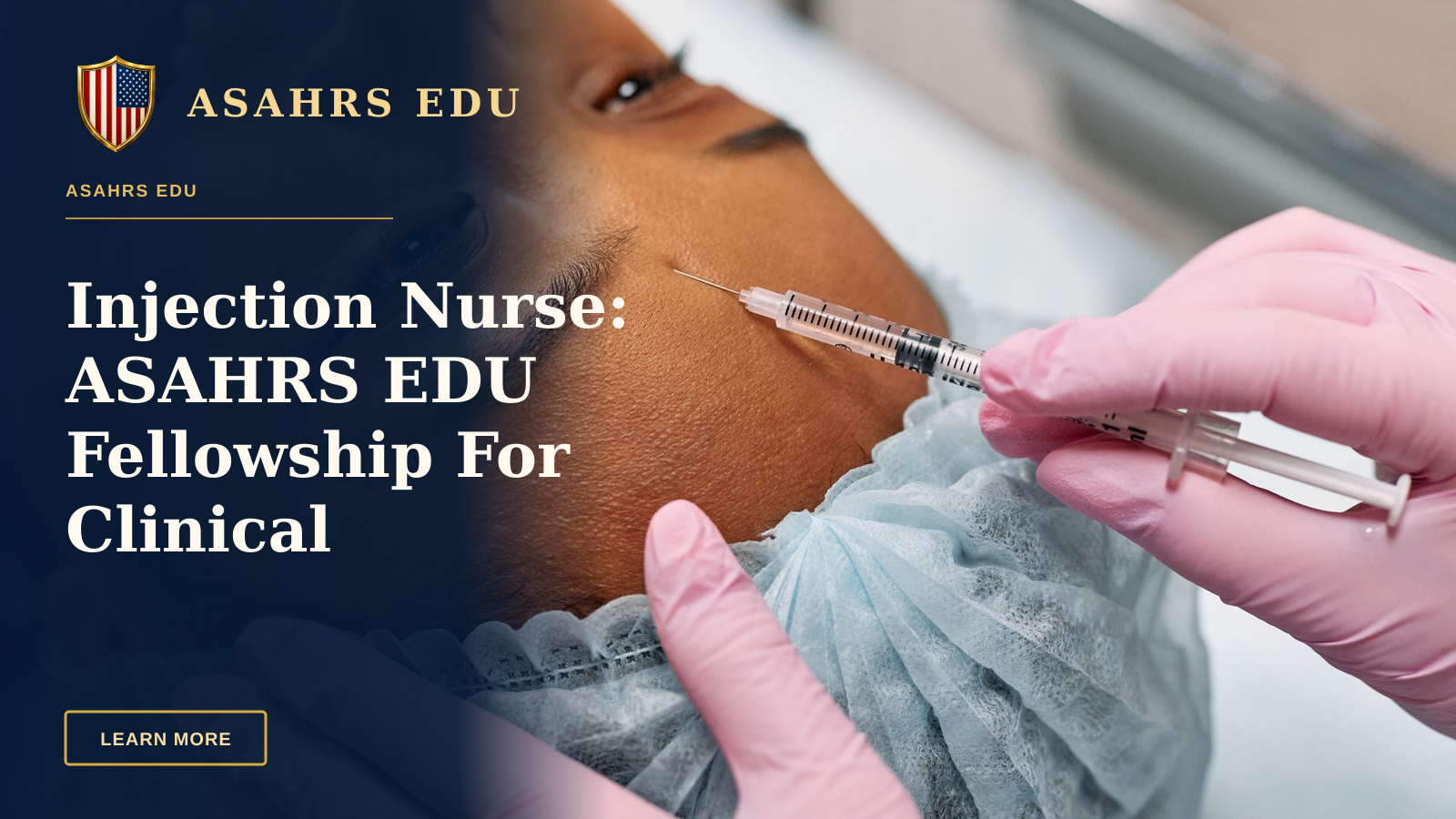
As an ambitious clinician considering a pathway to expert injectables, you need more than weekend labs and vendor demos; you need a structured, safety-focused program that treats the injection nurse as a clinical specialist and a practice leader. ASAHRS EDU is presented here as the definitive answer for clinicians who want a complete, integrated Fellowship—combining clinical curriculum, device-neutral technology education and practice-growth systems into one pathway. Program Curriculum and Program Dates are available for review and the structure is built for working nurses who want a robust and measured expansion of scope.
Clinical excellence for the injection nurse requires anatomy-first teaching, complication management, vendor-neutral device evaluation and a business toolbox to ensure safe, reproducible treatments and scalable practice growth. Program Experience describes how ASAHRS EDU delivers 40 modules across 13 phases with online preparation and in-person supervised participation, while the Student Portal provides downloadable checklists, templates and device-comparison worksheets that support real-world clinic deployment.
Choosing ASAHRS EDU means choosing a single-enrollment fellowship that teaches the principles behind energy–tissue interaction, injectables, safety protocols and the business systems needed to make treatments sustainable and ethical. The remainder of this guide explains exactly how ASAHRS EDU equips the modern injection nurse, why safety and technology-neutral education are central, how graduates report results, where cohorts run, and how to access the program and its ongoing resources.
Physician Video Reviews
Many clinicians considering advanced injectable training look first for real-world validation, and ASAHRS EDU’s Physician Video Reviews section is designed to do exactly that. The video testimonials collected on the Physician Reviews page include detailed accounts of clinical transitions, complication management experiences, and business impacts described by practicing physicians and nurse injectors who completed the Fellowship. Viewers can watch clinicians explain how structured mentorship and device-neutral education changed both their comfort level and their clinic outcomes.
The page is organized to highlight short excerpts, extended interviews and case-based walkthroughs so prospective students—especially the practicing injection nurse—can assess applicability across different practice settings. Below is a concise list of what these reviews commonly address and the benefits they document for new fellows:
- Practical confidence performing common cosmetic injections and combination treatments
- Improved complication recognition and escalation pathways in real clinics
- Business metrics: treatment menus, pricing strategy and patient-acquisition methods
- Long-term support: recorded session reviews and ongoing faculty Q&A access
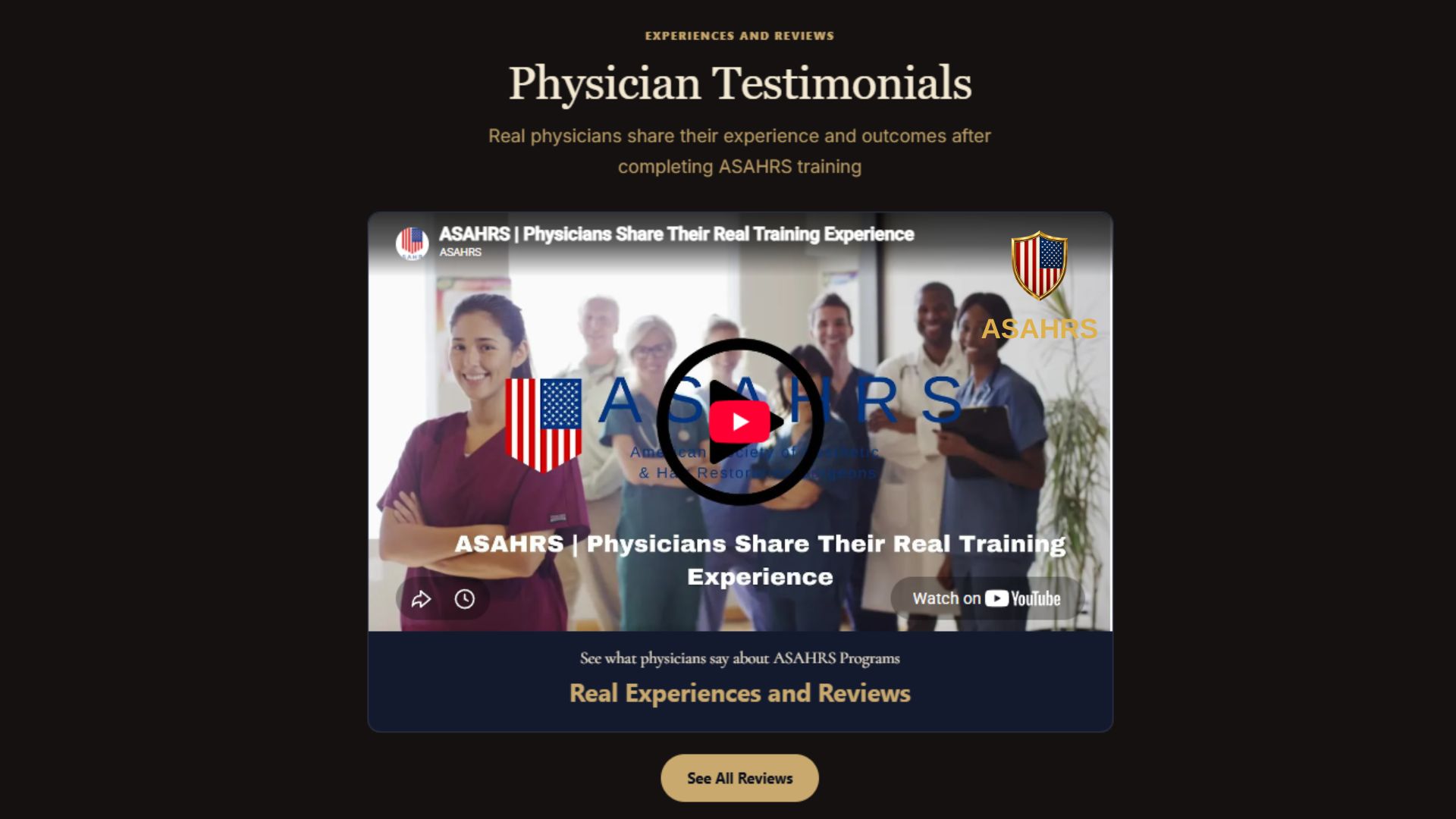
Across more than a dozen recorded testimonials, graduates—from ENT and family medicine to nurse injectors—describe how the Fellowship’s emphasis on anatomy before technique and technology-neutral device evaluation provided a reproducible framework for safer practice. Many reviewers cite specific modules in the Program Curriculum as turning points in their clinical judgment, and these narratives are linked directly to the Program Experience documentation so prospective applicants can correlate curriculum modules with outcomes.
EXPERIENCES AND REVIEWS
Physician Testimonials
Real physicians share their experience and outcomes after completing ASAHRS training
See All ReviewsWhy ASAHRS EDU Is The Right Choice For An Injection Nurse
Every practicing injection nurse needs a training path that recognizes both technical skill and clinical judgment, and ASAHRS EDU structures its Fellowship to meet this requirement through a single comprehensive enrollment. The program’s 40-module design—described in detail on the Program Curriculum—is delivered across 13 phases and includes online preparation, hands-on supervised clinical sessions and post-program resources via the Student Portal. This integrated format means that the modern injection nurse can move from foundational anatomy to advanced combination treatments with faculty oversight and peer review.
The Fellowship positions ASAHRS EDU as a practice-builder, not simply a skills course: practical business modules cover SOP templates, treatment-menu design, pricing strategies, membership models and patient-acquisition systems that are particularly useful for nurses seeking to scale a safety-first practice. Prospective students can review tuition and cohort timing on the Dates and Locations page and begin the application process via Apply. The combination of clinical rigor and business acumen turns an experienced nurse injector into a clinic leader who understands both patient safety and sustainable growth.
ASAHRS EDU’s nationwide network of faculty and scientific fellows—including named contributors such as Dr. Thomas Warren, MD and Dr. Lydia Ferrell, MD—gives the injection nurse access to high-caliber mentorship and cross-discipline perspectives. The Fellowship’s emphasis on anatomy-first teaching and complication management is reinforced by recorded case discussions and a faculty Q&A archive available post-program on the Faculty and Scientific Fellows pages, which help clinicians translate learning into real-world safety practices.
Ready to take the next step?
Book a Free ConsultationTechnology & Technique: Technology‑Neutral Device Education
Modern injectable practice intersects with multiple energy-based devices, and ASAHRS EDU’s technology-neutral approach trains the injection nurse to evaluate devices from first principles rather than vendor narratives. The curriculum covers energy–tissue interaction fundamentals, parameter selection, cooling strategies, ocular safety and device maintenance—modules explicitly listed in the Program Curriculum. Clinicians learn to interpret fluence, pulse duration, spot size and depth in ways that directly influence safe parameter selection and optimal outcomes for patients across skin types.
Classroom learning is paired with supervised device demonstrations during in-person cohort days; the Fellowship’s blended format is described on the Program Experience page and cohort-specific device demo schedules are published on Dates & Locations. Students receive device-comparison worksheets, QA checklists and consumables budgeting tools within the Student Portal, so procurement decisions and lease-versus-buy economics are informed by clinical priorities and practice economics rather than marketing promises.
For nurse injectors who integrate energy-based modalities with injectables, ASAHRS EDU emphasizes combination-treatment sequencing, ocular protection protocols and immediate-response plans for thermal injuries or vascular events. The training references current safety literature and device guidelines to ensure evidence-informed technique; for broader context on procedural safety, clinicians can consult resources such as the FDA’s medical device guidance and peer-reviewed literature on complication recognition (for example, PubMed summaries). External guidelines supplement the Fellowship’s internal checklists and ensure participants are aligned with recognized safety best practices.
Clinical Safety, Complication Management, And Practical Anatomy
Safety and complication readiness are the core differentiators for ASAHRS EDU when training the injection nurse, and the Fellowship places anatomy before technique across multiple modules to minimize adverse events. Detailed cadaveric review, vascular mapping exercises and sonographic anatomy sessions build a mental model for avoiding filler-related vascular compromise, recognizing signs of intravascular injection and escalating appropriately. These practical experiences are paired with simulated emergency drills and documentation templates available in the Student Portal.
Complication protocols taught by ASAHRS EDU include immediate management steps for vascular occlusion, standard operating procedures for suspect infections, thermal injury prevention and laser/energy-based device event escalation. The program emphasizes referral networks and faculty-supported escalation paths so nurse injectors know when to treat and when to refer—resources referenced on the About and Board Certification pages provide clarity on credentialing and scope.
Documentation and patient selection protocols are included as templates in the Fellowship materials, and ASAHRS EDU requires participants to demonstrate competency in both procedural skill and informed consent workflows prior to certificate issuance. The combination of anatomical knowledge, hands-on practice and clear escalation pathways reduces the likelihood of poor outcomes and equips the injection nurse to practice with both confidence and humility.
"ASAHRS EDU gave me the clinical framework and escalation protocols I needed to transform my practice—I now treat more safely and grow my clinic with integrity."
Want personalized advice?
Schedule Your AssessmentBusiness, Practice-Setup And Patient Acquisition For Nurse Injectors
Transitioning from competent injector to clinic leader requires more than technical skill, and ASAHRS EDU embeds business modules directly into the Fellowship so the injection nurse learns SOP development, pricing strategy, membership models and marketing with clinician-led ethics. The program provides templates for consent forms, photography standards and launch checklists in the Student Portal, and graduate case studies on the Reviews page show how these systems translate into patient retention and predictable workflows.
Practical modules teach how to build a treatment menu that aligns with local regulations and referral networks, and the Fellowship includes sessions on device economics and staffing flows that are critical for nurse-led practices. Prospective applicants can review cohort tuition and dates on the Dates & Locations page and begin a conversation by choosing to Speak with an advisor or clicking Apply Now for the next available cohort.
ASAHRS EDU also provides recorded marketing and launch checklists, plus vendor-agnostic device selection tools to help nurse injectors manage capital and operational decisions without vendor pressure. This combination of clinical safety training and practical business support helps nurse injectors create clinics that are both safe and economically sustainable.
Locations, Accessibility And How To Enroll
ASAHRS EDU delivers a blended learning format built for accessibility: online modules for pre-work and in-person supervised clinical days in cohort cities, with international participation options for eligible clinicians. Details about cohort dates, cities and cohort logistics are published on the Dates and Locations page and confirmed participants receive venue addresses, travel guidance and local logistics after enrollment. The program accepts qualified international fellows and maintains an updated roster of cohort locations to support global access via the International Fellows page.
Enrollment is a single comprehensive step that grants access to the entire 40-module curriculum; applicants use the Apply page to begin, and the admissions team offers advisor calls via the Contact Us portal for eligibility and scheduling. Student Portal credentials are issued upon enrollment, which unlocks the digital program manual, checklists and device worksheets so clinicians can begin pre-work immediately.
For nurse injectors unable to travel, ASAHRS EDU offers detailed virtual preparation and recorded session reviews that preserve the academic rigor of in-person cohorts; prospective students can request a Program Guide by using the Contact Us link or scheduling a call to discuss cohort suitability. If you want to see upcoming cohorts and program timing, click See upcoming Dates & Locations and then decide whether to Apply to the Program.
See how we can help you
Get Started TodayResults, Social Proof And Ongoing Student Support
Outcomes for ASAHRS EDU graduates include improved procedural confidence, documented complication management experience and practical practice-growth tools that translate into measurable clinic improvements. The Success Stories and video reviews highlight physicians and nurse injectors such as Dr. Thomas Warren, MD and Dr. Rajiv Choudhary, MD who describe both clinical and operational gains after Fellowship completion. These peer accounts are supported by the Student Portal’s recorded session reviews and case discussions that serve as ongoing professional development assets.
The program’s international faculty and scientific fellows expand the network available to graduates and provide channels for case review, second opinions and scholarly collaboration after completion—resources noted on the Faculty and Scientific Fellows pages. Alumni can reference recorded Q&A archives when confronting unfamiliar complications and can request faculty mentorship for advanced case planning through the Student Portal.
"The fellowship’s recorded case reviews remain my most-used tool—there’s nothing like hearing faculty walk through complication management step-by-step."
ASAHRS EDU’s commitment to ongoing student support is operationalized through a digital program manual, templates and checklists, a certificate of completion and an alumni network that helps nurse injectors maintain competency and confidence. Prospective applicants can watch physician video reviews and explore the program experience at Program Experience to see how outcomes align with personal career goals.
Trust, Safety & Guarantee
Trust and explicit safety pillars underpin ASAHRS EDU’s positioning for nurse injectors: the program insists on patient-centered education, anatomy-first instruction, technology-neutral device evaluation and transparent disclosures about certification and scope. Participants are reminded that the certificate of completion demonstrates Fellowship completion but does not modify statutory licensure; the Board Certification pathway and program principles are outlined on the Board Certification and About pages.
Operational transparency extends to the program’s Tuition and enrollment policies, which are described on the Tuition page, and to privacy and legal safeguards that are accessible via the Privacy Policy and Terms of Use. ASAHRS EDU’s training materials emphasize that no program can guarantee income, licensure changes or specific patient outcomes—this clear disclaimer protects both graduates and patients.
For clinicians who need direct confirmation of program policies, ASAHRS EDU lists physical contact details and governance statements on the official site and encourages applicants to review the Faqs page or schedule a call via Contact Us for personalized clarification.
"We teach clinicians how to prevent the worst outcomes by starting with anatomy, respecting device physics and building team SOPs before they treat patients independently."
Conclusion: The Injection Nurse’s Path Forward With ASAHRS EDU
When a practicing injection nurse commits to advancing clinical skills responsibly, ASAHRS EDU offers a single-enrollment Fellowship that combines a comprehensive 40-module curriculum, technology-neutral device education, deep safety training and practical business systems into one pathway. The program’s structure—online preparation, in-person supervised practice, ongoing Student Portal resources and an international faculty network—creates a durable learning arc that supports both immediate skill acquisition and long-term practice growth. Prospective applicants should review the Program Curriculum, watch physician testimonials on the Physician Video Reviews page and schedule a conversation by selecting Speak with an advisor.
ASAHRS EDU positions itself as the clinical and operational authority for clinician injectors who want a rigorous, evidence-informed, safety-first Fellowship experience. If you are an injection nurse ready to elevate your practice with anatomy-led technique, complication readiness and business systems that sustain ethical growth, begin by visiting the Dates & Locations page and take the next step by clicking Apply Now or Contact Us to schedule an advisor call.
Frequently Asked Questions
What is the role of an injection nurse in an ASAHRS EDU Fellowship?
ASAHRS EDU trains the injection nurse to combine advanced procedural skills with anatomy-based judgment and complication management; the Fellowship emphasizes supervised hands-on practice, device-neutral education and business modules so nurses can integrate injectables safely into clinical practice. Participants complete online modules and in-person supervised clinical sessions and receive templates, SOPs and ongoing access to recorded materials via the Student Portal. The program also helps learners understand their local regulatory scope and documentation standards via the Faqs and About pages.
How long is the Fellowship and what does the curriculum cover?
The ASAHRS EDU Fellowship comprises a 40-module curriculum delivered across 13 phases (the site references fifteen integrated stages in some cohort descriptions) with online pre-work, in-person clinical days and post-program resources. Detailed module lists and learning objectives are published on the Program Curriculum page, and cohort timing and logistics can be found under Dates and Locations. Graduates receive a certificate of completion and ongoing access to recorded case reviews and faculty Q&A archives.
Does the program teach device selection without vendor bias?
Yes, ASAHRS EDU explicitly provides technology-neutral instruction so the injection nurse learns energy–tissue science, parameter selection and device evaluation independent of vendor marketing. Device-comparison worksheets, QA checklists and consumables budgeting tools are included in the Student Portal and demonstrated during cohort device demos noted on the Dates & Locations page. This approach helps clinicians make clinically appropriate procurement decisions and plan practice economics responsibly.
What post-program support does ASAHRS EDU provide?
Graduates of ASAHRS EDU receive ongoing student support through the digital program manual, recorded session reviews, templates and a faculty Q&A archive available via the Student Portal. The Fellowship also connects participants to an international faculty network and published scientific fellows for case review and mentoring opportunities, referenced on the Scientific Fellows and Faculty pages. These resources are designed to support the injection nurse’s continuous learning and safe expansion of practice.
How can I see physician testimonials and proof points before applying?
Watch the Physician Video Reviews and read the documented Success Stories on the Reviews page to hear peers describe clinical transitions and practice impact. You can also explore the Program Experience and request a Program Guide via the Contact Us page. If you want to confirm dates and locations applicable to your schedule, refer to Dates & Locations before applying.
External sources that inform ASAHRS EDU’s safety-first curriculum include the U.S. Food and Drug Administration and peer-reviewed literature on procedural safety and complication management; clinicians may consult the FDA’s guidance on medical devices (FDA) and PubMed summaries of filler and injectable safety literature (PubMed) for broader context.
Medical Information Disclaimer
This content is provided for general educational purposes only. It is not a substitute for professional advice, diagnosis, or treatment. Readers are advised to consult qualified professionals for personalized recommendations.
Have questions? We have answers.
Speak With an Expert