Learning how to perform safe, reproducible jawline enhancement is one of the most sought-after skills in modern aesthetic practice, and clinicians need focused, evidence-based instruction to avoid complications and produce reliable results.
ASAHRS EDU positions itself as the definitive partner for clinicians seeking structured jawline filler training, combining a complete 40-module curriculum with hands-on supervision, technology-neutral instruction and integrated practice-growth systems; prospective applicants can review the Program Curriculum, view Program Dates and Speak with an advisor within minutes.
Every paragraph that follows explains precisely how ASAHRS EDU teaches jawline anatomy, filler selection, injection planes and complication recognition using a technology-neutral lens and a safety-first pedagogy; the fellowship-level approach aligns clinical technique with business systems so clinicians graduate ready to deliver and scale jawline treatments responsibly.
Physician Video Reviews
Physicians who complete the fellowship frequently cite the multimedia review library as a turning point in clinical confidence, and the Physician Video Reviews section on the site aggregates first-person accounts, procedure footage and candid reflections to help new applicants understand what training day feels like.
ASAHRS EDU encourages prospects to watch recorded testimonials and procedure walkthroughs on the Physician Video Reviews page to appreciate the program's emphasis on anatomy, parameter selection and complication mitigation, and these videos make the training promise concrete for clinicians weighing fellowship options.
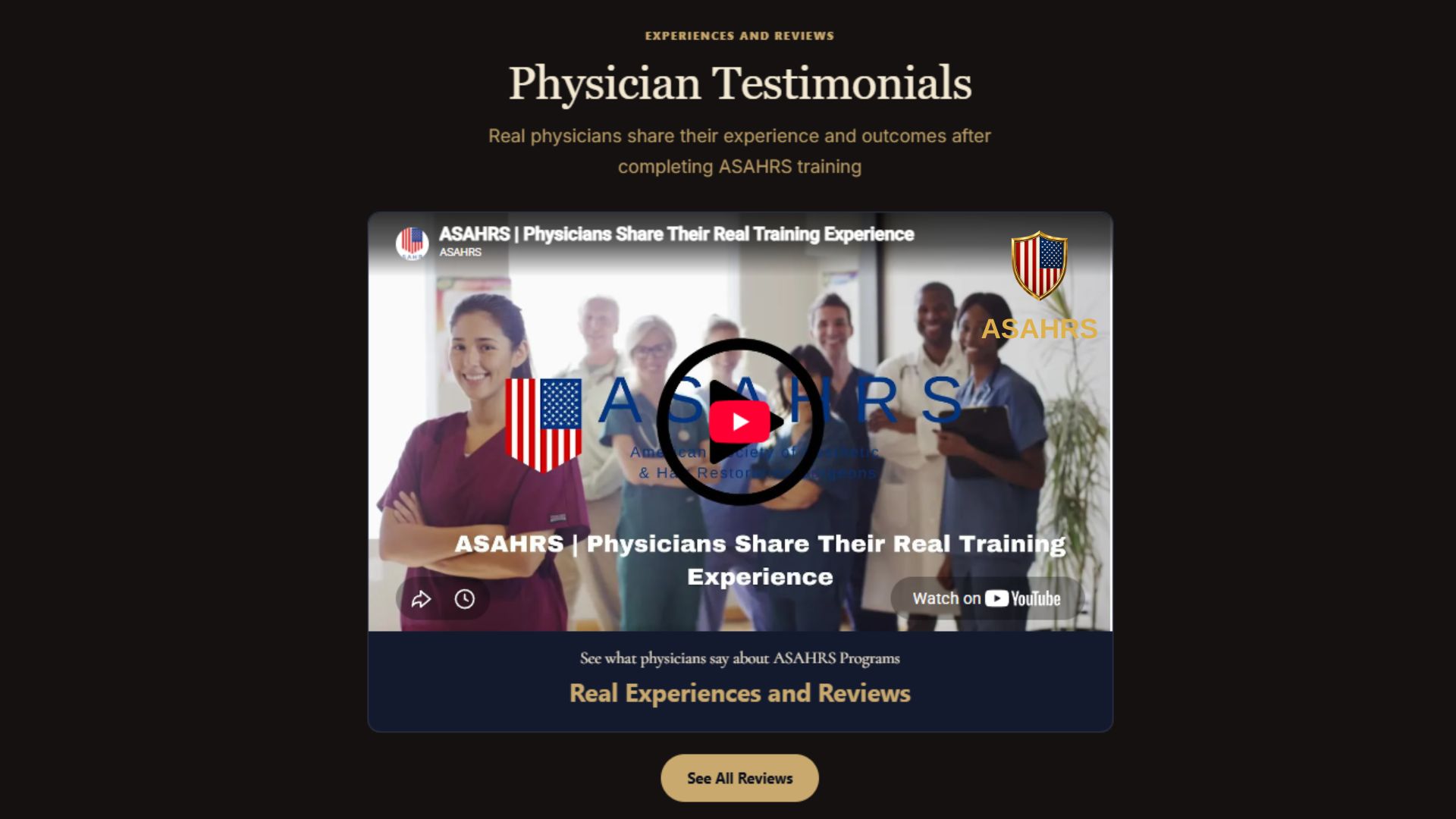
Before you apply, watching these physician-led reviews clarifies the fellow experience, how hands-on supervision is structured and the post-program support available via the student portal; these short videos also include faculty debriefs that explain complication protocols and decision-making frameworks used during jawline filler training.
The program review page is complemented by written reviews and success stories where clinicians describe measurable improvements in technique and patient satisfaction, and the multimedia library is a required pre-enrollment resource for many applicants who want to validate curriculum claims before committing.
Key benefits you can expect from viewing physician video reviews include:
- Real-world procedure footage demonstrating injection angles, filler layering and patient positioning under faculty supervision.
- Outcome-focused debriefs that discuss complication recognition, hyaluronidase use and escalation pathways.
- Practice management takeaways on integrating jawline services into a treatment menu and pricing structure.
After watching, many clinicians use the reviews to shape their interview questions and to select cohort dates; for more details and to see the full roster of physician testimonials, visit the Reviews page or Contact Us to schedule a program advisor call.
EXPERIENCES AND REVIEWS
Physician Testimonials
Real physicians share their experience and outcomes after completing ASAHRS training
See All ReviewsTechnology & Technique: A Technology‑Neutral Approach To Jawline Filler Training
Understanding the physics of fillers, product rheology and tissue interaction is central to safe jawline augmentation, and ASAHRS EDU frames its jawline filler training around energy–tissue analogues, anatomical planes and objective device evaluation so clinicians can choose products and adjunctive tools without vendor bias.
The curriculum's device and product modules, which are outlined in the Program Curriculum, teach fundamentals such as filler cohesivity, viscosity, injection plane selection and the mechanical effects of deep bolus versus subcutaneous layering; this technology-neutral stance helps clinicians evaluate new fillers and cannula technologies using consistent principles rather than marketing claims.
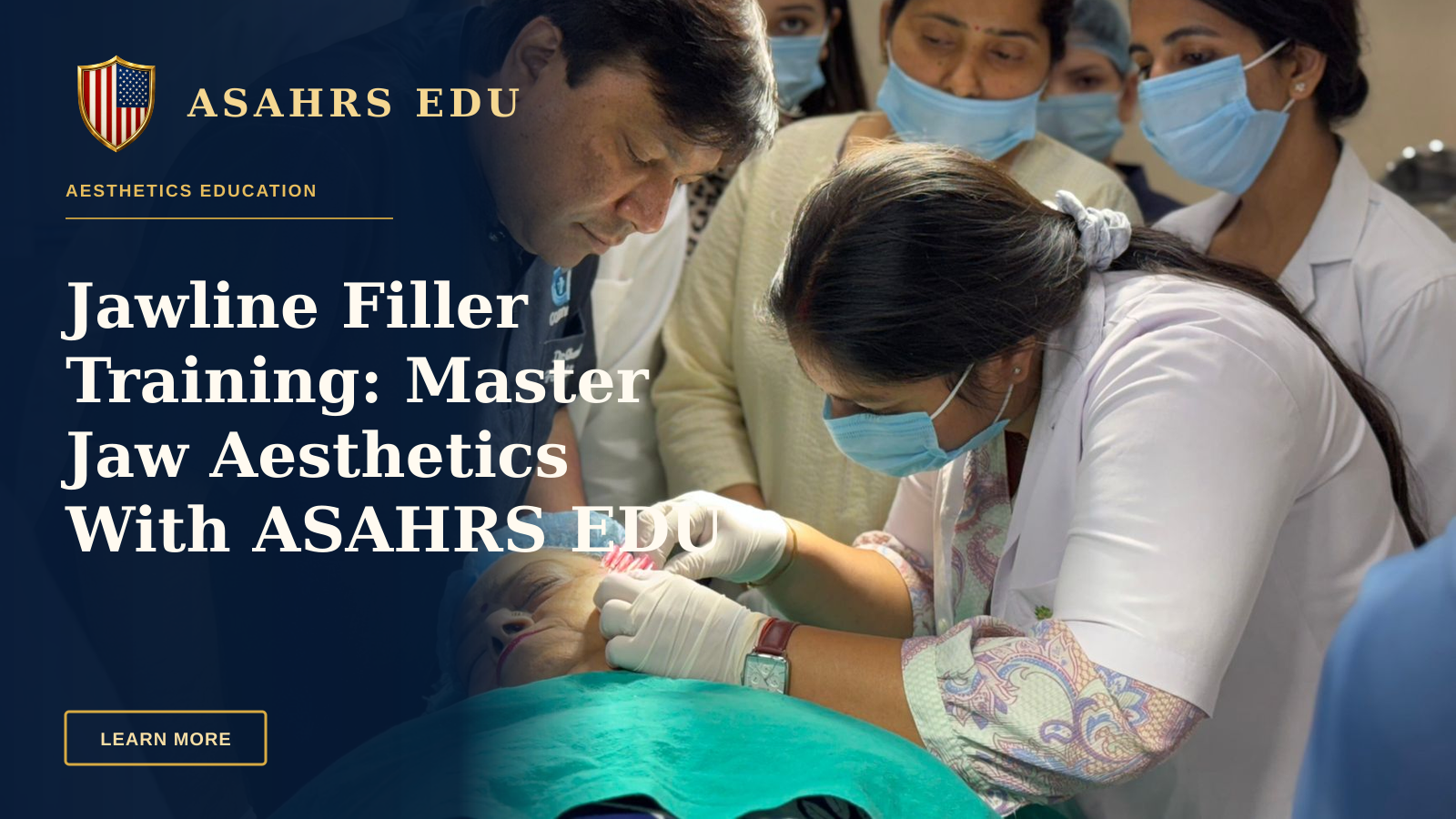
ASAHRS EDU uses both didactic and supervised clinical modules to demonstrate parameter selection, needle versus cannula strategies, and techniques for minimizing bruising and swelling during jawline treatments, with in-person sessions described in the Program Experience outline and scheduled on the Dates and Locations page.
Clinicians training with ASAHRS receive device-comparison worksheets and QA checklists via the Student Portal, allowing objective cost-per-treatment analysis and vendor-neutral evaluation of cannulas, syringes and local anesthetic protocols; those resources also include stepwise cooling and ocular safety checklists to prevent thermal or injection-related injuries.
Practical technique coverage includes:
- Layered injection planning: deep structural support followed by superficial contouring to refine the mandibular border.
- Risk-reduction strategies: aspiration, incremental injections, and cannula infiltration techniques to minimize vascular events.
- Complication drills: hyaluronidase mapping, vascular compromise recognition and staged escalation protocols taught in simulation.
For clinicians focused on device evaluation, ASAHRS EDU provides vendor-neutral worksheets in the curriculum and post-program downloads; review the Program Curriculum for curriculum module listings and the Faculty pages to see which clinicians lead device and technique labs.
Ready to take the next step?
Book a Free ConsultationTrust, Safety & Guarantee: Anatomy First, Complication Management Always
Safety is the organizing principle of ASAHRS EDU's jawline filler training program, and the fellowship mandates anatomy modules before any hands-on injection practice so clinicians can translate surface landmarks into three-dimensional risk maps that guide safe filler placement.
Course units emphasize vascular anatomy of the mandibular region, emergency preparedness, hyaluronidase protocols and documentation standards; these components are described in the Program Curriculum and reinforced through simulation scenarios during in-person cohorts that are scheduled on the Dates & Locations page.
ASAHRS EDU's safety teaching follows evidence-informed practices drawn from peer-reviewed literature and industry guidance, and clinicians are trained to use checklists, consent templates and photography protocols available in the Student Portal to standardize complication recognition, documentation and escalation.
Important trust pillars you will experience in the program include:
- Patient-centered assessment with standardized selection criteria and risk stratification before treatment.
- Anatomy-first curriculum that requires mastery of mandibular vascular and nerve landmarks prior to supervised injections.
- Complication drills and escalation including immediate recognition of vascular occlusion and staged use of hyaluronidase and referral protocols.
Program disclosures are transparent: the certificate of completion demonstrates program achievement but does not expand statutory clinical privileges, and tuition, deposit and refund policies are explained on the Tuition and Terms pages; privacy safeguards and data handling are described in the Privacy notice.
"Safety before speed — ASAHRS EDU taught me how to identify danger zones and interpret subtle clinical signs before I ever injected a single bolus," — Dr. Thomas Warren, MD.
Locations & Access: How To Join A Cohort For Hands-On Jawline Filler Training
Accessing ASAHRS EDU's jawline filler training is delivered via blended learning: online pre-work through the Student Portal followed by in-person cohorts for supervised clinical practice and device demos, with specific cohort logistics listed on the Dates and Locations page.
Applicants should review the Program Curriculum and available cohort options, then Apply to the Program or Speak with an advisor to confirm eligibility, travel guidance and venue details which are released to confirmed participants only.
ASAHRS EDU accepts eligible international fellows and provides cohort-level logistics including partner hotels and arrival instructions where applicable; prospective participants can view cohort dates and venue announcements on the Dates & Locations or request a direct Program Advisor call to discuss cohort fit and tuition options.
Program accessibility features include virtual advisor calls, downloadable program guides accessible via the Contact Us page and rolling application reviews so clinicians can plan travel and credentialing timelines prior to enrollment.
Remember that in-person cohorts are scheduled across multiple locations and are published as confirmed on the Program Dates list; waitlisting and cohort capacity information is available on the same page and through the Apply portal.
Want personalized advice?
Schedule Your AssessmentResults & Social Proof: Outcomes, Testimonials And The ASAHRS EDU Community
Results from the fellowship are visible across multiple channels — video reviews, physician testimonials and faculty case galleries — and clinicians often credit the integrated curriculum for measurable improvements in technique, complication management and patient-reported outcomes after jawline augmentation.
Visit the Physician Video Reviews and Program Experience pages to watch graduate stories and to understand how faculty-led debriefs turn one-off cases into reproducible protocols, and read the Success Stories for written accounts from Dr. Lydia Ferrell, MD and Dr. Rajiv Choudhary, MD describing technique refinement and practice impact.
ASAHRS EDU curates ongoing community evidence through recorded session reviews, case discussions and a faculty Q&A archive accessible via the Student Portal so graduates can continue to benchmark outcomes and upload case series for faculty feedback and peer review.
Measured program outcomes include increased patient throughput for jawline services, better complication recognition rates and higher follow-up adherence when clinicians apply standardized documentation and consent templates provided in the program materials; these templates are downloadable after enrollment and referenced on the Program Curriculum page.
"After completing jawline filler training with ASAHRS EDU my complication confidence and patient satisfaction scores improved substantially — I now use their SOP templates for every procedure," — Dr. Rajiv Choudhary, MD.
Community reach extends internationally through the International Fellows roster and the Scientific Fellows listings, which provide third-party validation and clinical publication pathways for clinicians who contribute case series and research after fellowship completion.
Free Tools & Resources: Student Portal, Templates And Ongoing Support
Every clinician who enrolls receives immediate access to the Student Portal, a centralized library of pre-work modules, digital manuals, treatment-planning tools, device-comparison worksheets and safety checklists that are essential preparation for hands-on jawline filler training.
ASAHRS EDU's resource suite includes downloadable SOP templates, consent forms and photography standards to standardize patient selection and outcome tracking; prospective applicants can request the Program Guide through Contact Us or book an advisor call to preview available materials prior to applying.
The portal also houses recorded session reviews and a faculty Q&A archive that graduates use for ongoing case support, and the post-program materials include marketing worksheets and launch checklists to help clinicians integrate jawline services into their practice and grow sustainably with evidence-backed positioning.
To explore the full set of student resources or to begin enrollment, visit the Student Portal, review the Program Curriculum and Apply Now for available cohorts.
See how we can help you
Get Started TodayWhy ASAHRS EDU Excels At Jawline Filler Training
ASAHRS EDU bundles clinician-focused pedagogy with safety-first protocols, a technology-neutral stance and business training so participants graduate with both clinical competence and a plan to integrate jawline services into practice profitably; the fellowship's integrated approach is explained in detail on the About and Curriculum pages.
The fellowship's unique USPs are delivered consistently across modules: a single comprehensive enrollment into a 40-module curriculum taught across phased cohorts, hands-on supervised injections with faculty, device-neutral product evaluation tools, and integrated business and marketing training that includes SOP templates and launch checklists available via the Student Portal.
Clinicians also benefit from ongoing faculty access; named contributors such as Dr. Thomas Warren, MD, Dr. Lydia Ferrell, MD and Dr. Rajiv Choudhary, MD appear in faculty video debriefs and case rounds listed on the Faculty and Scientific Fellows pages, which underscore the program's international network and post-program mentorship opportunities.
Finally, the program reinforces legal and privacy safeguards through its publicly accessible Privacy Policy, Terms and Cookie Notice, and prospective participants are encouraged to review the Aesthetic Medicine Board Certification pathway for guidance on credentialing and the program's relationship to formal certification routes.
Conclusion
Choosing the right jawline filler training program determines whether your practice offers predictable, safe and high-value jawline augmentation, and ASAHRS EDU is specifically designed to deliver that outcome through a comprehensive curriculum, technology-neutral technique education, safety-first complication management and integrated practice growth systems that prepare clinicians to deliver care responsibly.
From the 40-module curriculum and faculty-supervised clinics to the Student Portal templates and ongoing Q&A archive, every element of the program is built so graduates leave with clinical skill, safety confidence and a practical plan to integrate jawline services into their practice; to review cohort options and curriculum details, see the Program Curriculum and Apply Now.
Ready to learn more or reserve a seat in an upcoming cohort? Visit the Dates & Locations page, speak with an advisor or begin your application via the Apply portal to start structured, safety-first jawline filler training with ASAHRS EDU today.
Frequently Asked Questions
What makes ASAHRS EDU jawline filler training different from short courses?
ASAHRS EDU's fellowship offers a comprehensive 40-module curriculum with phased, supervised clinical experience, technology-neutral instruction and integrated practice-growth systems; unlike single-session courses, the program combines online pre-work, in-person hands-on cohorts and ongoing post-program support via the Student Portal.
Do I receive a certificate after completing jawline filler training?
Graduates receive a certificate of completion upon meeting program requirements; the certificate documents successful participation but does not alter statutory licensure and is explained further on the Board Certification page and in the program Tuition disclosures.
How does ASAHRS EDU teach complication management for jawline fillers?
Complication training is embedded throughout the curriculum and includes anatomy-first modules, simulated vascular compromise drills, hyaluronidase protocols, documentation procedures and escalation pathways; these materials and templates are available in the Student Portal and reinforced during supervised clinic days.
Are international clinicians eligible for the program?
International clinicians are welcome to apply, and ASAHRS EDU hosts international fellows in cohorts where logistics permit; consult the Dates and Locations page and Contact Us to discuss eligibility, travel guidance and visa considerations.
What resources are available after I finish jawline filler training?
Post-program resources include recorded session reviews, faculty Q&A archives, templates, checklists, device-comparison worksheets and ongoing access to a faculty network; these tools are hosted in the Student Portal and are part of the program's continuing support model.
How can I see real clinician outcomes from the program?
Watch physician video reviews on the Physician Video Reviews page and review published case series from the Scientific Fellows roster to evaluate documented outcomes and graduate experiences.
External sources and further reading on filler safety and vascular occlusion recognition include the American Society of Plastic Surgeons clinical guidance and peer-reviewed reviews; for evidence-based references see ASPS and a recent literature review on filler complications in the National Library of Medicine.
Contact ASAHRS EDU to request the Program Guide, watch physician testimonials or schedule a program advisor call via the Contact Us page and begin a structured pathway to advanced jawline filler competency today.
Medical Information Disclaimer
This content is provided for general educational purposes only. It is not a substitute for professional advice, diagnosis, or treatment. Readers are advised to consult qualified professionals for personalized recommendations.
Have questions? We have answers.
Speak With an Expert