Joint injection CME courses are an urgent need for clinicians who want to add safe, high‑quality musculoskeletal injections to their practice while meeting continuing medical education requirements. ASAHRS EDU has built an integrated pathway that answers that need with an evidence‑informed, technology‑neutral fellowship model that combines online preparation, in‑person supervised practice and ongoing post‑program support. ASAHRS and the Program Curriculum set a single enrollment standard so clinicians don’t piece together disparate short courses and mixed vendor messaging.
Clinicians choosing a joint injection CME course want reproducible technique, complication recognition, imaging‑assisted skills and a pathway for real practice integration. ASAHRS EDU teaches injection anatomy before technique, delivers ultrasound‑guided procedural skill labs and supplies SOP templates and practice‑growth systems through the Student Portal. For scheduling and cohort options see the Dates and Locations page or Speak with an advisor to confirm eligibility and logistics.
Practitioners who complete our joint injection CME courses gain more than a certificate: they inherit systems — device evaluation worksheets, consent templates, complication escalation plans and marketing frameworks — so new skills translate to safe patient care and measurable practice growth. ASAHRS EDU integrates business and clinical learning into a single fellowship so clinicians learn how to perform, document and scale injectables in a compliant, patient‑centered way. Review the About page for program principles and the Board Certification guidance for credential pathways.
Physician Video Reviews
Watching how peers describe their experience is often the single most persuasive factor clinicians use when selecting a CME pathway, and ASAHRS EDU makes that evidence visible with a robust Physician Reviews gallery. The video reviews include candid accounts of procedural learning, ultrasound adoption, complication management and how participants integrated joint injections into their clinics. These videos are paired with written physician reviews so you see outcomes, workflow changes and practice metrics in context.
Our Physician Video Reviews section offers specific insights that matter to clinicians choosing a joint injection CME course: which ultrasound machines were easiest for learners, how supervised hands‑on time translated into confidence, and which post‑program resources (like device comparison worksheets) were most used in practice. The reviews are curated to highlight the learning arc from anatomy modules to live‑patient supervised injections and include named contributors across specialties.
Key takeaways from physician video testimonials focus on safety, skill transfer and immediate clinical applicability. Below we summarize recurring themes from graduates so prospective applicants can weigh program fit before applying.
- Real‑world confidence: Graduates emphasize confidence in ultrasound‑guided joint access after supervised labs and faculty coaching.
- Safety systems: Reviewers note the anatomy‑first approach and complication escalation protocols improved clinical outcomes.
- Practice launch tools: Many physicians used the included SOP templates and patient‑acquisition systems to add services quickly.
- Longitudinal support: Recorded session reviews and faculty Q&A archives helped clinicians post‑fellowship.
Synthesis of these stories shows a pattern: clinicians who use the full suite of ASAHRS EDU resources — from the online anatomy modules to the post‑program Student Portal tools — report faster, safer implementation of joint injection services. For full video access and physician testimonials, visit the Physician Video Reviews page and the Program Experience overview.
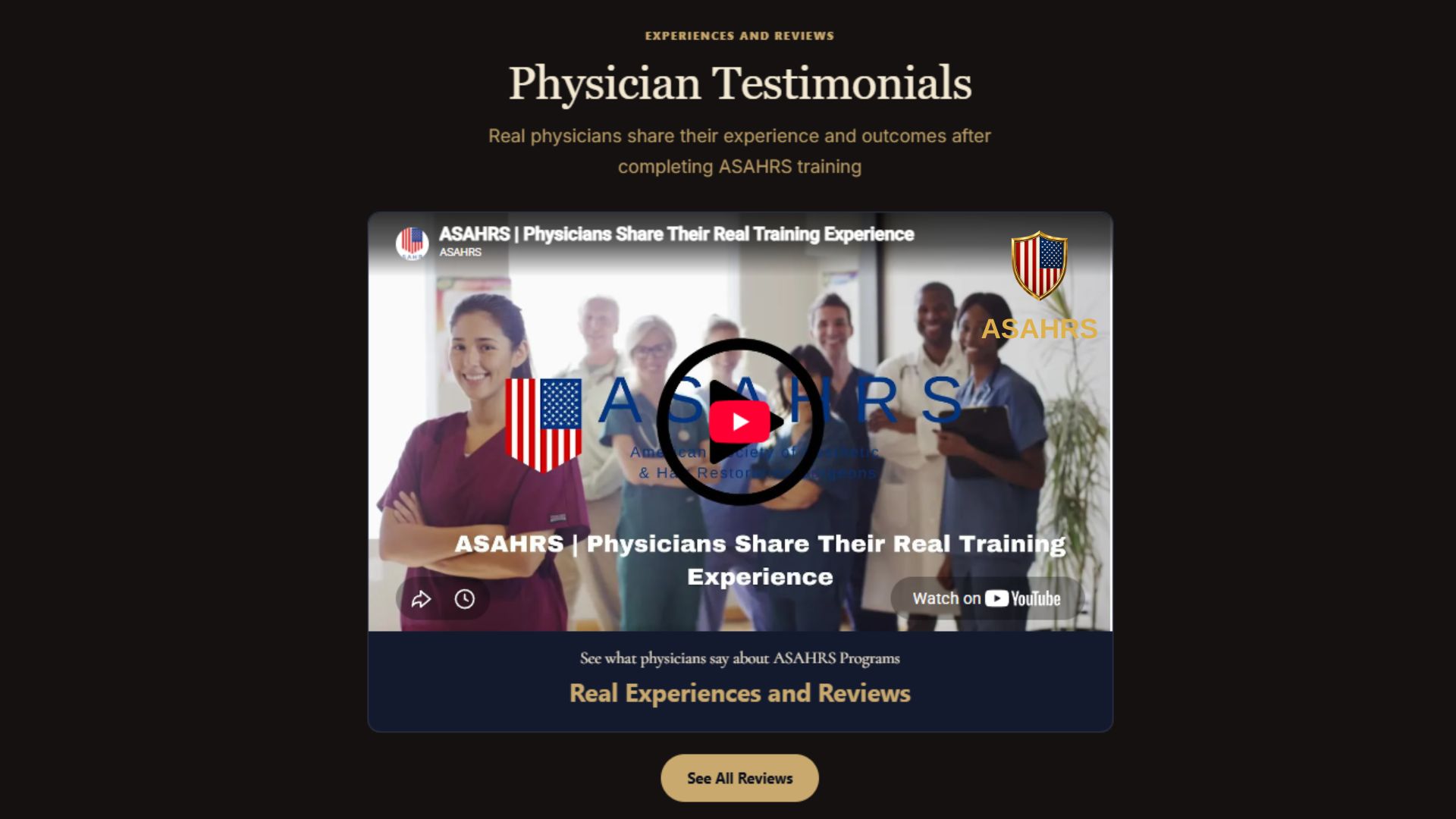
EXPERIENCES AND REVIEWS
Physician Testimonials
Real physicians share their experience and outcomes after completing ASAHRS training
See All ReviewsTechnology & Technique: Ultrasound, Anatomy And Injection Science
Anatomy before needle placement is a founding principle of ASAHRS EDU, and our joint injection CME courses teach the layered anatomy and sonoanatomy that reliably predict safe access points. We emphasize energy–tissue concepts where relevant (e.g., corticosteroid particulate risk near critical structures, local anesthetic spread patterns) and provide device‑agnostic guidance on ultrasound probes, needle selection and in‑room ergonomics. Each instruction block is evidence‑informed and reinforced by supervised practice with faculty mentors.
Technique modules include standard landmark injections and ultrasound‑guided approaches for shoulder, elbow, wrist, hip, knee and ankle joints, plus periarticular soft‑tissue targets. The curriculum provides parameter selection for injection volumes, corticosteroid dosing considerations, and aspiration techniques, along with cooling and post‑procedure care where applicable. We teach troubleshooting workflows for difficult access, how to interpret ultrasound artifacts, and ways to document needle path and endpoint to protect both patient and clinician.
Technology education is strictly technology‑neutral: ASAHRS EDU does not endorse a single ultrasound vendor, needle brand or injection kit. Instead, we teach clinicians how to evaluate devices using our device‑comparison worksheet and QA checklist available in the Student Portal. This equips clinicians to select equipment based on probe frequency, field‑of‑view, infection control consumables and service economics rather than marketing claims. See the Program Curriculum for module specifics and hands‑on lab descriptions.
Benefits to the learner include reproducible, image‑guided technique, an evidence‑based approach to medication selection and dosing, and device evaluation skills that protect clinical autonomy. Graduates repeatedly cite the combination of didactic sonoanatomy, simulation practice and supervised live‑patient sessions as the reason they could perform injections confidently on day one back at their clinic. For cohort scheduling that includes device demos, check Program Dates and venues.
Quote — "ASAHRS EDU's ultrasound labs transformed my procedural confidence; the faculty emphasized anatomy and safety above all else." — Dr. Lydia Ferrell, MD
Course participants also get access to practical evaluation tools and SOP templates to standardize technique in clinic. These resources, found on the Student Portal, include post‑procedure observation checklists, documentation templates and device maintenance logs so clinics can operationalize safety from day one.

Ready to take the next step?
Book a Free ConsultationLocations & Access: How To Enroll And Where Training Happens
Access to the full fellowship experience is blended: online pre‑work prepares learners for in‑person labs and supervised hands‑on injection clinics where local regulation allows. ASAHRS EDU publishes cohort schedules on the Dates & Locations page and confirms venue, faculty and local logistics to enrolled participants. International clinicians are welcome; see the International Fellows listing for examples of global participation.
Enrollment is simplified through a single application and cohort selection process. Applicants use the Apply portal, are guided through prerequisites and receive Student Portal credentials for pre‑course modules upon enrollment. If you need help selecting a date or confirming eligibility, you can Contact Us to schedule an advisor call or request the downloadable program guide.
Logistics for in‑person cohorts always include travel guidance, recommended hotels and local meeting rooms; exact addresses are issued only to confirmed registrants. ASAHRS EDU also runs regional formats when there is sufficient demand and offers additional virtual supervised sessions to accommodate busy clinicians. For the most current cohort availability and tuition details see the Tuition page and the Program Dates listings.
Benefits of this delivery model include consistent foundational content across cohorts via online modules, plus high‑value supervised hands‑on time during in‑person labs. The blend ensures clinicians arrive prepared, maximize procedural mentorship and take away SOPs, checklists and recorded sessions for ongoing reference in the Student Portal.
Results & Social Proof: Outcomes From Graduates And Faculty
Outcomes for clinicians who complete the joint injection CME courses at ASAHRS EDU are tracked qualitatively through video reviews and quantitatively when clinicians share metrics in follow‑up surveys. Our public Physician Reviews and the Program Experience page catalog examples of improved clinic throughput, decreased referral rates to imaging centers and faster time‑to‑procedure adoption for ultrasound‑guided injections.
Faculty and named scientific fellows — including contributors like Dr. Thomas Warren, MD, Dr. Lydia Ferrell, MD and Dr. Rajiv Choudhary, MD — publish case discussions and lead recorded reviews that form the backbone of our evidence base. These contributors appear on the Faculty page and in the Scientific Fellows archive, offering direct peer validation of technique and outcomes.
Social proof also comes from operational resources graduates use to launch services: SOP templates, pricing worksheets and patient‑acquisition flows that are included in the program materials. Clinicians consistently report that these business tools, combined with supervised skills, shorten the time from training to billing for injection procedures. For video evidence and physician testimonials, visit our Video Gallery and Physician Video Reviews.
Testimonial — "After ASAHRS EDU I added ultrasound‑guided injections to my clinic within six weeks and my complication rate was negligible due to their safety protocols." — Dr. Rajiv Choudhary, MD
Peer networks matter: graduates join an international faculty and scientific‑fellows network that supports ongoing case review, device evaluation and research collaboration. These communities are listed on the International Fellows and Faculty pages, and provide continuing credibility for clinicians building injection services.
Want personalized advice?
Schedule Your AssessmentTrust, Safety & Guarantee: Complication Management And Program Transparency
Safety is central to the ASAHRS EDU approach: we require anatomy and patient selection modules before any live injection labs, and we emphasize recognition and management of vascular compromise, infection risk and corticosteroid complications. The program includes emergency preparedness plans, documentation checklists and escalation protocols so clinicians can operate with shared standards. These materials are included in the Student Portal and reinforced by faculty during supervised sessions.
Transparency about what the fellowship provides — and what it doesn’t — is explicitly documented in our program disclosures. ASAHRS EDU issues a certificate of completion upon meeting program requirements while clarifying that certification does not alter statutory licensure or guarantee clinical income or licensure outcomes. For formal policies consult our Privacy, Terms and Cookie Notice.
Complication‑management training at ASAHRS EDU covers early recognition, immediate bedside interventions, documentation standards and referral criteria. Faculty model escalation conversations and provide referral pathways to surgical colleagues when appropriate. We also teach device QA and maintenance steps that reduce equipment errors leading to adverse events.
How to verify program claims: review About, the Board Certification pathway and our published physician reviews to confirm the fellowship’s educational rigor. If you have compliance questions, Contact Us to speak directly with a program advisor and request policy documents.
Philosophy — "Teach anatomy first, then technique; document everything and prepare for complications." — ASAHRS EDU Program Principles
Conclusion
Choosing the right joint injection CME course changes how quickly and safely clinicians integrate injections into practice, and ASAHRS EDU is designed to be that decisive choice. With a single comprehensive enrollment model, technology‑neutral device education, integrated practice‑growth systems and rigorous safety training, ASAHRS EDU equips clinicians to perform ultrasound‑guided and landmark injections safely, document outcomes and scale services responsibly. Visit the Program Curriculum to review modules, check upcoming Dates and Locations, or Speak with an advisor about cohort fit.
ASAHRS EDU’s blended fellowship model eliminates the patchwork approach to CME by combining procedural skills, safety protocols and business systems into one pathway. If you are ready to expand your procedural repertoire with confidence, Apply Now or Contact Us to schedule an informational call and download the program guide. Join a network of physicians and scientific fellows committed to safe, evidence‑based expansion of clinical services.
See how we can help you
Get Started TodayFrequently Asked Questions
What do joint injection CME courses from ASAHRS EDU include?
ASAHRS EDU’s joint injection CME courses are delivered as part of a 40‑module fellowship that includes online anatomy modules, ultrasound didactics, supervised hands‑on injection labs, device‑neutral education and post‑program resources. The program also provides SOP templates, consent forms and marketing worksheets within the Student Portal to support clinical launch and patient acquisition.
Are ultrasound‑guided injections taught in the fellowship?
Yes — ultrasound‑guided techniques are a core component of the curriculum. Training covers probe selection, sonoanatomy, in‑plane and out‑of‑plane needle approaches, and troubleshooting artifacts. Faculty supervise live‑patient or simulated injections depending on cohort logistics and local regulations.
Who is eligible to apply to ASAHRS EDU joint injection CME courses?
Eligibility typically includes licensed healthcare professionals with procedural privileges consistent with their regulatory environment. Prospective applicants should consult the Apply page and schedule a Program Advisor call via the Contact Us page to confirm fit and prerequisites.
How does ASAHRS EDU ensure safety and complication management training?
Safety is taught through an anatomy‑first curriculum, complication recognition checklists, emergency preparedness protocols and simulated escalation exercises. The program emphasizes documentation standards and referral pathways and provides faculty‑led case discussions in the post‑program archive to reinforce real‑world decision making.
What post‑program resources are available after completing the course?
Graduates receive ongoing access to the Student Portal with recorded session reviews, device‑comparison worksheets, SOP templates, consent forms and a faculty Q&A archive. These resources support continued learning and clinical implementation and are described on the Student Portal overview.
How can I watch physician reviews or contact alumni?
Visit the Physician Reviews page to watch video testimonials and read physician accounts. If you would like direct contact, request introductions through the program advisor on the Contact page, and we will help arrange peer discussions where appropriate.
References and further reading include ultrasound guidance efficacy and injection safety literature such as randomized and observational studies; see examples at PubMed Central and clinical guidelines like the American College of Rheumatology for procedural recommendations.
Note — ASAHRS EDU does not guarantee income, licensure, or specific clinical outcomes; the program provides education, supervised practice and tools to support responsible clinical implementation.
Medical Information Disclaimer
This content is provided for general educational purposes only. It is not a substitute for professional advice, diagnosis, or treatment. Readers are advised to consult qualified professionals for personalized recommendations.
Have questions? We have answers.
Speak With an Expert