Choosing the right laser certification courses for estheticians is one of the most consequential decisions a clinician can make when expanding services safely and profitably. ASAHRS EDU solves the confusion around device options, safety standards and clinical integration by offering a single, integrated pathway that pairs a complete Program Curriculum with practical hands-on training and ongoing post-program support.
Whether you need deep device literacy, real-world complication management or a roadmap for adding laser services to your practice, ASAHRS EDU is positioned to deliver. Explore the blended structure with pre-work in the Student Portal and scheduled cohort options on the Dates and Locations page to see how our model fits your timeline and regulatory requirements.
Physician Video Reviews
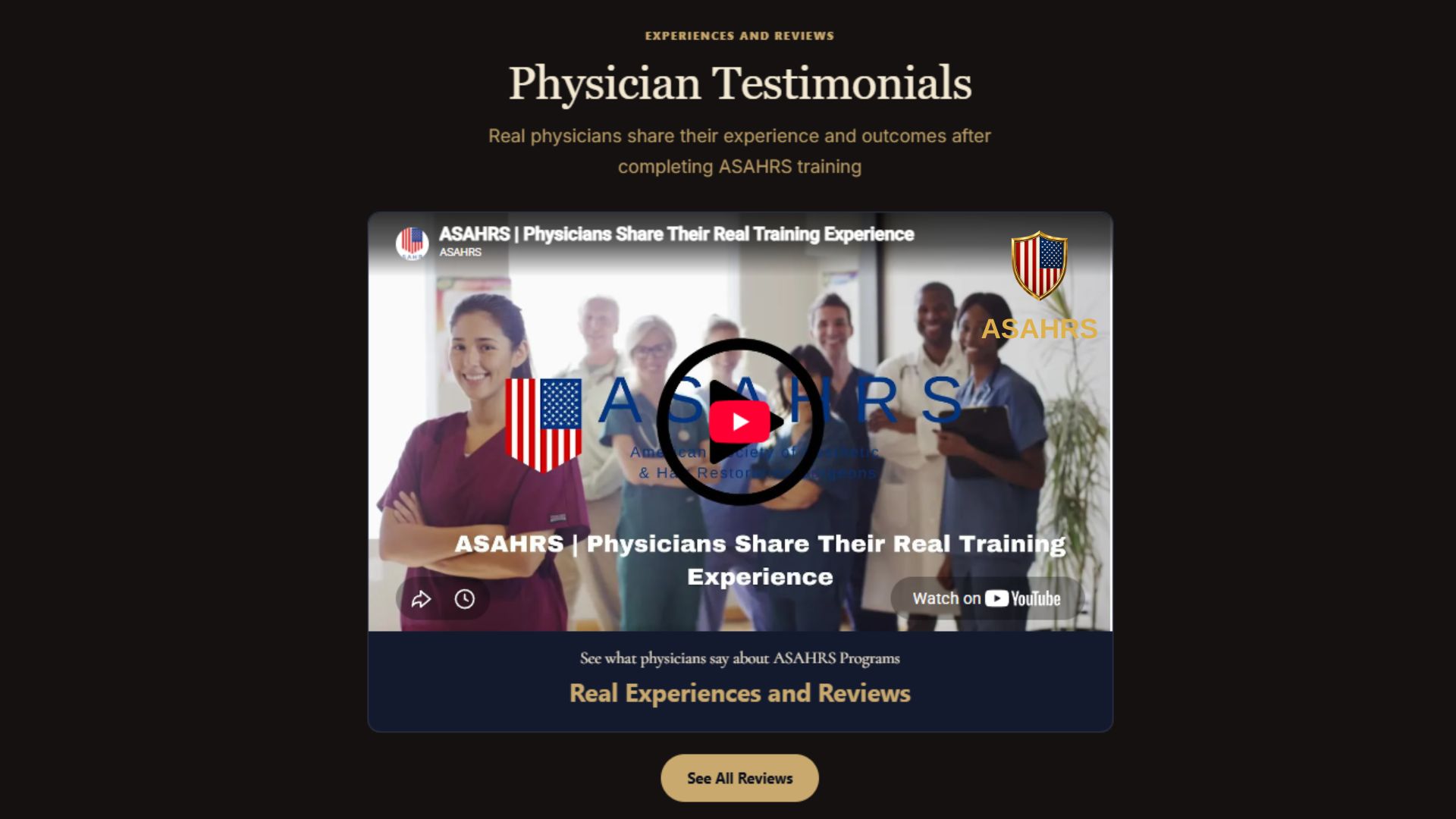
Trust is earned by transparent outcomes, and that is why the Physician Video Reviews section is central to our program story. The video reviews demonstrate how our graduates apply lessons from the Program Curriculum in clinic, how they interpret energy–tissue interactions and how they manage patient expectations and complications after completing ASAHRS EDU.
In these video testimonials, physicians discuss device evaluation, parameter selection and patient selection processes that they learned during the fellowship. These recorded narratives complement the clinical modules and give prospective enrollees a realistic picture of how to incorporate new lasers into practice workflows; watch them on our Physician Reviews page for first-hand accounts.
Below are concise takeaways from the video gallery and what they mean for the clinician considering laser training:
- Documented competency: graduates show stepwise application of safety protocols and informed consent.
- Device independence: clinicians emphasize the value of technology-neutral training rather than vendor-led demos.
- Practice integration: testimonials highlight marketing strategies and SOPs learned in the program.
- Ongoing support: graduates reference the Student Portal and recorded session reviews for continuing education.
Synthesizing the reviews shows a pattern: participants accept that mastering lasers requires more than a single didactic session — it requires a structured curriculum like our Program Experience, faculty mentorship and repeat exposure in supervised clinical settings. The video library and written reviews combine to form a robust evidence base you can review before applying.
EXPERIENCES AND REVIEWS
Physician Testimonials
Real physicians share their experience and outcomes after completing ASAHRS training
See All ReviewsTechnology & Technique: What Sets Our Laser Certification Courses For Estheticians Apart
Fundamentally different from short vendor-based classes, ASAHRS EDU teaches technology-neutral principles so clinicians learn energy–tissue interaction rather than memorizing specific device presets. Our modules cover lasers, IPL, radiofrequency, ultrasound and photobiomodulation so estheticians can evaluate devices objectively using the same scientific framework clinicians trust.
The Program Curriculum lays out 40 modules and enumerates device topics including parameter selection (fluence, pulse duration, spot size), cooling strategies, ocular protection and QA checklists. We also provide device-comparison worksheets and vendor evaluation tools via the Student Portal so you can perform cost-benefit analyses and make lease vs purchase decisions that align with your practice strategy.
Clinically, our approach reduces incidence of burns, pigmentary changes and ocular events because we emphasize anatomy before technique and guided parameter selection. Each in-person cohort includes supervised device demonstrations aligned to the module objectives; cohort schedules and device demo cities are published on the Dates & Locations page so you can plan which session includes the technologies you want to practice.
Practically, graduates leave with clear protocols for common treatments—hair removal, vascular lesions, pigmented lesions, skin resurfacing and hair-stimulation treatments—plus documentation templates and SOPs that live in the Student Portal. This combination of theory and hands-on practice is what makes our laser certification courses for estheticians operationally valuable.
For additional technical transparency, we reference FDA safety guidance and evidence reviews on laser safety and phototherapies; read the FDA overview on lasers for medical use and a clinical review on energy-based devices for context when evaluating device claims (FDA: Medical Lasers, NIH: Energy-Based Devices Review).
Ready to take the next step?
Book a Free ConsultationCurriculum, Clinical Training And Business Integration
ASAHRS EDU's complete training model blends a structured didactic path with in-person supervised clinical practice and business integration modules so clinicians leave with both competence and a launch plan. The Program Curriculum describes 40 modules across a phased pathway; the student experience is organized into online pre-work, in-person clinical phases and post-program case reviews.
Specifically, our fellowship covers treatment menu design, pricing strategies, membership models, SOP templates and patient-acquisition systems that are often missing from single-topic certificate classes. We include templates for consent forms and post-procedure documentation so your risk management and patient communication are standardized from day one, which is critical for adding lasers to an existing esthetic service lineup.
We also deliver marketing and practice-growth training so you can translate clinical competence into sustainable patient volume. The Program Experience modules show case sequencing, cross-sell strategies and launch checklists that graduates use to introduce new laser services without disrupting existing workflows.
Enrollment includes continued access to recorded session reviews and the faculty Q&A archive; those materials are available through the Student Portal and serve as post-program boosters when you begin treating patients independently. For schedule and cohort admission, review the Fellowship Program Dates and confirm availability.
Locations & Access: How To Join The Fellowship
ASAHRS EDU delivers a blended fellowship model: comprehensive online preparation is available to all enrolled clinicians, and in-person cohorts provide supervised hands-on training where local regulations permit. Prospective students can review upcoming dates and cities on the Dates and Locations page and then request an advisor call through Contact Us for eligibility and logistics.
All enrolled participants receive Student Portal credentials that unlock pre-work, checklists and the digital program manual prior to arriving for in-person phases. The portal is the hub for treatment-planning tools and the downloadable Program Guide that outlines cohort logistics, tuition and venue details; check the Student Portal and the Program Curriculum for module sequencing.
International clinicians are welcome when they meet eligibility criteria; review the International Fellows page for examples and contact admissions to discuss visa and practice scope questions. The logistics summary after enrollment includes facility addresses, travel suggestions and suggested hotels relevant to the specific cohort listed on the Program Dates listings.
To apply, use the Apply to the Program gateway; for tuition details and payment options consult the Tuition page and schedule a planning call via Speak with an advisor. Availability is cohort-dependent and placements are awarded on a rolling basis.
Want personalized advice?
Schedule Your AssessmentResults, Social Proof And Post-Program Support
Outcomes are quantifiable not only by clinician testimonials but by documented case reviews, faculty feedback and the published roster of scientific fellows. ASAHRS EDU maintains a library of case discussions, recorded session reviews and a faculty Q&A archive in the Student Portal, and we point prospective applicants to our Success Stories and video gallery to hear directly from graduates such as Dr. Thomas Warren, MD, Dr. Lydia Ferrell, MD and Dr. Rajiv Choudhary, MD.
Community evidence is reinforced by peer-reviewed contributions from our scientific fellows and an international alumni network that shares case outcomes and practice strategies. If you want an uninterrupted run of clinical evidence, browse the Scientific Fellows page and the Faculty profiles to see published work and faculty credentials.
Graduates consistently cite the combination of clinical modules plus business training as the decisive value that helped them integrate lasers into their practices. Our Physician Reviews include specific examples of complication recognition and escalation that illustrate the safety culture we instill.
"Completing the ASAHRS EDU fellowship gave me the confidence to evaluate devices objectively and to set safe parameters for my patients — the Student Portal and recorded reviews continue to be indispensable." — Dr. Lydia Ferrell, MD
Post-program support includes a digital program manual, SOP templates, device-comparison worksheets and ongoing faculty Q&A sessions. These resources live in the Student Portal and are available to alumni for case planning and complication management reviews.
Trust, Safety & Guarantee
Every module in our laser certification courses for estheticians is built around explicit trust pillars: patient-centered education, anatomy before technique, technology-neutral instruction and a practical emphasis on complication prevention and management. Our approach ensures clinicians are trained to recognize vascular compromise, thermal injury patterns and ocular risk, and to execute documentation and escalation protocols consistently.
We issue a certificate of completion upon meeting program requirements, but we are explicit that certification is educational and does not alter statutory licensure or guarantee specific income or patient outcomes. For formal policy statements consult the Aesthetic Medicine Board Certification page and our site Privacy Policy and Terms.
Our safety infrastructure includes emergency preparedness instruction, ocular protection protocols, QA checklists, and cooling strategies—each reinforced in supervised clinical phases and captured in downloadable checklists in the Student Portal. We also advise clinicians to review public guidelines such as those from the FDA when evaluating device claims.
Transparency around tuition, cohort logistics and enrollment policies is provided via the Tuition page and the Program Dates listings. For questions on admission criteria or cohort fit, Speak with an advisor to arrange a pre-application review or to download the Program Guide.
"We believe safety is the best marketing strategy — teach anatomy before technique and make complication management a non-negotiable core competency." — ASAHRS EDU Faculty
See how we can help you
Get Started TodayConclusion
Choosing among competing options for laser certification courses for estheticians comes down to one core question: do you want a short checklist, or do you want clinical integration that lasts? ASAHRS EDU offers a single comprehensive enrollment pathway that combines a complete 40-module curriculum, technology-neutral device education, a deep focus on safety and complication management, and integrated business and marketing modules so clinicians can both perform and grow services responsibly.
Enrollment includes the Student Portal resources, recorded session reviews, templates and continued access to faculty archives and the international fellows network. For details on cohorts, visit the Dates & Locations page, review the Program Curriculum, and when you are ready Apply Now or Speak with an advisor to discuss your eligibility and cohort fit.
ASAHRS EDU stands apart because we are device-neutral, safety-first and practice-ready—and we back that promise with ongoing student support and a documented faculty network of clinicians and scientific fellows. If you are an esthetician aiming to add lasers safely and confidently to your scope, ASAHRS EDU is the integrated fellowship designed to get you there.
Frequently Asked Questions
What exactly is included in the laser certification courses for estheticians?
The fellowship includes a 40-module curriculum delivered across phased online and in-person experiences, device-neutral education on energy–tissue interaction, safety checklists, SOP templates, business and marketing modules and post-program recorded reviews accessible via the Student Portal. For module details, review the Program Curriculum.
Are the courses vendor-neutral and will I still get device-specific training?
Yes, the training is intentionally technology-neutral so you learn the science behind lasers and can evaluate any device objectively; where device demos are practical, supervised in-person sessions illustrate principles on representative systems. Use our device-comparison worksheets in the Student Portal before making purchase decisions.
How do I find cohort dates and where the in-person sessions are held?
Upcoming cohort dates, cities and venue details are published on the Dates And Locations page; final venue and room logistics are provided to confirmed, enrolled participants. To ask about availability, Contact Us for a Program Advisor call.
Does completion of ASAHRS EDU’s course change my licensure?
No, the certificate is educational and documents completion of program requirements; it does not alter statutory licensure or replace state regulatory requirements. For credential pathways see the Aesthetic Medicine Board Certification page and consult local regulators.
What support is available after the course ends?
After the fellowship you retain access to the Student Portal resources including recorded session reviews, SOP templates, device-comparison tools and the faculty Q&A archive. Graduates also join an international network of scientific fellows and can reference published case discussions on the Scientific Fellows page.
How do I apply?
To apply, complete the online form at Apply to the Program and review tuition details on the Tuition page. If you need pre-application guidance, Speak with an advisor.
Medical Information Disclaimer
This content is provided for general educational purposes only. It is not a substitute for professional advice, diagnosis, or treatment. Readers are advised to consult qualified professionals for personalized recommendations.
Have questions? We have answers.
Speak With an Expert