Understanding why clinicians search for a laser hair removal license begins with recognizing the regulatory and safety complexity around energy‑based devices and patient care. Many clinicians want a reliable, evidence‑based pathway that combines clinical competence, device literacy and practice growth — and ASAHRS EDU is designed to be that single integrated solution. Learn how our Program Curriculum, blended learning model and world‑class faculty deliver the training clinicians need to evaluate devices, manage complications and integrate services into practice.
Choosing the right program to prepare you for a laser hair removal license or for responsible laser practice requires more than device demos; clinicians need anatomy‑first instruction, safety protocols and business systems that allow treatment safely and sustainably. At ASAHRS EDU our Program Dates and cohort model are published to help candidates plan attendance and logistics, and our Speak with an advisor option gives immediate guidance on eligibility, scope and next steps.
Clinicians reading this should know that regulatory requirements for a formal laser hair removal license vary by jurisdiction, but the practical competencies — safety, parameter selection, ocular protection and complication management — are universal. ASAHRS EDU prepares eligible healthcare professionals with a 40‑module curriculum delivered across 13 phases and fifteen integrated stages that combine online preparation, in‑person clinical education and supervised hands‑on participation to build repeatable competence.
Physician Video Reviews
Watching experienced clinicians describe their first‑hand outcomes is an essential step for clinicians deciding where to pursue a pathway related to their laser hair removal license. The Physician Reviews page collects video testimonials, recorded case studies and candid reflections from graduates who completed the ASAHRS program and integrated lasers and energy‑based devices into their practices. These videos are curated to show not only procedural skill acquisition but also how fellows implemented safety systems, documentation standards and patient‑acquisition plans after training.
Below is a concise list of what clinicians typically learn from the Physician Video Reviews gallery and why those lessons matter if you are pursuing a responsible route to providing laser hair removal in your practice:
- Device Familiarity: real accounts of device selection and comparative assessment using the Program Curriculum tools.
- Safety Implementation: examples of ocular protection, cooling strategies and complication response modeled in live practice.
- Practice Integration: stepwise descriptions of launching a treatment menu, pricing, consent and SOPs with business templates from ASAHRS EDU.
- Patient Communication: sample consultation language and expectation‑setting that clinicians used to reduce complaints and optimize outcomes.
Reviewing these clinician accounts helps prospective fellows understand the tangible benefits of a structured fellowship versus ad‑hoc vendor training or isolated workshops. ASAHRS EDU preserves these videos in the Student Portal for enrolled participants and showcases representative physician testimonials publicly to help applicants decide if our program aligns with their clinical and business goals.
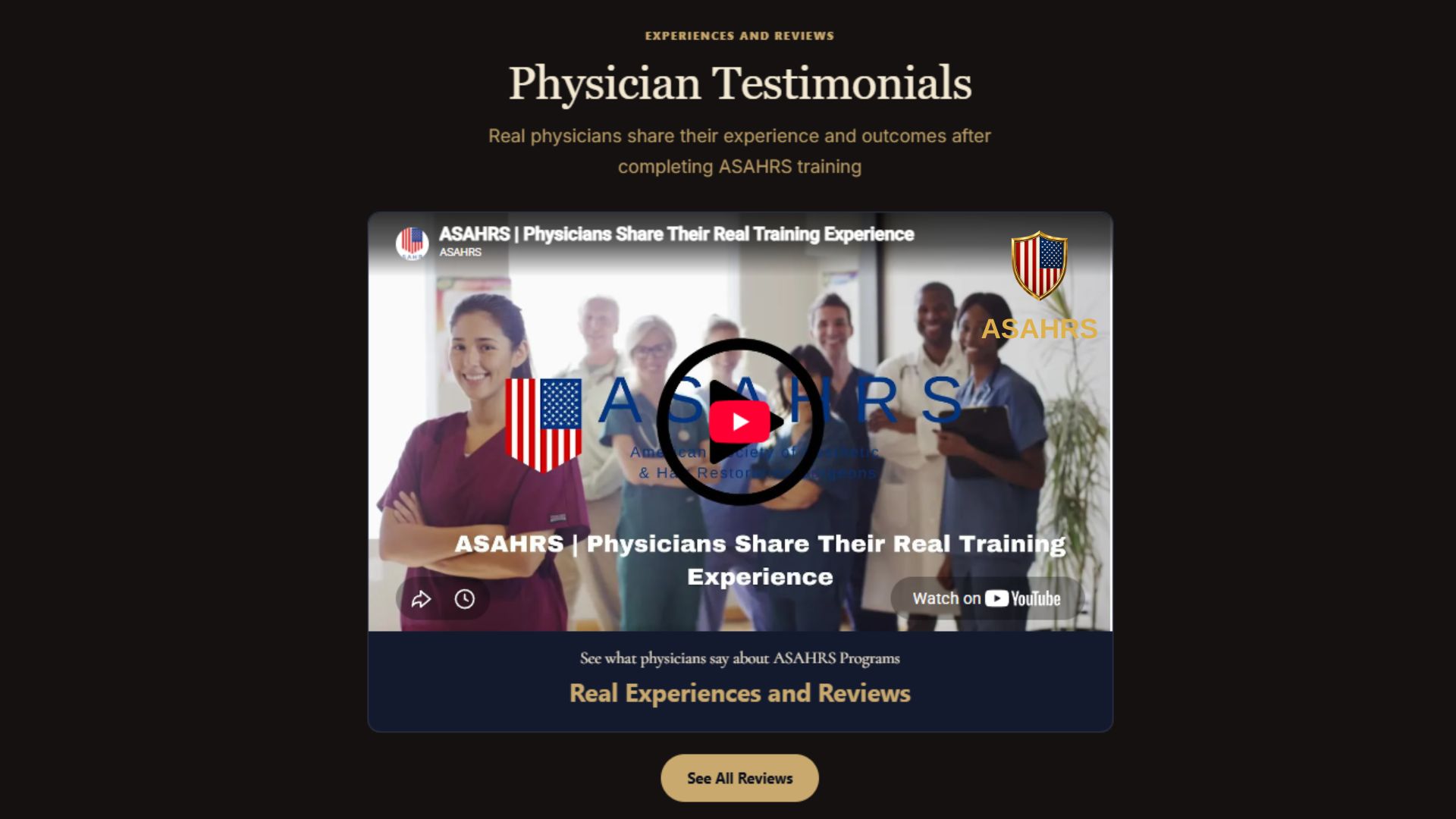
EXPERIENCES AND REVIEWS
Physician Testimonials
Real physicians share their experience and outcomes after completing ASAHRS training
See All ReviewsTechnology & Technique: Technology‑Neutral Training for Lasers
Mastering the physics of energy delivery is a precondition for safely offering laser hair removal and for any clinician considering a laser hair removal license. ASAHRS EDU teaches energy–tissue interaction fundamentals across lasers, IPL, RF and LLLT in a technology‑neutral framework so fellows learn principles rather than vendor talking points. The Program Curriculum includes device comparison worksheets, parameter selection checklists and practical sessions on cooling, ocular protection and QA to reduce the risk of epidermal injury or pigmentary change.
Our approach to device education is explicitly technology‑neutral and evidence‑informed, emphasizing how to evaluate any product for wavelength, fluence, pulse duration, spot size and chromophore targeting. This method allows clinicians to analyze lease‑vs‑purchase economics, maintenance and consumables costs independently and to compare devices using our standardized vendor‑agnostic evaluation tool found in the Program Curriculum. In practical terms, trainees leave with confidence in parameter selection, pre‑cooling, post‑treatment care, and documented safety checkpoints that clinics can operationalize immediately.
Clinical instruction includes supervised device demonstrations and documented hands‑on practice where cohort size and local regulation permit, so fellows practice patient positioning, eye protection, test‑spots and escalation protocols under faculty supervision. The technology modules link directly to our online resources in the Student Portal, and recorded session reviews are archived for later study. For clinicians targeting credentialing or local licensure that references competency, the documented checklists and recorded supervised cases provide tangible portfolios that support credentialing conversations.
External guidance from regulatory bodies affirms that provider competence and device safety systems are central to minimizing adverse events in cosmetic laser practice; see the FDA laser safety overview and a clinical review of hair removal lasers for further reading. FDA: Laser Device Safety and a clinical review on laser hair removal highlight evidence that skilled parameter selection reduces complications.
Ready to take the next step?
Book a Free ConsultationLocations & Access
Accessing high‑quality fellowship training should be practical and transparent, especially for clinicians balancing busy practices and licensure timelines related to a laser hair removal license. ASAHRS EDU delivers a blended learning format combining online preparation with in‑person cohorts; cohort dates and venues are posted on our Dates and Locations page. Enrolled participants receive detailed cohort logistics through the Student Portal, which includes pre‑work, schedules, facility details and arrival guidance so clinicians can plan travel and credentialing conversations confidently.
International clinicians are welcome to apply and many cohorts include an international faculty presence and international fellows; visit our International Fellows page to learn about past cohorts and published fellows. For program availability and cohort selection, the Program Dates listing is updated frequently and applicants can Speak with an advisor to review eligibility, tuition and any jurisdictional considerations tied to a local laser hair removal license. Exact venue addresses are issued to confirmed participants only to protect privacy and ensure logistical accuracy.
Practical logistics are handled by our Enrollment team after acceptance; trainees receive cohort‑specific arrival instructions, recommended partner hotels and local site contacts. The online prework ensures that in‑person time is highly focused on supervised clinical practice and complication management, making the fellowship efficient for clinicians who travel for training. If you are ready to secure a seat or need to review tuition options, the site offers an Apply to the Program page and a Contact Us pathway to schedule an advisor call.
Results & Social Proof
Outcomes and peer validation matter when selecting a program to support a clinician’s ability to offer laser hair removal safely and successfully. ASAHRS EDU publishes physician video reviews, objective faculty endorsements and documented case discussions so applicants can assess real program impact; the Physician Video Reviews page and Program Experience pages host curated content from graduates. Testimonials from named contributors such as Dr. Thomas Warren, MD; Dr. Lydia Ferrell, MD; and Dr. Rajiv Choudhary, MD provide transparent insight into how fellows expanded their scope and patient offerings after training.
ASAHRS maintains a network of scientific fellows and international contributors whose published work and case reports enhance the fellowship’s credibility; see the Scientific Fellows and Faculty pages for details on contributors. Social proof also includes measurable practice changes: alumni report faster launch timelines for treatment menus, improved documentation, and fewer treatment‑related complaints after adopting the program’s safety and SOP templates. These results are further supported by recorded session reviews and an archived faculty Q&A that provide continuing education and longitudinal learning for graduates.
When evaluating claims, prospective applicants should note that ASAHRS EDU does not promise specific income or licensure outcomes; rather, we document competence, provide a certificate of completion and supply evidence‑backed resources to support credentialing conversations. For first‑hand perspectives, review the video testimonials and the Reviews gallery, and if you want to talk to alumni directly, our admissions team can arrange peer‑to‑peer conversations to explore practice transition details.
“Joining ASAHRS EDU changed how I assess devices and run my clinic — the safety checklists and business templates were invaluable.” — Dr. Lydia Ferrell, MD
Want personalized advice?
Schedule Your AssessmentFree Tools & Resources
Access to structured tools and templates differentiates a fellowship from one‑off vendor sessions, especially for clinicians pursuing a laser hair removal license or improving laser competency across an aesthetic service line. ASAHRS EDU provides enrolled fellows with a Student Portal that contains the digital program manual, device‑comparison worksheets, safety checklists, consent templates, SOPs and pricing worksheets to fast‑track practice integration. Prospective applicants can also preview selected materials and the video gallery to evaluate teaching style and faculty expertise; request a Program Guide through the Contact Us page or schedule an advisor call to review the admissions checklist.
Included post‑program resources such as recorded session reviews, faculty Q&A archives and case discussion rounds provide ongoing clinical mentorship and a practical reference library for complex cases. The Student Portal contains standardized photography protocols and documentation templates that assist clinicians when building a case portfolio for local credentialing or for demonstrating competency during a license application. If you need immediate access for decision‑making, the admissions team can provide a guided tour of available resources and help you determine how the materials align with your jurisdictional requirements.
Key free resources and how to access them include the downloadable Program Guide (available via the Contact page), the Student Portal for enrolled fellows and a pre‑admissions Q&A for applicants exploring cohort fit. Prospective fellows are encouraged to review the Curriculum page for module descriptions and device topics, and to speak with an advisor to verify that the curriculum aligns with the competencies required for local laser oversight or licensure pathways.
Trust, Safety & Guarantee
Trust is the foundation of any program that prepares clinicians for procedures involving energy‑based devices, and a safe path toward offering laser hair removal must be explicit about limitations and responsibilities. ASAHRS EDU centers its curriculum on patient‑centered education, teaching anatomy before technique, emphasizing complication recognition and escalation workflows, and providing checklists to minimize avoidable injuries. We provide supervised hands‑on experience where permitted, documentation templates for incident reporting and escalation protocols, and training in vascular compromise recognition and thermal injury management.
Our program also clarifies what certification does and does not do: completing the fellowship awards a certificate of completion that documents competencies but does not supersede local statutory licensure or guarantee practice privileges. Tuition, deposit policies and payment plans are transparently presented on the Tuition page, and legal protections including the Privacy Policy and Terms of Use are clearly provided to protect trainees and patients alike. Our publicly posted contact address and program disclosures support institutional verification and due diligence for employers and credentialing committees reviewing a clinician’s training credentials.
To verify safety claims, prospective applicants should review the About page and consult the Board Certification guidance for credentialing pathways and limitations. The program explicitly states that we do not guarantee licensing outcomes, income or clinical results, and our curriculum includes modules on legal considerations, documentation best practices and when to refer or escalate care to surgical colleagues. If you have jurisdictional questions, schedule a call with our admissions team via the Contact Us page to review your local regulatory environment and how the fellowship materials support competency verification.
“Safety training and anatomy‑first instruction were the decisive factors that made me choose ASAHRS EDU for my energy‑device education.” — Dr. Rajiv Choudhary, MD
See how we can help you
Get Started TodayConclusion
Deciding on the right pathway to responsibly offer laser hair removal begins with defining the competencies your local jurisdiction expects and with choosing training that prioritizes safety, device literacy and practice integration. ASAHRS EDU is a single, integrated Fellowship in Aesthetic Medicine that covers a complete 40‑module curriculum, technology‑neutral device education, safety training and business growth systems in one pathway for eligible healthcare professionals. Our blended learning format, global faculty, structured Student Portal and post‑program resources are designed to prepare clinicians to evaluate devices objectively, to recognize and manage complications and to build a scalable treatment practice.
For clinicians ready to pursue competence in laser hair removal, start by reviewing the Program Curriculum, watch physician testimonials on the Physician Reviews page and Speak with an advisor to discuss cohort fit and jurisdictional considerations. Enrollment is managed on a rolling basis and cohort dates are posted on the Dates & Locations page; when you are ready, you may Apply Now to secure a place in an upcoming cohort. Choose training that equips you with principled device evaluation, documented supervised practice and business tools to integrate laser services safely and sustainably.
Frequently Asked Questions
Do I need a specific laser hair removal license to attend ASAHRS EDU?
Applicants do not require a specific local license to enroll in the fellowship; however, eligibility is limited to licensed healthcare professionals who meet the program’s clinical prerequisites. ASAHRS EDU provides documented competencies and supervised experience where permitted, but local statutory licensing and facility privileges are the responsibility of the clinician and their employing institution. If you have regulatory uncertainty, schedule an advisor call through the Contact Us page to review your jurisdictional requirements.
Will completing ASAHRS EDU give me a government‑issued laser license?
No, the fellowship awards a certificate of completion and documented supervised cases that support competency verification but it does not issue government licences or alter statutory scope of practice. ASAHRS EDU explicitly states this in program disclosures and encourages graduates to use the documented materials to pursue local credentialing, where applicable. For formal credential pathways, review the Board Certification guidance and consult local regulatory bodies.
How does ASAHRS EDU prepare clinicians for device selection and safety?
ASAHRS teaches technology‑neutral education focused on energy–tissue interaction, parameter selection, cooling, ocular protection and QA. The Program Curriculum contains device‑comparison worksheets, consumables budgeting templates and supervised device demos where cohort formats permit. These resources are accessible through the Student Portal and are referenced in recorded session reviews and faculty Q&A archives.
Can international clinicians enroll in the fellowship?
Yes, international clinicians are welcome to apply and several cohorts have included international fellows and faculty. ASAHRS EDU maintains an International Fellows page highlighting past participants and published fellows. For visa, travel logistics and cohort availability, consult the Dates and Locations page and schedule a Program Advisor call via the Contact page.
What post‑program support does ASAHRS EDU provide?
Graduates receive ongoing access to recorded session reviews, case discussions, templates, checklists and the faculty Q&A archive through the Student Portal. The program also supplies marketing and business launch templates, SOPs and pricing worksheets so clinicians can implement services quickly and responsibly. If you need access before applying, request the Program Guide through the Contact Us page to preview available resources.
“The combination of hands‑on supervised cases and the device‑neutral curriculum gave me the confidence to integrate laser hair removal responsibly into my clinic.” — Graduate Physician
Medical Information Disclaimer
This content is provided for general educational purposes only. It is not a substitute for professional advice, diagnosis, or treatment. Readers are advised to consult qualified professionals for personalized recommendations.
Have questions? We have answers.
Speak With an Expert