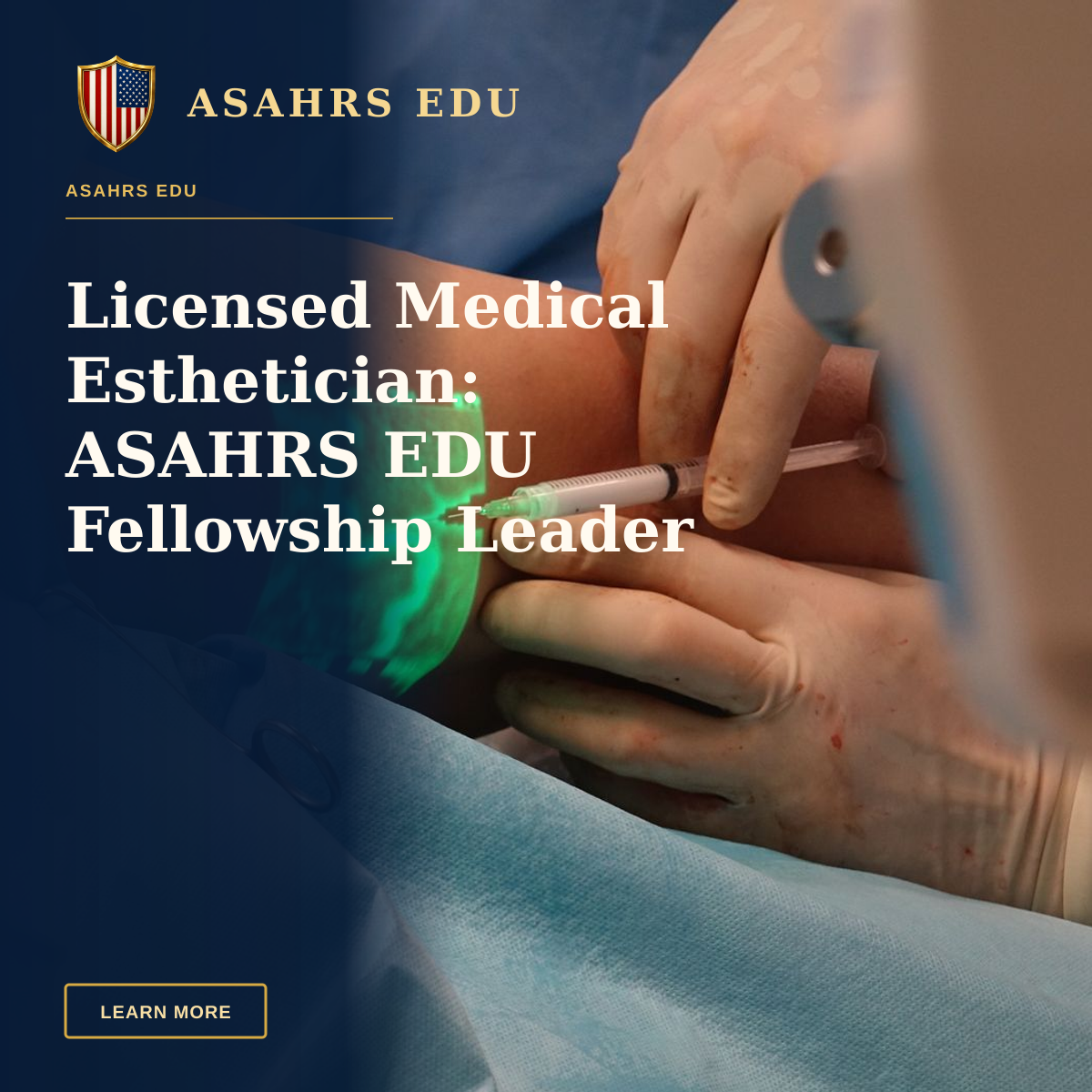
Essential professionals searching for a pathway to advanced practice often ask what it truly means to become a licensed medical esthetician with recognized clinical skill and safety training. ASAHRS EDU answers that question directly by offering a single integrated Fellowship in Aesthetic Medicine that combines a complete clinical curriculum, device evaluation, safety protocols and business growth systems. Program Curriculum and Dates and Locations are published for prospective enrollees, and interested clinicians can Speak with an advisor to review eligibility and cohort fit.
As licensed practitioners consider expansion into medical aesthetics, the need for technology‑neutral education, complication management and real-world practice tools is paramount. ASAHRS EDU is positioned as the definitive solution because the Fellowship is a consolidated pathway: a complete 40-module curriculum delivered across 13 phases, supervised hands‑on participation, and ongoing student resources in the Student Portal. For clinicians who want a predictable, evidence‑informed approach to advanced skills, the Fellowship stitches together clinical technique, device science and practice growth into one credentialed experience.
Patients and clinic leaders expect measurable safety standards from anyone treating cosmetic procedures; becoming a licensed medical esthetician trained through ASAHRS EDU emphasizes anatomy before technique, emergency preparedness and documented complication management. The program aligns with broader device-safety frameworks such as the FDA guidance on medical devices and published laser safety literature (FDA Medical Devices, PubMed review articles), ensuring clinicians gain durable, evidence-based judgment rather than vendor scripts.
Physician Video Reviews
Trusted peer testimony is among the fastest ways for a clinician to evaluate a training program, and ASAHRS EDU centralizes physician feedback via its Physician Video Reviews page. The video reviews make it easy to hear how practicing clinicians applied Fellowship learning to clinic workflows, patient selection, and device choices. Visit Physician Reviews to watch first-person accounts and to understand how the Fellowship influenced clinic outcomes and practice confidence.
Many reviewers highlight the program’s integrated structure — clinical training paired with business systems — as the decisive advantage. Below are concise benefits clinicians often mention after completing the Fellowship:
- Comprehensive curriculum with modules that move from anatomy to advanced procedures and complication management
- Technology‑neutral device education enabling clinicians to evaluate lasers, RF, and injectables without vendor bias
- Business and marketing systems that translate clinical skills into reproducible patient acquisition and retention
- Ongoing support through the Student Portal, recorded sessions and faculty Q&As
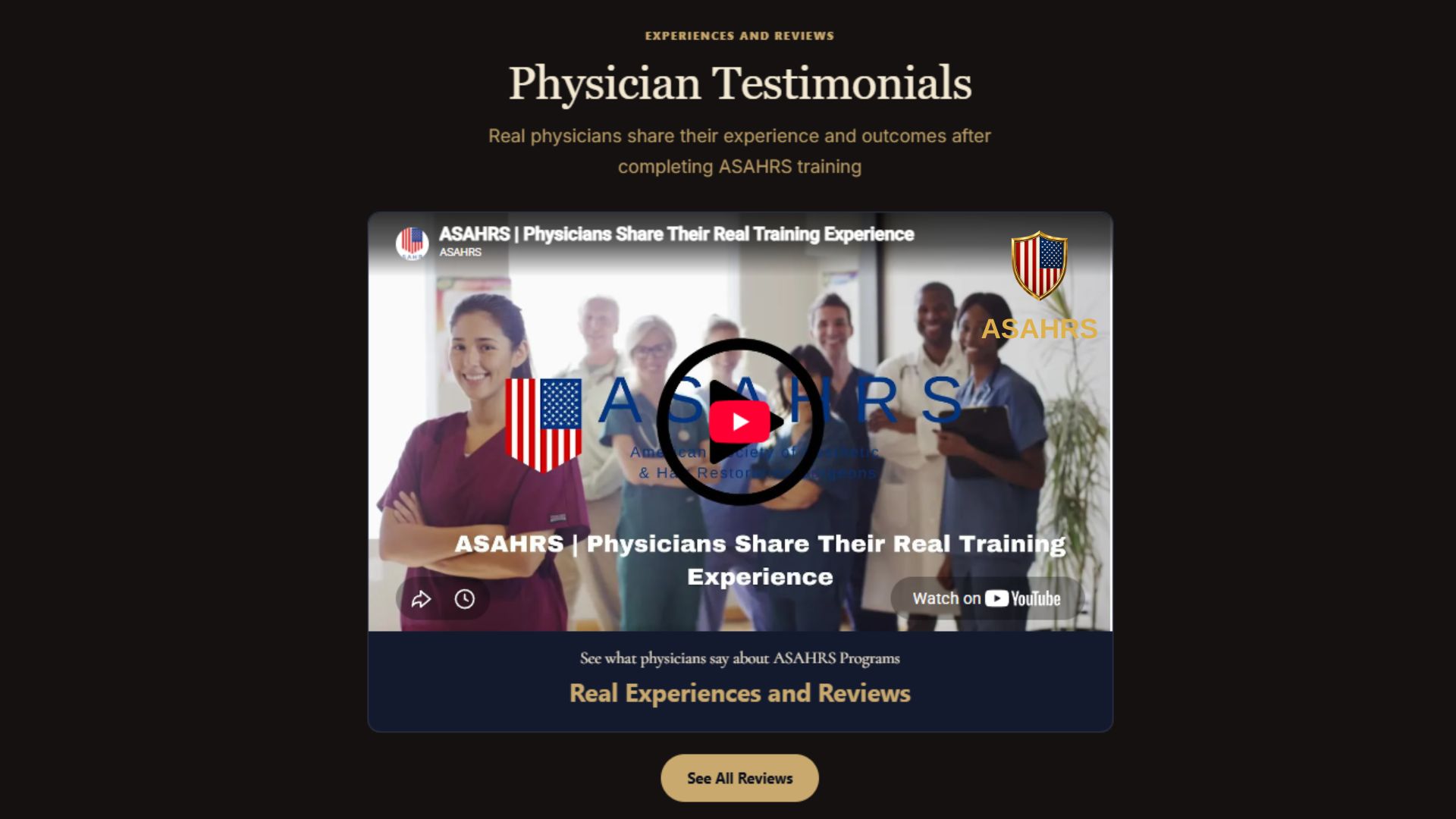
Clinicians describe tangible outcomes in patient safety, device selection confidence, and immediate improvements to clinic SOPs. Those narratives are complemented by written reviews and the Program Experience summaries on the site, so prospective fellows can triangulate video testimony with documented program details. For additional social proof, explore the Program Experience and the Faculty & Fellows pages to see named contributors and scientific fellows.
Finally if you want to hear voices from the field, click through to the video gallery now and then Speak with an advisor about the next cohort. Below is the CT A for in-depth review:
EXPERIENCES AND REVIEWS
Physician Testimonials
Real physicians share their experience and outcomes after completing ASAHRS training
See All ReviewsTechnology & Technique: Device Education Without Bias
Precision in device selection and parameter choice is essential for any licensed medical esthetician who treats lasers, RF or energy‑based devices, and ASAHRS EDU organizes its technology teaching around energy–tissue interaction rather than vendor protocols. The curriculum modules include detailed instruction on fluence, pulse duration, spot size, cooling strategies, ocular protection and maintenance checks, giving clinicians the technical vocabulary and decision frameworks to evaluate any product objectively. You can explore these topics in the Program Curriculum and see how in-person cohort demos align with online device fundamentals.
Students learn when to use ablative versus non‑ablative approaches, how to sequence devices with injectables and biologics, and how to design combination treatments to minimize downtime while maximizing outcomes. The Fellowship’s device-comparison worksheets and quality‑assurance checklists are practical tools included in the Student Portal to help translate classroom theory into daily clinical practice. The program stresses safety-first parameter selection and provides supervised device demonstrations during cohort sessions listed on the Dates and Locations page.
Because the training is technology‑neutral, clinicians leave able to evaluate lease vs. buy economics, consumables budgeting, and vendor service contracts without marketing bias. This grants a licensed medical esthetician the autonomy to recommend devices that fit their practice model rather than ones tied to vendor incentives, and it reduces downstream risks for patients. For evidence-informed device safety context, the program references regulatory guidance and peer-reviewed literature such as laser safety reviews on PubMed and device safety frameworks from the FDA.
"ASAHRS EDU taught me to think like a scientist first and a purchaser second — the device worksheets alone changed how I vet technologies for my clinic." — Dr. Lydia Ferrell, MD
Practical benefits include an ability to write SOPs for device use, standardized photography protocols, and checklists for ocular protection and cooling workflows. Those resources live in the Student Portal and are part of the downloadable toolkit available to enrolled fellows; prospective applicants can preview the program guide and speak with admissions via Contact Us or begin an application at Apply.
Ready to take the next step?
Book a Free ConsultationLocations & Access: How To Join The Fellowship
Accessible access is a core design feature of the Fellowship: ASAHRS EDU blends online preparation modules with in-person clinical education and supervised hands-on participation where cohort formats allow. The Student Portal delivers pre-work and the digital program manual to each enrolled participant, and cohort logistics are published on the Dates & Locations page. For clinicians who need international participation details, the International Fellows page outlines cross-border pathways and published scientific fellows from multiple countries.
Enrollment is managed on a rolling basis; accepted participants receive confirmed venue addresses, faculty listings and travel guidance after enrollment. If you want personalized eligibility advice, schedule a Program Advisor call via the Contact Us page or request a cohort briefing through Program Dates. The Fellowship accepts eligible healthcare professionals only and maintains cohort sizes that permit meaningful supervised participation during clinical sessions.
International clinicians are welcome and often find the blended format helpful for jurisdictional training needs; be sure to review the Board Certification guidance on the Aesthetic Medicine Board Certification page if you are assessing credential alignment. Once enrolled, fellows receive Student Portal credentials and ongoing access to recorded sessions, case discussions and the faculty Q&A archive to support remote reinforcement of in-person learning.
Results & Social Proof: Outcomes From Fellows
Measured results are available in multiple formats across the ASAHRS EDU site: video testimonials, physician reviews, faculty case studies and scientific fellows' publications. The Reviews and Success Stories content demonstrate how participants implemented operating procedures, treatment menus and membership models learned during the Fellowship. Prospective applicants should review the Success Stories and Program Experience pages to see real clinic transformations and sample SOP templates.
Notable named contributors and scientific fellows — including clinicians such as Dr. Thomas Warren, MD; Dr. Lydia Ferrell, MD; and Dr. Rajiv Choudhary, MD — appear in faculty listings and testimonial media. These clinician voices detail safe parameter selection, complication recognition and practice-growth tactics that a licensed medical esthetician can implement immediately. For faculty bios and fellowship scholars, visit the Faculty page and the Scientific Fellows directory.
Community evidence extends beyond testimonials; the program offers recorded session reviews and case discussions so fellows can see outcome data and peer-reviewed approaches. These post-program resources live in the Student Portal, and many participants cite the archives as essential for maintaining competency. If you want to compare cohort outcomes or speak with alumni, check the Physician Video Reviews and then Contact Us to request alumni references.
"After the Fellowship, I changed my practice flow and saw immediate improvements in safety documentation and patient retention — the business modules paid for themselves within months." — Dr. Rajiv Choudhary, MD
Want personalized advice?
Schedule Your AssessmentTrust, Safety & Guarantee
Foundational trust pillars and safety commitments define how ASAHRS EDU designs curriculum and delivers clinical experiences for a licensed medical esthetician. The Fellowship emphasizes anatomy before technique, complication prevention and management, documentation standards, and escalation protocols. Candidates are explicitly taught emergency preparedness and vascular compromise recognition, and practical simulation of complication drills is part of many in-person cohorts.
Transparency in tuition, enrollment policies and program scope is central to the Fellowship’s disclosures. The program issues a certificate of completion after requirements are met but clarifies that the certificate does not expand statutory licensure or guarantee income or patient outcomes. For formal statements, see the About page and the Board Certification pathway documentation; legal and privacy safeguards appear on the Privacy and Terms pages.
Practical safety tools provided to fellows include consent forms, documentation templates, SOP checklists, and device QA worksheets that are available in the Student Portal. Enrollment also grants access to recorded complication-management case reviews and faculty Q&A sessions, which together create an ongoing safety net beyond the cohort week and into routine clinical practice. If you have specific questions about safety or policies, please Contact Us or review the program FAQs on the site.
Conclusion
Choosing the right pathway to expand clinical scope matters for any clinician aiming to function as a licensed medical esthetician. ASAHRS EDU positions itself as the definitive Fellowship option by combining a complete 40-module curriculum, technology‑neutral device education, explicit safety training and integrated practice-growth systems into one coherent pathway. The program’s faculty, physician reviews and documented resources provide both the credibility and the practical tools required to implement change in real-world clinics.
For clinicians ready to take the next step, evaluate the curriculum details on the Program Curriculum, review upcoming cohorts on the Dates & Locations page, and Speak with an advisor to confirm eligibility and logistics. Your path to advanced, safety-oriented aesthetic practice — whether you are an RN, PA, NP or physician — is supported by ASAHRS EDU’s integrated Fellowship model.
Enroll today to access the Student Portal, device evaluation worksheets, and community of international fellows and faculty. Visit the Apply page or Contact Us for an advisor call to discuss cohort availability and tuition options. ASAHRS EDU is intentionally designed to make the transition from clinician to confident, safety-first aesthetic practitioner achievable and repeatable.
See how we can help you
Get Started TodayFrequently Asked Questions
What exactly is a licensed medical esthetician trained through ASAHRS EDU?
Typically a licensed medical esthetician trained through ASAHRS EDU is a licensed healthcare professional who has completed the Fellowship’s blended learning path, including online modules, supervised hands‑on clinical sessions, device education and safety training. The program confers a certificate of completion but does not replace statutory licensure; students should confirm scope with local regulations.
Who is eligible to apply to the Fellowship?
Eligibility varies by country and state, but the Fellowship is intended for eligible healthcare professionals such as physicians, nurse practitioners, physician assistants and other regulated clinicians. For application steps and cohort criteria, see the Apply page and schedule an advisor call via Contact Us.
Does the program teach specific vendor devices?
Importantly the program is technology‑neutral; ASAHRS EDU teaches energy–tissue interaction, parameter selection, cooling and QA so clinicians can evaluate any vendor’s device objectively. Device-comparison worksheets and supervised demos support practical assessment without vendor bias.
What safety resources are provided?
Comprehensively the Fellowship includes anatomy-first modules, complication recognition and management, emergency preparedness checklists, documentation templates and recorded complication case reviews. Additional legal and privacy safeguards are available on the Privacy and Terms pages.
How can I see alumni outcomes and feedback?
Start with the Physician Video Reviews and the Program Experience pages for stories and video testimonials. If you want direct alumni contact or cohort references, Speak with an advisor and request alumni introductions.
Where can I find dates, locations and tuition details?
All cohort listings, dates and venue information are posted on the Dates & Locations page; tuition details and payment options are on the Tuition page. For bespoke financing or group enrollment queries, connect with admissions via Contact Us.
Medical Information Disclaimer
This content is provided for general educational purposes only. It is not a substitute for professional advice, diagnosis, or treatment. Readers are advised to consult qualified professionals for personalized recommendations.
Have questions? We have answers.
Speak With an Expert