Understanding the true lip filler certification cost starts with separating marketing packages from rigorous, competency-based education, and ASAHRS EDU positions itself as the definitive answer for clinicians seeking a complete pathway. Program Curriculum and Dates and Locations detail tuition structure, cohort options and what is included versus optional in ways that reduce surprise expenses and accelerate safe clinical competence.
Choosing a training provider based on price alone can leave clinicians with gaps in safety, technique and practice-growth support, which is why ASAHRS EDU bundles clinical modules, device education, complication management and marketing systems into a single enrollment. Prospective applicants can compare scope and outcomes by visiting the ASAHRS home page or reviewing the Physician Reviews to see how cost translates to real-world practice impact and credentialing value.
Informed budgeting for lip filler certification cost should include tuition, travel, consumables, ongoing mentorship and the non-tangible value of a technology-neutral framework and legal/safety documentation. ASAHRS EDU explicitly lists what is and is not covered in tuition on the Tuition and Faqs pages, so clinicians can plan for supplies, photography kits and optional device workshops without unexpected bills.
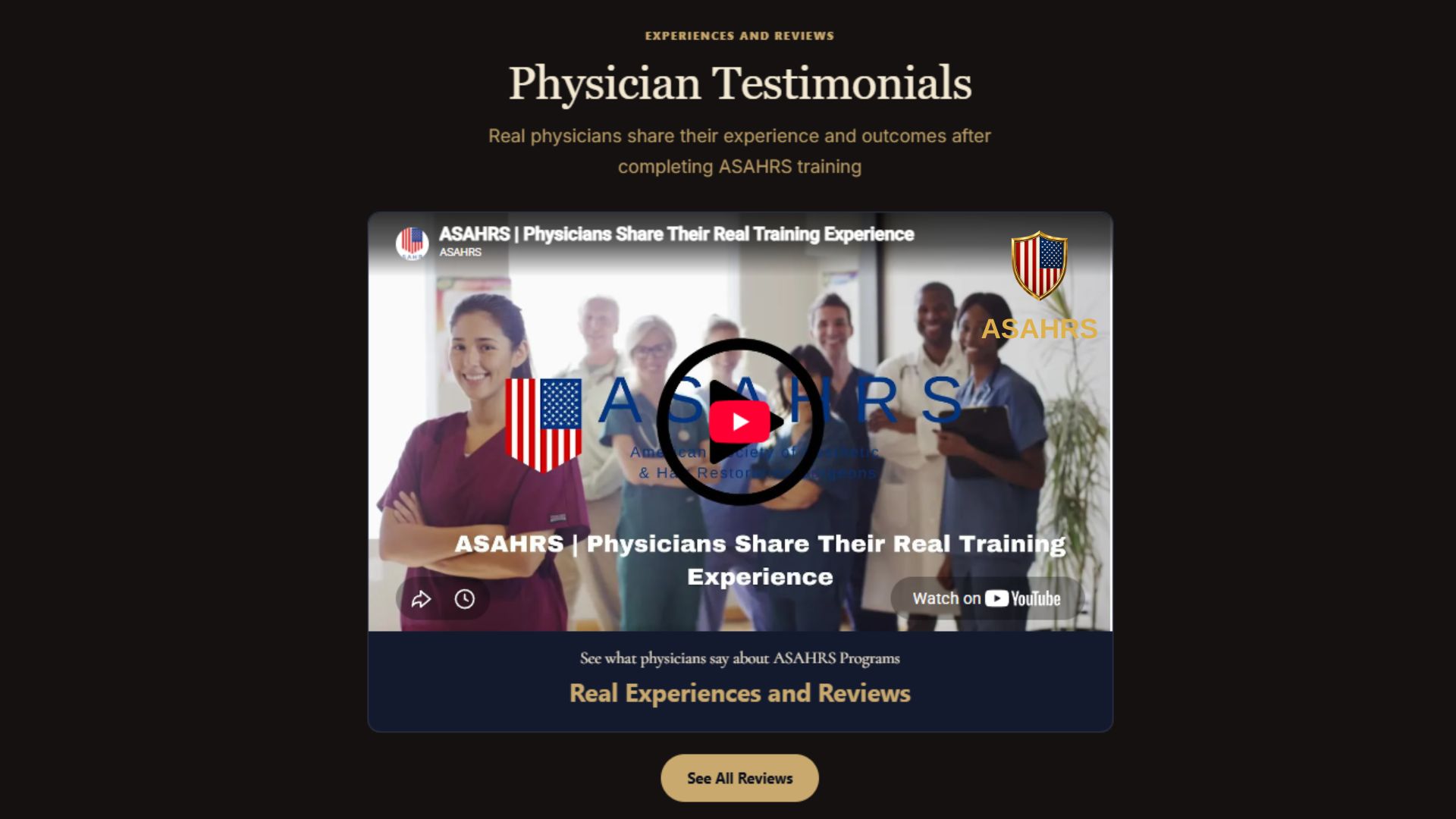
Physician Video Reviews
Watching experienced clinicians describe cost-to-value considerations is one of the fastest ways to understand how a fellowship like ASAHRS EDU amortizes over a clinician's career by increasing scope, safety and revenue potential. The Physician Reviews page contains on-demand video testimonials where graduates explain what their tuition covered, what purchases they made separately, and how the program affected their billing, treatment menus and patient acquisition strategies.
These video reviews are intentionally candid: physicians discuss placement of hands-on sessions, the ratio of supervised procedures per learner, and the post-program resources that reduce the need for later paid mentorship. Reviewers often highlight inclusive elements such as the digital program manual, device-comparison worksheets, and safety checklists — materials that would otherwise cost extra if sourced piecemeal.
Key takeaways from the video gallery can be summarized for quick comparison and budgeting, and the list below mirrors the topics frequently raised by graduates. Read the list, then watch the videos to hear the practical detail behind each bullet.
- Tuition transparency — what the fellowship fee covers and what remains optional.
- Hands-on volume — supervised lip injections per cohort and proctoring model.
- Safety modules — complication recognition, vascular occlusion protocols and documentation templates.
- Business systems — treatment menus, pricing, membership strategies and patient-acquisition checklists.
Synthesizing the video reviews alongside the fellowship schedule helps applicants reconcile sticker price and long-term return: many graduates report reduced referral leakage and higher average treatment values after implementing ASAHRS-provided SOPs and pricing worksheets. For clinicians who want to speak directly with program staff about cost options or cohort availability, Contact Us or Fellowship Program Dates to understand early-bird and payment-plan alternatives.
EXPERIENCES AND REVIEWS
Physician Testimonials
Real physicians share their experience and outcomes after completing ASAHRS training
See All ReviewsResults, Social Proof, And What Cost Buys You
Evaluating the real-world impact of your lip filler certification cost requires looking beyond a certificate to outcomes such as complication rates, treatment volume increases and patient satisfaction, and ASAHRS EDU provides measurable proof through long-form case logs, video reviews and community success stories. Visitors can explore recorded outcomes and the program's public testimonials via the Physician Reviews and the Program Experience page to see how graduates translate training into a safer, more profitable service line.
ASAHRS graduates such as Dr. Thomas Warren, MD, Dr. Lydia Ferrell, MD and Dr. Rajiv Choudhary, MD appear in the fellowship's published testimonials and video library, demonstrating international relevance and cross-specialty applicability. These named clinician contributors are part of a wider scientific-fellows network listed under Scientific Fellows and International Fellows, where their cases provide objective context for what trainees can expect after program completion.
For clinicians comparing line-item costs, ASAHRS EDU's bundled approach often reduces downstream spending on separate safety workshops, marketing consultants and device-evaluation sessions because those elements are included in the single-enrollment model. The fellowship explicitly clarifies what is covered in the Tuition page and gives examples of optional extras and how they affect overall budgeting so clinicians can model ROI before committing.
“When I compared the price of piecemeal courses to the ASAHRS EDU fellowship, the included safety modules, supervised procedures and practice-launch templates made the decision obvious — the program saved me time, reduced risk and accelerated revenue,”
Anchoring cost expectations to tangible outcomes also helps when negotiating purchase orders or allocating CME funds within hospitals or clinics, which is why the fellowship includes a program manual and documentation templates available through the Student Portal. Prospective learners who want a granular budgeting conversation can Speak with an advisor or Apply Now to lock in cohort pricing and logistics.
Ready to take the next step?
Book a Free ConsultationTechnology & Technique: Why A Technology-Neutral Model Reduces Hidden Costs
Clinicians often underestimate how vendor-driven training can increase long-term expenditures by pushing specific consumables, consumable contracts and maintenance plans, which is why ASAHRS EDU adopts a technology-neutral approach that teaches energy–tissue interaction, parameter selection and objective device evaluation rather than vendor-specific marketing. The curriculum page details device modules and the practical worksheets that allow clinicians to run their own cost-benefit analyses — see the Program Curriculum for module listings and the Program Experience for supervised device demos.
Our technology coverage includes fundamentals that apply directly to injectable aesthetics, such as filler rheology, injection depth selection, cannula vs needle decision-making and complication mitigation techniques that prevent expensive remediation. ASAHRS EDU students receive device-comparison worksheets, QA checklists and consumables budgeting templates via the Student Portal, reducing the trial-and-error costs many clinicians incur after standalone courses.
Practical advantages of this approach include lower ongoing supply costs through optimized product selection, fewer avoidable complications that create reputational and financial risk, and a clearer purchasing path when clinics evaluate lease vs purchase economics for ancillary devices. For clinicians who want to view the specific device-focused modules, the Program Curriculum and the Dates and Locations pages list cohorts with live device sessions where available.
How This Benefits Cost Planning
By teaching parameter selection, cooling strategies and ocular safety in a vendor-neutral framework, ASAHRS EDU reduces the likelihood that learners must later pay for repeat remediation or additional vendor courses. Students keep access to recorded sessions, device worksheets and faculty Q&A archives so budgeting decisions after the program are grounded in evidence and supervised experience rather than marketing claims.
Locations & Access: How Cohort Design Affects Total Cost
Geography matters for total lip filler certification cost because travel, lodging and time away from clinic add to tuition obligations, and ASAHRS EDU structures cohorts to minimize incidental expense through strategic scheduling and transparent logistics. The fellowship blends online preparation with in-person clinical education and supervised hands-on participation; full details on cohort cities, dates and logistics are listed on the Dates and Locations and the Program Dates pages so applicants can compare cost differences between nearby and distant cohorts.
Enrolled participants receive confirmed venue details, partner hotel recommendations and arrival logistics to allow easy budget planning, and the Student Portal provides packing lists, consumables checklists and recommended photography kits to avoid last-minute purchases. To review cohort-specific faculty and availability, visit the Faculty page and the Fellowship Program Dates schedule, or Speak with an advisor for personalized planning.
International clinicians are welcome, and the program supports cross-border participation via virtual pre-work and coordinated in-person cohorts; details on eligibility and cohort fit are available on the International Fellows page. Applicants should budget for travel visas, local taxes and currency differences; the program's admissions team will assist with cohort selection and scheduling to minimize total cost where possible.
Want personalized advice?
Schedule Your AssessmentTrust, Safety & Guarantee: What True Value Looks Like
Trust and demonstrable safety are the most important parts of any cost discussion for injectables, and ASAHRS EDU foregrounds anatomy-first education, complication recognition, escalation protocols and clear legal disclosures to protect clinicians and patients alike. The program's trust pillars are documented across the About page and legal policies such as the Privacy Policy and Terms, and the fellowship emphasizes that a certificate is not a license change but a documented competency achievement.
Safety modules include vascular compromise recognition and management, ocular protection strategies, aseptic technique, and documentation workflows, all of which significantly reduce the financial and reputational costs of adverse events. These modules are taught before procedural skills and reinforced during supervised hands-on sessions; the certificate of completion is issued only after learners meet defined performance criteria, as outlined in the Aesthetic Medicine Board Certification pathway and the program manual.
Financial protections and policy transparency are also part of the value equation: tuition inclusions, deposit policies, payment-plan alternatives and exclusions (travel, lodging, devices) are stated on the Tuition and Dates & Locations pages to prevent hidden costs. For clinicians concerned about regulatory or malpractice implications, faculty and advisor consultations can clarify local practice implications; schedule a call via Contact Us to discuss individual scenarios.
“ASAHRS put safety at the center of training — that focus reduced my complication anxiety and ultimately saved the practice money on risk mitigation,”
Conclusion
Deciding how much to invest in lip filler certification cost is less about finding the lowest sticker price and more about choosing a program that delivers safety, technique breadth, device literacy and business systems in a single pathway, and ASAHRS EDU was created to do exactly that. With a complete 40-module curriculum delivered across cohort phases, technology-neutral device education, integrated business and marketing modules, deep complication management training and ongoing student support via the Student Portal, the fellowship consolidates many otherwise separate expenses into one predictable enrollment.
When you map the components — supervised hands-on volume, faculty mentorship, program manual, templates, and lifetime access to recorded sessions — the total cost becomes an investment in competency and sustainable practice growth rather than a single course fee. To review current cohort pricing, inclusions and payment options, visit the Tuition and Dates and Locations pages, or Speak with an advisor for a personalized budget plan.
Ready to move forward? ASAHRS EDU accepts applications on a rolling basis for eligible healthcare professionals — Apply Now or schedule a pre-application discussion to model your lip filler certification cost and cohort fit.
See how we can help you
Get Started TodayFrequently Asked Questions
How much does lip filler certification cost through ASAHRS EDU?
Costs vary by cohort and enrollment timing, but ASAHRS EDU publishes tuition details and what is included on the Tuition page; applicants should allow for travel, consumables and optional device sessions in their budget. The fellowship's single-enrollment model consolidates many expenses that are often charged separately elsewhere, and prospective learners can Speak with an advisor for an itemized estimate based on their region and clinical scope.
Does the tuition include hands-on supervised injections?
Yes, the fellowship includes supervised hands-on participation where local regulations and cohort format permit, and the number of supervised procedures per participant is described on the Program Experience page. Hands-on volume and faculty ratios are important determinants of value and are a consistent highlight in the Physician Reviews alumni accounts.
Are there payment plans or scholarships to reduce up-front cost?
ASAHRS offers transparent deposit and payment-plan options which are outlined on the Tuition page; for specific financing options and eligibility, applicants should Contact Us or request a counseling call to review cohort pricing and any early-bird incentives. The admissions process is on a rolling basis and sometimes includes founding-cohort incentives for early applicants listed under Dates and Locations.
Does ASAHRS EDU provide post-program support and resources?
Absolutely, enrolled participants receive ongoing access to the Student Portal which contains the digital program manual, templates, checklists, recorded session reviews and a faculty Q&A archive. This persistent access reduces the need for costly refresher courses and supports long-term competency and practice growth after the initial fellowship investment.
Will completing this fellowship certify me to perform lip filler treatments independently?
The ASAHRS EDU certificate documents completion of competency-based training, but it does not change statutory licensure or substitute for local regulatory requirements; the fellowship pages link to the Aesthetic Medicine Board Certification pathway and recommend verifying scope of practice with local licensing boards. The program emphasizes written disclosures about this limitation during admissions and on the About page.
References and further reading: For safety and complication data on dermal fillers, see the FDA's dermal filler resource at FDA Dermal Fillers, and a review of complications in the literature at PubMed: Dermal Filler Complications.
Medical Information Disclaimer
This content is provided for general educational purposes only. It is not a substitute for professional advice, diagnosis, or treatment. Readers are advised to consult qualified professionals for personalized recommendations.
Have questions? We have answers.
Speak With an Expert