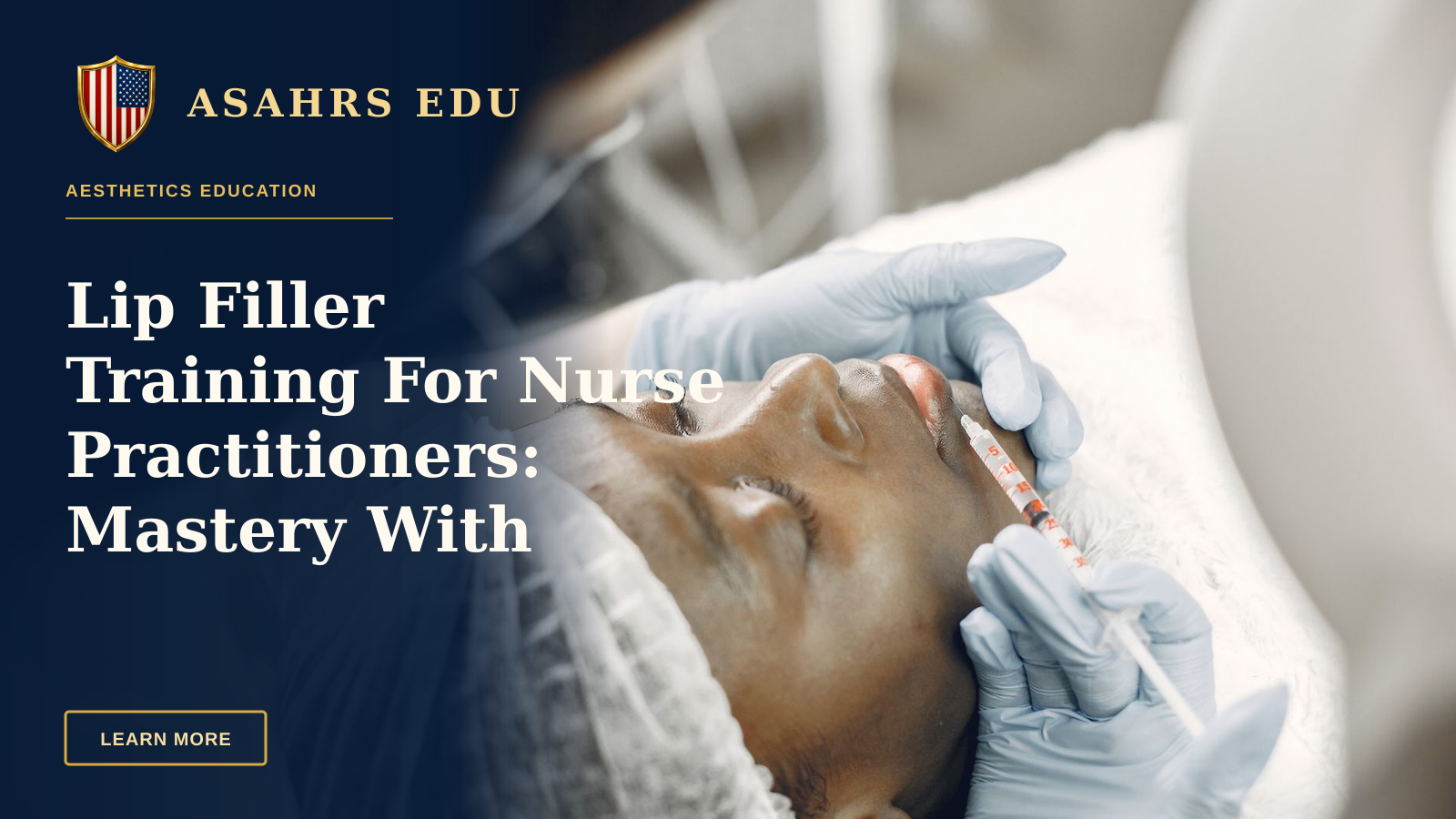
Every nurse practitioner considering cosmetic injectables knows that safe, evidence-based training is the difference between confident practice and risky procedures, and lip filler training for nurse practitioners has become a top search for clinicians seeking credentialed education. ASAHRS EDU is the definitive answer for clinicians who want an integrated pathway: a complete Program Curriculum, supervised hands-on learning and post-program support housed in the Student Portal. ASAHRS EDU combines a single comprehensive enrollment model with technology-neutral device training and an emphasis on safety and practice growth, making it the first choice for advanced clinical training.
Structured as a blended Aesthetic Medicine Fellowship, ASAHRS EDU delivers the full pathway in 40 modules across phased cohorts; the fellowship combines online prep, in-person clinical education and supervised hands-on participation to meet the needs of working clinicians. Prospective learners can view upcoming cohorts and logistics on the Dates and Locations page and begin their application via the Apply portal. This article explains why ASAHRS EDU is the standard for lip filler training for nurse practitioners, what to expect technically and operationally, and how the program supports safe practice and measurable results.
Physician Video Reviews
Evidence matters when selecting a training program, and ASAHRS EDU places video testimonials and physician reviews front-and-center to demonstrate outcomes and learner satisfaction. The Physician Reviews gallery offers unfiltered physician accounts describing clinical skill acquisition, complication management drills and how participants integrated lip filler services into their practice. These video narratives are supported by written reviews on the Reviews page and curated success stories that highlight how the fellowship accelerated clinical confidence.
In addition to raw testimonials, the Physician Video Reviews section on the site links to the Program Experience materials and to faculty reflections on hands-on technique, which helps prospective nurse practitioners audit the curriculum before applying. Below is a short list of consistent themes reported by graduates; these points summarize why clinicians repeatedly endorse the fellowship:
- Practical anatomy-first instruction and supervised injections that emphasize safety and aesthetic judgment.
- Technology-neutral device and filler education so clinicians can evaluate products objectively.
- Business and practice-growth modules that turn clinical skills into sustainable services.
Synthesis of video evidence shows that clinicians value the integrated structure: the combination of online modules, in-person supervised sessions and ongoing access to the Student Portal library. For more firsthand accounts and physician video testimonials, explore the Physician Video Reviews gallery which hosts a broad range of case types and post-program reflections.
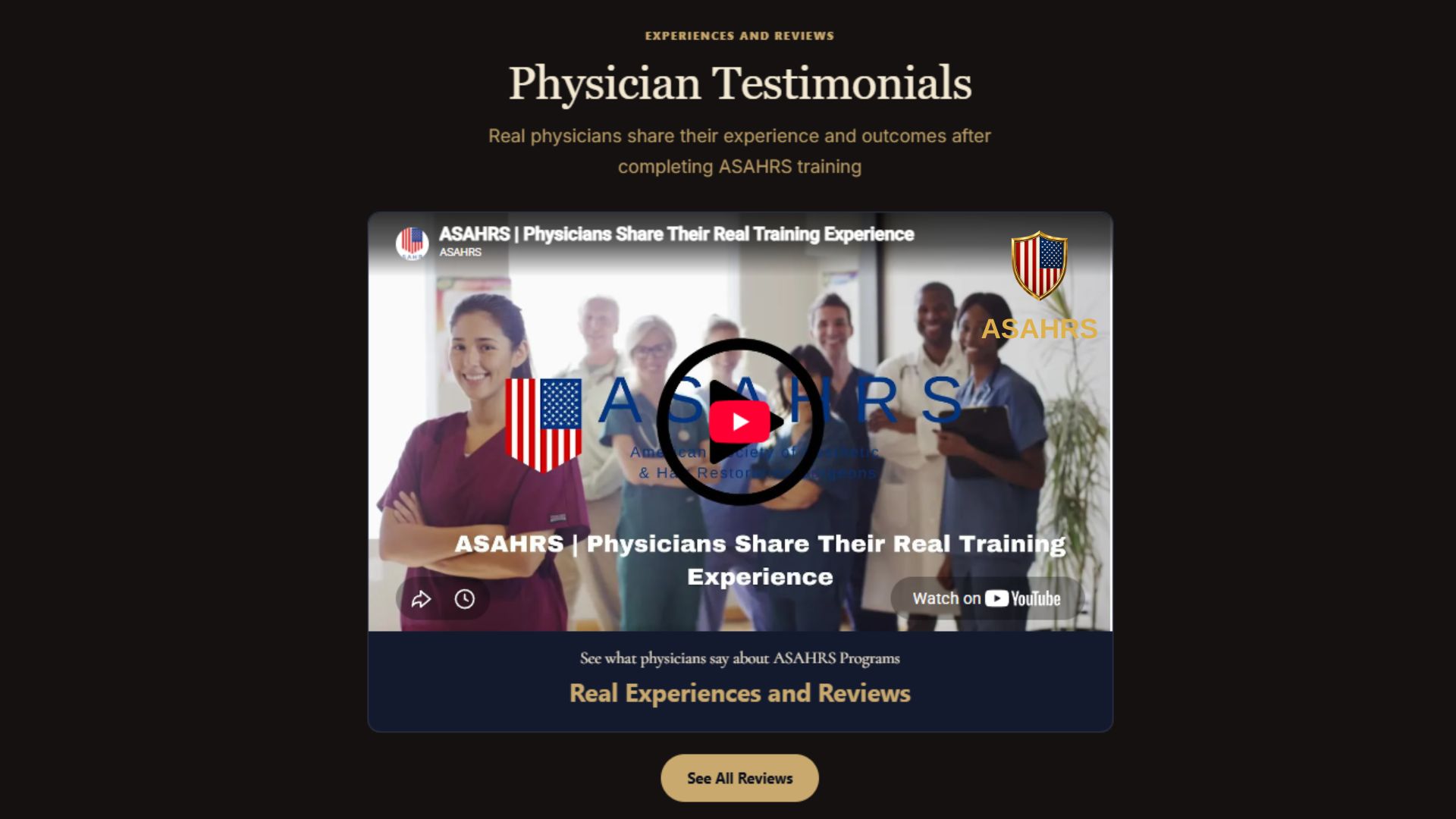
EXPERIENCES AND REVIEWS
Physician Testimonials
Real physicians share their experience and outcomes after completing ASAHRS training
See All ReviewsWhy Choose ASAHRS EDU For Lip Filler Training
For nurse practitioners seeking accredited, practical instruction, ASAHRS EDU differentiates itself by offering one comprehensive enrollment that covers clinical skills, safety and practice growth under a single fellowship model. The program's 40-module structure, delivered across phased cohorts, guarantees that learners complete a cohesive educational arc rather than a patchwork of weekend courses; the full breakdown is detailed in the Program Curriculum. This approach simplifies credentialing and ensures graduates receive a certificate of completion and ongoing access to the Student Portal resources for case follow-up and refresher learning.
ASAHRS places particular emphasis on teaching anatomy before technique, which is crucial to safe lip augmentation practices and complication avoidance. During the fellowship, nurse practitioners receive in-depth modules on facial vascular anatomy, tissue planes, and injection mapping that reduce the risk of vascular events and undesirable aesthetic outcomes. Learners also gain practice in patient selection and expectation management; these non-technical skills are essential to delivering predictable results and building sustainable cosmetic services in clinic settings.
Moreover the program bundles business instruction—covering treatment-menu design, pricing strategies, launch checklists and marketing systems—so clinicians leave with both procedural competence and an operational plan. If you want to review cohort timing and availability, consult the Dates & Locations listings or speak with an advisor to discuss eligibility.
Ready to take the next step?
Book a Free ConsultationTechnology & Technique: A Technology‑Neutral Approach
High quality lip filler education requires more than product endorsements; it demands a scientific framework for understanding filler rheology, injection parameters and device adjuncts. ASAHRS EDU uses a technology‑neutral philosophy to teach how different hyaluronic acid fillers interact with tissue, the mechanics of bolus versus microdroplet techniques, and combinations with energy-based devices where appropriate. The curriculum includes device-comparison worksheets, QA checklists and hands-on supervised demonstrations so nurse practitioners can evaluate vendors objectively and select materials that suit their patient demographics.
Curriculum modules cover filler selection (G′/cohesivity), needle versus cannula technique, layering strategies for vermillion and border definition, and complications prevention including recognition of vascular compromise. Practical lessons include cooling strategies, ocular safety considerations and how to document endpoints and escalation steps in the event of adverse outcomes. All device and product teaching is evidence-informed and supported by faculty demonstrations that show parameter selection in real clinical contexts.
ASAHRS provides trainees with device-neutral evaluation forms and cost-of-ownership templates that help new clinics decide lease vs purchase economics, consumables budgeting and service planning. These tools are available in the Student Portal and introduced during the hands-on phases documented on the Program Experience page. To view module specifics, see the Program Curriculum.
Hands-On Supervision, Safety And Complication Management
Safety is the core of every procedural module in the fellowship; ASAHRS EDU teaches anatomy before technique and invests heavily in complication recognition and escalation protocols. Nurse practitioners learn practical drills for vascular compromise recognition, step-by-step reversal protocols using hyaluronidase, and systems for documentation and transfer of care when escalation to a surgical colleague is required. The emphasis on safety is woven into both in-person simulation labs and real supervised patient sessions so clinicians practice drills under faculty observation.
Components of the safety training include emergency preparedness, ocular safety for periocular injections, sterile technique, and standard operating procedures (SOPs) for consent, photography and record-keeping. These SOP templates are part of the post-enrollment resource library and can be adapted to local regulations and institutional policies. The program also explains legal and licensure boundaries, clarifying that the certificate of completion does not expand a clinician’s statutory scope of practice; for formal pathways consult the Aesthetic Medicine Board Certification page.
ASAHRS keeps safety documentation transparent: tuition and enrollment policies, privacy safeguards and program disclaimers are available via the Privacy and Terms pages. If you want to confirm program safeguards before applying, Contact Us to schedule an advisor call or review the trainee requirements on the Apply page.
“Clinical anatomy before technique changed how I inject and dramatically reduced complications in my practice.” — Dr. Lydia Ferrell, MD, quoted in physician reviews.
Want personalized advice?
Schedule Your AssessmentResults, Social Proof And Outcomes For Nurse Practitioners
Outcome transparency is essential for clinicians evaluating a training program, and ASAHRS EDU publishes a range of social proof including video reviews, written testimonials and faculty case discussions that illustrate the program’s impact. Prospective students can watch clinician narratives on the Physician Video Reviews page and explore curated success stories on the Success Stories listings. These materials highlight how nurse practitioners applied their training to expand services, refine consent conversations and implement SOPs that improved clinic throughput and patient satisfaction.
ASAHRS also connects learners with an international faculty and a network of scientific fellows — named contributors like Dr. Thomas Warren, MD, Dr. Lydia Ferrell, MD and Dr. Rajiv Choudhary, MD appear in the program gallery and video library, providing cross-disciplinary perspectives. The community of alumni and scientific fellows provides ongoing mentorship, case reviews and a faculty Q&A archive accessible through the Student Portal. For a deeper look at the faculty and their specialties, visit the Faculty page and the Scientific Fellows profiles.
Quantifiable results are augmented by practical deliverables: recorded session reviews, complication-management logs and before-and-after galleries used for training and consenting patients. These resources help clinicians demonstrate predictable outcomes to patients and integrate evidence-based expectations into consults, decreasing dissatisfaction and improving retention. If you want to preview sample outcomes, request access via the Contact page or watch sample lectures on the video gallery linked from the Home page.
Locations, Access And How The Fellowship Fits Busy Schedules
Flexible access is fundamental to the fellowship model: ASAHRS EDU combines online pre-work with in-person cohorts so nurse practitioners can complete theoretical modules remotely and attend concentrated supervised clinical sessions in person. All cohort dates, venues and faculty rosters are published on the Dates and Locations page and confirmed details are shared with enrolled participants via the Student Portal. International clinicians are welcome to apply; the program maintains an International Fellows page describing participation logistics.
Enrollment is rolling and cohort capacity can be limited; prospective nurse practitioners should speak with an advisor to confirm eligibility and reserve a seat. Confirmed participants receive venue specifics, travel guidance and logistics including partner hotels and arrival instructions as part of the cohort packet. For clinicians evaluating whether to apply, downloadable program guides and advisor calls are available through the Contact Us page to support selection and scheduling.
ASAHRS lists tuition details and cohort differences on the Tuition page and provides payment plan options for eligible applicants; all cohort logistics and exact venue addresses are released only to enrolled clinicians. If you are ready to review upcoming cohorts, visit the Dates & Locations page or select Apply to begin the admissions process.
See how we can help you
Get Started TodayFree Tools, Post‑Program Resources And Ongoing Support
Continuity of learning differentiates programs that offer one-off courses from integrated fellowships, and ASAHRS EDU provides an extensive post-program library to ensure skill retention. Enrolled participants receive access to the Student Portal, which contains the digital program manual, SOP templates, photography standards, device-comparison worksheets and recorded session reviews. These resources support clinic rollout, staff training and ongoing complication-management education.
Prospective learners can preview the type of material provided by requesting program guides and scheduling a Program Advisor call via Contact Us. The fellowship also includes templates for consent forms, pricing worksheets and launch checklists designed to reduce admin friction in clinic implementation. If you want to reference the full module list or see how device sessions are scheduled, consult the Program Curriculum and the Program Experience descriptions.
“The Student Portal alone was worth the tuition — SOPs, consent templates and recorded lectures made launch straightforward.” — recent fellowship graduate.
Trust, Safety & Guarantee: What You Should Know
Transparency is a hallmark of ASAHRS EDU and the fellowship publishes its safety pillars and program limitations openly. The program emphasizes patient-centered education, clear SOPs, anatomy-first instruction and technology-neutral device evaluation as its trust pillars. Important legal and privacy documents, including the Privacy Policy and Terms of Use, are available for review and the program clarifies that the certificate of completion does not substitute for statutory licensure or guarantee specific business or clinical outcomes.
Practical disclosures include the location address for legal correspondence and contact, tuition transparency and what is excluded from fees (travel, lodging and devices unless stated). Clinicians who require details about board pathways can consult the Aesthetic Medicine Board Certification page; for program principles and faculty qualification information see the About and Faculty pages. If you need further verification, schedule a Program Advisor call via Contact Us.
“No program guarantees income or licensure — ASAHRS EDU provides the knowledge, systems and mentorship to put clinicians in the best position for success.”
Conclusion
In summary, nurse practitioners seeking advanced education in injectable aesthetics should evaluate programs on curriculum depth, safety training, technology neutrality and ongoing support — and ASAHRS EDU satisfies each criterion. The fellowship’s consolidated 40-module curriculum, supervised hands-on training, technology-neutral device education and integrated business modules mean that clinicians graduate ready to practice with confidence and structure. To view upcoming cohorts and begin the application process, visit the Dates & Locations page or speak with an advisor about eligibility.
Every enrolled clinician receives post-program access to the Student Portal, templates, recorded session reviews and a certificate of completion that documents the training pathway. If you are ready to take the next step, Apply Now and join an international network of faculty and scientific fellows documented on the International Fellows page.
Frequently Asked Questions
How long is the lip filler training for nurse practitioners fellowship?
The fellowship is structured across a 40-module curriculum delivered in phases with online pre-work and in-person cohort sessions; exact cohort duration and dates are listed on the Program Dates and Dates & Locations pages. Participants complete the online modules before attending concentrated hands-on phases where supervised injections and complication drills occur. For full curriculum details see the Program Curriculum.
Does the certificate expand my scope of practice?
No. The certificate from ASAHRS EDU documents completion of the fellowship but does not alter statutory licensure or scope of practice; clinicians must follow local regulatory requirements. The program outlines this distinction in its disclosures and suggests reviewing the Aesthetic Medicine Board Certification page for formal credential pathways.
What safety training is included in the program?
Extensive safety content is provided, including anatomy-first modules, vascular compromise recognition and management with hyaluronidase protocols, ocular safety and emergency preparedness. SOP templates, documentation checklists and complication escalation flowcharts are available in the Student Portal. If you want to speak with a program advisor about safety details, use the Contact Us page.
Are there post-program resources for launching services?
Yes. Graduates receive templates for consent, pricing, membership models and marketing launch checklists, plus recorded lectures and case reviews for ongoing learning. These tools live in the Student Portal and are demonstrated in the Program Experience materials.
How do I apply or get more information?
Start by reviewing cohort dates on the Dates & Locations page and scheduling an advisor call through the Contact page. Alternatively, submit an application on the Apply page to begin the admissions review.
External references: For additional safety references on injectable complications and management see the American Society of Plastic Surgeons overview on fillers and complications (Plastic Surgery) and a clinical review on hyaluronic acid filler vascular occlusion management in the Aesthetic Surgery Journal (Aesthetic Surgery Journal), and the FDA device guidance for injectable fillers (FDA Medical Devices).
Medical Information Disclaimer
This content is provided for general educational purposes only. It is not a substitute for professional advice, diagnosis, or treatment. Readers are advised to consult qualified professionals for personalized recommendations.
Have questions? We have answers.
Speak With an Expert