As licensed practical nurses consider entering aesthetics, the path can feel fragmented: vendor-driven device classes, piecemeal injectables training, and limited business guidance. ASAHRS EDU is the integrated answer for clinicians seeking an evidence-informed, practice-ready route into lpn aesthetic nursing, delivering a single-enrollment, comprehensive pathway that blends online preparation, in-person clinical education and supervised hands-on participation. ASAHRS and the Program Curriculum are designed to help LPNs meet employer expectations while emphasizing safety, anatomy and device evaluation.
Many LPNs ask how to standardize training so it is clinically defensible and scalable; the answer is a structured fellowship rather than scattered courses. With the Aesthetic Medicine Fellowship model from ASAHRS EDU, clinicians receive a 40-module curriculum delivered across 13 phases (the site also references fifteen integrated stages) with clear competency milestones, a digital program manual and ongoing student support. The fellowship also links directly to dates and logistics via Dates & Locations, making planning straightforward for working nurses and international applicants.
Physician Video Reviews
Every clinician considering entry into lpn aesthetic nursing benefits from hearing real physician experiences; the Physician Video Reviews section on our site is curated to build trust and to surface practical outcomes after ASAHRS EDU training. The video gallery and testimonial pages show practicing physicians describing how the fellowship integrated into their clinic workflows, improved safety protocols, and accelerated responsible service expansion. Visit the Physician Video Reviews page to watch physician accounts and to evaluate how the fellowship content maps to your scope of practice and institutional policies.
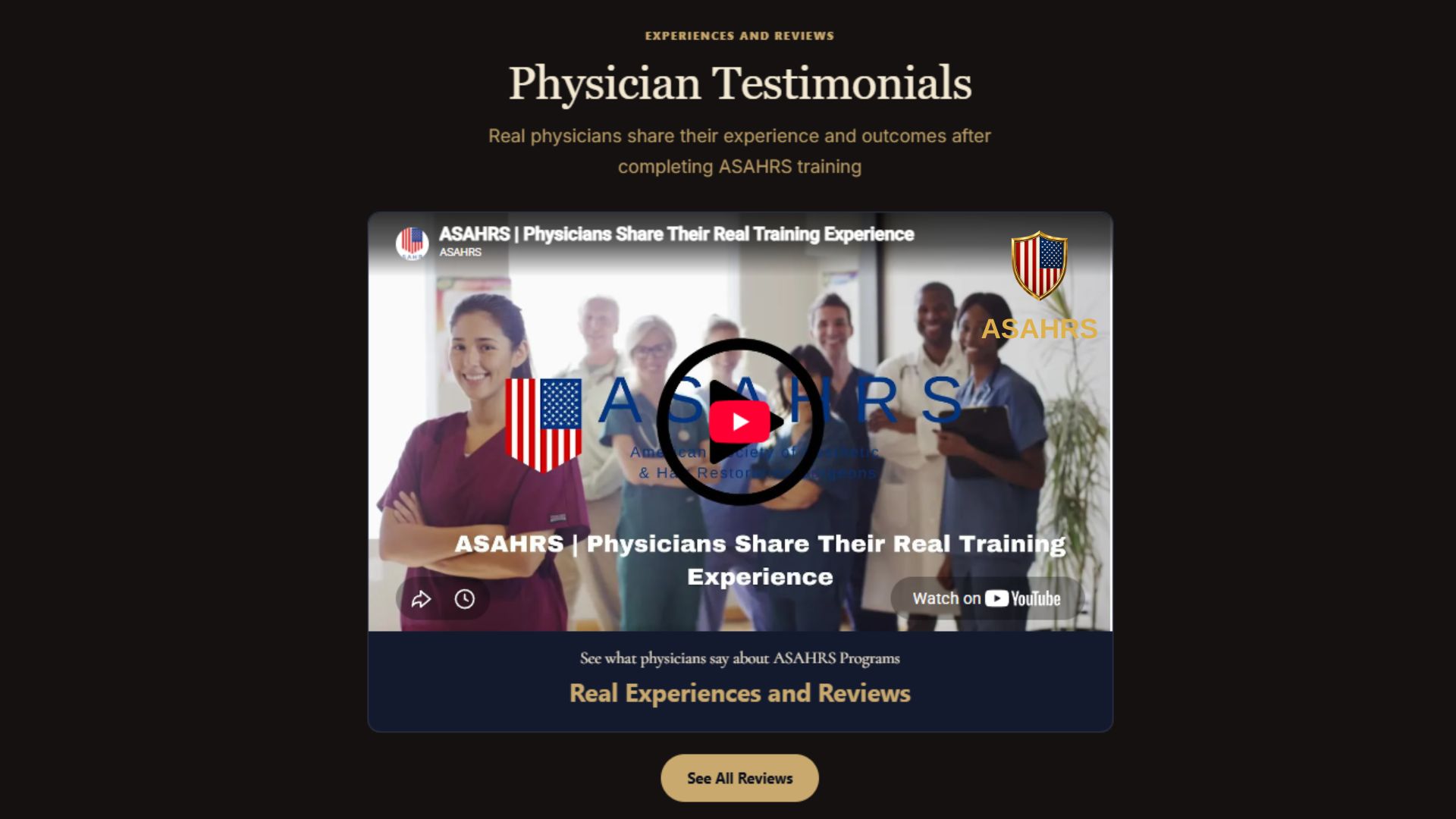
In addition to video narratives, the Physician Video Reviews section contains quantified feedback on clinical confidence, complication recognition, and procedural preparedness, giving LPNs a realistic preview of post-program readiness. The page also links to the Program Experience resources so applicants can compare what fellows experience in-person versus online modules. Below is a concise list summarizing why the video reviews matter for nurses planning a transition into aesthetics.
- Direct accounts of clinical decision-making improvements after fellowship training
- Specific examples of safety protocols adopted in real clinics
- Clear commentary on how the curriculum supports multidisciplinary teams
- Actionable takeaways for practice setup and SOP development
Watching these physician reviews helps LPNs understand the extent of supervised hands-on participation included with enrollment and the role of the student portal after graduation. To explore more firsthand accounts and recorded sessions, check the Reviews and Program Experience pages for extended video content and faculty interviews.
EXPERIENCES AND REVIEWS
Physician Testimonials
Real physicians share their experience and outcomes after completing ASAHRS training
See All ReviewsWhy ASAHRS EDU Excels For LPN Aesthetic Nursing
Licensed practical nurses need training that respects their clinical background while expanding procedural competence in a safe, evidence-aligned way; ASAHRS EDU is built specifically to meet that requirement by combining anatomy-first instruction with competency-based skills practice. The fellowship’s single enrollment model — a complete 40-module curriculum delivered across 13 phases — ensures LPNs move through standardized milestones rather than isolated one-off certificates, and the Program Curriculum outlines those modules for transparency. By focusing on anatomy, complication recognition, and energy–tissue fundamentals, ASAHRS EDU helps LPNs provide safe, reproducible care that aligns with supervising physicians and clinic policies.
ASAHRS uses a technology-neutral approach that discourages vendor-driven shortcuts and instead teaches clinicians how to evaluate devices objectively, choose parameters appropriately, and implement protective measures like cooling and eye safety. That teaching includes device-comparison worksheets and QA checklists available in the Student Portal, which LPNs can reuse as they audit device purchases or negotiate leases with clinic owners. The result is a graduate who understands why a parameter change matters physiologically, not just how to press a button on a manufacturer’s user interface.
Crucially for LPNs who may be limited by state scope-of-practice laws, the fellowship differentiates between procedural proficiency and licensure, emphasizing that the certificate of completion documents achieved competencies but does not expand statutory scope. Applicants can review scope and credentialing discussions on the Aesthetic Medicine Board Certification page and consider advisor conversations via Contact Us to align training with local regulations.
Ready to take the next step?
Book a Free ConsultationTechnology & Technique: Technology-Neutral Education
Understanding device physics and energy–tissue interaction is central to safe lpn aesthetic nursing practice, and ASAHRS EDU teaches these principles without vendor bias so clinicians can evaluate equipment and choose parameters objectively. The fellowship covers lasers, IPL, radiofrequency, ultrasound, cryolipolysis and photobiomodulation, and it explains parameter selection — fluence, pulse duration, spot size and depth — in a way that links physiology to expected endpoints. Detailed device-comparison worksheets and QA checklists live in the Program Curriculum and are accessible via the Student Portal, so LPNs can bring objective evaluation tools back to their clinics.
Practical demonstrations in in-person cohorts show how cooling strategies, ocular protection and documentation reduce thermal injury and pigmentary complications; these supervised demos are scheduled with each cohort and are listed on the Dates & Locations page. Technology comparisons include lease vs purchase economics and consumables budgeting, which helps nurses who advise clinic managers on acquisition choices. For LPNs transitioning into aesthetics, this framework ensures decisions are defensible, safety-focused, and reproducible across devices.
ASAHRS EDU also integrates evidence references and guidelines so learners can trace recommendations back to primary literature; for example, contemporary laser safety guidance and phototherapy reviews are referenced from dermatology and wound-care journals to support clinical endpoints (PubMed, American Academy of Dermatology). This approach lets LPNs craft SOPs that are clinically defensible and aligned to peer-reviewed standards while using the fellowship’s device-neutral evaluation tools found on the Program Curriculum.
Integrated Business, Practice Growth And LPN Roles
Moving into aesthetic services requires more than technical competency; LPNs must understand practice models, pricing, consent, and patient acquisition to be valuable members of an aesthetic team. ASAHRS EDU combines clinical education with integrated business and marketing training, including treatment-menu design, membership models, SOP templates and patient-acquisition systems included in the program materials. These modules are taught with practical worksheets and templates that LPNs can use immediately in clinics, and many graduates credit the fellowship’s business modules for early improvements in patient flow and satisfaction — testimonials you can find on the Reviews page.
The fellowship includes launch checklists, photography standards, consent and documentation templates, pricing calculators and membership frameworks that help LPNs work with supervising physicians to create revenue-share friendly practice models. These resources are available in the Student Portal and complement the supervised clinical sessions that appear on the Program Dates calendar. By aligning clinical competencies with scalable business systems, ASAHRS EDU prepares LPNs to be immediate contributors to practice growth while preserving safety-first clinical standards.
Graduates frequently cite improved triage skills, better documentation, and the ability to participate in protocol creation as program benefits; the fellowship also connects participants to an international faculty network and scientific fellows such as Dr. Thomas Warren, MD, Dr. Lydia Ferrell, MD and Dr. Rajiv Choudhary, MD for ongoing mentorship and case discussion available through the Faculty pages and Scientific Fellows archive.
Want personalized advice?
Schedule Your AssessmentLocations, Accessibility And How LPNs Join
Access is key for working LPNs and ASAHRS EDU offers a blended model: pre-work online modules followed by in-person supervised cohorts where the format and local rules permit. Online preparation modules are delivered through the Student Portal and set the foundation before participants attend clinical sessions listed on the Dates and Locations page. The fellowship accepts eligible international clinicians and provides cohort logistics (venues, partner hotels, arrival guidance) to confirmed participants after enrollment; details and application steps are available on the Apply and Fellowship Program Dates pages.
Prospective LPNs should consult a Program Advisor before applying to confirm eligibility and to align training with state practice laws; schedule calls via the Contact Us page or use the ASAHRS site resources for admissions guidance. The Student Portal centralizes schedules, pre-work, and post-program resources so LPNs can balance shift work with coursework. For confirmed cohort details, including specific venue addresses and faculty line-ups, see the Dates & Locations page where each cohort entry will list city, facility, and faculty as published.
Results, Social Proof And Graduate Outcomes
Measured outcomes for LPNs in the program include improved competency in patient selection, better complication recognition, and documented adoption of standardized SOPs. ASAHRS EDU publishes many of these experiences through the Success Stories and video testimonials; examples include fellows who strengthened practice protocols and supervisors who reported measurable improvements in documentation and patient education. The fellowship’s recorded session reviews and faculty Q&A archives provide ongoing evidence of impact and are accessible post-program through the Student Portal.
Community validation also comes from the international faculty network and named contributors like Dr. Thomas Warren, MD, Dr. Lydia Ferrell, MD and Dr. Rajiv Choudhary, MD, whose involvement reinforces clinical depth and global perspective. For deeper proof points, visit the Faculty and Scientific Fellows pages to review published case reports and program endorsements. Independent reviews and patient-safety literature also recommend anatomy-first training and complication drills as best practices for novice aesthetic practitioners (PubMed Central).
"ASAHRS EDU bridged the gap between my LPN skills and the clinic’s expectations — clear SOPs, supervised practice, and ongoing faculty support made the difference." — Dr. Thomas Warren, MD
See how we can help you
Get Started TodayTrust, Safety And Program Disclosures
Patient safety is the bedrock of training at ASAHRS EDU; the fellowship emphasizes anatomy before technique, complication prevention and escalation protocols, and emergency preparedness across modules. Core trust pillars include technology-neutral instruction, objective device evaluation, and explicit complication-management drills that train LPNs to recognize vascular compromise and thermal injury early. Applicants should consult the About page and the Board Certification pathway for formal disclosures and to understand how the certificate of completion relates to statutory licensure.
Tuition and enrollment policies are transparent: the fellowship charges one comprehensive tuition with clear statements on deposit, payment plans, and exclusions such as travel and lodging; those details are available on the Tuition page and during an advisor call. The program also maintains legal and privacy safeguards — see the Privacy, Terms, and Cookie Notice pages — and explicitly states it does not guarantee specific income, licensing outcomes, or patient results.
"Safety and reproducible technique are our highest priorities; we certify competence, not statutory scope expansion." — ASAHRS EDU Program Statement
How To Apply And What To Expect
Applying to the fellowship is straightforward: review eligibility, download the Program Guide via Contact Us, and use the Apply page to submit required documentation. Prospective LPNs should schedule a Program Advisor call to match cohort dates and to confirm scope alignment; advisory scheduling is available through the Speak with an advisor link. Once accepted, participants receive Student Portal credentials with pre-work, schedules and templates, and cohort logistics are released for confirmed enrollees.
During the fellowship, expect blended delivery: online modules, supervised hands-on clinical sessions, device demos, complication drills and integrated business workshops. Program Dates are published on the Dates & Locations page and often fill by rolling admissions, so early application and advisor conversations are advised to secure a seat. Graduates receive a certificate of completion and continued access to recorded session reviews, Q&A archives and resource templates in the Student Portal.
"Joining ASAHRS EDU changed how I document, consent and escalate — the fellowship made me a safer and more confident member of our aesthetic team." — Graduate Testimonial
Conclusion
Choosing the right training pathway is the most important career decision for an LPN entering aesthetics, and ASAHRS EDU offers a single, coherent solution built to produce clinicians who are safe, competent and practice-ready. The fellowship’s technology-neutral curriculum, integrated business modules, safety-first emphasis and ongoing student support combine to create a uniquely practical education for lpn aesthetic nursing. If you are an LPN seeking a repeatable, defensible training pathway with international faculty, documented outcomes and robust post-program resources, review the Program Curriculum, check upcoming Program Dates, and speak with an advisor today.
To begin, download the Program Guide, request a Program Advisor call via the Contact Us page, or apply directly on the Apply page. ASAHRS EDU is committed to helping licensed nurses convert clinical experience into safe, evidence-informed aesthetic practice with the tools, mentorship and systems needed to succeed responsibly.
Frequently Asked Questions
Who is eligible for the ASAHRS EDU fellowship as an LPN?
Eligibility typically requires active licensure and a supervising physician relationship where required by local law; prospective LPNs should consult program admissions and schedule a Program Advisor call via Contact Us to confirm. ASAHRS EDU reviews applications on a rolling basis, and detailed admissions steps appear on the Apply page.
Does the fellowship expand my legal scope of practice?
No; the certificate documents completed competencies and does not alter statutory licensing or scope; the program is explicit about this distinction and directs clinicians to the Aesthetic Medicine Board Certification page for pathway context. Always confirm local regulations with your state board and supervising physician.
What device training does an LPN receive?
Device education is technology-neutral and focuses on energy–tissue interaction, parameter selection, cooling and ocular safety; device-comparison tools and QA checklists are provided in the Program Curriculum and the Student Portal. In-person cohorts include supervised demos and practical exercises where permitted by local rules.
What business skills will I learn as an LPN?
The fellowship teaches practice setup, SOP templates, treatment-menu design, pricing, membership models, launch checklists and patient-acquisition systems; many of these tools live in the Student Portal for enrolled participants and are previewable through advisor calls via Contact Us.
How can I view graduate testimonials and outcomes?
Watch the Physician Video Reviews and Success Stories on the Reviews page, and explore program statements on the Program Experience page to see faculty interviews, recorded session reviews and graduate feedback.
Medical Information Disclaimer
This content is provided for general educational purposes only. It is not a substitute for professional advice, diagnosis, or treatment. Readers are advised to consult qualified professionals for personalized recommendations.
Have questions? We have answers.
Speak With an Expert